
Fatty Acid Amides Market Outlook: Size, Share, Trends, Growth Analysis, Competitive Landscape & Forecast, 2026–2033

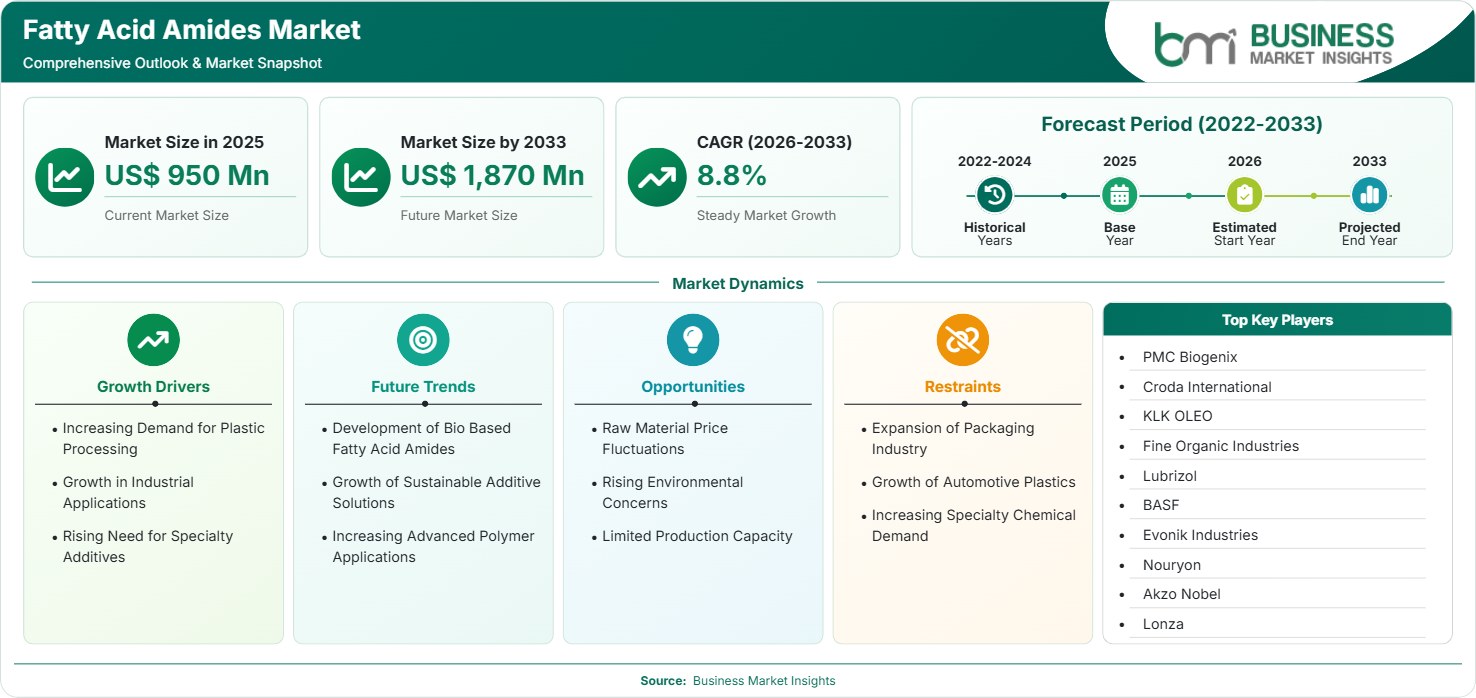
The Fatty Acid Amides Market size was valued at US$ 0.95 billion in 2025 and is projected to reach US$ 1.87 billion by 2033, growing at a CAGR of 8.8% during 2026–2033. Rising demand from plastic processing industries, expanding specialty chemical applications, increasing packaging production, and growing adoption of high-performance polymer additives are driving sustained market expansion across global manufacturing sectors.

Report Coverage
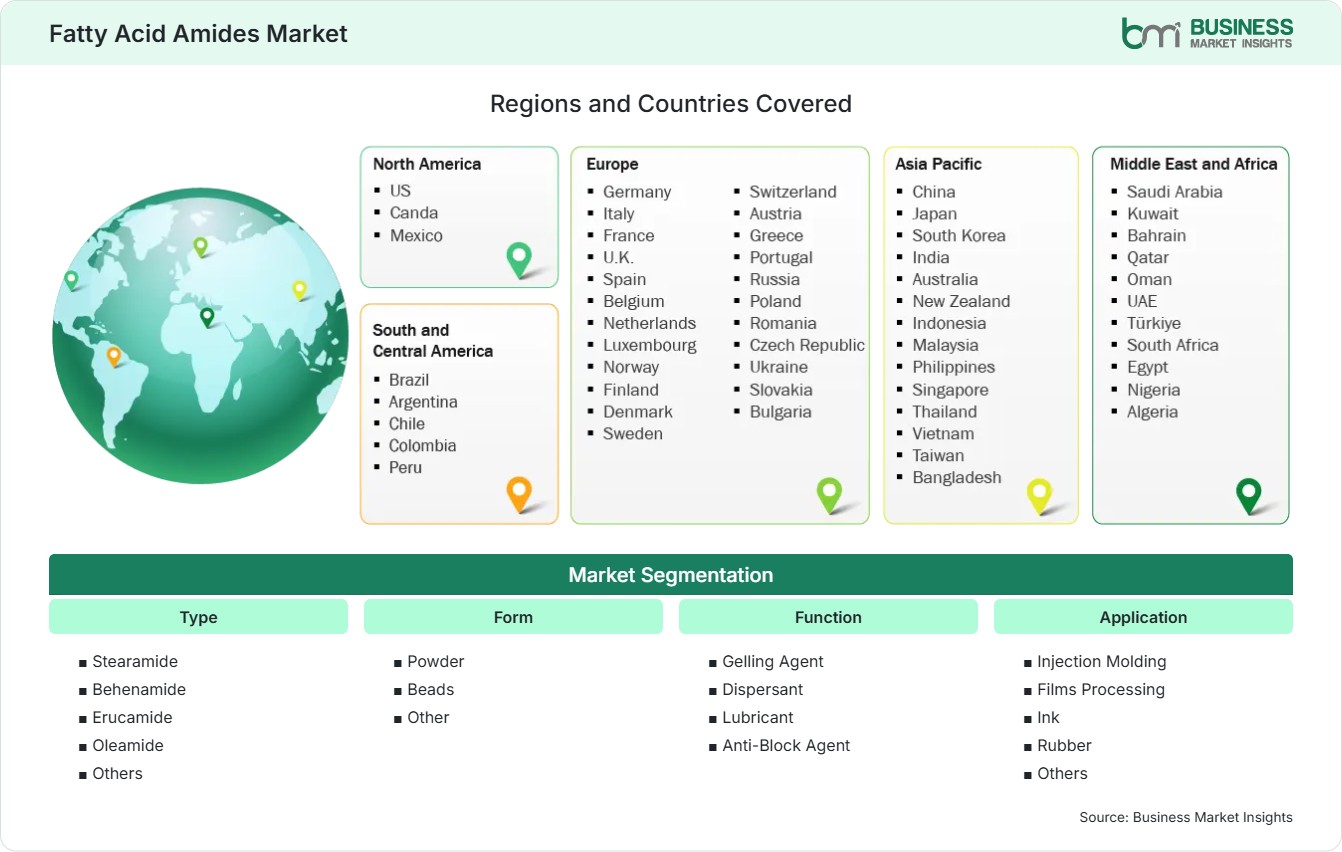
  • Type: Stearamide, Behenamide, Erucamide, Oleamide, Others
  • Form: Powder, Beads, Other
  • Function: Gelling Agent, Dispersant, Lubricant, Anti-Block Agent
  • Application: Injection Molding, Films Processing, Ink, Rubber, Others
US$ 950 Mn Market size in 2025
US$ 1,870 Mn Market Size by 2033
8.8% CAGR, 2026 - 2033
2026-2033 Forecast Period

AI Overview

Fatty Acid Amides Market Summary

  • North America Region: North America holds 34%–36% share in 2025 and is projected to grow at a CAGR of 8.1%–8.7% during 2026–2033, supported by advanced polymer manufacturing, strong packaging demand, and continuous innovation in specialty chemical formulations. The U.S. market benefits from mature plastics processing infrastructure and expanding industrial production, growing at a 8.4% CAGR through 2033.
  • Fastest Growing Region: Asia Pacific accounts for 31%–33% share in 2025 and is anticipated to register a 9.7%–10.3% CAGR during 2026–2033, driven by rapid industrialization, expanding plastics manufacturing, increasing packaging production, and rising demand for specialty additives across emerging economies.
  • Leading Segment: Erucamide accounts for 28%–30% share in 2025 and is projected to grow at a 9.0%–9.6% CAGR during 2026–2033, supported by widespread use in polyolefin films, packaging applications, and superior slip performance during polymer processing.
  • High Growth Segment: Films Processing accounts for 33%–35% share in 2025 and is expected to expand at a 9.4%–10.0% CAGR during 2026–2033, driven by rising flexible packaging production, food packaging demand, and increasing consumption of polymer films.
  • Key Market Opportunity: Expanding flexible packaging production, lightweight automotive plastics, and growing specialty chemical applications create attractive opportunities for manufacturers developing advanced, high-performance fatty acid amide formulations.
  • Major Market Players: PMC Biogenix, Croda International Plc, KLK OLEO, Fine Organic Industries Limited, The Lubrizol Corporation, BASF SE, Evonik Industries AG, Nouryon, Akzo Nobel N.V., and Lonza Group AG.
Strategic Insights

Fatty Acid Amides Market: Strategic Insights

Fatty Acid Amides Market Strategic Framework
FREE PDF
Request your free sample
Request free sample
Stakeholder View

Key Takeaways

  • The value chain increasingly integrates oleochemical producers, specialty chemical manufacturers, polymer compounders, packaging companies, and industrial processors to improve additive performance and manufacturing efficiency.
  • Films processing represents the strongest commercial opportunity as global demand for flexible packaging, food packaging, and industrial films continues expanding across developed and emerging economies.
  • Innovation is increasingly focused on sustainable formulations, enhanced slip performance, improved thermal stability, and multifunctional additives capable of supporting advanced polymer processing technologies.
  • Asia Pacific offers the strongest regional investment opportunity due to expanding plastics manufacturing, rapid industrialization, and increasing demand for specialty chemical additives across multiple industries.
  • Strategic investments in production capacity, specialty chemical research, and application-specific formulations continue strengthening competitive positioning among leading manufacturers.
  • Sustainable feedstock development and environmentally responsible manufacturing processes are becoming increasingly important competitive differentiators as regulatory standards continue evolving.
Geographic Outlook

Fatty Acid Amides Market Regional Highlights

North America Fatty Acid Amides Market

North America accounted for 34%–36% of the Fatty Acid Amides Market share in 2025 and is projected to expand at a 8.1%–8.7% CAGR through 2033. Strong polymer processing capabilities, advanced packaging manufacturing, and increasing demand for high-performance industrial additives continue supporting regional leadership. Continuous investments in specialty chemicals and sustainable materials further strengthen long-term market expansion.

  • Packaging manufacturers continue increasing consumption of slip additives and anti-block agents to improve flexible film production efficiency and finished product quality.
  • Automotive and consumer goods industries increasingly utilize advanced polymer additives to improve processing performance and component durability.
  • Specialty chemical companies continue investing in sustainable additive technologies and bio-based raw material development to address evolving environmental standards.
  • Strong industrial manufacturing infrastructure supports widespread adoption of multifunctional polymer processing additives across multiple end-use sectors.

US Fatty Acid Amides Market

The United States represented 29%–31% of global revenue in 2025 and is projected to grow at a 8.4% CAGR during 2026–2033. Expanding plastics manufacturing, increasing demand for flexible packaging, and continued investments in specialty chemicals support sustained market growth. Industrial manufacturers increasingly adopt advanced processing additives to improve productivity, reduce waste, and enhance product quality.

  • Polymer compounders continue expanding production capabilities to meet rising demand from packaging, automotive, and consumer goods manufacturers.
  • Growing investments in sustainable packaging materials encourage development of environmentally responsible additive formulations.
  • Advanced manufacturing technologies improve processing efficiency while increasing demand for multifunctional polymer additives.
  • Research institutions and specialty chemical producers continue developing innovative additive chemistries supporting industrial productivity improvements.

Europe Fatty Acid Amides Market

Europe accounted for 25%–27% of global revenue in 2025 and is expected to register a 8.4%–9.0% CAGR through 2033. Strong specialty chemical manufacturing, increasing sustainable packaging initiatives, and growing demand for engineered plastics continue supporting regional expansion. Germany remains the leading regional Fatty Acid Amides Market, while Poland is projected to record the fastest growth at a 9.4% CAGR during the forecast period.

  • Packaging manufacturers increasingly prioritize high-performance additives supporting recyclable and lightweight polymer film production.
  • Automotive suppliers continue increasing utilization of engineering plastics requiring advanced processing additives and specialty lubricants.
  • Sustainability initiatives encourage manufacturers to invest in bio-based specialty chemical production and environmentally responsible formulations.
  • Continuous innovation across specialty chemicals strengthens industrial competitiveness and supports long-term additive demand.

Asia Pacific Fatty Acid Amides Market

Asia Pacific accounted for 31%–33% of global revenue in 2025 and is projected to register the fastest Fatty Acid Amides Market growth at 9.7%–10.3% CAGR through 2033. Rapid industrialization, expanding plastics manufacturing, increasing packaging production, and strong automotive growth continue driving regional demand. China remains the leading regional market, while India is expected to register the fastest growth with an estimated 10.8% CAGR during the forecast period.

  • Expanding polymer manufacturing capacity continues increasing consumption of specialty processing additives across industrial production facilities.
  • Flexible packaging production continues accelerating due to growing food processing, consumer goods, and e-commerce industries.
  • Automotive manufacturing expansion strengthens demand for engineering plastics requiring advanced lubrication and processing additives.
  • Local specialty chemical producers continue investing in product innovation and manufacturing capacity to meet growing regional demand.

Rest of World Fatty Acid Amides Market

The Rest of World region, comprising South & Central America and the Middle East & Africa, accounted for 8%–10% of global revenue in 2025 and is projected to grow at a 8.8%–9.4% CAGR through 2033. Brazil leads regional demand through its expanding plastics industry, while Saudi Arabia is anticipated to record the fastest regional growth with a 9.7% CAGR, supported by increasing petrochemical investments and industrial diversification.

Across the Middle East and Africa, expanding polymer manufacturing, growing packaging industries, and rising investments in specialty chemicals continue strengthening long-term Fatty Acid Amides Market prospects. Industrial diversification strategies and downstream petrochemical expansion further support demand for advanced polymer processing additives.

  • Brazil continues expanding flexible packaging production supported by strong food processing and consumer goods manufacturing industries.
  • Gulf countries increasingly invest in downstream petrochemical and specialty chemical manufacturing to strengthen industrial value chains.
  • Packaging companies continue adopting advanced additive technologies to improve production efficiency and product performance.
  • Growing industrial manufacturing activity supports broader adoption of multifunctional specialty additives across diverse end-use applications.
Global Market Geography
FREE PDF
Request your free sample
Request free sample
Segment Analysis

Fatty Acid Amides Market Segmentation

Type

Type represents the largest segment of the market due to the widespread use of fatty acid amides as slip agents, anti-block additives, lubricants, and processing aids across polymer manufacturing. This segment accounted for 47%–49% market share in 2025 and is projected to grow at a 9.0%–9.6% CAGR during 2026–2033. The Fatty Acid Amides Market scope continues expanding as manufacturers develop advanced additive formulations that improve processing efficiency, surface properties, and product durability across industrial applications.

  • Stearamide: Stearamide is extensively used as a lubricant and mold-release additive in plastics and rubber manufacturing due to its excellent processing stability and compatibility with multiple polymer systems.
  • Behenamide: Behenamide is increasingly adopted for premium polymer applications requiring long-lasting slip performance, superior thermal stability, and reduced coefficient of friction in packaging films.
  • Erucamide: Erucamide remains one of the most widely utilized slip additives for polyolefin films, supporting efficient packaging production through excellent migration characteristics and consistent surface lubrication.
  • Oleamide: Oleamide is commonly used in flexible plastic films and extrusion applications where rapid slip performance, anti-block functionality, and improved processing efficiency are essential.
  • Others: Other specialty fatty acid amides serve niche industrial applications requiring customized lubrication, anti-static properties, and formulation-specific processing performance.

Form

Form plays a significant role in determining handling efficiency, dosing accuracy, and manufacturing flexibility across industrial production processes. This segment accounted for 30%–32% market share in 2025 and is projected to register an 8.7%–9.3% CAGR, according to Fatty Acid Amides Market Forecasts. Manufacturers increasingly optimize product forms to improve storage stability, processing convenience, and compatibility with automated industrial production systems.

  • Powder: Powder form remains widely preferred due to its ease of blending, uniform dispersion, efficient processing characteristics, and suitability for high-volume polymer compounding operations.
  • Beads: Bead formulations continue gaining popularity because they reduce dust generation, improve handling safety, provide consistent dosing accuracy, and simplify automated feeding processes.
  • Other: Alternative forms address specialized manufacturing requirements where customized particle characteristics or formulation flexibility improve production performance.

Function

Function represents a critical market segment as fatty acid amides provide multiple performance-enhancing properties across plastics, rubber, coatings, and specialty chemical applications. This segment accounted for 35%–37% market share in 2025 and is anticipated to expand at a 8.9%–9.5% CAGR through 2033. Continuous product innovation supports broader industrial adoption by improving processing efficiency and finished product quality.

  • Gelling Agent: Gelling agents improve formulation stability, viscosity control, and structural consistency across coatings, personal care formulations, and specialty chemical products.
  • Dispersant: Dispersants promote uniform distribution of pigments, fillers, and additives while improving formulation consistency and manufacturing efficiency across industrial applications.
  • Lubricant (internal & External): Internal and external lubricants reduce friction, improve polymer flow, minimize equipment wear, and enhance processing performance during extrusion and molding operations.
  • Anti-Block agent: Anti-block agents prevent film adhesion during production, storage, and transportation while maintaining smooth processing and superior packaging performance.

Application

Application diversity continues strengthening long-term market expansion as manufacturers increasingly utilize fatty acid amides across multiple polymer processing industries. This segment accounted for 39%–41% market share in 2025 and is expected to register a 9.1%–9.7% CAGR during 2026–2033. The Fatty Acid Amides Market trends reflect increasing adoption of specialty additives that improve manufacturing productivity, product quality, and operational efficiency across industrial value chains.

  • Injection molding: Injection molding applications utilize fatty acid amides to improve mold release, reduce cycle times, minimize equipment wear, and enhance finished component quality.
  • Films processing: Film processing represents a major application where slip additives and anti-block agents improve film handling, packaging efficiency, and surface performance.
  • Ink: Printing ink formulations utilize fatty acid amides to enhance dispersion, improve surface characteristics, and deliver consistent print quality across multiple substrates.
  • Rubber: Rubber manufacturers incorporate fatty acid amides to improve processing efficiency, lubrication performance, mold release, and finished product durability.
  • Others: Additional applications include coatings, adhesives, textiles, specialty chemicals, and industrial formulations requiring advanced lubrication and surface modification properties.
Market Forces

Fatty Acid Amides Market Dynamics

Key Market Drivers

Increasing Demand for Plastic Processing

Growing production of plastic films, molded components, packaging materials, and engineering polymers continues driving demand for fatty acid amides as essential processing additives. These materials improve lubrication, reduce friction, enhance mold release, and minimize production defects across polymer manufacturing operations. The Fatty Acid Amides Market growth is supported by increasing investments in flexible packaging, consumer goods, and industrial plastics, where manufacturers prioritize production efficiency, consistent product quality, and lower processing costs through advanced additive technologies.

Growth in Industrial Applications

Expanding industrial manufacturing across packaging, automotive, consumer goods, construction, and electronics continues increasing the use of fatty acid amides in specialized processing applications. Their multifunctional characteristics improve production efficiency while enhancing surface finish, anti-block performance, and material durability. Manufacturers increasingly develop customized additive formulations capable of meeting application-specific performance requirements, supporting wider industrial adoption and strengthening long-term market demand.

Rising Need for Specialty Additives

Industrial manufacturers increasingly seek high-performance additives capable of improving polymer processing while delivering enhanced product functionality. Fatty acid amides provide superior slip performance, lubrication, anti-block properties, and processing stability across multiple manufacturing environments. Ongoing material innovation and demand for premium polymer formulations continue encouraging producers to introduce advanced specialty additives that improve operational efficiency while supporting increasingly sophisticated industrial manufacturing requirements.

Key Market Opportunities

Expansion of Packaging Industry

The rapid expansion of flexible packaging, food packaging, pharmaceutical packaging, and industrial films creates substantial opportunities for fatty acid amide manufacturers. Increased need for light, robust, and high-performing packaging materials leads to the increasing use of slip and antistatic additives. Businesses that are able to come up with environmentally friendly and food-safe additives would have an upper hand in meeting the changing global packaging needs.

Growth of Automotive Plastics

Automotive manufacturers continue replacing conventional materials with lightweight engineering plastics to improve fuel efficiency and vehicle performance. This shift leads to a need for specialist additives, which improve processes, dimensional stability, and quality of end products. Fatty acid amides help to effectively manufacture automotive plastic parts by minimizing production errors and process inconsistencies. This creates an appealing prospect for suppliers of additives.

Increasing Specialty Chemical Demand

Growing investments in specialty chemicals across industrial manufacturing, coatings, personal care, and advanced materials continue expanding demand for multifunctional processing additives. The manufacturers have started to focus on customized formulations with better performance and regulatory standards. With this changing industrial scenario, fatty acid amide manufacturers have many opportunities to make customized products as per the specific needs of their customers.

Market Restraints and Challenges

Raw Material Price Fluctuations

Factor: Fatty acid amide production depends heavily on vegetable oils, petrochemical derivatives, and other raw materials that experience significant price volatility due to agricultural output, geopolitical events, and supply chain disruptions.

Impact: Unstable costs for raw materials narrow profit margins, affect future planning regarding procurement activities, and cause price instability for producers and consumers in the industrial sector. Manufacturers use diversified purchasing policies, build relationships with suppliers in the long term, and optimize manufacturing processes to minimize fluctuations in prices for raw materials. Investment in resilient supply chains, optimization of inventories, and research on new sources of raw materials can be helpful in these situations.

Rising Environmental Concerns

Factor: Increasing environmental regulations and sustainability expectations encourage manufacturers to reduce environmental impact while improving the lifecycle performance of specialty chemical products. Impact: Conformity with environmental regulations might raise production costs, change the product formula, and speed up investments in sustainable manufacturing technology. Manufacturers are constantly making investments in sustainable feedstock, sustainable manufacturing technology, and sustainable products to meet regulatory requirements. Sustainable innovation, resource efficiency, and environmentally sustainable formula are becoming increasingly crucial for competing in the specialty chemicals sector on a global level.

Company Analysis

Competitive Landscape

The market is moderately consolidated, with leading manufacturers focusing on product innovation, sustainable oleochemical solutions, production capacity expansion, and application-specific formulations. The Fatty Acid Amides Market analysis indicates that companies are strengthening their positions through investments in specialty additives, strategic partnerships, and advanced manufacturing technologies to meet the growing demand from plastics, packaging, automotive, and industrial processing industries.

Company Name

Overview

Products and Services Relevant to this Market

PMC Biogenix

Specialty chemical manufacturer focused on high-performance oleochemical derivatives and industrial additives.

Fatty acid amides, slip additives, anti-block agents, lubricants, specialty oleochemicals, and polymer processing additives.

Croda International Plc

Global specialty chemicals company serving consumer care, life sciences, and industrial markets.

Oleochemical additives, fatty acid amides, polymer additives, processing aids, specialty lubricants, and performance chemicals.

KLK OLEO

Leading global oleochemical producer supplying sustainable specialty chemical ingredients worldwide.

Fatty acid amides, oleochemical intermediates, lubricants, slip agents, anti-block additives, and specialty industrial chemicals.

Fine Organic Industries Limited

Global manufacturer of specialty additives for plastics, coatings, food, and polymer industries.

Fatty acid amides, slip agents, anti-block additives, lubricants, processing aids, and polymer performance additives.

The Lubrizol Corporation

Specialty chemicals company delivering advanced material technologies across industrial applications.

Polymer additives, specialty lubricants, processing aids, performance chemicals, and industrial additive solutions.

BASF SE

Global chemical company with a diversified portfolio across materials and performance chemicals.

Specialty additives, polymer processing aids, performance chemicals, industrial lubricants, and advanced chemical solutions.

Evonik Industries AG

Global specialty chemicals producer focused on innovative industrial material solutions.

Polymer additives, specialty chemicals, processing aids, lubricant additives, and performance-enhancing chemical technologies.

Nouryon

Specialty chemicals company supplying sustainable technologies for industrial manufacturing applications.

Fatty acid derivatives, specialty additives, polymer processing chemicals, lubricants, and industrial performance solutions.

Akzo Nobel N.V.

Global paints and specialty chemicals company serving multiple industrial sectors.

Specialty chemical intermediates, industrial additives, performance chemicals, coatings technologies, and manufacturing solutions.

Lonza Group AG

Global life sciences and specialty ingredients company with advanced manufacturing expertise.

Specialty ingredients, industrial chemical intermediates, formulation technologies, and performance material solutions.

Industry Activity

Recent Developments

February 2025

KLK OLEO expanded its global operations by establishing KLK OLEO India (KLKOI), a new representative office in Mumbai, India. The expansion strengthens the company's presence in one of the fastest-growing markets for oleochemicals.

October 2024

BASF and its customer Evonik Industries announced the first delivery of BASF's biomass-balanced ammonia (ammonia BMBcert) to Evonik.

September 2024

KLK (parent company of KLK OLEO) was recognized as one of Malaysia's Best Managed Companies 2024 for the third consecutive year under Deloitte's Best Managed Companies program.

April 2024

Croda Beauty showcased its latest sustainable ingredient technologies and formulation innovations at in-cosmetics Global 2024 in Paris.

Trust & Transparency

Research Methodology

The market analysis combines proprietary research with secondary data from government agencies, company disclosures, regulatory filings, industry databases and expert interviews. Market estimates are validated through data triangulation, cross-market benchmarking and analyst review.

View Full Research Methodology

Questions Answered

Frequently Asked Questions

What does the Fatty Acid Amides Market Report include?

The report provides detailed market sizing, forecasts, regional analysis, segmentation, competitive landscape, company profiles, technology trends, recent developments, and strategic recommendations for industry participants.

Which application offers the strongest growth potential?

Films Processing represents the strongest growth opportunity due to increasing flexible packaging production, rising food packaging demand, expanding e-commerce packaging, and greater use of high-performance polymer films.

Why is Asia Pacific expected to register the fastest growth?

Asia Pacific benefits from expanding plastics manufacturing, rapid industrialization, increasing packaging demand, growing automotive production, and rising investments in specialty chemical manufacturing across emerging economies.

Which type segment holds the largest market share?

Erucamide holds the largest share because of its excellent slip properties, strong compatibility with polyolefin films, superior processing performance, and extensive use in flexible packaging applications.

What factors are driving the Fatty Acid Amides Market?

Growing demand for plastic processing additives, increasing industrial manufacturing activities, expanding packaging production, and rising consumption of specialty chemicals continue driving market growth across multiple end-use industries.

Access the Full Fatty Acid Amides Market Report

Get segment-level forecasts, regional estimates, competitive benchmarking, company profiles and downloadable Excel datasets.

Access the full Fatty Acid Amides Market Report
350 pages PDF & Excel | 2026-07-30
Similar Research

Related Market Reports