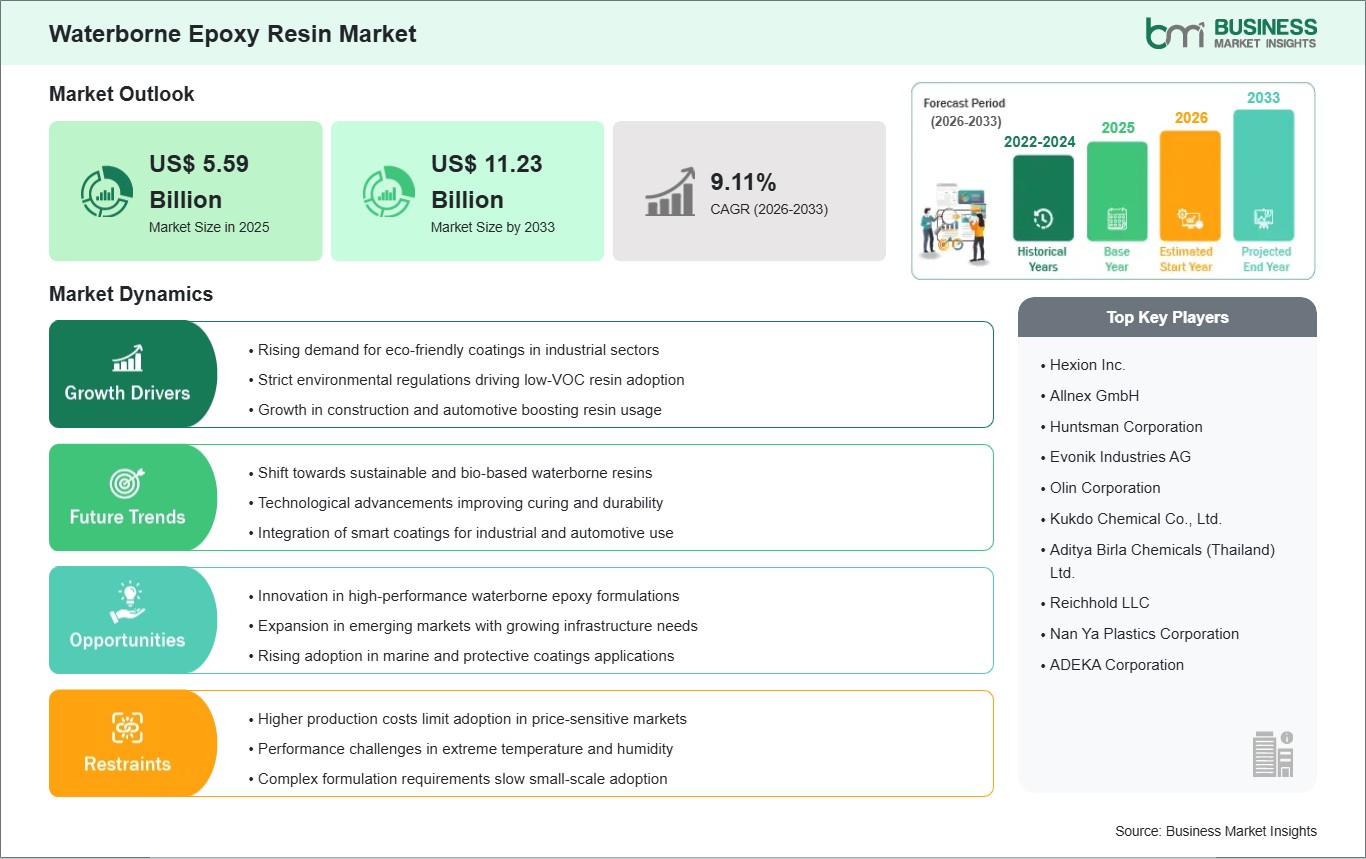
The Waterborne Epoxy Resin Market size is expected to reach US$ 11.23 billion by 2033 from US$ 5.59 billion in 2025. The market is estimated to record a CAGR of 9.11% from 2026 to 2033.
The worldwide market for waterborne epoxy resin solutions is currently receiving strong market interest because of changes to environmental regulations and because industrial sector preferences and end-use market demand are both evolving. Waterborne epoxy resins replace traditional solvent-borne systems in architectural, automotive, marine and industrial applications because these materials produce lower volatile organic compound emissions and maintain strong adhesion and work well with environmentally friendly coatings. The shift occurred because businesses face both regulatory environmental requirements and consumer demand for corporate sustainability initiatives. Manufacturers in both developed and emerging markets now concentrate on creating eco-friendly products that fulfill performance requirements and adhere to regulations, which makes waterborne systems more widely used.
The international market growth receives its primary momentum from governments around North America, Europe and the Asia Pacific regions, which enforce strict rules to limit dangerous chemical emissions. Agencies and standards bodies promote low-volatile organic compound coatings, which create a demand for waterborne epoxy resin products. The global increase in infrastructure development, together with rising residential and commercial construction activities, generates demand for strong and high-quality coatings that need to meet environmental standards for green building certifications. Waterborne epoxy resins serve automotive manufacturing and industrial maintenance needs because they provide corrosion resistance, flexible performance and long-lasting surface protection that meets environmental standards.
The market expansion process faces restrictions because multiple constraints exist. The waterborne formulations face their main challenge because they cannot cure properly under extreme conditions, which occur in both cold weather and high-humidity situations, that restrict their use in particular situations. The advanced waterborne epoxy systems present two major obstacles for price-sensitive markets and small users because they require more complex formulations and higher initial expenses than some solvent-based systems. The market will continue its upward trend because technological progress and stricter sustainability regulations will drive worldwide innovation in resin chemistry development and formulation method research.

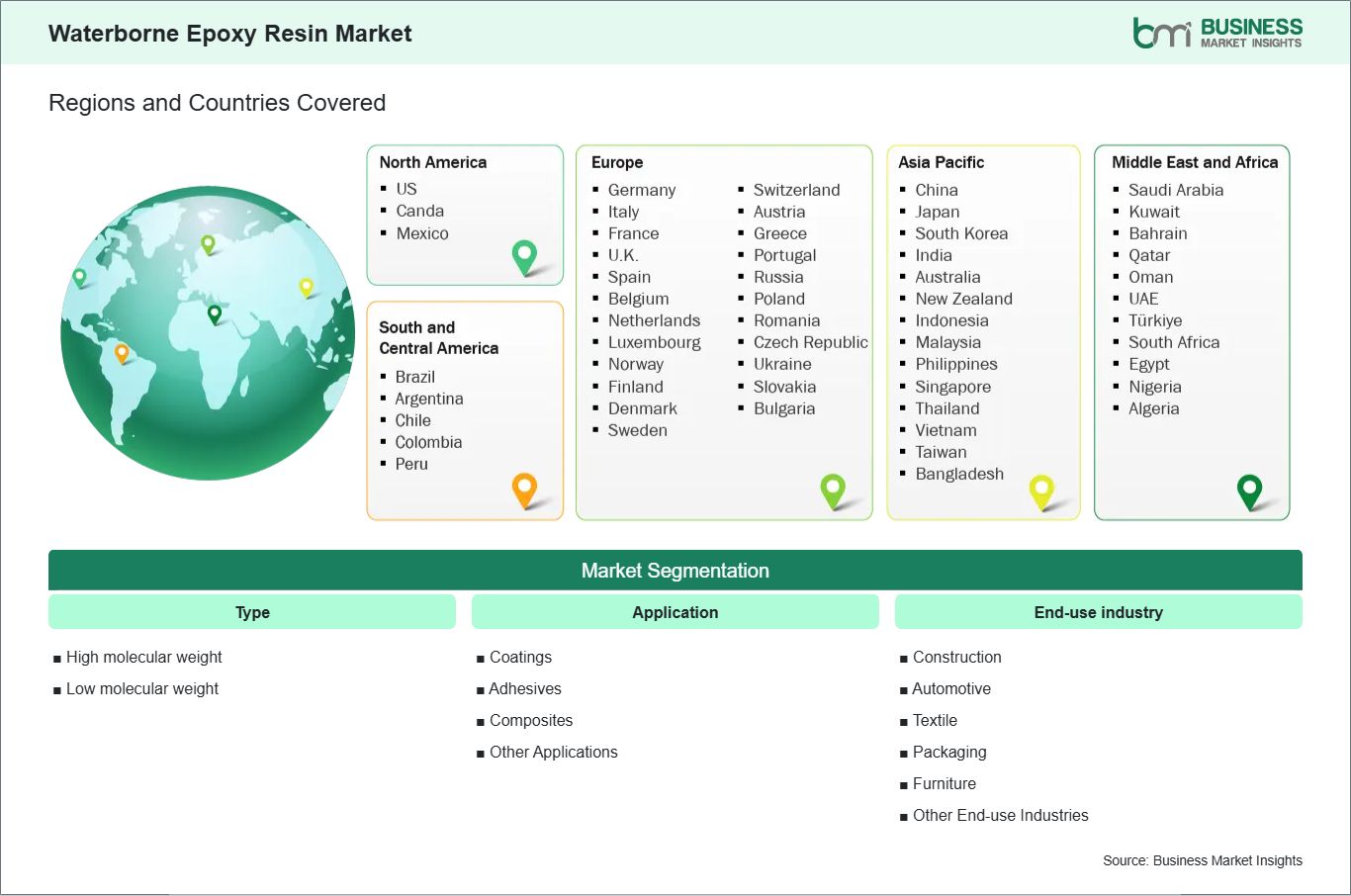
Key segments that contributed to the derivation of the waterborne epoxy resin market analysis are type, application, and end-use industry.
The rising need for environmentally friendly coatings in industrial sectors is driving a major increase in the worldwide waterborne epoxy resin market. The automotive industry, construction sector, electronics industry and heavy machinery sector now select materials that reduce environmental damage yet deliver high performance. North American and European automotive manufacturers use waterborne epoxy resins to create corrosion-resistant coatings that fulfill strict emissions requirements and sustainability objectives. Waterborne epoxy coatings protect machinery and metal structures in industrial equipment manufacturing because they improve durability while decreasing VOC emissions.
The growing population and infrastructure expansion in the Asia Pacific and South America are creating a greater demand for waterborne resin technologies. The construction of commercial buildings, bridges and industrial facilities requires durable coatings that have minimal environmental impact. The governments of China, Japan and Brazil promote sustainable material usage through their environmental regulations and green building incentives. The trend shows that consumer knowledge about eco-friendly products has increased, which leads businesses worldwide to change from using traditional solvent-based resins to waterborne resins. The industrial demand for waterborne epoxy resins keeps growing worldwide, which establishes this material as fundamental for sustainable coating solutions.
Innovation in high-performance waterborne epoxy formulations is emerging as a key opportunity in the global market. Manufacturers are investing in research to develop resins with faster curing times, improved chemical resistance, and enhanced adhesion to diverse substrates. These advancements enable waterborne epoxy resins to perform in demanding environments, including extreme temperatures and high humidity, which were previously limiting factors. Europe and North America are at the forefront of this innovation, with companies focusing on coatings for industrial maintenance, automotive refinishing, and protective applications in energy infrastructure.
Emerging markets in Asia Pacific and the Middle East are also benefiting from these innovations. Advanced waterborne formulations are increasingly applied in large-scale infrastructure projects, including oil refineries, ports, and industrial plants, where durability and environmental compliance are critical. Additionally, research into hybrid and bio-based waterborne resins is gaining traction, offering opportunities for manufacturers to meet sustainability targets while expanding into new applications, such as marine coatings and electronics encapsulation. By combining performance and environmental advantages, innovative waterborne epoxy formulations are shaping the global coatings market and creating pathways for long-term growth across industries worldwide.
The waterborne epoxy resin market demonstrates steady growth, with size and share analysis highlighting evolving trends and competitive dynamics among key players. The report examines subsegments categorized within type, application, and end-use industry, offering insights into their contribution to overall market performance.
By type, the high molecular weight subsegment dominated the market in 2025, driven by its superior durability, corrosion resistance, and better performance in protective coatings.
Based on application, the coatings subsegment dominated the market in 2025, driven by the rising demand for eco-friendly, low-VOC coating solutions across construction and industrial applications.
In terms of end-use industry, the construction subsegment dominated the market in 2025, driven by increasing infrastructure development and the growing use of protective coatings in buildings and structures.
| Report Attribute | Details |
|---|---|
| Market size in 2025 | US$ 5.59 Billion |
| Market Size by 2033 | US$ 11.23 Billion |
| Global CAGR (2026 - 2033) | 9.11% |
| Historical Data | 2022-2024 |
| Forecast period | 2026-2033 |
| Segments Covered | By Type
|
|
Regions and Countries Covered
| |
| North America | US, Canada, Mexico |
| Europe | Belgium, Austria, Finland, Denmark, Greece, Poland, Romania, Russia, Ukraine, Czech Republic, Slovakia, Bulgaria, Italy, Luxembourg, Germany, Switzerland, France, Netherlands, Norway, Portugal, Spain, Sweden, United Kingdom |
| Asia-Pacific | Australia, China, India, Japan, South Korea, Indonesia, Malaysia, Philippines, Singapore, Thailand, Vietnam, Bangladesh, New Zealand, Taiwan |
| South and Central America | Brazil, Argentina, Peru, Chile, Colombia |
| Middle East and Africa | Bahrain, Kuwait, Oman, Qatar, Saudi Arabia, United Arab Emirates, Turkiye, South Africa, Egypt, Algeria, Nigeria |
| Market leaders and key company profiles |
|
The "Waterborne Epoxy Resin Market Size and Forecast (2022 - 2033)" report provides a detailed analysis of the market covering below areas:
The geographical scope of the Waterborne Epoxy Resin Market report is divided into North America, Asia Pacific, Europe, Middle East & Africa, and South & Central America. North America held the largest share in 2025.
The global waterborne epoxy resin market shows its strongest presence in North America because the region enforces strict environmental regulations and has developed advanced industrial facilities and uses sustainable materials in its construction and automotive and industrial maintenance work. The U.S. and Canada are leading the adoption of low-VOC coatings, where waterborne epoxy resins are preferred for their strong adhesion, corrosion resistance, and compliance with environmental standards, particularly in applications such as commercial construction, infrastructure rehabilitation, and automotive OEM and refinish segments.
The European market has reached maturity because people understand eco-friendly solutions, while Germany, France and the U.K. enforce strict environmental regulations and building standards that promote the use of waterborne resins instead of solvent-based materials. The region aims for both regulatory compliance and optimal performance through its industrial coatings and infrastructure projects, which encompass bridges, transportation facilities and chemical-processing plants.
The Asia Pacific market experiences rapid growth because of its quick industrial growth, urban development and increasing investments in infrastructure. China, Japan, and India are increasingly adopting waterborne epoxy resins in automotive manufacturing, electronics, and protective coatings for industrial equipment, driven by a combination of environmental initiatives and the need for durable, low-emission solutions in high-volume applications.
The Middle East and Africa experience their growth through three main factors, which include infrastructure development, oil and gas facilities and marine coatings that use waterborne resins to provide environmental benefits while protecting against extreme weather conditions. The region shows first signs of adoption, which gains speed because people become more aware of sustainability, and multinational construction companies and industrial projects require materials that meet their compliance needs. Waterborne epoxy resin usage is spreading across
South and Central America because urban infrastructure projects and industrial maintenance and automotive refinishing work drive demand, but adoption rates remain sluggish because of price concerns and differences in how regulations are enforced. All regions concentrate on developing new formulations that will enhance the curing process, chemical resistance and application versatility, together with North America establishing itself as the standard for regulatory-based product adoption, which creates market trends that impact worldwide market activities.

The Waterborne Epoxy Resin Market is evaluated by gathering qualitative and quantitative data post primary and secondary research, which includes important corporate publications, association data, and databases. A few of the key developments in the waterborne epoxy resin market are:
The Waterborne Epoxy Resin Market is valued at US$ 5.59 Billion in 2025, it is projected to reach US$ 11.23 Billion by 2033.
As per our report Waterborne Epoxy Resin Market, the market size is valued at US$ 5.59 Billion in 2025, projecting it to reach US$ 11.23 Billion by 2033. This translates to a CAGR of approximately 9.11% during the forecast period.
The Waterborne Epoxy Resin Market report typically cover these key segments-
The historic period, base year, and forecast period can vary slightly depending on the specific market research report. However, for the Waterborne Epoxy Resin Market report:
The Waterborne Epoxy Resin Market is populated by several key players, each contributing to its growth and innovation. Some of the major players include:
The Waterborne Epoxy Resin Market report is valuable for diverse stakeholders, including:
Essentially, anyone involved in or considering involvement in the Waterborne Epoxy Resin Market value chain can benefit from the information contained in a comprehensive market report.
Please tell us your area of interest
(Market Segments/ Regions and Countries/ Companies)