
Washing Machine Market Size, Share, Trends & Forecast Report, 2026–2033

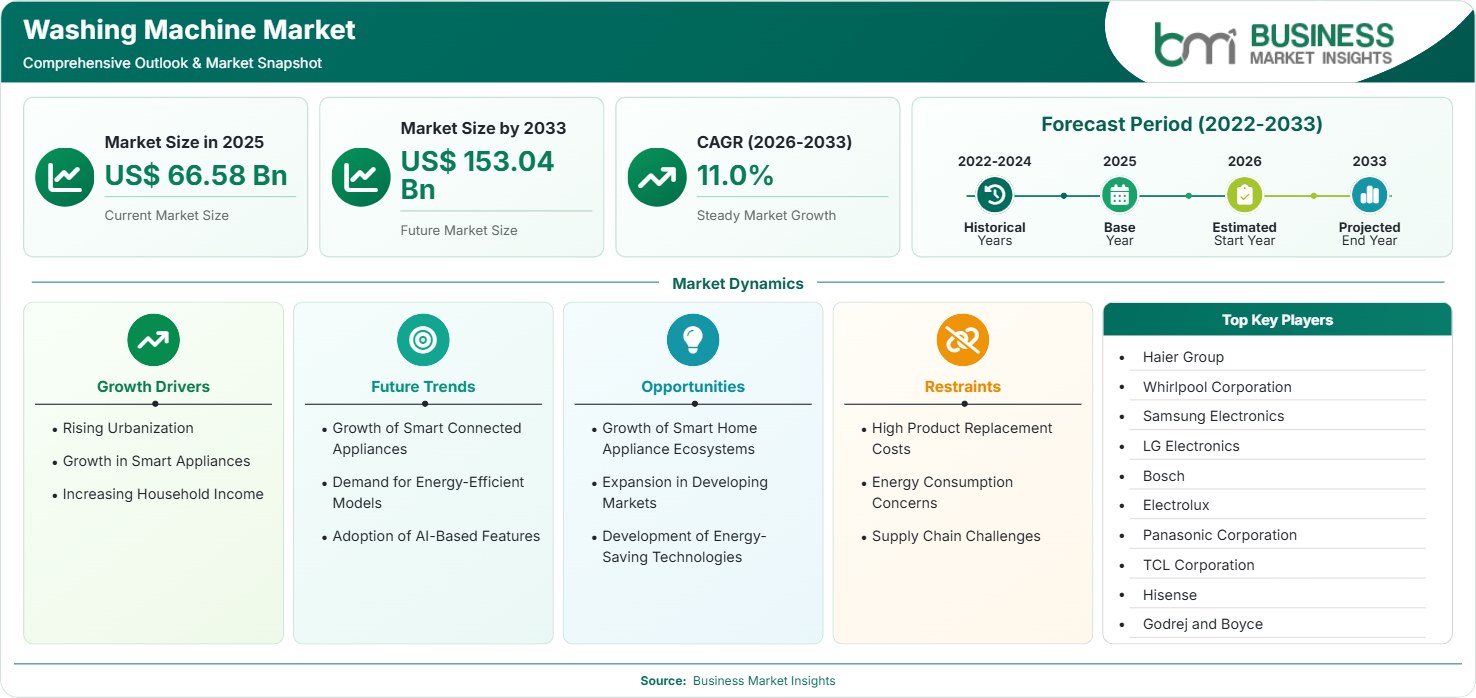
The Washing Machine Market size was valued at US$ 66.58 billion in 2025 and is projected to reach US$ 153.04 billion by 2033, growing at a CAGR of 11.0% during 2026–2033, driven by rising urbanization, smart appliance adoption, increasing household income, smart home ecosystem expansion, developing market penetration, and energy-efficient technology advancements.

Report Coverage
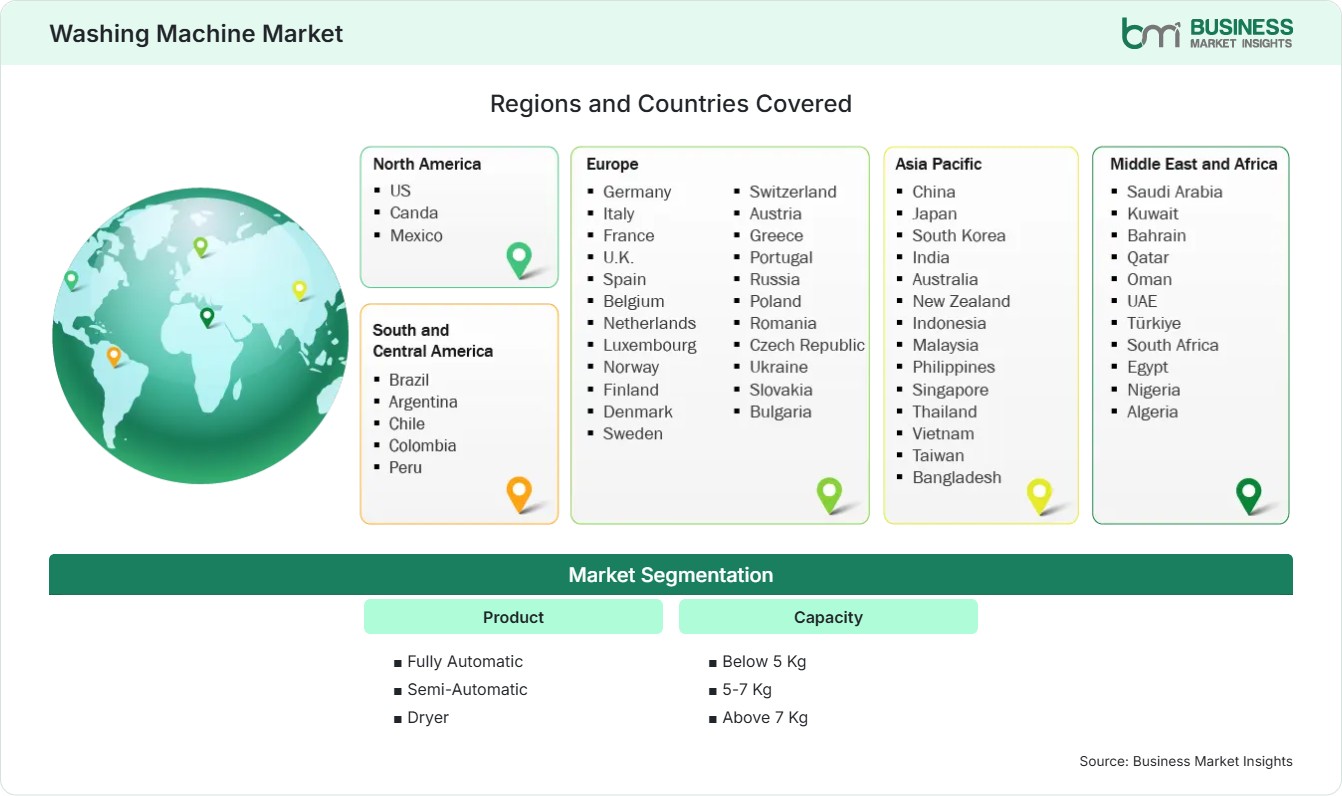
  • Product: Fully Automatic, Semi-Automatic, Dryer
  • Capacity: Below 5 Kg, 5-7 Kg, Above 7 Kg
US$ 66.58 Bn Market size in 2025
US$ 153.04 Bn Market Size by 2033
11.0% CAGR, 2026 - 2033
2026-2033 Forecast Period

AI Overview

Washing Machine Market Summary

  • North America Region: North America holds market share of 24%–28% in 2025, growing with a CAGR of 10.5%–11.2% influenced by smart appliance adoption, premium product demand, replacement cycles, and energy efficiency initiatives. The US market is projected to grow at a CAGR of 10.7%–11.3% from 2026–2033, supported by connected home integration, high appliance ownership, and the adoption of advanced washing technology.
  • Fastest Growing Region: Asia Pacific holds a market share of 38%–42% in 2025, growing with a CAGR of 12.0%–12.8%, influenced by urbanization, rising disposable income, expanding residential infrastructure, and increasing adoption of automated household appliances.
  • Leading Segment: Fully Automatic washing machines hold a market share of 62%–66% in 2025, growing with a CAGR of 11.2%–11.8%, influenced by convenience demand, smart features, improved washing performance, and changing consumer lifestyles.
  • High Growth Segment: Dryer products hold a market share of 12%–16% in 2025, growing with a CAGR of 12.5%–13.2%, influenced by urban housing limitations, premium appliance adoption, changing weather conditions, and demand for integrated laundry solutions.
  • Key Market Opportunity: Smart home appliance ecosystems, developing market expansion, and energy-saving technologies create opportunities through connected appliances, efficient performance, and increasing household appliance penetration.
  • Major Market Players: Haier Group, Whirlpool Corporation, Samsung Electronics, LG Electronics, Bosch, Electrolux, Panasonic Corporation, TCL Corporation, Hisense, and Godrej and Boyce.
Strategic Insights

Washing Machine Market: Strategic Insights

Washing Machine Market Strategic Framework
FREE PDF
Request your free sample
Request free sample
Stakeholder View

Key Takeaways

  • The washing machine ecosystem includes appliance manufacturers, component suppliers, technology providers, retail channels, and service networks supporting product development, distribution, and after-sales operations.
  • Fully automatic models, large-capacity appliances, and connected washing solutions represent major growth opportunities as consumers seek convenience, efficiency, and advanced household automation.
  • Innovation is shifting toward artificial intelligence-based washing programs, smart connectivity, energy-efficient motors, water-saving technologies, and integrated home appliance platforms.
  • Asia Pacific offers strong investment potential due to urban population growth, rising middle-class households, expanding housing infrastructure, and increasing adoption of modern appliances.
  • Strategic partnerships, product launches, and manufacturing expansion initiatives are shaping competition as companies strengthen their presence across premium and emerging appliance markets.
  • Energy efficiency and sustainability are becoming important purchase considerations as consumers and regulators focus on reducing electricity consumption and improving household resource management.
Geographic Outlook

Washing Machine Market Regional Highlights

North America Washing Machine Market

North America Market accounted for a 24%–28% share in 2025 and is projected to expand at a CAGR of 10.5%–11.2% during 2026–2033. The region maintains strong demand due to high appliance ownership, smart home adoption, premium product preference, and replacement purchases. The US and Canada are key markets, supported by advanced retail networks, energy-efficiency standards, and growing interest in connected laundry solutions.

  • Smart washing machines are gaining adoption through integration with connected home ecosystems and mobile applications.
  • Consumers are preferring energy-efficient appliances due to sustainability goals and utility cost considerations.
  • Premium front-load models are expanding through advanced features and improved washing performance.
  • Replacement demand remains strong due to aging household appliances across residential markets.
  • Retail and e-commerce channels are improving product accessibility for consumers.

US Washing Machine Market

The US Washing Machine Market share represented a 20%–24% in 2025 and is estimated to grow at a CAGR of 10.7%–11.3% between 2026 and 2033. The country remains a major contributor due to established appliance ownership, increasing smart appliance penetration, and consumer preference for advanced laundry technologies. Manufacturers are focusing on connected products, efficiency improvements, and premium offerings.

  • Smart appliance adoption is increasing through integration with home automation platforms.
  • Consumers are upgrading to high-capacity and energy-efficient washing machine models.
  • Online appliance sales channels are improving access to advanced product categories.
  • Manufacturers are introducing AI-enabled features to enhance washing performance.

Europe Washing Machine Market

Europe Market held a 22%–26% share in 2025 and is forecast to register a CAGR of 10.2%–10.9% during 2026–2033. The region benefits from strong sustainability awareness, strict energy efficiency requirements, and demand for technologically advanced appliances. Germany, the UK, France, Italy, and Spain are important markets, with Germany leading due to strong appliance demand and environmental standards.

  • Energy efficiency regulations are encouraging the adoption of low-consumption washing machines.
  • Germany is driving demand through advanced appliance technologies and sustainability-focused consumers.
  • European households are increasingly adopting smart-connected laundry solutions.
  • Compact appliance demand is increasing due to urban housing patterns.
  • Manufacturers are investing in sustainable materials and efficient product designs.

Asia Pacific Washing Machine Market

The Asia Pacific Market accounted for 38%–42% of the market share in 2025 and is expected to grow at the fastest CAGR of 12.0%–12.8% between 2026 and 2033. Rapid urbanization, rising household income, and expanding residential construction are supporting regional growth. China, India, Japan, South Korea, and Southeast Asian countries represent major markets, with India and Southeast Asia showing strong Washing Machine Market growth potential.

  • Urban households are increasingly adopting automatic washing machines for convenience.
  • Rising middle-class income is supporting appliance ownership across developing economies.
  • Local manufacturing expansion is improving product availability and affordability.
  • Smart appliance adoption is increasing among digitally connected consumers.
  • E-commerce platforms are accelerating appliance sales across emerging markets.

Rest of World Washing Machine Market

Rest of World Market represented a 8%–12% share in 2025 and is projected to grow at a CAGR of 10.8%–11.5% from 2026–2033. Latin America, the Middle East, and Africa markets are developing through rising urban populations, improving residential infrastructure, and increasing household appliance adoption. Brazil, Mexico, the UAE, Saudi Arabia, and South Africa represent key markets driven by economic development and consumer modernization trends.

  • Latin American households are increasing their adoption of automatic washing machines through improved purchasing power.
  • Brazil and Mexico are supporting regional demand through expanding appliance distribution networks.
  • Middle Eastern consumers are adopting premium appliances with advanced washing technologies.
  • African urban development is creating new opportunities for household appliance manufacturers.
  • Regional retailers are improving appliance availability through digital commerce platforms.
Global Market Geography
FREE PDF
Request your free sample
Request free sample
Segment Analysis

Washing Machine Market Segmentation

Product

Product segmentation includes fully automatic, semi-automatic, and dryer categories. Fully automatic washing machines maintained a leading position in 2025 with a 62%–66% share and are expected to grow at a CAGR of 11.2%–11.8% from 2026–2033. Convenience requirements, urban lifestyles, smart features, and increasing preference for automated laundry solutions support growth.

  • Fully Automatic: Fully automatic machines provide convenience through automated washing cycles, advanced controls, and improved operational efficiency.
  • Front Load: Front-load machines attract consumers through better cleaning performance, lower water usage, and premium features.
  • Top Load: Top-load machines remain popular due to affordability, convenience, and easier loading preferences.
  • Semi-Automatic: Semi-automatic models appeal to price-sensitive consumers seeking affordable laundry solutions with flexible operation.
  • Dryer: Dryers support urban households requiring faster laundry completion and integrated clothing care solutions.

Capacity

Capacity segmentation includes washing machines below 5 Kg, 5-7 Kg, and above 7 Kg. The 5-7 Kg category represents a significant market segment due to suitability for average household requirements, affordability, and broad consumer acceptance. Increasing household-size variation and changing lifestyles are influencing demand across different capacity categories.

  • Below 5 Kg: Below 5 Kg machines serve compact households, smaller living spaces, and consumers requiring basic laundry solutions.
  • 5-7 Kg: 5-7 Kg machines provide balanced capacity, affordability, and efficiency for standard household washing requirements.
  • Above 7 Kg: Above 7 Kg machines support large families and consumers requiring higher laundry capacity and convenience.
Market Forces

Washing Machine Market Dynamics

Key Market Drivers

Rising Urbanization

With urbanization taking place on an unprecedented scale, the need for washing machines is gaining momentum, with people residing in urban centers looking for easy and effective ways to wash clothes. Changes in lifestyle habits, along with reduced space available for houses, are compelling individuals to move away from manually washing clothes to using machines. An increase in the urban population drives the Washing Machine Market growth, the construction of residences, and the increased availability of appliances in developing countries. Some of the market trends include the growing preference for compact designs, full-auto machines, and smart-connected appliances.

Growth in Smart Appliances

The growth of smart appliances is revolutionizing consumer expectations as people continue to embrace interconnected and intelligent devices. In washing machine manufacturing, artificial intelligence, mobile, cycle automation, and energy optimization technologies have been incorporated to increase user convenience. The factors contributing to market growth include the increasing adoption of smart homes by consumers. Washing Machine Market trends reflect the growing demand for interconnected washing machines that increase efficiency, reduce resource use, and enable personalization of the washing experience.

Increasing Household Income

Rising family incomes are promoting the use of washing machines by increasing the ability to purchase and upgrade from simple to more sophisticated machines. The demand for automatic washing machines in emerging countries is rising due to the growth of the middle class and improvements in housing standards. The factors driving the market include increased financing options, improved distribution channels, and greater consumer awareness of the benefits of using appliances. There is high demand for premium washing machines that have efficient energy usage and enhanced durability.

Key Market Opportunities

Growth of Smart Home Appliance Ecosystems

The emergence of an ecosystem around smart home appliances creates opportunities for washing machine companies to introduce products in a connected home environment. Customers have started using smart home appliances that connect to smartphones and voice assistants. Features like remote control, maintenance notification, automatic cycles, and energy monitoring are some of the functionalities provided by smart washing machines. Interoperable products developed by companies can capitalize on growing consumer interest in connected living solutions. Collaboration between appliance companies and tech firms is helping them develop more advanced functionalities and better experiences. According to The Washing Machine Market Forecasts, the growth of smart homes will provide more opportunities for innovations.

Expansion in Developing Markets

Expansion in developing markets offers significant opportunities as urbanization, rising incomes, and improving infrastructure increase household appliance penetration. Many emerging economies continue experiencing growth in residential construction and consumer modernization trends. Manufacturers are expanding distribution networks, local production facilities, and affordable product offerings to capture these markets. Demand is increasing for reliable, energy-efficient washing machines suited to diverse consumer needs. Companies focusing on regional preferences, pricing strategies, and after-sales service capabilities can strengthen market presence. Developing economies represent important growth opportunities due to increasing household adoption and expanding access to modern appliances.

Development of Energy-Saving Technologies

The development of energy-efficient technologies provides opportunities for businesses, given the growing preference of consumers and regulatory bodies for appliances with high energy efficiency. Manufacturers are focusing on developing sophisticated motors, effective washing programs, water-saving technologies, and environmentally safe materials to reduce resource consumption. Energy-efficient washing machines allow consumers to reduce operating costs and meet their sustainability needs. Products designed by companies to meet the standards of efficiency have competitive advantages in all markets of the world. Future innovations in the field of appliances are expected to be driven by energy-efficient technologies.

Market Restraints and Challenges

High Product Replacement Costs

Factor: High product replacement costs associated with purchasing advanced washing machines, installation requirements, and premium technology features create affordability challenges for some consumers.

Impact: Higher replacement expenses can delay upgrade cycles and limit the adoption of technologically advanced models, particularly in price-sensitive markets. Consumers may continue using older appliances when repair costs remain lower than replacement expenses. Manufacturers are addressing this challenge through affordable product lines, financing options, and durable designs that improve long-term value. However, replacement cost considerations remain an important factor influencing purchasing decisions and market expansion across developing regions.

Energy Consumption Concerns

Factor: Energy consumption concerns related to electricity usage, environmental impact, and operating costs influence consumer preferences and regulatory requirements.

Impact: Concerns about inefficient appliances can reduce demand for older washing machine models and increase pressure on manufacturers to develop energy-saving alternatives. Consumers are increasingly evaluating energy ratings, operating expenses, and sustainability features before purchase decisions. Companies must invest in efficient motors, optimized technologies, and environmentally responsible manufacturing practices to address these concerns. Meeting evolving energy standards while maintaining performance remains a key challenge for washing machine manufacturers competing in global markets.

Company Analysis

Competitive Landscape

The Washing Machine Market analysis highlights competition among global appliance manufacturers focusing on smart technologies, energy-efficient solutions, product innovation, and regional expansion strategies. Companies are investing in connected appliances, advanced washing technologies, sustainable designs, and expanded distribution networks to strengthen market positioning. Leading players are targeting both premium and emerging consumer segments through diversified product portfolios.

Company Name

Overview

Products and Services relevant to this market

Haier Group

Global home appliance manufacturer with broad consumer product offerings.

Washing machines, smart laundry appliances, connected home solutions, and dryers.

Whirlpool Corporation

Major appliance company serving residential markets worldwide.

Washing machines, laundry systems, smart appliances, and household solutions.

Samsung Electronics

Technology company offering advanced consumer appliances.

Smart washing machines, AI-enabled laundry products, and connected appliances.

LG Electronics

Consumer electronics and appliance manufacturer.

Washing machines, AI laundry solutions, dryers, and smart home products.

Bosch

Appliance brand focused on quality and efficiency.

Washing machines, energy-efficient laundry systems, and household appliances.

Electrolux

Global appliance manufacturer serving residential consumers.

Washing machines, dryers, and sustainable laundry solutions.

Panasonic Corporation

An electronics company providing household appliances.

Washing machines, home appliances, and smart household solutions.

TCL Corporation

Technology company expanding consumer appliance portfolio.

Washing machines, smart appliances, and connected home products.

Hisense

Consumer electronics and appliance manufacturer.

Washing machines, laundry appliances, and smart home solutions.

Godrej and Boyce

An Indian consumer appliance and engineering company.

Washing machines, household appliances, and laundry products.

Industry Activity

Recent Developments

August 2025

LG Electronics Inc. expanded its AI-enabled home appliance portfolio with new AI DD washing machine models as part of its broader smart home strategy. The company highlighted AI-driven washing performance, energy efficiency, and connected appliance capabilities across its laundry product lineup.

June 2025

GE Appliances, a Haier company, announced a US$490 million investment at its Louisville, Kentucky headquarters to build an advanced laundry manufacturing facility. The investment will bring production of the GE Profile UltraFast Combo Washer/Dryer and GE and GE Profile UltraFresh Front Load Washer lines to the U.S., creating approximately 800 jobs and expanding domestic washing machine manufacturing capacity.

April 2025

Samsung Electronics Co., Ltd. launched its Bespoke AI Top Load Washer lineup globally, introducing AI-based features including AI Wash, AI Energy Mode, and AI Vibration Reduction Technology Plus (VRT+) to improve washing performance, energy efficiency, and user experience.

March 2025

Samsung Electronics Co., Ltd. introduced its Bespoke AI Laundry with AI Home washer and dryer range, featuring integrated AI Home displays and smart connectivity through Samsung’s connected appliance ecosystem. The launch expanded Samsung’s AI-enabled laundry portfolio across multiple global markets.

Trust & Transparency

Research Methodology

The market analysis combines proprietary research with secondary data from government agencies, company disclosures, regulatory filings, industry databases and expert interviews. Market estimates are validated through data triangulation, cross-market benchmarking and analyst review.

View Full Research Methodology

Questions Answered

Frequently Asked Questions

What does the Washing Machine Market Report indicate about future opportunities?

The market report indicates opportunities in smart home integration, developing market expansion, connected appliances, energy-efficient technologies, and innovative laundry solutions designed for changing consumer needs.

How are energy-saving technologies influencing washing machine development?

Energy-saving technologies are encouraging manufacturers to develop efficient motors, optimized washing programs, and water-saving features that reduce operating costs while meeting sustainability requirements and consumer expectations.

Which product segment leads the market?

Fully automatic washing machines lead due to consumer preference for convenience, automated operation, improved cleaning performance, advanced features, and suitability for urban households with busy lifestyles.

Why are smart washing machines gaining popularity?

Smart washing machines are gaining popularity due to features such as remote monitoring, artificial intelligence-based washing cycles, energy optimization, smartphone connectivity, and integration with smart home ecosystems.

What factors are driving growth in the Washing Machine Market?

The market is driven by rising urbanization, increasing household income, smart appliance adoption, changing consumer lifestyles, and growing demand for energy-efficient and convenient laundry solutions.

Access the Full Washing Machine Market Report

Get segment-level forecasts, regional estimates, competitive benchmarking, company profiles and downloadable Excel datasets.

Access the full Washing Machine Market Report
350 pages PDF & Excel | 2026-07-31