
Fully Automatic Washing Machine Market Outlook: Size, Share, Trends, Growth Analysis, Competitive Landscape & Forecast, 2026-2033

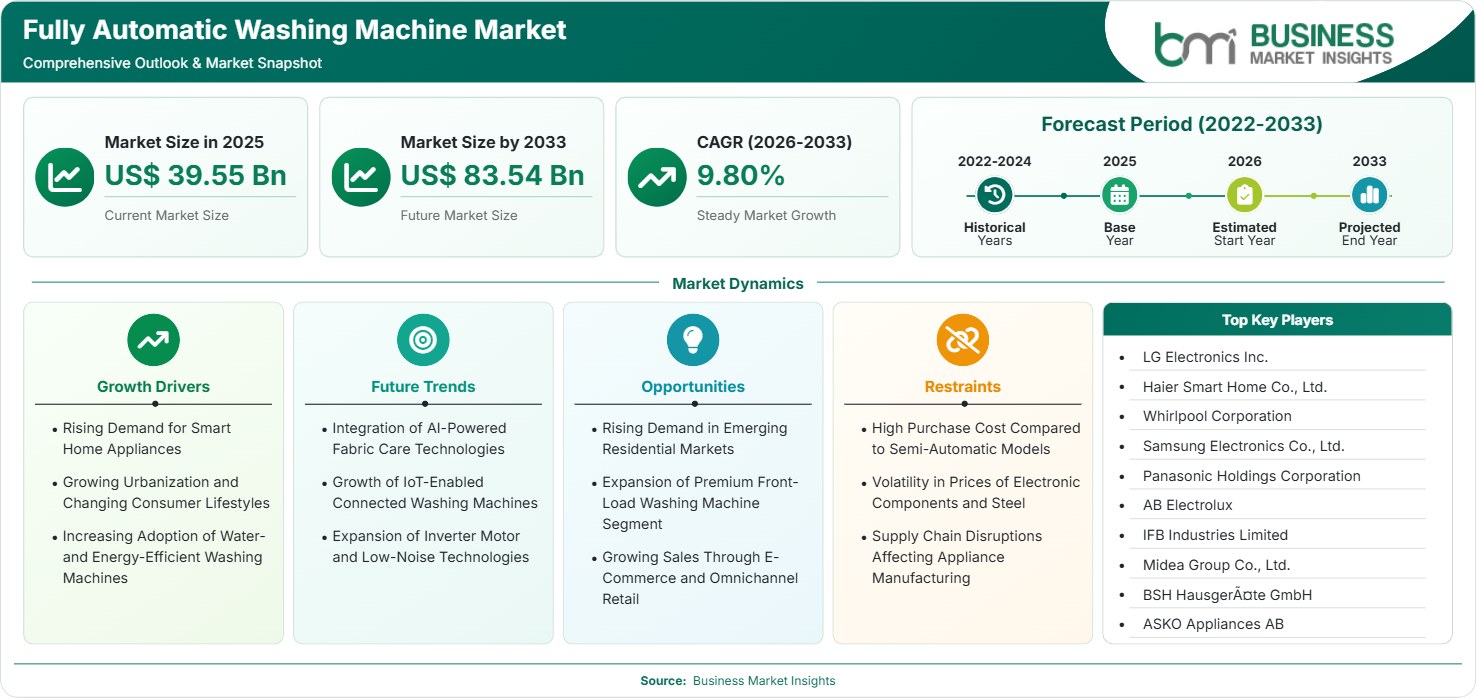
The Fully Automatic Washing Machine Market size was valued at US$ 39.55 Billion in 2025 and is projected to reach US$ 83.54 Billion by 2033, growing at a CAGR of 9.80% during 2026–2033. Rising disposable incomes, rapid smart home adoption, increasing urbanization, and growing consumer preference for energy-efficient appliances continue creating strong opportunities for premium washing machine manufacturers.

Report Coverage
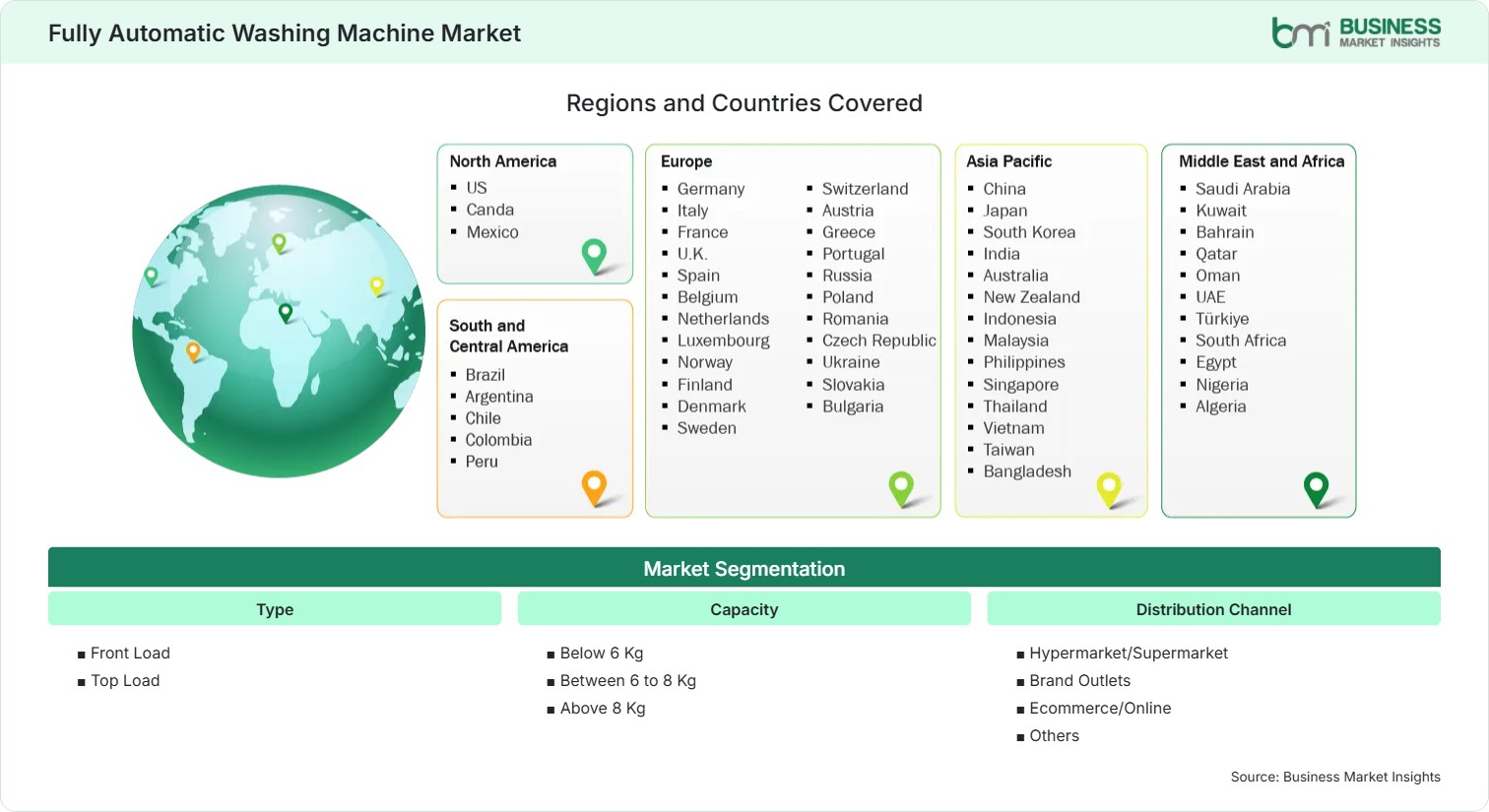
  • Type: Front Load, Top Load
  • Capacity: Below 6 Kg, Between 6 to 8 Kg, Above 8 Kg
  • Distribution Channel: Hypermarket/Supermarket, Brand Outlets, Ecommerce/Online, Others
US$ 39.55 Bn Market size in 2025
US$ 83.54 Bn Market Size by 2033
9.80% CAGR, 2026 - 2033
2026-2033 Forecast Period

01 AI Overview

Fully Automatic Washing Machine Market Summary

  • North America Region: North America holds 28%–31% fully automatic washing machine market share in 2025 and is projected to expand at a CAGR of 8.5%–8.9% during 2026–2033. Growing replacement demand, smart home adoption, premium appliance purchases, energy efficiency regulations, connected home ecosystems, and technological innovation continue supporting sustained market expansion.
  • Fastest Growing Region: Asia Pacific accounts for 39%–42% of the market in 2025 and is anticipated to grow at a CAGR of 11.2%–11.7%. Rising urbanization, expanding middle-class population, increasing residential construction, improving electricity access, and higher consumer spending continue accelerating demand for fully automatic washing machines.
  • Leading Segment: Front Load machines account for 56%–59% market share in 2025 while expanding at a CAGR of 10.1%–10.5%. Superior water efficiency, lower energy consumption, advanced washing performance, smart connectivity, and premium consumer preference continue strengthening market leadership.
  • High Growth Segment: E-commerce/Online represents 25%–28% market share in 2025 and is projected to register a CAGR of 12.3%–12.8%. Expanding digital retail platforms, doorstep delivery, competitive pricing, product comparison tools, financing options, and omnichannel retail strategies continue driving rapid consumer adoption.
  • Key Market Opportunity: Growing integration of artificial intelligence, IoT connectivity, predictive maintenance, personalized washing programs, and energy optimization technologies enables premium product differentiation while enhancing consumer convenience and long-term operational efficiency.
  • Major Market Players: LG Electronics Inc., Haier Smart Home Co., Ltd., Whirlpool Corporation, Samsung Electronics Co., Ltd., Panasonic Holdings Corporation, AB Electrolux, IFB Appliances Limited, Midea Group Co., Ltd., BSH Hausgeräte GmbH, and ASKO Appliances AB.
02 Strategic Insights

Fully Automatic Washing Machine Market: Strategic Insights

Fully Automatic Washing Machine Market Strategic Framework
FREE PDF
Request your free sample
Request free sample
03 Stakeholder View

Key Takeaways

  • The value chain of the fully automatic washing machine market is becoming more and more integrated as companies are joining hands with semiconductor vendors, software providers, smart home platform providers, and retail partners to offer connected consumer appliances ecosystem.
  • Premium home appliances would be the most lucrative long-term opportunity owing to consumers' preference for convenience, reduced utility consumption, smart capability, and sophisticated fabric care systems while buying home appliances.
  • Innovation in products has been moving towards AI-enabled wash optimization, inverter technology, remote monitoring & diagnostics, predictive maintenance, automated detergent dosing, and customized washing cycles.
  • Asia Pacific is the most lucrative region owing to rising urban population, increased disposable income, increasing house building activities, and adoption of premium home appliances in emerging countries.
  • Direct-to-consumer distribution, e-commerce, localized production, and after-sales services continue to be the competitive advantages for leading players.
04 Geographic Outlook

Fully Automatic Washing Machine Market Regional Highlights

North America Fully Automatic Washing Machine Market

North America accounted for approximately 28%–31% of global revenue during 2025 and is projected to expand at a CAGR of 8.5%–8.9% through 2033. Strong replacement demand, premium appliance purchases, smart home integration, and high consumer purchasing power continue supporting regional expansion. The Fully Automatic Washing Machine Market share remains driven by energy-efficient product adoption, connected home ecosystems, and growing consumer preference for technologically advanced household appliances.

  • Growing need for replacement of old household appliances promotes purchases of energy-efficient washers that have inverter motors, smart wash algorithms, and wireless capabilities.
  • Increasing trend towards adoption of smart homes promotes installation of appliances that can be monitored remotely, use voice assistants, engage in predictive maintenance, and automate energy management processes.
  • More retailers enhance their omnichannel strategies through use of physical retail outlets together with online sales channels.

US Fully Automatic Washing Machine Market

The United States represents approximately 84%–87% of North American demand and is expected to register a CAGR of 8.6%–9.0% during the forecast period. Strong household appliance replacement cycles, high smart home adoption, and consumer preference for premium connected appliances continue supporting sustained market demand across residential applications.

  • Premium appliance purchases continue increasing as consumers prioritize advanced features including AI-powered washing programs, remote smartphone controls, and energy-efficient inverter technologies.
  • E-commerce platforms strengthen appliance sales through competitive pricing, rapid delivery services, flexible financing, and improved customer product comparison capabilities.
  • Builders increasingly install premium fully automatic washing machines within newly developed residential projects targeting higher-income consumers seeking modern smart home lifestyles.
  • Utility rebate programs and energy efficiency standards encourage households to replace conventional appliances with advanced high-efficiency washing machines offering lower operating costs.

Europe Fully Automatic Washing Machine Market

Europe represented approximately 24%–27% of the fully automatic washing machine market during 2025 and is anticipated to grow at a CAGR of 8.8%–9.2% through 2033. Strict energy efficiency regulations, mature replacement demand, and growing consumer preference for premium front-load appliances continue driving market expansion. Germany leads regional demand, while Poland records one of the fastest growth rates supported by rising household appliance purchases.

  • European consumers increasingly prefer front-load washing machines because of their superior water efficiency, lower electricity consumption, and enhanced fabric care performance.
  • Germany remains the largest regional market owing to strong purchasing power, advanced appliance manufacturing, and high adoption of energy-efficient household products.
  • Poland demonstrates strong growth supported by improving household income, expanding residential construction, and increasing replacement demand for modern appliances.
  • Digital retail expansion and manufacturer-backed financing programs improve accessibility to premium washing machines across developed and emerging European markets.

Asia Pacific Fully Automatic Washing Machine Market

Asia Pacific accounted for approximately 39%–42% of global revenue during 2025 and is forecast to expand at a CAGR of 11.2%–11.7% through 2033, making it the fastest-growing regional market. Rising urbanization, expanding middle-class households, improving electrification, and increasing consumer spending continue driving rapid adoption. China leads regional demand, while India records the fastest growth.

  • China dominates regional demand through large-scale manufacturing capabilities, widespread urban household adoption, and continuous product innovation by domestic and international appliance manufacturers.
  • India experiences rapid expansion driven by increasing disposable income, rural electrification, residential construction, and growing consumer preference for automated household appliances.
  • Japan and South Korea continue supporting premium product innovation through development of AI-enabled, connected, and highly energy-efficient washing machine technologies.

Rest of World Fully Automatic Washing Machine Market

The Rest of World region accounted for approximately 6%–8% of global market revenue during 2025 and is projected to grow at a CAGR of 9.5%–9.9% through 2033. South & Central America benefit from improving household incomes, while the Middle East and Africa experience growing appliance demand supported by urban development and expanding retail infrastructure. Brazil leads Latin America, whereas Saudi Arabia records the fastest regional growth.

  • Brazil continues witnessing increasing adoption of premium household appliances supported by urbanization, expanding organized retail, and improving consumer financing availability.
  • Saudi Arabia records strong growth driven by residential construction, smart home adoption, and increasing demand for technologically advanced household appliances.
  • Expanding e-commerce platforms improve consumer access to premium washing machines across emerging economies while supporting wider product availability.
  • International manufacturers continue strengthening regional distribution partnerships and localized service networks to improve customer support, product accessibility, and long-term brand loyalty.
Global Market Geography
FREE PDF
Request your free sample
Request free sample
05 Segment Analysis

Fully Automatic Washing Machine Market Segmentation

Type

The Type segment accounted for approximately 56%–59% of the market in 2025 and is projected to expand at a CAGR of 10.0%–10.4% during 2026–2033. Product demand is influenced by energy efficiency, washing performance, water consumption, and smart technology integration. The Fully Automatic Washing Machine Market scope continues expanding as consumers increasingly prefer advanced appliances offering convenience, intelligent wash cycles, and lower operating costs.

  • Front Load: Front-load machines dominate premium household applications because of superior cleaning efficiency, reduced water and electricity consumption, larger load capacity, and compatibility with smart home technologies.
  • Top Load: Top-load washing machines remain popular among value-conscious consumers owing to shorter wash cycles, ergonomic loading convenience, competitive pricing, and continuous technological improvements enhancing washing performance.

Capacity

Capacity-based demand is expanding alongside changing household sizes and consumer preferences for larger washing loads. This segment represented approximately 33%–36% of the market in 2025 and is anticipated to register a CAGR of 9.8%–10.2% during the forecast period. The Fully Automatic Washing Machine Market trends indicate growing consumer preference for higher-capacity appliances that improve convenience while supporting efficient household laundry management.

  • Below 6 Kg: Compact washing machines remain suitable for single-person households, students, and small apartments where space efficiency, affordability, and lower utility consumption remain key purchasing factors.
  • Between 6 to 8 Kg: This capacity range represents the preferred choice for average households due to balanced washing capacity, energy efficiency, and suitability for everyday family laundry requirements.
  • Above 8 Kg: Larger-capacity machines continue gaining popularity among large families and premium consumers seeking fewer wash cycles, greater convenience, and enhanced washing efficiency for bulky garments.

Distribution Channel

Distribution channels continue evolving rapidly with increasing digitalization and omnichannel retail strategies. The segment accounted for nearly 29%–32% of the market in 2025 and is projected to grow at a CAGR of 10.8%–11.3% during 2026–2033. Manufacturers continue expanding online platforms, exclusive retail stores, and organized retail partnerships to improve accessibility while strengthening customer engagement and after-sales support.

  • Hypermarket/Supermarket: Large retail chains continue attracting consumers through product demonstrations, promotional pricing, bundled offers, and immediate product availability across major urban markets.
  • Brand Outlets: Exclusive brand stores strengthen customer confidence by providing personalized consultations, complete product portfolios, installation support, and comprehensive after-sales service.
  • E-commerce/Online: Online platforms continue recording strong growth through competitive pricing, detailed product comparisons, consumer reviews, financing options, and convenient home delivery services.
  • Others: Regional appliance dealers, multi-brand electronics retailers, wholesalers, and institutional distributors continue contributing to product availability across urban and semi-urban markets.
06 Market Forces

Fully Automatic Washing Machine Market Dynamics

Key Market Drivers

Rising Demand for Smart Home Appliances

Growing adoption of connected home ecosystems is encouraging consumers to purchase intelligent household appliances equipped with Wi-Fi connectivity, artificial intelligence, remote monitoring, and voice assistant compatibility. Modern washing machines increasingly feature automatic detergent dispensing, personalized washing cycles, predictive maintenance, and smartphone-based controls that improve convenience and operational efficiency. Smart home penetration continues expanding across developed and emerging economies, encouraging manufacturers to introduce digitally connected products. The Fully Automatic Washing Machine Market growth is further supported by increasing consumer willingness to invest in premium appliances offering automation, energy savings, enhanced user experience, and seamless integration with broader smart home platforms.

Growing Urbanization and Changing Consumer Lifestyles

The rapid pace of urbanization and hectic lifestyles keep pushing the need for fully automatic washing machines, which make life easier by saving on time and labor. Increasing numbers of nuclear families, two-wage earning families, and apartment-living families motivate people to prefer convenience, space-saving features, and high-end washing capacity. As per estimates by the United Nations of urbanization, the number of urban inhabitants keeps increasing consistently all around the world, and this helps in maintaining high demand for household appliances. The manufacturers develop space-saving models, which have various washing cycles and inverters.

Increasing Adoption of Water- and Energy-Efficient Washing Machines

The issue of resource efficiency for home appliances is gaining importance among consumers and regulating bodies as an appliance that minimizes both the use of energy and water does not reduce cleaning effectiveness. The development of energy labels and environmental regulations results in manufacturers producing improved washing machines based on inverter technology, optimized drums and efficient water management system. This makes possible to save money on home utility and to pursue sustainable goals at the same time. The increasing popularity of premium front loaders can be attributed to their efficiency in comparison with standard ones.

Key Market Opportunities

Rising Demand in Emerging Residential Markets

Emerging markets continue to generate many opportunities through expanding middle-class consumers, income increases among families, and increased electrification. There is a growing preference for fully automatic washers among consumers switching from manual or semi-automatic washers due to increased convenience and efficiency in the laundry process. Housing development programs undertaken by governments also reinforce appliance penetration among developing economies. Companies investing in local manufacturing, premium but low-cost appliances, and wide distribution networks are well placed to benefit from increased appliance penetration and changing consumer buying behavior.

Expansion of Premium Front-Load Washing Machine Segment

Premium front-load washing machines continue attracting consumers seeking advanced cleaning performance, intelligent automation, and superior energy efficiency. Manufacturers increasingly differentiate products through artificial intelligence, steam washing technologies, automatic detergent dosing, fabric protection programs, and remote connectivity features. The Fully Automatic Washing Machine Market Forecasts remain favorable as higher-income households increasingly prioritize premium appliances offering improved convenience, sustainability, and lower lifecycle operating costs. Continuous product innovation and premiumization strategies are expected to generate attractive revenue opportunities across developed and rapidly urbanizing markets.

Growing Sales Through E-Commerce and Omnichannel Retail

The digital commerce keeps evolving the way appliances are bought through offering consumers wide selections of products, clear pricing, financing opportunities, feedback from other customers, and easy home delivery of products. There is an emerging trend where manufacturers are integrating their digital commerce with physical retail shops in order to offer a seamless experience that enables product discovery, purchase, installation, and post-purchase services for their clients. Digital logistics and marketing initiatives continue improving online sales of appliances.

Market Restraints and Challenges

High Purchase Cost Compared to Semi-Automatic Models

Factor: Fully automatic washing machines incorporate advanced electronic controls, inverter motors, intelligent sensors, and premium washing technologies that significantly increase manufacturing and retail prices compared with semi-automatic alternatives.

Impact: Higher upfront costs discourage price-sensitive consumers, particularly in developing economies where affordability remains a primary purchasing consideration. Many households continue choosing semi-automatic machines because of lower acquisition costs despite higher long-term operating effort. Manufacturers therefore face the challenge of balancing advanced features with competitive pricing while expanding financing options and localized production to improve affordability and accelerate fully automatic washing machine market penetration.

Volatility in Prices of Electronic Components and Steel

Factor: Fluctuating prices of steel, semiconductors, electronic control units, motors, and other essential components continue affecting manufacturing costs and supply chain stability across the household appliance industry.

Impact: Raw material price volatility increases production expenses, creates pricing uncertainty, and places pressure on manufacturer profit margins. Component shortages may also extend production timelines and delay product deliveries during periods of supply chain disruption. To reduce these risks, manufacturers continue diversifying supplier networks, strengthening local sourcing capabilities, and optimizing inventory management while improving supply chain resilience and maintaining competitive product pricing.

07 Company Analysis

Competitive Landscape

The Fully Automatic Washing Machine Market analysis reflects intense competition among global home appliance manufacturers focused on smart connectivity, energy efficiency, product innovation, and premium consumer experiences. Companies continue investing in artificial intelligence, inverter motor technologies, IoT-enabled appliances, and sustainable manufacturing practices to strengthen their competitive positions. Expansion of direct-to-consumer channels, omnichannel retail strategies, localized manufacturing, and after-sales service networks remains central to long-term competitive differentiation.

Company Name

Overview

Products and Services Relevant to this Market

LG Electronics Inc.

LG Electronics Inc. is a leading global consumer electronics and home appliance manufacturer recognized for premium smart home technologies and energy-efficient household appliances.

Fully automatic front-load and top-load washing machines, AI-powered laundry solutions, ThinQ smart connectivity, inverter technologies, and after-sales support services.

Haier Smart Home Co., Ltd.

Haier Smart Home Co., Ltd. develops intelligent household appliances with strong capabilities in connected home ecosystems and energy-efficient consumer products worldwide.

Front-load washing machines, top-load washing machines, smart laundry appliances, IoT-enabled home solutions, inverter technologies, and digital appliance management platforms.

Whirlpool Corporation

Whirlpool Corporation is a global home appliance manufacturer offering innovative laundry solutions designed for convenience, sustainability, and superior fabric care performance.

Fully automatic washing machines, premium laundry appliances, energy-efficient washing technologies, smart appliance platforms, and connected home solutions.

Samsung Electronics Co., Ltd.

Samsung Electronics Co., Ltd. delivers advanced digital appliances integrating artificial intelligence, smart connectivity, and innovative technologies across residential applications.

AI-enabled washing machines, front-load washers, top-load washers, SmartThings connectivity, inverter motor technologies, and intelligent laundry management systems.

Panasonic Holdings Corporation

Panasonic Holdings Corporation develops premium consumer appliances emphasizing energy efficiency, intelligent automation, and reliable household performance across global markets.

Fully automatic washing machines, inverter technologies, smart washing programs, household appliances, and energy-efficient laundry solutions.

AB Electrolux

AB Electrolux is a leading home appliance manufacturer providing premium household products with strong emphasis on sustainability, innovation, and consumer convenience.

Front-load washing machines, premium laundry appliances, intelligent washing technologies, energy-efficient products, and home appliance services.

IFB Appliances Limited

IFB Appliances Limited specializes in premium home appliances with strong market presence across washing machines and advanced fabric care technologies.

Fully automatic front-load and top-load washing machines, steam wash technologies, inverter motors, smart wash programs, and installation services.

Midea Group Co., Ltd.

Midea Group Co., Ltd. manufactures diversified home appliances integrating intelligent technologies, energy efficiency, and connected home capabilities for residential consumers.

Smart washing machines, inverter washing technologies, connected home appliances, laundry solutions, and energy-saving household equipment.

BSH Hausgeräte GmbH

BSH Hausgeräte GmbH develops premium household appliances through globally recognized brands emphasizing quality, efficiency, and connected home innovation.

Fully automatic washing machines, premium laundry systems, Home Connect technology, intelligent wash programs, and energy-efficient appliance solutions.

ASKO Appliances AB

ASKO Appliances AB manufactures premium Scandinavian home appliances designed for durability, professional-grade performance, and sustainable household operation.

Premium front-load washing machines, high-capacity laundry systems, intelligent washing technologies, energy-efficient appliances, and fabric care solutions.

10 Trust & Transparency

Research Methodology

The market analysis combines proprietary research with secondary data from government agencies, company disclosures, regulatory filings, industry databases and expert interviews. Market estimates are validated through data triangulation, cross-market benchmarking and analyst review.

View Full Research Methodology

11 Questions Answered

Frequently Asked Questions

What does a Fully Automatic Washing Machine Market Report typically include?

A comprehensive report covers market size, competitive landscape, regional analysis, segmentation, technology trends, consumer demand patterns, growth opportunities, industry challenges, company profiles, and long-term market forecasts for strategic decision-making.

How is digital technology influencing washing machine development?

Manufacturers are integrating artificial intelligence, IoT connectivity, smartphone applications, predictive maintenance, automatic detergent dispensing, and personalized wash programs to improve convenience, efficiency, and overall user experience.

Why is Asia Pacific the fastest-growing regional market?

Asia Pacific benefits from rapid urbanization, rising middle-class populations, expanding residential housing, and growing consumer spending on modern household appliances across developing economies.

Which type of fully automatic washing machine is witnessing higher demand?

Front-load washing machines lead demand because they provide superior washing performance, lower water and electricity consumption, quieter operation, and advanced smart features preferred by premium residential consumers.

What factors are driving the growth of the fully automatic washing machine market?

Market growth is supported by rising disposable incomes, rapid urbanization, increasing smart home adoption, expanding residential construction, and continuous product innovation focused on convenience, sustainability, and intelligent automation.

Access the Full Fully Automatic Washing Machine Market Report

Get segment-level forecasts, regional estimates, competitive benchmarking, company profiles and downloadable Excel datasets.

Access the full Fully Automatic Washing Machine Market Report
350 pages PDF & Excel | 2026-08-07