
Hand Wash Market Outlook: Size, Share, Trends, Growth Analysis, Competitive Landscape & Forecast, 2026-2033

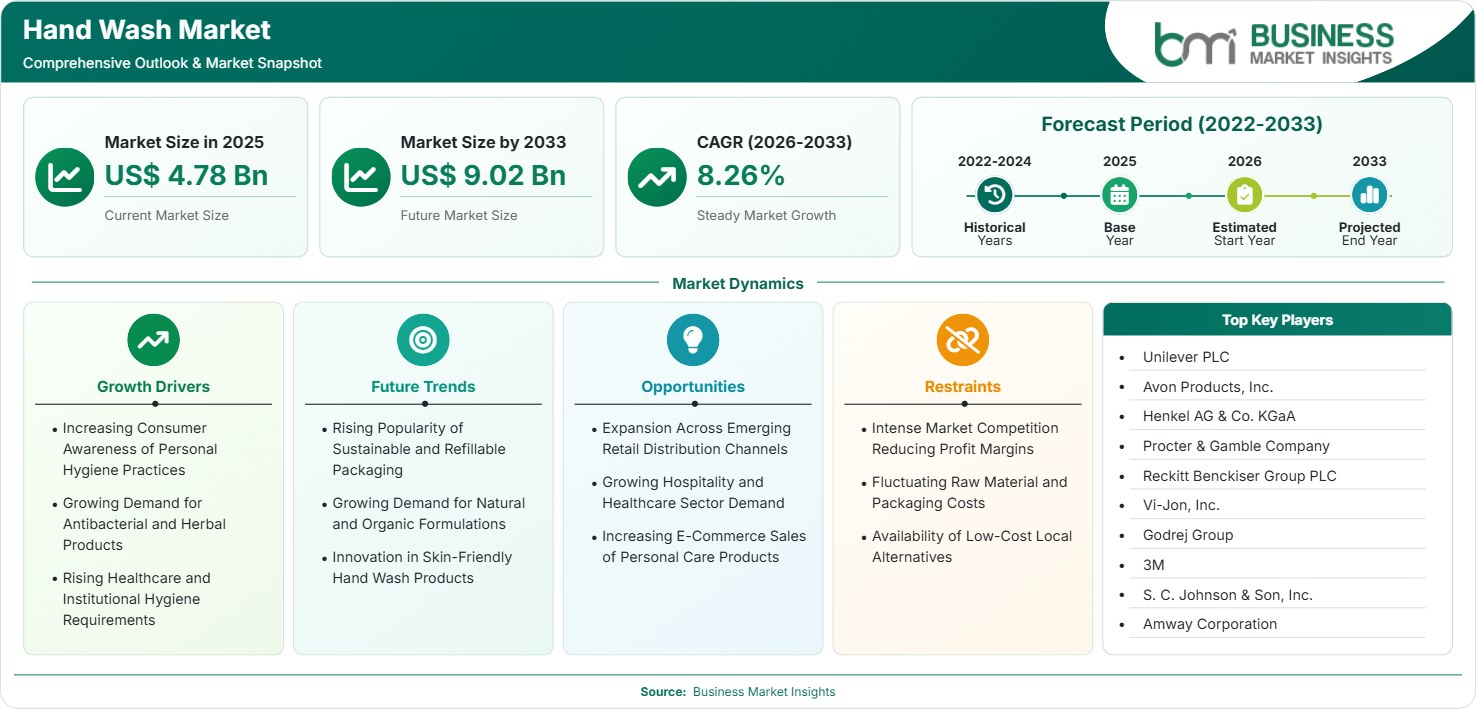
The Hand Wash Market size was valued at US$ 4.78 Billion in 2025 and is projected to reach US$ 9.02 Billion by 2033, growing at a CAGR of USD 8.26% during 2026–2033, driven by hygiene awareness, antibacterial formulations, healthcare demand, and expanding digital retail opportunities.

Report Coverage
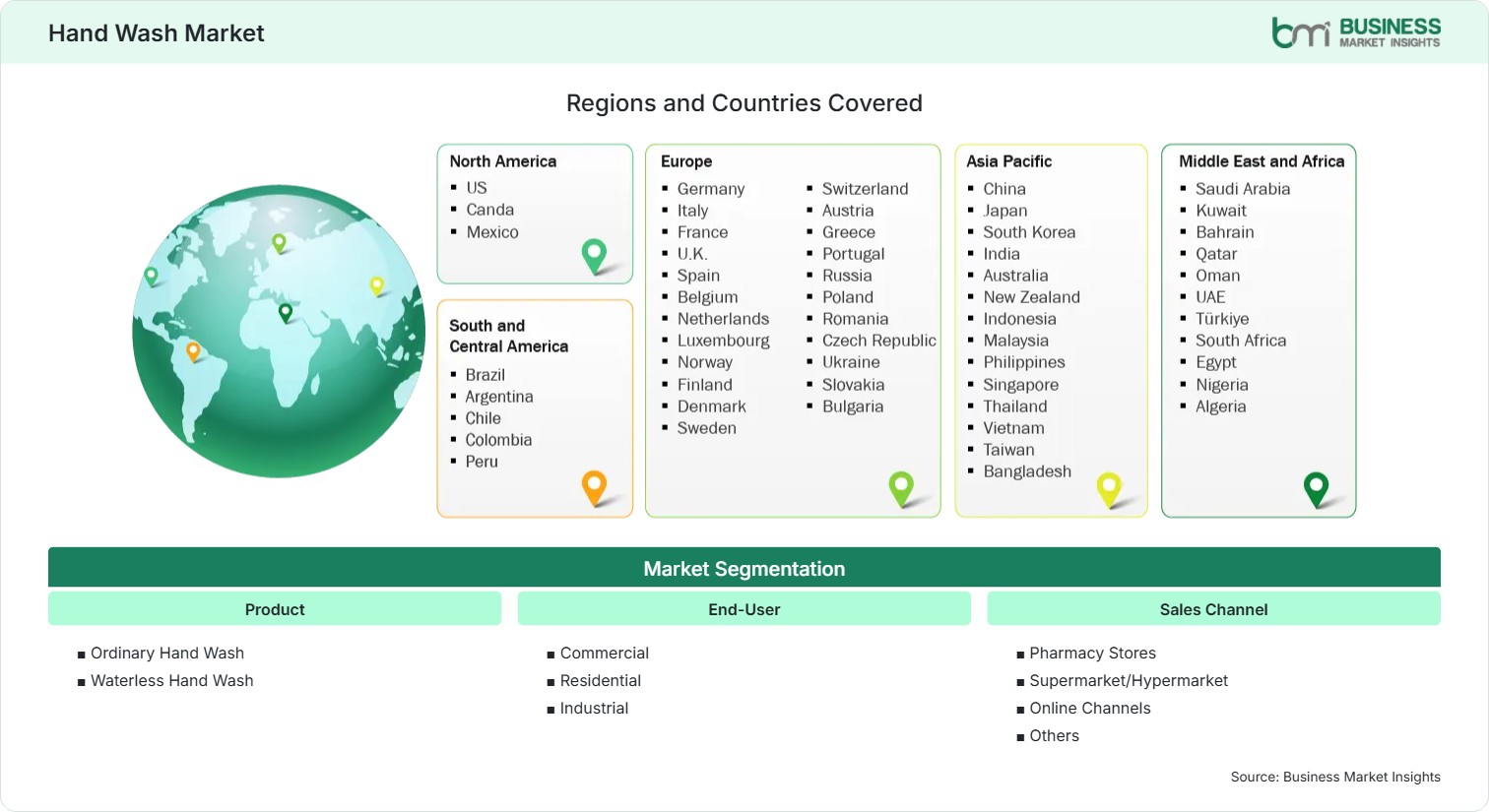
  • Product: Ordinary Hand Wash, Waterless Hand Wash
  • End-User: Commercial, Residential, Industrial
  • Sales Channel: Pharmacy Stores, Supermarket/Hypermarket, Online Channels, Others
US$ 4.78 Bn Market size in 2025
US$ 9.02 Bn Market Size by 2033
8.26% CAGR, 2026 - 2033
2026-2033 Forecast Period

01 AI Overview

Hand Wash Market Summary

  • North America Region: North America holds a market share of 32%–35% in 2025, growing with a CAGR of 7.6%–8.0% due to hygiene regulations, healthcare usage, premium products, and institutional demand. The US market expands with a CAGR of 7.8%–8.2% from 2026–2033 through strong consumer adoption.
  • Fastest Growing Region: Asia Pacific maintains a market share of 30%–33% in 2025, advancing with a CAGR of 8.8%–9.3% supported by urbanization, rising disposable income, hygiene education programs, and increasing penetration of personal care products across developing economies.
  • Leading Segment: Residential end-user applications represent a market share of 45%–48% in 2025, progressing with a CAGR of 8.0%–8.4% due to household hygiene practices, consumer awareness, frequent usage patterns, and increased availability of affordable formulations.
  • High Growth Segment: Online channels account for a market share of 18%–21% in 2025, growing at a CAGR of 10.0%–10.5% driven by digital purchasing convenience, subscription models, broader product selection, and expanding e-commerce infrastructure.
  • Key Market Opportunity: Manufacturers can capitalize on sustainable packaging, herbal formulations, smart dispensing technologies, and emerging market expansion by targeting healthcare, hospitality, residential, and digital commerce applications.
  • Major Market Players: Unilever PLC, Avon Products, Inc., Henkel AG & Co. KGaA, Procter & Gamble Company, Reckitt Benckiser Group PLC, Vi-Jon, Inc., Godrej Group, 3M, S. C. Johnson & Son, Inc., and Amway Corporation.
02 Strategic Insights

Hand Wash Market: Strategic Insights

Hand Wash Market Strategic Framework
FREE PDF
Request your free sample
Request free sample
03 Stakeholder View

Key Takeaways

  • The supply chain structure is becoming increasingly integrated, with manufacturers focusing on ingredient sourcing, packaging optimization, and distribution partnerships to improve efficiency and maintain consistent product availability across global markets.
  • Commercial and residential applications present strong growth potential as organizations, households, and institutions prioritize frequent hand hygiene practices, creating opportunities for innovative formulations and application-specific product development.
  • Product innovation is shifting toward alcohol-free alternatives, herbal ingredients, biodegradable packaging, and advanced moisturizing technologies that address consumer expectations for effective yet skin-friendly hygiene solutions.
  • Asia Pacific offers attractive investment potential due to expanding middle-class populations, increasing healthcare awareness, and rapid growth of modern retail channels in countries including India, China, and Southeast Asian economies.
  • Strategic partnerships, portfolio expansion, and acquisitions are shaping competitive positioning as established consumer goods companies strengthen their presence across personal care categories and emerging hygiene product segments.
  • Digital transformation is influencing purchasing behavior through online subscriptions, targeted marketing, and direct-to-consumer models, enabling brands to reach consumers with personalized hygiene solutions.
    04 Geographic Outlook

    Hand Wash Market Regional Highlights

    North America Hand Wash Market

    North America accounted for a market share of 32%–35% in 2025 and is projected to expand at a CAGR of 7.6%–8.0% during 2026–2033. The region benefits from established personal care brands, healthcare hygiene standards, and strong consumer preference for premium products. The Hand Wash Market share remains supported by commercial facilities, households, and institutional adoption across the United States and Canada.

    • Rising demand for antibacterial and moisturizing formulations is encouraging manufacturers to introduce premium products designed for frequent consumer usage and enhanced skin protection across North American households.
    • Healthcare facilities, food service organizations, and workplaces are increasing hygiene product procurement, supporting consistent demand through institutional purchasing agreements and professional hygiene management programs.
    • Sustainable packaging initiatives and recyclable containers are gaining traction as consumers and retailers prioritize environmentally responsible personal care products with reduced ecological impact.
    • Digital retail expansion is improving accessibility of specialized hand wash products through subscription services, online marketplaces, and direct brand purchasing platforms.

    US Hand Wash Market

    The US Hand Wash Market represented a share of 27%–30% in 2025, expanding at a CAGR of 7.8%–8.2% between 2026–2033. Strong brand presence, advanced retail infrastructure, and increasing workplace hygiene requirements support market development. The country remains a major contributor due to high consumer spending on personal care products and continuous innovation in formulations.

    • Consumer preference for premium hand hygiene products with natural ingredients, fragrances, and skin conditioning benefits continues influencing product launches across major retail channels.
    • Healthcare institutions and commercial establishments are maintaining elevated hygiene practices, creating stable demand for bulk dispensers and professional cleaning solutions.
    • Online purchasing adoption is accelerating through convenience-driven shopping behavior, enabling brands to expand product visibility and improve consumer engagement.

    Europe Hand Wash Market

    Europe captured a market share of 24%–27% in 2025 and is expected to grow at a CAGR of 7.2%–7.6% during 2026–2033. The region demonstrates strong demand for sustainable personal care products, regulatory compliance, and environmentally responsible packaging. Germany and the United Kingdom remain leading markets, while France and Italy provide additional growth opportunities through premium hygiene product adoption.

    • Germany demonstrates steady expansion with a CAGR of 7.4%–7.8% supported by sustainable product demand, advanced retail networks, and strong consumer awareness regarding hygiene standards.
    • The United Kingdom maintains market momentum through healthcare investments, hospitality sector requirements, and increased preference for convenient personal care solutions.
    • France and Italy are experiencing rising adoption of botanical and premium formulations as consumers seek differentiated products with enhanced wellness benefits.
    • European regulations promoting ingredient transparency and sustainable packaging are encouraging manufacturers to redesign products and improve environmental performance.

    Asia Pacific Hand Wash Market

    Asia Pacific held a market share of 30%–33% in 2025 and is forecast to record a CAGR of 8.8%–9.3% from 2026–2033. The region represents the fastest-growing market due to urbanization, improving hygiene awareness, expanding retail infrastructure, and rising disposable incomes. China and India remain major contributors, with Southeast Asian countries supporting additional growth.

    • China is advancing with a CAGR of 8.5%–8.9% due to strong e-commerce penetration, domestic personal care manufacturing, and increasing household hygiene awareness.
    • India shows higher growth potential with a CAGR of 9.2%–9.6% supported by public hygiene campaigns, expanding middle-class consumers, and broader retail availability.
    • Southeast Asian economies are adopting modern hygiene products through supermarkets, pharmacies, and digital platforms, improving access across urban and semi-urban populations.
    • Manufacturers are increasing investments in localized formulations and affordable packaging formats to address diverse consumer preferences across developing markets.
    • Healthcare infrastructure expansion across Asia Pacific is supporting institutional demand for reliable hand hygiene products in hospitals and public facilities.

    Rest of World Hand Wash Market

    Rest of World Hand Wash Market accounted for a market share of 8%–11% in 2025 and is projected to grow at a CAGR of 7.5%–7.9% between 2026–2033. South and Central America are benefiting from improving retail penetration, while Middle East and Africa markets are supported by healthcare development and hygiene initiatives. Brazil, Saudi Arabia, and the UAE represent important growth markets.

    Latin American markets are adopting branded personal care products through supermarkets and online channels, while Middle Eastern countries are increasing institutional hygiene investments across healthcare, hospitality, and commercial sectors.

    • Brazil is expanding at a CAGR of 7.6%–8.0% due to urban consumer demand, personal care awareness, and increasing modern retail availability.
    • Saudi Arabia demonstrates growth with a CAGR of 8.0%–8.4% supported by healthcare investments, hospitality expansion, and government hygiene programs.
    • Middle Eastern markets are increasing demand for premium hand wash products through hotels, offices, and healthcare facilities.
    • African markets are gradually improving product accessibility through pharmacy networks, local distribution partnerships, and affordable hygiene solutions.
    • Regional manufacturers are exploring cost-effective formulations and localized packaging strategies to address diverse economic conditions and consumer requirements.
    Global Market Geography
    FREE PDF
    Request your free sample
    Request free sample
    05 Segment Analysis

    Hand Wash Market Segmentation

    Product

    The product segment remains a critical component of the Hand Wash Market scope, with formulations evolving around convenience, skin protection, and specialized hygiene requirements. The segment accounted for a combined market share of 100% in 2025 and is projected to expand with a CAGR of 8.2% between 2026–2033, supported by innovation, consumer preferences, and rising hygiene standards across applications.

    • Ordinary Hand Wash: This segment maintains broad consumer adoption due to affordability, easy availability, and extensive usage across residential and commercial environments requiring regular hygiene practices.
    • Waterless Hand Wash: Demand is increasing due to portability, convenience, and suitability for locations with limited water access, including transportation, workplaces, and outdoor activities.

    End-User

    The end-user segment demonstrates diversified adoption across households, businesses, and industrial facilities requiring effective hygiene management. The segment accounted for a combined market share of 100% in 2025, with growth supported by institutional hygiene programs, workplace safety requirements, and consumer awareness. Increasing demand across multiple applications is strengthening product development strategies and distribution expansion globally.

    • Commercial: Commercial users drive demand through offices, hospitality facilities, educational institutions, and healthcare environments requiring consistent hand hygiene solutions and bulk procurement options.
    • Residential: Residential adoption remains strong due to increased awareness of personal hygiene, frequent household usage, and expanding availability of affordable products through retail channels.
    • Industrial: Industrial applications require specialized hygiene products for manufacturing, food processing, and workplace safety environments with strict cleanliness standards and operational requirements.

    Sales Channel

    Sales channels are transforming due to digital purchasing behavior, retail expansion, and improved consumer accessibility. The segment accounted for a combined market share of 100% in 2025, while online platforms demonstrate accelerated development due to convenience, wider product selection, and direct brand engagement. Distribution strategies continue evolving as manufacturers balance physical retail presence with digital commerce opportunities.

    • Pharmacy Stores: Pharmacies remain important distribution points due to consumer trust, healthcare associations, and availability of specialized hygiene products recommended for sensitive skin applications.
    • Supermarket/Hypermarket: Supermarkets and hypermarkets support high-volume purchases through strong visibility, promotional activities, and broad accessibility for household and commercial consumers.
    • Online Channels: Online channels are expanding through e-commerce platforms, subscription models, and direct-to-consumer strategies that improve convenience and product discovery.
    06 Market Forces

    Hand Wash Market Dynamics

    Key Market Drivers

    Increasing Consumer Awareness of Personal Hygiene Practices

    Rising consumer awareness regarding hygiene procedures is boosting the demand since individuals in their households or offices focus on establishing proper hand cleansing habits. The global health bodies like the WHO are continuing to advocate for proper hand hygiene practice as one of the important methods of disease prevention. Factors such as consumer education, urban living, and availability of personal care products are fueling the growth of the market. The Hand Wash Market trends include preferences for easy-to-use and gentle formulations.

    Growing Demand for Antibacterial and Herbal Products

    Consumers have started favoring antibacterial, herbal, and natural formulations owing to the growing inclination towards wellness-related personal care products. Brands have started incorporating products that contain plant extracts, essential oils, and skin conditioning agents in order to distinguish their products. The trend of opting for cleaner ingredients is driving the innovations and marketing strategies of the brands globally. The growing preference for specialized formulations is driving the launch of high-end products, whereas herbs are attracting those consumers who want to go easy on themselves when it comes to hygiene.

    Rising Healthcare and Institutional Hygiene Requirements

    The increased emphasis on hygiene in healthcare facilities, labs, food processing industries, and commercial companies is leading to an increase in the use of hand washing agents. The Hand Wash Market need for effective hygiene products that are safe to use and can be used in workplace hygiene programs has become common among institutional customers. The development of new healthcare infrastructure in developing countries is helping to generate future demand. Hospitals and commercial firms are using bulk dispensing systems, thus necessitating efficient packaging by manufacturers.

    Key Market Opportunities

    Expansion Across Emerging Retail Distribution Channels

    The development of retail infrastructure in the emerging economy is opening doors for the manufacturers to enhance the availability and penetration of the brands. The increasing retail network through supermarket, pharmacies, and convenience stores is helping in reaching consumers better especially in developing urban markets. There is a focus on making product availability easy by using affordable packages, localizing the products, and establishing regional distribution partners. As per the estimates of Hand Wash Market Forecasts, retailers with logistics and inventory management systems can help in quick market expansion. Increased investments in organized retail channels are facilitating brands to launch their premium hygiene products among consumers.

    Growing Hospitality and Healthcare Sector Demand

    The hospitality and health care industries provide major growth opportunities because of the growing demand for hygiene in hotels, hospitals, clinics, and institutional facilities. Health care organizations need reliable hand sanitizers to ensure their infection control practices, whereas hotel operators are concerned about safety and the quality of services for their guests. Growing investments in the health care industry in developing nations and the development of tourism infrastructure are driving manufacturers to create professional solutions for dispensers that can be used in these industries.

    Increasing E-Commerce Sales of Personal Care Products

    Digital commerce is offering new possibilities for growth as customers purchase personal care products from e-commerce sites. Through e-commerce, it becomes easier for manufacturers to target more customers, use the subscription-based buying model, and develop new products without relying completely on physical distribution channels. The brands have been developing digital solutions in order to enhance customer interaction. Hand Wash Market growth in online sales is especially important among the younger generation that likes easy access to products. The further development of mobile commerce and better logistics infrastructure in emerging economies will help in growing online hygiene product purchases.

    Market Restraints and Challenges

    Intense Market Competition Reducing Profit Margins

    Factor: High competition among multinational corporations, regional manufacturers, and private-label brands increases pricing pressure within the personal care industry. Impact: Inflexible pricing may adversely impact the margins of the manufacturers and reduce their capacity to invest in innovations related to marketing, distribution, and development of new products. Big firms use their brands as their means of competing, while small firms use their cost advantage to compete. The fact that there are many product variations including regular, antibacterial, herbal, and luxury segments contributes to market segmentation.

    Fluctuating Raw Material and Packaging Costs

    Factor: Changes in prices of surfactants, fragrances, chemicals, plastics, and packaging materials create uncertainty in production expenses. Impact: High cost of inputs is capable of raising the prices of goods, managing the supply chain processes and impacting consumers' buying behaviors. Organizations that rely on petroleum based raw materials and plastic packaging have been further impacted by the changes in commodity prices. Some firms have adopted alternative sources of ingredients, packaging strategies, and use of recycled materials in order to address the issue. The cost variability continues to be a problem for pricing stability.

    07 Company Analysis

    Competitive Landscape

    The Hand Wash Market analysis reflects a competitive environment driven by multinational consumer goods companies, hygiene solution providers, and personal care specialists. Leading participants are focusing on product innovation, sustainable packaging, premium formulations, and expanded distribution networks. Competitive strategies include antibacterial product development, herbal ingredient integration, digital commerce expansion, and partnerships with commercial institutions to strengthen market presence.

    Company Name

    Overview

    Products and Services relevant to this market

    Unilever PLC

    Global consumer goods company offering personal care and hygiene products across worldwide markets.

    Hand wash products, antibacterial solutions, liquid soaps, and sustainable hygiene brands.

    Avon Products, Inc.

    Beauty and personal care company serving consumers through direct selling channels.

    Hand care products, personal hygiene solutions, and personal care formulations.

    Henkel AG & Co. KGaA

    International manufacturer providing consumer and industrial hygiene solutions.

    Hand wash products, cleaning solutions, adhesives, and hygiene technologies.

    Procter & Gamble Company

    Global consumer goods company with extensive personal care product portfolios.

    Hand washes, hygiene products, personal care brands, and consumer solutions.

    Reckitt Benckiser Group PLC

    Health and hygiene company specializing in consumer wellness products.

    Antibacterial hand washes, hygiene brands, and infection prevention solutions.

    Vi-Jon, Inc.

    Personal care manufacturer producing health and hygiene products.

    Liquid hand soaps, sanitizers, and personal care manufacturing services.

    Godrej Group

    Indian diversified company with strong consumer products presence.

    Hand wash products, personal care solutions, and hygiene offerings.

    3M

    Technology company providing healthcare and hygiene-related solutions.

    Hand hygiene products, professional solutions, and workplace safety products.

    S. C. Johnson & Son, Inc.

    Family-owned consumer products company serving global markets.

    Hygiene products, cleaning solutions, and consumer care formulations.

    Amway Corporation

    Direct-selling company offering health and personal care products.


    10 Trust & Transparency

    Research Methodology

    The market analysis combines proprietary research with secondary data from government agencies, company disclosures, regulatory filings, industry databases and expert interviews. Market estimates are validated through data triangulation, cross-market benchmarking and analyst review.

    View Full Research Methodology

    11 Questions Answered

    Frequently Asked Questions

    What information does the Hand Wash Market Report provide?

    The market report covers industry trends, market segmentation, regional analysis, competitive landscape, growth factors, challenges, opportunities, and strategic insights for stakeholders evaluating market developments.

    What role do institutional buyers play in market development?

    Hospitals, offices, hotels, educational facilities, and industrial organizations create consistent demand through bulk purchasing requirements and hygiene management programs that support recurring product consumption.

    Why are online channels becoming important for hygiene product sales?

    Online platforms provide wider product availability, convenient purchasing, subscription options, direct brand communication, and access to specialized products that may not be available through traditional retail stores.

    How are manufacturers improving hand wash product differentiation?

    Companies are developing herbal formulations, fragrance variations, premium packaging, and targeted solutions for sensitive skin, healthcare environments, and commercial applications to improve product positioning.

    What factors are influencing consumer preferences in the hand wash industry?

    Consumers are increasingly prioritizing products with skin-friendly ingredients, natural formulations, sustainable packaging, and specialized benefits such as antibacterial protection and moisturizing properties.

    Access the Full Hand Wash Market Report

    Get segment-level forecasts, regional estimates, competitive benchmarking, company profiles and downloadable Excel datasets.

    Access the full Hand Wash Market Report
    350 pages PDF & Excel | 2026-08-05