Agricultural Testing Market Outlook (2022-2033)

Historic Data: 2022-2024   |   Base Year: 2025   |   Forecast Period: 2026-2033
Report Content: Market Scope, Market Segmentation, Market Dynamics, and Competitive Analysis

Report Coverage:
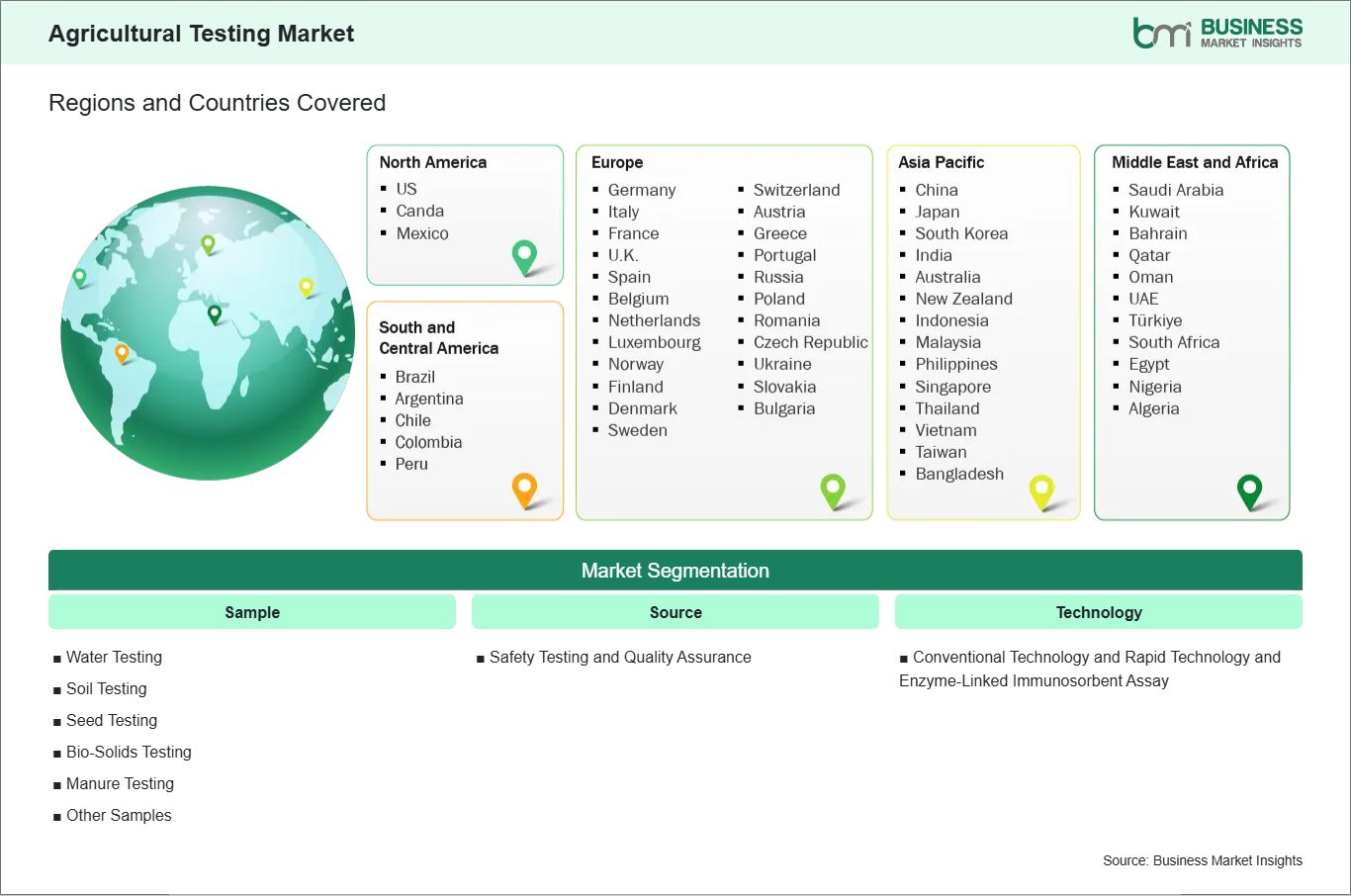
  • Sample (Water Testing, Soil Testing, Seed Testing, Bio-Solids Testing, Manure Testing, and Other Samples)
  • Source (Safety Testing (Toxins, Pathogens, Heavy Metals, Pesticides, and Other Safety Testing), Quality Assurance)
  • Technology (Conventional Technology, Rapid Technology (Spectrometry and Chromatography, Polymerase Chain Reaction (PCR)), Enzyme-Linked Immunosorbent Assay (ELISA))

No. of Pages: 400
Report Code: BMIPUB00033398
Category: Consumer Goods
Agricultural Testing Market
Buy Now

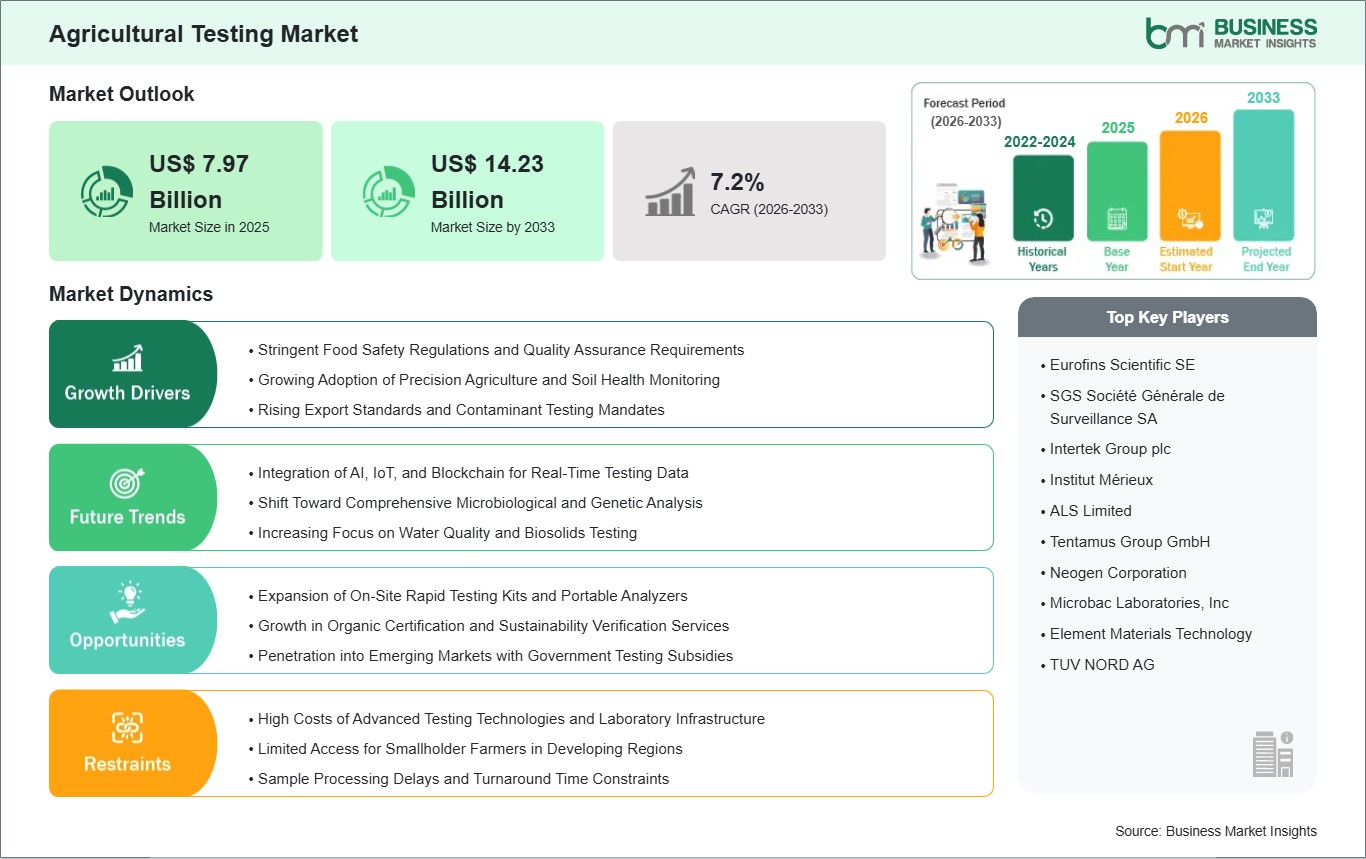
The agricultural testing market size is expected to reach US$ 14.23 billion by 2033 from US$ 7.97 billion in 2025. The market is estimated to record a CAGR of 7.2% from 2026 to 2033.

Executive Summary and Global Market Analysis:

Agricultural testing has become a foundational component of modern farming and food production, serving as a critical tool for ensuring crop safety, maintaining soil health, and supporting sustainable yield enhancement across multiple end‑use sectors. Its core applications include soil analysis, water quality assessment, pesticide and fertilizer residue testing, and comprehensive crop quality evaluation. As a key pillar of precision agriculture, agricultural testing enables optimized resource utilization and improved soil fertility. By providing accurate insights into nutrient availability, irrigation needs, and pest or disease risks, testing empowers growers to make data‑driven decisions that improve productivity and reduce ecological impact. In food processing and agribusiness, these testing services are vital for meeting stringent safety regulations and delivering consistent, high‑quality outputs. Within livestock and horticulture, they play an important role in feed quality assessment, disease monitoring, and sustainable water management, ensuring operational efficiency and reliability. The value proposition of agricultural testing lies in its ability to deliver timely, actionable data that supports advanced analytical techniques, strengthens resource management, and enables tailored interventions aligned with specific crop, soil, and environmental conditions. Market growth is being driven by rising global demand for premium‑quality food, the expansion of the agribusiness sector, and the worldwide emphasis on sustainable and climate‑resilient agriculture. Additional momentum comes from advancements in rapid diagnostic kits, molecular testing technologies, and innovative solutions designed to promote environmentally conscious farming. These developments position agricultural testing as an essential enabler of high‑yield, sustainable agricultural systems.

Despite its strong growth outlook, the agricultural testing market faces several structural challenges. High costs associated with testing equipment, reagents, and advanced diagnostic platforms can limit adoption, especially among smallholder farmers. Limited awareness, the need for skilled personnel to interpret results, and strict compliance requirements further constrain market penetration. Regulatory complexities surrounding food safety and agrochemical usage, along with substantial capital investment required for state-of-the-art testing facilities, also contribute to slower adoption rates in resource-constrained regions. Additionally, the lack of standardized testing protocols across regions can lead to inconsistency in results, complicating operations for laboratories and service providers and hindering uniform quality assurance. Despite these hurdles, the market’s long‑term prospects remain highly favorable. Growing adoption of precision agriculture, increased integration of IoT‑enabled sensors, remote diagnostics, and AI‑driven testing platforms are expected to significantly enhance efficiency and accessibility. Rising consumer demand for sustainable, safe, and traceable food will continue to propel investments in advanced agricultural testing services.

Agricultural Testing Market - Strategic Insights:

global-market-strategic-framework
Get more information on this report

Agricultural Testing Market Segmentation Analysis:

Key segments that contributed to the derivation of the agricultural testing market analysis are sample, source, and technology.

  • By sample, the agricultural testing market is segmented into water testing, soil testing, seed testing, bio-solids testing, manure testing, and other samples. The water testing segment dominated the market in 2025.
  • By source, the market is divided into safety testing and quality assurance. The safety testing segment dominated the market in 2025.
  • By technology, the agricultural testing market is categorized into conventional technology and rapid technology, and enzyme-linked immunosorbent assay (ELISA). The conventional technology and rapid technology segments held the largest share of the market in 2025.

Agricultural Testing Market Drivers and Opportunities:

Expanding Demand for Precision Agriculture and Soil Testing

Precision agriculture and advanced soil testing are gaining widespread adoption as they enable higher crop productivity, more efficient resource utilization, and improved environmental sustainability. These technologies are increasingly being integrated across agriculture, horticulture, animal husbandry, and agribusiness operations due to their ability to deliver accurate, data‑driven insights. Rising industry priorities—such as optimized nutrient management, water conservation, and effective pest control—are accelerating the shift away from traditional, less precise farming methods toward comprehensive soil, water, and crop testing services. At the same time, heightened global attention to food safety and quality assurance is driving demand for robust testing solutions, including pesticide residue analysis, microbial assessments, and crop‑health monitoring. In horticulture and controlled‑environment agriculture, soil and plant testing play a pivotal role in fine‑tuning nutrient levels and maximizing productivity, supported by the reliability and consistency of analytical results. Furthermore, the rapid expansion of agribusiness and commercial farming in developing economies is creating a strong need for precise, scalable testing capabilities across various production segments. As farmers and agribusinesses increasingly prioritize efficiency, sustainability, and yield optimization, agricultural testing continues to gain momentum as a critical enabler of modern, high‑performance farming systems.

Development of Rapid and Environmentally Friendly Testing Solutions

Agricultural testing has traditionally relied on lengthy, resource‑intensive procedures that require significant use of chemical reagents, creating both environmental and operational challenges. As global sustainability standards tighten and farms and agribusinesses increasingly prioritize reduced chemical usage and water conservation, there is growing demand for rapid, low‑impact, and eco‑friendly testing methodologies. Emerging technologies—such as molecular diagnostics, digital testing platforms, and portable field kits—are gaining prominence as viable alternatives. These solutions deliver faster results, reduce environmental footprint, and maintain the high accuracy needed for data‑driven decision‑making. This shift aligns closely with the expanding adoption of precision agriculture, data‑centric farming practices, and sustainable land‑management approaches across crop production and livestock operations. Large farms and commercial agricultural enterprises are becoming more willing to invest in modern testing solutions to strengthen sustainability initiatives, meet regulatory requirements, and enhance operational efficiency. Innovations in biosensors, IoT‑enabled testing devices, and automated laboratory systems are improving scalability, reducing costs, and simplifying use—making widespread adoption increasingly feasible. Organizations that invest in advanced agricultural testing technologies and strategic partnerships will be best positioned to secure a competitive advantage, capture high‑value market segments, and build long‑term resilience in an agriculture sector that places growing emphasis on sustainability, operational efficiency, and informed decision‑making.

Agricultural Testing Market Size and Share Analysis:

The Agricultural Testing market demonstrates steady growth, with size and share analysis revealing evolving trends and competitive positioning among key players. The report further examines subsegments categorized within sample, source, and technology, offering insights into their contribution to overall market performance.

Based on the sample, the water testing segment dominates the agricultural testing market. Water testing provides high accuracy, stability of analysis, and reliable operation. Therefore, it is a vital service in evaluating the quality of the irrigation water, its nutrients, salinity, and the existence of contaminants. Its effectiveness in sustaining massive agricultural productivity as well as in ensuring safety and sustainability has made it the choice testing segment among farmers, agribusinesses, and commercial growers in crop cultivation, horticulture, livestock management, and greenhouse farming systems.

Agricultural Testing Market Report Highlights:

Report Attribute Details
Market size in 2025 US$ 7.97 Billion
Market Size by 2033 US$ 14.23 Billion
Global CAGR (2026 - 2033)7.2%
Historical Data 2022-2024
Forecast period 2026-2033
Segments Covered By Sample
  • Water Testing
  • Soil Testing
  • Seed Testing
  • Bio-Solids Testing
  • Manure Testing
  • Other Samples
By Source
  • Safety Testing
  • Quality Assurance
By Technology
  • Conventional Technology
  • Rapid Technology
  • Enzyme-Linked Immunosorbent Assay
Regions and Countries Covered North America
  • US
  • Canada
  • Mexico
Europe
  • Belgium
  • Austria
  • Finland
  • Denmark
  • Greece
  • Poland
  • Romania
  • Russia
  • Ukraine
  • Czech Republic
  • Slovakia
  • Bulgaria
  • Italy
  • Luxembourg
  • Germany
  • Switzerland
  • France
  • Netherlands
  • Norway
  • Portugal
  • Spain
  • Sweden
  • United Kingdom
Asia-Pacific
  • Australia
  • China
  • India
  • Japan
  • South Korea
  • Indonesia
  • Malaysia
  • Philippines
  • Singapore
  • Thailand
  • Vietnam
  • Bangladesh
  • New Zealand
  • Taiwan
South and Central America
  • Brazil
  • Argentina
  • Peru
  • Chile
  • Colombia
Middle East and Africa
  • Bahrain
  • Kuwait
  • Oman
  • Qatar
  • Saudi Arabia
  • United Arab Emirates
  • Turkiye
  • South Africa
  • Egypt
  • Algeria
  • Nigeria
Market leaders and key company profiles
  • Eurofins Scientific SE\r\n
  • SGS Société Générale de Surveillance SA\r\n
  • Intertek Group plc\r\n
  • Institut Mérieux \r\n
  • ALS Limited\r\n
  • Tentamus Group GmbH\r\n
  • Neogen Corporation\r\n
  • Microbac Laboratories, Inc\r\n
  • Element Materials Technology\r\n
Get more information on this report

Agricultural Testing Market Report Coverage and Deliverables:

The " Agricultural Testing Market Size and Forecast (2022–2033)" report provides a detailed analysis of the market covering below areas:

  • Agricultural Testing market size and forecast at global, regional, and country levels for all the key market segments covered under the scope
  • Agricultural Testing market trends, as well as market dynamics such as drivers, restraints, and key opportunities
  • Agricultural Testing market analysis covering key market trends, global and regional framework, major players, regulations, and recent market developments
  • Industry landscape and competition analysis covering market concentration, heat map analysis, prominent players, and recent developments for the agricultural testing market
  • Detailed company profiles, including SWOT analysis

Agricultural Testing Market Geographic Insights:

The geographical scope of the Agricultural Testing market report is divided into five regions: North America, Asia Pacific, Europe, the Middle East & Africa, and South & Central America.

The Asia Pacific Agricultural Testing Market is segmented into China, Japan, South Korea, India, Australia, New Zealand, Indonesia, Malaysia, the Philippines, Singapore, Thailand, Vietnam, Taiwan, Bangladesh, and the Rest of the Asia Pacific. Asia Pacific has shown high growth in major fields of agriculture such as crop production, horticulture, livestock production, aquaculture, and agribusiness, making the region a key destination for the agricultural testing market. The market growth can also be reinforced by the increased need to have food safety guarantees, precision agriculture, and sophisticated testing technology that can ensure the achievement of high yields, resource optimization, and crop quality.

The region’s expanding population, growing commercial agriculture sector, and heightened emphasis on sustainable farming and regulatory compliance are driving strong adoption of agricultural testing services. Together, these factors reinforce the region’s strategic importance within the global agricultural testing value chain and position it as one of the market’s most significant demand centers.

global-market-geography
Get more information on this report

Agricultural Testing Market Research Report Guidance:

  • The report includes qualitative and quantitative data in the Agricultural Testing market across sample, source, technology, and geography.
  • The report starts with the key takeaways (chapter 2), highlighting the key trends and outlook of the Agricultural Testing market.
  • Chapter 3 includes the research methodology of the study.
  • Chapter 4 further includes ecosystem analysis.
  • Chapter 5 highlights the major industry dynamics in the Agricultural Testing market, including factors that are driving the market, prevailing deterrents, potential opportunities, as well as future trends. Impact analysis of these drivers and restraints is also covered in this section.
  • Chapter 6 discusses the Agricultural Testing market scenario, in terms of historical market revenues, and forecast till the year 2033.
  • Chapters 7 to 10 cover the Agricultural Testing market segments by sample, source, technology, and geography across North America, Europe, Asia Pacific, Middle East and Africa, and South and Central America. They cover the market revenue, forecast, and factors driving the market.
  • Chapter 11 describes the competitive analysis along with the heat map analysis for the key players operating in the market.
  • Chapter 12 describes the industry landscape analysis. It provides detailed descriptions of business activities such as market initiatives, new developments, mergers, and joint ventures globally, along with a competitive landscape.
  • Chapter 13 provides detailed profiles of the major companies operating in the Agricultural Testing market. Companies have been profiled on the basis of their key facts, business descriptions, products and services, financial overview, SWOT analysis, and key developments.
  • Chapter 14, i.e., the appendix, is inclusive of a brief overview of the company, a list of abbreviations, and a disclaimer.

Agricultural Testing Market News and Key Development:

  • In November 2025, Kazakhstan launched its first carbon agro-climatic testing ground, Kaz Agro Carbon, at the A.I. Barayev Scientific and Production Center for Grain Farming. This initiative represents a significant advancement towards climate-resilient agriculture, involving collaboration between the agriculture ministries of Kazakhstan and Russia, the National Academy of Sciences of Kazakhstan, and scientists from the University of Hannover in Germany.
  • In September 2025, FarmLab expanded its soil-measurement capabilities beyond agriculture through the acquisition of Ziltek, an Australian company known for its portable soil scanner, RemScan. This acquisition allows FarmLab to enhance its carbon measurement tools and broaden its customer base and applications for its technology, as stated by cofounder and CEO Sam Duncan.

Key Sources Referred:

  • World Bank – Global Trade Indicators
  • European Chemicals Agency
  • International Council of Chemical Associations
  • International Monetary Fund (IMF)
  • World Trade Organization (WTO)
  • International Trade Administration (ITA)
  • Company Websites
  • Company Annual Reports
  • Company Investor Presentations

The List of Companies - Agricultural Testing Market

Frequently Asked Questions
How big is the Agricultural Testing Market?

The Agricultural Testing Market is valued at US$ 7.97 Billion in 2025, it is projected to reach US$ 14.23 Billion by 2033.

What is the CAGR for Agricultural Testing Market by (2026 - 2033)?

As per our report Agricultural Testing Market, the market size is valued at US$ 7.97 Billion in 2025, projecting it to reach US$ 14.23 Billion by 2033. This translates to a CAGR of approximately 7.2% during the forecast period.

What segments are covered in this report?

The Agricultural Testing Market report typically cover these key segments-

  • Sample (Water Testing, Soil Testing, Seed Testing, Bio-Solids Testing, Manure Testing, and Other Samples)
  • Source (Safety Testing (Toxins, Pathogens, Heavy Metals, Pesticides, and Other Safety Testing), Quality Assurance)
  • Technology (Conventional Technology, Rapid Technology (Spectrometry and Chromatography, Polymerase Chain Reaction (PCR)), Enzyme-Linked Immunosorbent Assay (ELISA))

What is the historic period, base year, and forecast period taken for Agricultural Testing Market?

The historic period, base year, and forecast period can vary slightly depending on the specific market research report. However, for the Agricultural Testing Market report:

  • Historic Period : 2022-2024
  • Base Year : 2025
  • Forecast Period : 2026-2033
  • Who are the major players in Agricultural Testing Market?

    The Agricultural Testing Market is populated by several key players, each contributing to its growth and innovation. Some of the major players include:

  • Eurofins Scientific SE\r\n
  • SGS Société Générale de Surveillance SA\r\n
  • Intertek Group plc\r\n
  • Institut Mérieux \r\n
  • ALS Limited\r\n
  • Tentamus Group GmbH\r\n
  • Neogen Corporation\r\n
  • Microbac Laboratories, Inc\r\n
  • Element Materials Technology\r\n
  • TUV NORD AG
  • Who should buy this report?

    The Agricultural Testing Market report is valuable for diverse stakeholders, including:

    • Investors: Provides insights for investment decisions pertaining to market growth, companies, or industry insights. Helps assess market attractiveness and potential returns.
    • Industry Players: Offers competitive intelligence, market sizing, and trend analysis to inform strategic planning, product development, and sales strategies.
    • Suppliers and Manufacturers: Helps understand market demand for components, materials, and services related to concerned industry.
    • Researchers and Consultants: Provides data and analysis for academic research, consulting projects, and market studies.
    • Financial Institutions: Helps assess risks and opportunities associated with financing or investing in the concerned market.

    Essentially, anyone involved in or considering involvement in the Agricultural Testing Market value chain can benefit from the information contained in a comprehensive market report.

    Available Report Formats

    pdf-format excel-format pptx-format
    Buy Now

    Customization Form

    Please tell us your area of interest
    (Market Segments/ Regions and Countries/ Companies)