
Accent Furniture Market Outlook: Size, Share, Trends, Growth Analysis, Competitive Landscape & Forecast, 2026-2033

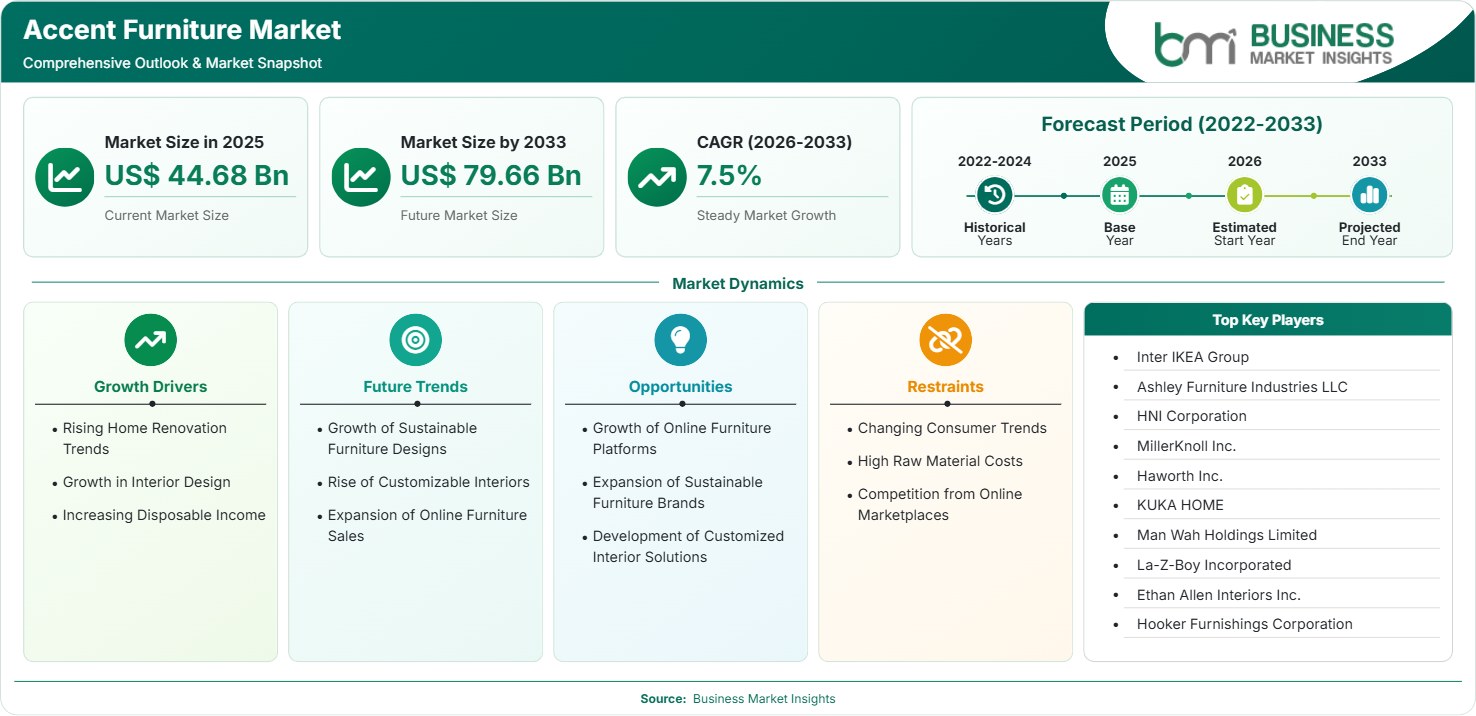
The Accent Furniture Market size was valued at US$ 44.68 Billion in 2025 and is projected to reach US$ 79.66 Billion by 2033, growing at a CAGR of US$ 7.5% during 2026–2033, driven by home renovation, interior customization, premium décor demand, and expanding online furniture platforms.

Report Coverage
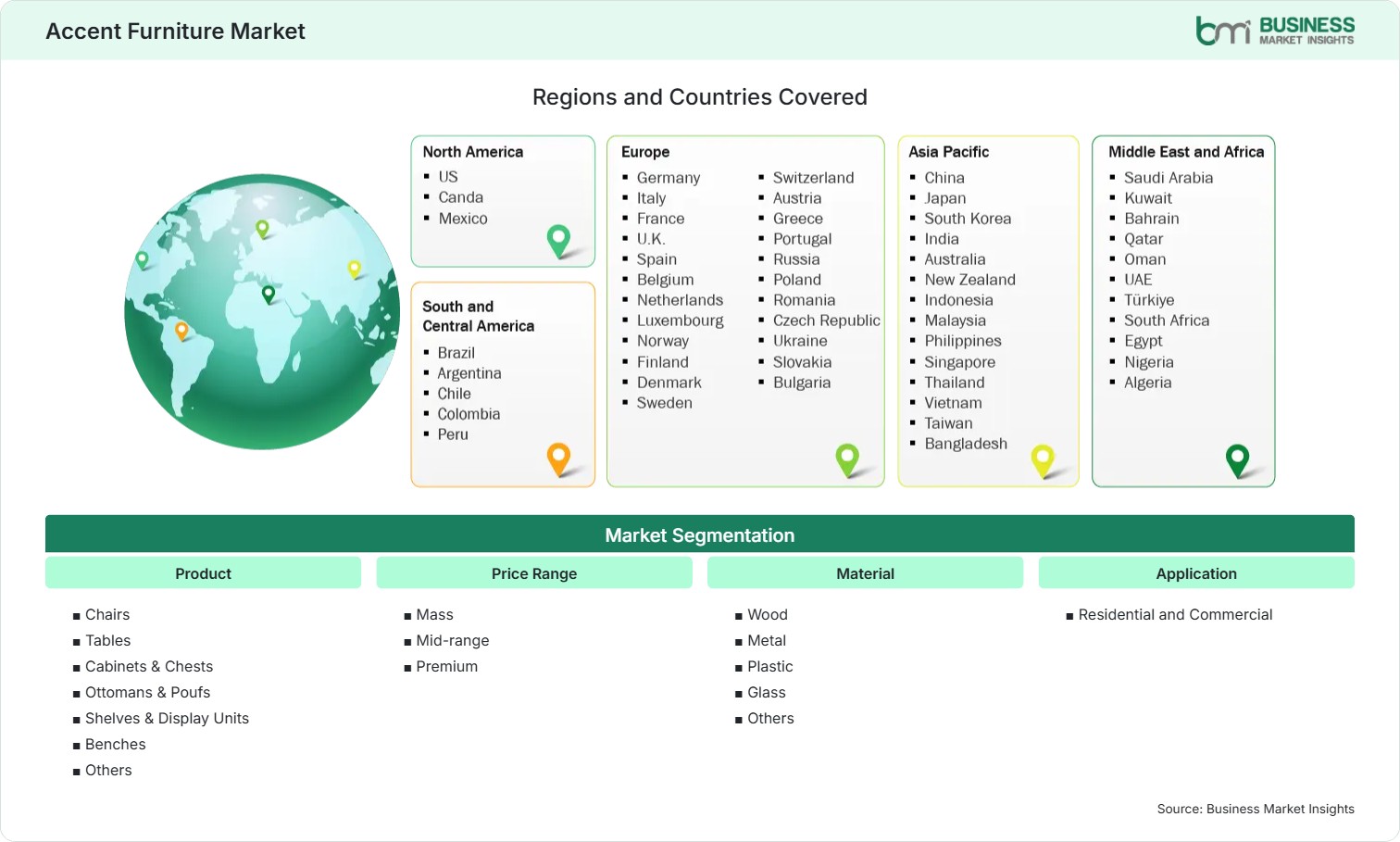
  • Product: Chairs, Tables, Cabinets & Chests, Ottomans & Poufs, Shelves & Display Units, Benches, Others
  • Price Range: Mass, Mid-range, Premium
  • Material: Wood, Metal, Plastic, Glass, Others
  • Application: Residential and Commercial
  • Distribution Channel: Supermarkets & Hypermarkets, Specialty Furniture Stores, Home Décor Stores, Direct Sales, Online Retail, Others
US$ 44.68 Bn Market size in 2025
US$ 79.66 Bn Market Size by 2033
7.5% CAGR, 2026 - 2033
2026-2033 Forecast Period

01 AI Overview

Accent Furniture Market Summary

  • North America Region: North America holds a market share of 35%–38% in 2025, growing with a CAGR of 7.0%–8.0% influenced by renovation activity, premium décor preferences, and strong furniture retail networks. The US market shows steady adoption with a CAGR of 7.2%–8.2% during 2026–2033 due to residential remodeling and online purchases.
  • Fastest Growing Region: Asia Pacific holds a market share of 25%–28% in 2025, growing with a CAGR of 8.0%–9.0% supported by urbanization, rising disposable income, expanding housing developments, and increasing adoption of contemporary furniture styles across emerging economies.
  • Leading Segment: Chairs represent the leading product segment with a share of 28%–31% in 2025, growing with a CAGR of 7.2%–8.2% due to versatile applications, space optimization, ergonomic designs, and demand for decorative seating solutions.
  • High Growth Segment: Online Retail is the high growth distribution segment with a share of 18%–21% in 2025, growing with a CAGR of 9.0%–10.0% driven by digital shopping adoption, wider product availability, and personalized furniture recommendations.
  • Key Market Opportunity: Customized interior solutions, sustainable materials, and digital furniture platforms create opportunities for brands to capture evolving consumer preferences through personalization, environmentally responsible designs, and improved shopping experiences.
  • Major Market Players: Inter IKEA Group, Ashley Furniture Industries LLC, HNI Corporation, MillerKnoll Inc., Haworth Inc., KUKA HOME, Man Wah Holdings Limited, La-Z-Boy Incorporated, Ethan Allen Interiors Inc., Hooker Furnishings Corporation.
02 Strategic Insights

Accent Furniture Market: Strategic Insights

Accent Furniture Market Strategic Framework
FREE PDF
Request your free sample
Request free sample
03 Stakeholder View

Key Takeaways

  • Accent furniture value chains are shifting toward integrated ecosystems where manufacturers, designers, digital platforms, and retailers collaborate to deliver faster customization and improved consumer experiences.
  • Growth opportunities are concentrated in decorative seating, multifunctional tables, sustainable materials, and online channels where consumers increasingly seek convenience and personalized home solutions.
  • Product innovation is moving toward modular furniture concepts, eco-friendly materials, compact designs, and digitally assisted visualization tools that improve purchasing confidence.
  • Asia Pacific presents a strong investment opportunity due to urbanization, increasing residential development, and rising preference for modern interior aesthetics across developing markets.
  • Industry consolidation is increasing as established furniture companies expand portfolios through acquisitions, partnerships, and investments in digital retail capabilities to strengthen competitive positioning.
  • Sustainable manufacturing practices are becoming a strategic differentiator as consumers and businesses prioritize responsible sourcing and environmentally conscious interior products.
04 Geographic Outlook

Accent Furniture Market Regional Highlights

North America Accent Furniture Market

North America accounted for a market share of 35%–38% in 2025, expanding at a CAGR of 7.0%–8.0% during 2026–2033. The region benefits from strong residential renovation activity, established furniture retailers, and high consumer spending on interior décor. The Accent Furniture Market share is supported by premium product adoption, online purchasing, and demand for stylish functional furniture across households and hospitality spaces.

  • Rising home improvement expenditure is encouraging consumers to replace traditional furnishings with decorative accent pieces that improve aesthetics, functionality, and overall interior appeal across residential properties.
  • Growing preference for contemporary, minimalist, and multifunctional furniture designs is supporting manufacturers developing compact solutions suitable for urban apartments and modern living environments.
  • Expansion of online furniture marketplaces is improving product accessibility, enabling consumers to compare designs, customize selections, and purchase accent furniture through convenient digital platforms.
  • Sustainable material adoption is increasing as North American consumers seek furniture products manufactured using responsible sourcing practices, recycled materials, and environmentally conscious production methods.

US Accent Furniture Market

The US represented a dominant share within North America, accounting for 30%–33% in 2025, with growth projected at a CAGR of 7.2%–8.2% between 2026–2033. The country benefits from strong remodeling expenditure, mature retail infrastructure, and high consumer interest in personalized interiors. The Accent Furniture Market share in the US is strengthened by demand for premium chairs, tables, storage units, and décor-focused furniture.

  • Residential renovation projects continue driving demand as homeowners upgrade living spaces with statement furniture pieces that enhance comfort, visual appeal, and property value.
  • Increasing adoption of e-commerce platforms is allowing furniture brands to expand direct-to-consumer models while offering broader catalogs, customization options, and improved delivery experiences.
  • Commercial spaces including offices, hotels, and restaurants are increasing investments in decorative furniture to create attractive environments and improve customer experiences.

Europe Accent Furniture Market

Europe held a market share of 25%–28% in 2025 and is projected to grow at a CAGR of 6.5%–7.5% from 2026–2033. The region benefits from strong design heritage, sustainability awareness, and demand for premium furniture solutions. Germany, the United Kingdom, and France remain leading markets, while Germany and the UK demonstrate growth rates of 6.8%–7.8% and 7.0%–8.0%, respectively.

  • European consumers increasingly prioritize sustainable furniture manufactured with certified wood, recycled materials, and environmentally responsible production processes.
  • Interior design trends emphasizing Scandinavian, minimalist, and functional aesthetics are supporting demand for premium accent furniture collections across households.
  • Growth of specialty furniture stores and online platforms is improving accessibility to designer products and customized furniture solutions.
  • Hospitality and commercial renovation projects are creating additional demand for decorative seating, tables, and display units across hotels and workplaces.

Asia Pacific Accent Furniture Market

Asia Pacific accounted for 25%–28% market share in 2025 and is expected to expand at the highest CAGR of 8.0%–9.0% during 2026–2033. Rapid urbanization, rising disposable incomes, and residential development are accelerating furniture adoption. China, India, and Japan represent key markets, with India recording a CAGR of 9.0%–10.0% and China expanding at 8.0%–9.0%.

  • Urban housing expansion is increasing demand for compact and multifunctional furniture suitable for apartments and modern residential developments.
  • Rising middle-class purchasing power is encouraging consumers to invest in decorative furniture products that improve home aesthetics and comfort.
  • Online furniture platforms are gaining traction due to improved logistics, digital payment adoption, and wider access to international furniture designs.
  • Domestic manufacturers are expanding sustainable furniture portfolios to address increasing consumer interest in eco-friendly interior products.

Rest of World Accent Furniture Market

Rest of World accounted for a market share of 8%–10% in 2025, growing at a CAGR of 5.5%–6.5% between 2026–2033. South America and the Middle East & Africa are witnessing increasing demand due to urban development, hospitality investments, and expanding retail infrastructure. Brazil, UAE, and Saudi Arabia represent important markets, with Brazil growing at 5.8%–6.8% and UAE at 6.0%–7.0%.

  • Hospitality construction projects in Middle Eastern countries are increasing demand for premium accent furniture used in hotels, resorts, and commercial interiors.
  • Growing urban populations across South America are supporting demand for affordable decorative furniture solutions through expanding retail networks.
  • International furniture brands are entering emerging markets through partnerships, franchise models, and digital commerce channels.
  • Rising awareness of modern interior styles is encouraging consumers to adopt contemporary furniture designs across residential applications.
Global Market Geography
FREE PDF
Request your free sample
Request free sample
05 Segment Analysis

Accent Furniture Market Segmentation

Product

The Product segment accounted for a market share of 2025 with chairs maintaining dominance due to broad residential and commercial applications. The segment is projected to grow at a CAGR of 7.2%–8.2% between 2026–2034, supported by evolving interior preferences, compact living trends, and demand for decorative furniture pieces. Product innovation focuses on multifunctionality, premium finishes, ergonomic designs, and sustainable materials. The Accent Furniture Market scope is expanding as consumers increasingly integrate statement furniture into personalized interior environments.

  • Chairs: Decorative chairs remain highly preferred for living rooms, bedrooms, offices, and hospitality spaces, with manufacturers focusing on ergonomic structures, premium fabrics, and contemporary designs.
  • Tables: Accent tables support flexible interior layouts through coffee tables, side tables, and console designs that combine functionality with decorative appeal for modern spaces.
  • Cabinets & Chests: Storage-focused furniture solutions are gaining demand as consumers seek stylish organization options combining traditional storage functions with modern interior aesthetics.
  • Ottomans & Poufs: Compact seating accessories are growing due to space-saving benefits, versatile placement options, and increasing adoption in casual residential environments.
  • Shelves & Display Units: Display-oriented products are benefiting from demand for personalized décor arrangements, collectibles presentation, and enhanced visual organization within interiors.
  • Benches: Accent benches are gaining popularity in entryways, bedrooms, and commercial spaces due to multifunctional seating and decorative applications.

Price Range

The Price Range segment demonstrates varied consumer preferences, with mid-range products holding a significant market share in 2025 due to affordability and design accessibility. The segment is expected to expand at a CAGR of 7.0%–8.0% from 2026–2034. Changing lifestyles, online availability, and increased interior spending are influencing purchasing decisions. Premium offerings are gaining traction among consumers seeking exclusive designs, customization, and luxury materials.

  • Mass: Mass-priced furniture attracts value-conscious consumers through affordable designs, broad availability, and practical solutions suitable for budget-focused residential applications.
  • Mid-range: Mid-range furniture benefits from balanced pricing, improved quality, and attractive designs appealing to expanding middle-income consumer groups across global markets.
  • Premium: Premium furniture demand is increasing through luxury interiors, customized designs, high-quality materials, and consumer preference for distinctive decorative furnishings.

Material

The Material segment is shaped by changing sustainability preferences and evolving design requirements, with wood maintaining a leading position due to durability and aesthetic appeal. The segment is projected to grow at a CAGR of 7.0%–8.0% during 2026–2034. Manufacturers are incorporating innovative materials, responsible sourcing practices, and mixed-material designs to meet diverse consumer expectations across residential and commercial applications.

  • Wood: Wood-based accent furniture remains popular due to natural appearance, durability, customization potential, and compatibility with multiple interior design styles.
  • Metal: Metal furniture is gaining adoption through modern designs, structural strength, industrial aesthetics, and applications requiring durable decorative solutions.
  • Plastic: Plastic-based furniture supports affordable production, lightweight designs, color flexibility, and practical usage in contemporary interior environments.
  • Glass: Glass furniture appeals to consumers seeking elegant appearances, space-enhancing designs, and visually lightweight solutions for modern interiors.

Application

The Application segment reflects increasing demand across residential and commercial environments, with residential usage representing a larger share in 2025. The segment is projected to grow at a CAGR of 7.3%–8.3% between 2026–2034. Rising home improvement activities, commercial renovations, and evolving workplace designs are supporting adoption. The Accent Furniture Market trends indicate stronger integration of decorative products across lifestyle-oriented spaces.

  • Residential: Residential applications dominate due to renovation activities, personalized décor preferences, urban housing growth, and demand for stylish functional furniture.
  • Commercial: Commercial adoption is increasing through hospitality, offices, restaurants, and retail environments requiring attractive furniture to improve customer and employee experiences.

Distribution Channel

The Distribution Channel segment is undergoing transformation through digital commerce expansion and changing shopping behaviors. Online Retail is emerging as the fastest-growing channel with increasing consumer acceptance and improved delivery networks. The segment is projected to grow at a CAGR of 9.0%–10.0% between 2026–2034. Retailers are adopting omnichannel strategies to provide wider selections, customization services, and enhanced purchasing experiences.

  • Supermarkets & Hypermarkets: These channels provide accessibility for affordable furniture purchases through established retail networks and convenient consumer shopping experiences.
  • Specialty Furniture Stores: Specialty retailers attract customers through expert guidance, curated collections, customization options, and premium furniture selections.
  • Home Décor Stores: Home décor outlets support furniture purchases by combining accent pieces with complementary decorative products and interior styling solutions.
  • Direct Sales: Direct sales enable manufacturers to strengthen customer relationships, offer customization, and improve control over pricing and distribution.
  • Online Retail: Online retail is expanding through digital platforms, virtual visualization tools, broad product availability, and simplified purchasing processes.
06 Market Forces

Accent Furniture Market Dynamics

Key Market Drivers

Rising Home Renovation Trends

Increasing residential renovation activity is a major factor supporting furniture demand as homeowners invest in improving aesthetics, comfort, and functionality. An increase in improvement expenditures on properties, particularly in developed countries, is driving the demand for replacing existing furniture with accent pieces. The Accent Furniture Market growth is driven by customers seeking to add personal touches to their homes and by furniture that serves multiple purposes and is aesthetically pleasing. Social media sites are another factor influencing remodeling trends and thereby leading to the increasing use of modern furniture.

Growth in Interior Design

Expansion of professional interior design services and increasing consumer interest in customized home aesthetics are strengthening demand for accent furniture products. Interior designers are incorporating statement chairs, tables, storage units, and decorative pieces to create distinctive environments across residential and commercial projects. Due to awareness of the trends in design, color, and space, consumers have opted to go for special furniture types. The accent furniture market benefits from the collaboration between furniture manufacturers and the designers, who produce special types of furniture. The changes in lifestyle decisions, urban lifestyles, and interior designs continue to influence consumers' decisions.

Increasing Disposable Income

Rising disposable income levels, particularly across emerging economies, are enabling consumers to increase spending on lifestyle products, including decorative furniture. Growing middle-class populations are shifting purchasing priorities from basic functionality toward improved aesthetics and premium home environments. Accent Furniture Market Trends indicates an increasing demand for quality materials and beautiful design elements. According to global economic trends, increase in household spending in the developing world contributes to discretionary spending segments. The furniture industry has started developing its luxury collections owing to increasing demands from consumers.

Key Market Opportunities

Growth of Online Furniture Platforms

With the growth of the online furniture industry, there are many new opportunities arising from increased consumer accessibility to a wider variety of products, customization, and virtual visualization. E-commerce channels allow brands to reach broader customer groups without relying exclusively on physical stores. The Accent Furniture Market Forecasts indicate more growth areas for those businesses that have invested in the direct-to-consumer approach, logistics, and technology-led shopping experience. Room planners, augmented reality applications, and recommendation engines are contributing towards building the buying confidence of consumers. The online medium is also allowing small-scale furniture brands to compete globally by adopting customer-oriented digital marketing techniques.

Expansion of Sustainable Furniture Brands

Growing environmental awareness is encouraging the development of sustainable furniture brands focused on responsible sourcing, recycled materials, and low-impact manufacturing processes. Consumers are increasingly evaluating furniture purchases based on environmental credentials, durability, and material transparency. Investing in certified wood, circular production systems, and environmentally friendly finishes will help to increase brand differentiation for the company. Environmentally sustainable furniture products have become increasingly important to residential, commercial, and hospitality clients seeking interiors that uphold the principles of environmental responsibility. There is a clear case here backed up by business sustainability efforts and consumer product expectations.

Development of Customized Interior Solutions

Demand for customized interior solutions is creating opportunities for furniture companies to provide personalized designs, made-to-order products, and integrated décor services. Consumers increasingly prefer furniture that reflects individual lifestyles, spatial requirements, and aesthetic preferences. With the help of digital design tools and technological advancements in manufacturing processes, firms are now able to provide personalized products in relatively less time than before. Personalization options are becoming increasingly available in residential, hospitality, and commercial sectors, where distinctive interior spaces can give an edge over the competitors. Firms with expertise in design and manufacturing can capitalize on this demand.

Market Restraints and Challenges

Changing Consumer Trends

Changing consumer preferences create uncertainty for furniture manufacturers adapting to rapidly evolving design expectations. Factor: Shifts toward new interior styles, minimalist concepts, multifunctional furniture, and changing lifestyle patterns require continuous product innovation and portfolio adjustments.

Impact: Businesses can encounter problems like stock shortages, design costs, and even risks due to their out-of-date product lines. As the power of social media trends increases, forecasting becomes more difficult due to rapidly fluctuating demand. Manufacturers have to be aware of all these aspects and implement certain approaches to stay competitive in the furniture industry.

High Raw Material Costs

Rising raw material expenses present challenges for furniture producers managing manufacturing costs and pricing strategies. Factor: Fluctuating prices of wood, metals, fabrics, and other materials increase production expenses and affect supply chain stability.

Impact: Higher input costs could result in lower profit margins, higher store prices, and changes in consumer buying behavior. Companies are using different materials in manufacturing processes, enhancing their sourcing practices, and optimizing their manufacturing processes to cope with rising costs. The requirement for sustainable materials could add to the challenge of sourcing.

07 Company Analysis

Competitive Landscape

The competitive environment includes global furniture manufacturers, home furnishing companies, and design-focused brands competing through product innovation, sustainable materials, omnichannel distribution, and customization capabilities. The Accent Furniture market analysis highlights increasing focus on digital retail expansion, consumer-centric designs, and premium product development to address evolving residential and commercial interior requirements.

Company Name

Overview

Products and Services relevant to this market

Inter IKEA Group

Global home furnishing company offering affordable and design-focused furniture solutions worldwide.

Accent chairs, tables, cabinets, storage furniture, décor products, and customized interior solutions.

Ashley Furniture Industries LLC

Leading furniture manufacturer providing residential and lifestyle furniture collections.

Accent seating, occasional tables, cabinets, décor furniture, and home furnishing solutions.

HNI Corporation

Workplace and residential furniture provider focused on innovative design solutions.

Office accent furniture, seating products, tables, and commercial interior furnishings.

MillerKnoll Inc.

Global design company specializing in modern furniture and workplace solutions.

Premium chairs, tables, ergonomic furniture, and designer interior products.

Haworth Inc.

Furniture manufacturer providing workspace and lifestyle-oriented design solutions.

Office furniture, lounge seating, tables, and customized interior products.

KUKA HOME

International furniture company specializing in upholstered and residential furniture.

Accent sofas, chairs, tables, living room furniture, and premium home solutions.

Man Wah Holdings Limited

Furniture manufacturer known for upholstered furniture and home lifestyle products.

Accent seating, recliners, sofas, tables, and residential furniture collections.

La-Z-Boy Incorporated

Furniture company recognized for comfort-focused residential furniture products.

Accent chairs, recliners, occasional furniture, and customized home furnishings.

Ethan Allen Interiors Inc.

Premium interior design company offering customized furniture solutions.

Designer chairs, tables, cabinets, décor products, and interior planning services.

Hooker Furnishings Corporation

Furniture manufacturer providing residential and hospitality furniture collections.

Accent furniture, case goods, tables, cabinets, and decorative interior products.

08 Industry Activity

Recent Developments

October 2025

Four Hands Inc. unveiled its Fall 2025 Collection at High Point Market, introducing more than 500 new home furnishing designs, including expanded accent furniture offerings and an extension of its collaboration with designer Amber Lewis. The collection added new tables, seating, storage, and decorative furniture pieces targeting residential and designer markets.

August 2025

Habitat (Sainsbury’s Group) announced its AW25 collaboration collection with Morris & Co., adding more than 160 homeware and furniture pieces, including accent furniture items incorporating heritage-inspired patterns and contemporary designs. The launch expanded Habitat’s furniture collaboration portfolio with a focus on decorative interiors.

July 2025

Kelly Wearstler Studio launched new furniture and décor collections, including additions to its Studio Collection and the Pacific Collection. The expansion introduced sculptural furniture pieces and decorative objects, strengthening the designer brand’s presence in the luxury accent furniture and interiors segment.

April 2025

Surya Inc. expanded its furniture portfolio by launching a 50+ piece furniture collection with designer Becki Owens. The collaboration introduced new accent furniture, living room, dining, and bedroom pieces featuring curved forms, natural materials, and decorative finishes, expanding Surya’s offerings beyond its traditional rugs and décor categories.

10 Trust & Transparency

Research Methodology

The market analysis combines proprietary research with secondary data from government agencies, company disclosures, regulatory filings, industry databases and expert interviews. Market estimates are validated through data triangulation, cross-market benchmarking and analyst review.

View Full Research Methodology

11 Questions Answered

Frequently Asked Questions

What information is included in the Accent Furniture Report?

The Accent Furniture Market Report provides analysis of market dynamics, segmentation, regional developments, competitive strategies, emerging opportunities, and industry trends influencing future growth.

What role does digital technology play in furniture purchasing?

Digital platforms enable virtual visualization, online customization, product comparison, and convenient purchasing experiences, allowing brands to improve engagement and expand market reach.

How is sustainability affecting furniture manufacturers?

Sustainability is encouraging manufacturers to adopt responsibly sourced materials, recycled components, circular production methods, and environmentally conscious designs to meet changing consumer expectations.

Which product category contributes significantly to the accent furniture market?

Chairs represent a leading product category due to their versatility across residential, hospitality, and commercial environments, supported by continuous innovation in design, comfort, and materials.

What factors are shaping demand for accent furniture products?

Demand is influenced by home renovation activity, evolving interior design preferences, rising disposable income, urban housing trends, and consumer interest in personalized living spaces.

Access the Full Accent Furniture Market Report

Get segment-level forecasts, regional estimates, competitive benchmarking, company profiles and downloadable Excel datasets.

Access the full Accent Furniture Market Report
350 pages PDF & Excel | 2026-07-28