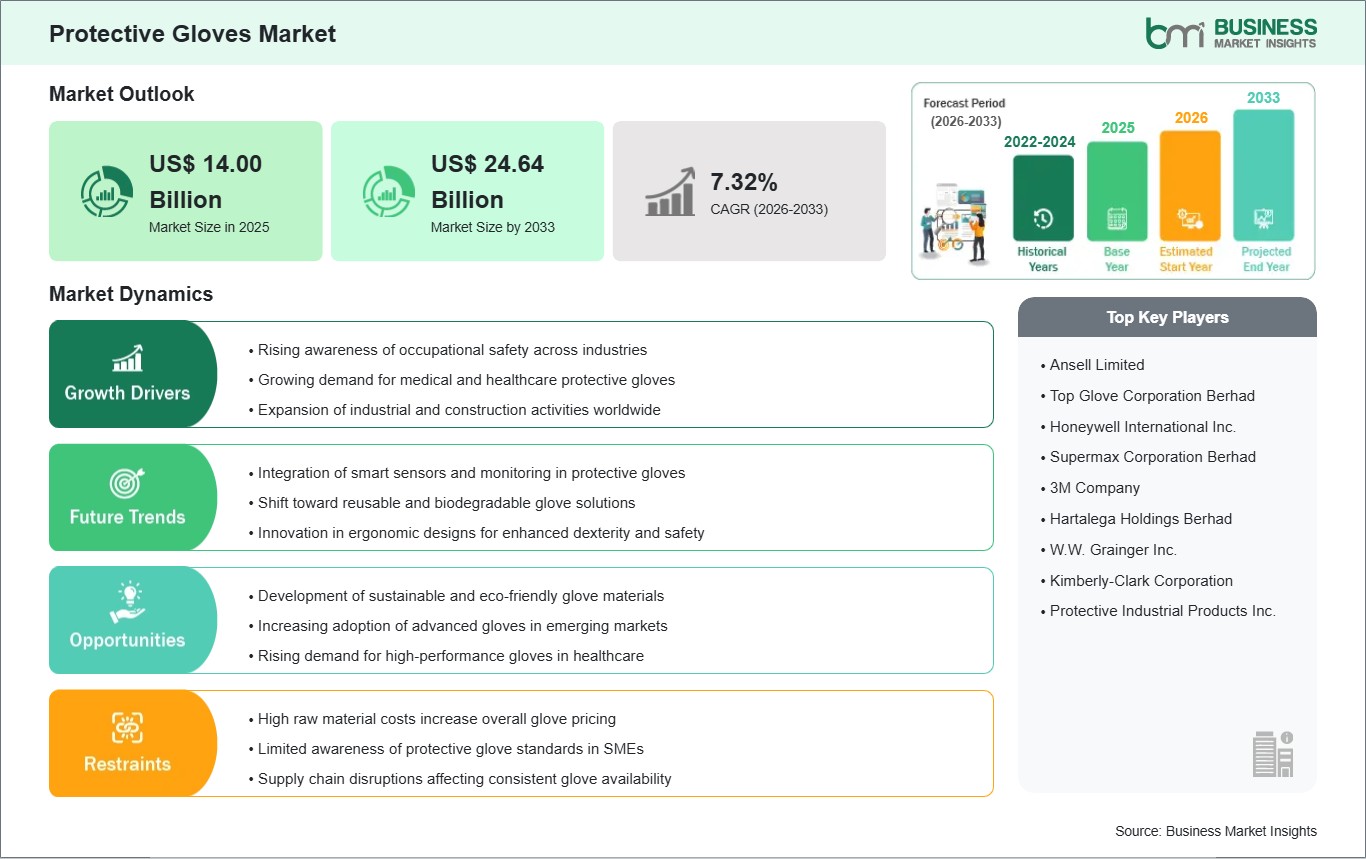
The Protective Gloves Market size is expected to reach US$ 24.64 billion by 2033 from US$ 14. billion in 2025. The market is estimated to record a CAGR of 7.32% from 2026 to 2033.
The global protective glove market has become an essential part of personal protective equipment (PPE) markets because industrial, healthcare, commercial and consumer sectors now need greater worker protection. Protective gloves protect hands from chemical, biological, thermal, mechanical and electrical dangers, which makes them essential for workplaces that include manufacturing and construction and medical and food processing operations.
The public has developed a better understanding of safety requirements at work while companies enforce their safety rules, and people now accept personal protective equipment. This protective glove trend has expanded through these three drivers, which now reach beyond their base industrial applications to service providers and individual users. The market experiences its main growth driver through increasing demand for gloves, which protect users from specific risks while allowing them to move freely and feel comfortable.
The development of synthetic nitrile formulas, high-strength polymers, composite fabrics and advanced coating systems has allowed manufacturers to create gloves that offer users three benefits: superior cut protection, complete chemical protection and increased tactile sensitivity. This evolution has been particularly important in healthcare and laboratory settings where professionals require precise manual control and reliable barrier protection against pathogens, contaminants, and hazardous substances.
Organizations in North America and Europe, and developed Asian economies, must follow industry standards and regulatory requirements, which force them to purchase certified protective gloves from suppliers who offer protection equipment for their long term operational needs. The market has expanded, but there are significant limitations that exist. Companies in cost-sensitive markets face challenges because advanced specialty polymers incur high material costs which affect their pricing models. The specific types of gloves became harder to obtain because supply chains faced interruptions from worldwide events, which included pandemic-related factory shutdowns and logistics problems, leading customers to search for alternative sourcing options. The limited knowledge of glove efficacy standards among businesses in specific areas results in their employees not using gloves properly, which especially affects small and medium enterprises.
The protective gloves market worldwide shows three main factors that shape its development, which include new technologies, government regulations and the growth of new customer bases. The market for gloves develops as safety requirements and new material technologies progress toward better products, which offer protection, comfort and performance to users because these gloves protect both workplace environments and public health safety standards.

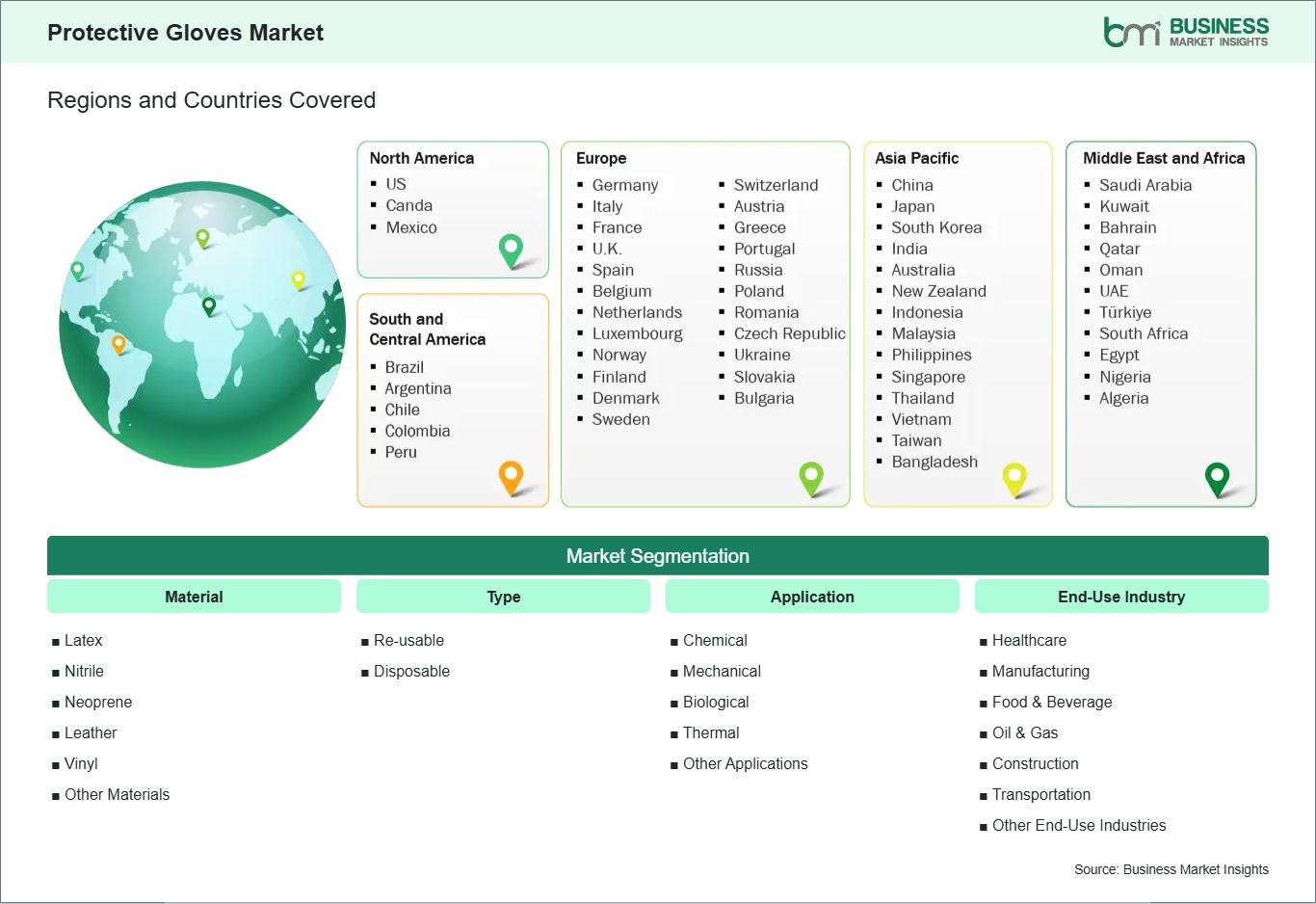
Key segments that contributed to the derivation of the protective gloves market analysis are material, type, application, and end-use industry.
The global protective gloves market is strongly driven by rising awareness of occupational safety across industries. Organizations worldwide are increasingly prioritizing the health and safety of their workforce, recognizing that effective hand protection reduces workplace injuries, improves productivity, and ensures compliance with regulatory standards. Industrial sectors, including manufacturing, construction and oil and gas operations, now require gloves with high cut, abrasion and chemical resistance to protect workers from dangerous materials.
Healthcare professionals and laboratory staff have greatly increased their knowledge about infection control methods since global health emergencies began to occur. Medical facilities such as hospitals, diagnostic centers and research laboratories now use medical-grade gloves which offer protective barriers and tactile sensitivity while decreasing allergen exposure to keep professionals safe who work with biohazardous materials. Safety training programs and governmental occupational health initiatives in North America and Europe create heightened awareness, which helps people understand rules that organizations must follow to maintain safety standards.
People are developing safety awareness, which leads them to change their work-related behavior. Commercial and consumer segments, which include food processing and cleaning services and home improvement activities, have started to realize they need protective gloves to stop injuries and contamination. The demand for various glove types, including disposable nitrile and latex gloves and industrial-grade specialty gloves, has increased because both industries and individual people now use safety practices, which leads to worldwide market advancements in material development, ergonomic design and product functionality.
Sustainability and environmental responsibility are becoming key factors in the global protective gloves market. Manufacturers are responding to growing demand for eco-friendly materials by introducing gloves made from biodegradable polymers, recycled components, and low-impact chemical processes. This trend is particularly pronounced in regions like Europe and North America, where regulatory pressure and consumer expectations encourage environmentally conscious production and disposal practices.
In industrial applications, sustainable gloves are designed not only to reduce environmental impact but also to maintain high performance. For example, chemical-resistant and cut-resistant gloves now incorporate recycled or bio-based materials without compromising durability or safety standards. Healthcare institutions are similarly exploring biodegradable disposable gloves that meet infection control requirements while minimizing plastic waste, particularly in large-scale hospital systems and laboratory networks.
The opportunity extends to emerging markets in Asia Pacific and Latin America, where industrial growth and heightened safety awareness intersect with sustainability goals. Companies that innovate in eco-friendly glove technologies can differentiate themselves, meet corporate social responsibility targets, and capture environmentally conscious buyers. As global industries increasingly prioritize sustainability alongside safety and performance, the development of green protective gloves is expected to become a key growth driver, shaping product portfolios and influencing procurement decisions worldwide.
The protective gloves market demonstrates steady growth, with size and share analysis highlighting evolving trends and competitive dynamics among key players. The report examines subsegments categorized within material, type, application, and end-use industry, offering insights into their contribution to overall market performance.
By material, the latex subsegment dominated the market in 2025, driven by its widespread use due to superior elasticity and protective performance across multiple industries.
Based on type, the disposable subsegment dominated the market in 2025, driven by rising health and safety norms that favor single‑use gloves for hygiene and contamination control.
On the basis of application, the chemical subsegment dominated the market in 2025, driven by strong demand from industries requiring protection against corrosive and hazardous chemicals.
In terms of end-use industry, the healthcare subsegment dominated the market in 2025, driven by high demand for protective gloves for medical procedures and strict regulatory safety standards.
| Report Attribute | Details |
|---|---|
| Market size in 2025 | US$ 14.00 Billion |
| Market Size by 2033 | US$ 24.64 Billion |
| Global CAGR (2026 - 2033) | 7.32% |
| Historical Data | 2022-2024 |
| Forecast period | 2026-2033 |
| Segments Covered | By Material
|
|
Regions and Countries Covered
| |
| North America | US, Canada, Mexico |
| Europe | Belgium, Austria, Finland, Denmark, Greece, Poland, Romania, Russia, Ukraine, Czech Republic, Slovakia, Bulgaria, Italy, Luxembourg, Germany, Switzerland, France, Netherlands, Norway, Portugal, Spain, Sweden, United Kingdom |
| Asia-Pacific | Australia, China, India, Japan, South Korea, Indonesia, Malaysia, Philippines, Singapore, Thailand, Vietnam, Bangladesh, New Zealand, Taiwan |
| South and Central America | Brazil, Argentina, Peru, Chile, Colombia |
| Middle East and Africa | Bahrain, Kuwait, Oman, Qatar, Saudi Arabia, United Arab Emirates, Turkiye, South Africa, Egypt, Algeria, Nigeria |
| Market leaders and key company profiles |
|
The "Protective Gloves Market Size and Forecast (2022 - 2033)" report provides a detailed analysis of the market covering below areas:
The geographical scope of the Protective Gloves Market report is divided into North America, Asia Pacific, Europe, Middle East & Africa, and South & Central America. North America held the largest share in 2025.
North America dominates the global protective glove market because its occupational safety standards are strictly enforced, while its industrial base is strong and its companies use advanced protective equipment. The United States and Canada maintain established regulatory systems and workplace safety regulations that require protective glove use in healthcare, manufacturing, construction and chemical sectors, thus creating ongoing requirements for certified and high-quality gloves. Medical-grade gloves serve essential purposes in North American healthcare and laboratory environments to create protective barriers and control infections, whereas industrial sectors such as automotive, oil and gas and chemical production need gloves that deliver cut, chemical and mechanical protection while still enabling hand movement.
Europe represents another substantial market that benefits from strict safety standards, advanced industrial automation and extensive healthcare systems. The countries of Germany, France, and the United Kingdom support protective gloves whose design meets high-performance standards because they protect against chemical exposure, medical procedures and industrial work.
The Asia Pacific region stands as one of the fastest-expanding markets because rapid industrial development, growing healthcare systems and increased understanding of workplace safety drive its growth. China, India, Japan, and South Korea experience a rise in industrial and medical glove usage because of increased investment in manufacturing facilities and industrial automation, which drives the need for strong and specialized gloves.
The Middle East and Africa region presents itself as a growing market through its industrial projects, oil and gas operations and healthcare sector development, especially in Saudi Arabia, the UAE and South Africa, despite the fact that regulatory agencies fail to enforce their rules consistently. South & Central America are witnessing gradual market growth, while Brazil, Mexico and Argentina increase glove usage for healthcare, manufacturing and food processing sectors despite supply chain infrastructure challenges and price sensitivity restrictions that hinder market access.
North America leads all regions through its strict regulatory framework and high product standards and innovative approaches ,while each region presents distinct factors that shape the global protective glove market through its industrial growth in the Asia Pacific and regulatory requirements in Europe, energy and healthcare requirements in the Middle East & Africa and emerging market growth in South & Central America.

The Protective Gloves Market is evaluated by gathering qualitative and quantitative data post primary and secondary research, which includes important corporate publications, association data, and databases. A few of the key developments in the protective gloves market are:
The Protective Gloves Market is valued at US$ 14.00 Billion in 2025, it is projected to reach US$ 24.64 Billion by 2033.
As per our report Protective Gloves Market, the market size is valued at US$ 14.00 Billion in 2025, projecting it to reach US$ 24.64 Billion by 2033. This translates to a CAGR of approximately 7.32% during the forecast period.
The Protective Gloves Market report typically cover these key segments-
The historic period, base year, and forecast period can vary slightly depending on the specific market research report. However, for the Protective Gloves Market report:
The Protective Gloves Market is populated by several key players, each contributing to its growth and innovation. Some of the major players include:
The Protective Gloves Market report is valuable for diverse stakeholders, including:
Essentially, anyone involved in or considering involvement in the Protective Gloves Market value chain can benefit from the information contained in a comprehensive market report.
Please tell us your area of interest
(Market Segments/ Regions and Countries/ Companies)