Market Summary
Executive Summary and Global Market Analysis
Robotic lawn mowers are autonomous systems that cut grass with minimal human involvement. These machines use sensors, navigate on their own, and have automated cutting features to provide consistent lawn care for homes, businesses, and institutions. Their ability to work independently helps manage lawns efficiently and reduces the need for manual labor. The market is experiencing growth due to changing landscaping habits and a growing desire for automated outdoor maintenance. Property owners are looking for equipment that lowers routine tasks while keeping their lawns looking good. Features like scheduling and smart route planning also make these products more appealing in different settings. Market segmentation shows the variety of operational needs.
Categories based on range cater to various property sizes, from small residential yards to large recreational areas. Navigation technology plays a big role in buying decisions as customers consider accuracy, ability to handle different terrains, and obstacle detection. Demand comes from households, commercial places, sports facilities, public spaces, and specialized uses. Technological improvement is a key feature of this industry. Traditional boundary-wire systems still work well in existing setups, while camera-based and GPS-enabled models offer better navigation accuracy.
Hybrid systems that use different positioning methods increase reliability in varying conditions. Connectivity features and software-driven performance improvements are also impacting how products are developed. Competition focuses on innovation, product differences, and enhanced functionality. Manufacturers aim to boost operational efficiency, improve user experience, and enhance autonomous decision-making. They also stress durability, smart navigation, and compatibility with other systems to strengthen their market position in a tech-driven environment.
Segment Analysis
Robotic Lawn Mower Market Segmentation
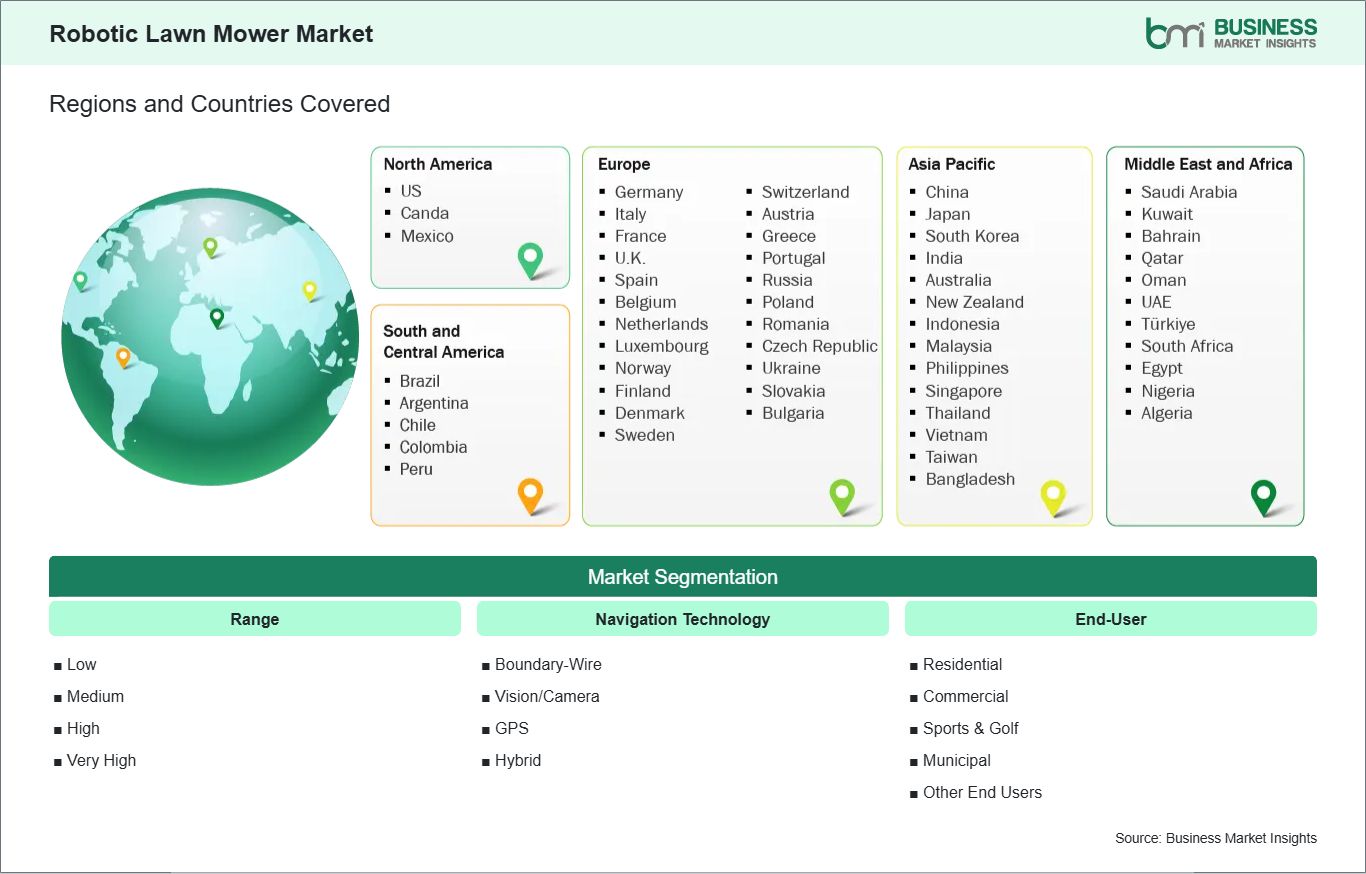
The market is divided based on operating range, navigation technology, and end-user needs. This division shows different deployment settings and performance expectations.
By Range
- Low (<500 m²) -; Ideal for small residential lawns that need easy maintenance
- Medium (501-;2,000 m²) -; Offers a good mix of coverage and efficiency
- High (>2,000 m²) -; Suitable for larger landscaped areas and institutional grounds. Very High (>2,000 m²) -; Fits large outdoor spaces that require continuous operation
By Navigation Technology
- Boundary-Wire -; Keeps mowing areas defined with structured perimeter guidance.
- Vision/Camera -; Improves obstacle detection through real-time environmental recognition.
- GPS -; Allows for precise positioning over large landscapes
- Hybrid -; Merges different navigation methods for better reliability
By End User
- Residential -; Gains from automated lawn care and user-friendly features
- Commercial -; Ensures consistent maintenance for business properties
- Sports and; Golf -; Provides a uniform turf look for professional surfaces
- Municipal -; Aids in managing public spaces with less labor
- Other End Users -; Addresses specific landscaping and facility maintenance needs
Market Forces
Robotic Lawn Mower Market Drivers and Opportunities
Expansion of Smart Outdoor Maintenance Solutions
Improvements in automation technology have changed what people expect from landscape management. Property owners now prefer equipment that can handle routine tasks with little oversight. Robotic lawn mowers meet this need by offering programmed schedules, smart navigation, and the ability to operate continuously. These features match today's desire for convenience, consistent operations, and less reliance on manual maintenance.
The impact of automation goes beyond residential users to include commercial and institutional spaces. Organizations managing large outdoor areas look for equipment that provides reliable maintenance while making the best use of resources. As digital technology becomes more common in outdoor tools, robotic lawn mowers are increasingly seen as practical options for keeping turf quality high across various settings.
Development of AI-Based Navigation Systems
New navigation technologies offer chances for product differentiation and better performance. Artificial intelligence, machine vision, and adaptive sensing systems help robotic lawn mowers understand their surroundings more accurately. These advancements support efficient route planning, better obstacle avoidance, and improved responsiveness in different terrains and landscape setups.
Future growth opportunities depend on more advanced autonomous abilities. Better mapping, connectivity, and awareness of the environment can expand use in complex outdoor areas. As smart navigation technologies evolve, manufacturers may discover new application areas while boosting user confidence, operating efficiency, and long-term value in both residential and commercial settings.
Size and Share Analysis
Robotic Lawn Mower Market Size and Share Analysis
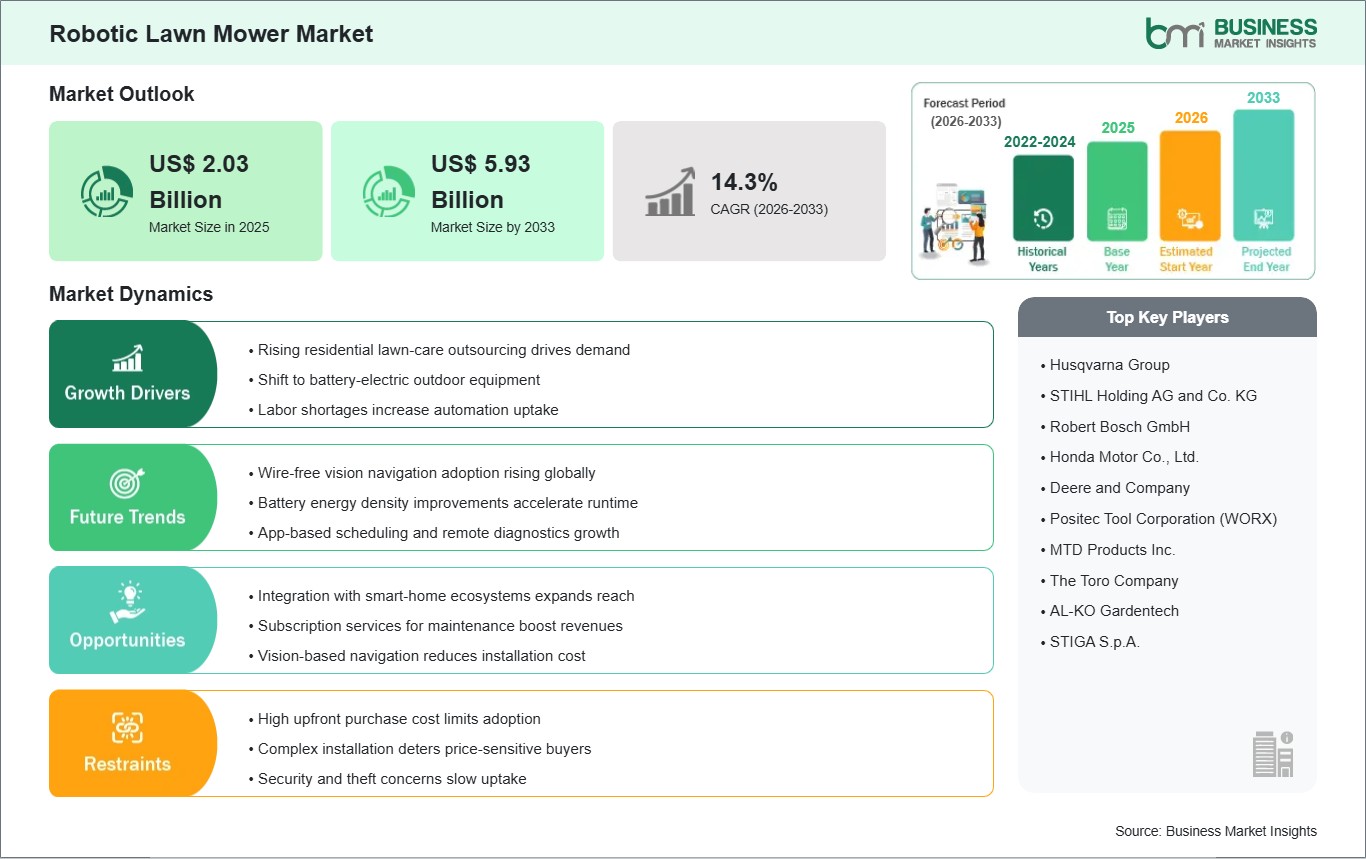
The robotic lawn mower market size is expected to reach US$ 5.93 billion by 2033, up from US$ 2.03 billion in 2025. The market is projected to record a CAGR of 14.3% from 2026 to 2033.
This growth shows an increasing acceptance of autonomous lawn care equipment and a wider use of smart outdoor automation technologies across various end-user categories. Among the categories, medium-capacity and high-capacity robotic lawn mowers perform well due to their fit for many property sizes. Preferences for navigation technology are shifting toward better systems that offer more operational flexibility, improved route planning, and greater environmental awareness.
Residential applications account for a large share of industry demand as homeowners focus on convenience and automated maintenance. Commercial landscapes, sports facilities, and municipal installations also play a significant role by generating ongoing needs for consistent turf management and operational efficiency.
Report Coverage
Robotic Lawn Mower Market Report Coverage and Deliverables
The "Robotic Lawn Mower Market Size and Forecast (2022-;2033)" report provides a detailed analysis of the market covering below areas:
- The market size and forecast at global, regional, and country levels for all market segments covered under the scope
- The market trends, as well as drivers, restraints, and opportunities
- The market analysis covering key trends, global and regional framework, major players, regulations, and recent developments
- Industry landscape and competition analysis covering market concentration, heat map analysis, prominent players, and recent developments for the market
- Detailed company profiles, including SWOT analysis
Geographic Insights
Robotic Lawn Mower Market Geographic Insights
The robotic lawn mower market shows different patterns of regional adoption, driven by landscaping practices, automation choices, technological development, and outdoor property management needs. Demand varies significantly between developed and emerging economies, creating unique opportunities for manufacturers that offer tailored solutions for different environments and user needs.
North America shows strong market participation because many people own private lawns, and there is a growing interest in automated maintenance tools. Consumers focus on convenience, connectivity, and efficiency when choosing robotic mowers. Commercial property managers and recreational facilities also boost regional growth through ongoing investment in modern landscaping technologies.
Asia Pacific offers a vibrant growth environment due to urban expansion, rising incomes, and increased acceptance of smart home technologies. The region benefits from a greater awareness of automated outdoor equipment and improvements in residential infrastructure. Manufacturers keep introducing technologically advanced products that meet changing consumer preferences and diverse landscaping conditions.
Europe has a solid presence in the industry, thanks to a strong understanding of robotic gardening tools and a focus on sustainable maintenance practices. Demand continues to be shaped by technological advancements and product complexity. Emerging markets in the Middle East, Africa, and South and Central America are slowly increasing participation as awareness grows, landscaping investments rise, and automation solutions become more available to a wider audience.
Industry Activity
Recent Developments
The robotic lawn mower market is evaluated by gathering qualitative and quantitative data post primary and secondary research, which includes important corporate publications, association data, and databases. Recent developments and news in the market include:
- In April 2026, Husqvarna Group introduced the Automower 560 EPOS. This professional robotic lawn mower is made for municipalities and large facilities. The model has satellite-based virtual boundaries, operates without wires, and includes an AI-ready platform. It helps maintain complex commercial landscapes efficiently while cutting down on labor needs.
- In February 2026, Segway Navimow revealed its 2026 robotic mower lineup. This includes the X4, H2, i2 AWD, i2 LiDAR, i2 LiDAR Pro, and Terranox series. The new models feature improved automation, wireless navigation, better terrain handling, and increased precision for both residential and professional lawn care.
Trust & Transparency
Research Methodology
The market analysis combines proprietary research with secondary data from government agencies, company disclosures, regulatory filings, industry databases and expert interviews. Market estimates are validated through data triangulation, cross-market benchmarking and analyst
review.
View Full Research Methodology
Key Sources Referred:
Agricultural Engineers Association (AEA)ComagardenOutdoor Power Equipment Institute (OPEI)International Organization for Standardization (ISO)European Garden Machinery Industry Federation (EGMF)Company WebsitesCompany Annual ReportsCompany Investor Presentations