
Robotic Vacuum Cleaners Market Outlook: Size, Share, Trends, Growth Analysis, Competitive Landscape & Forecast, 2026-2033

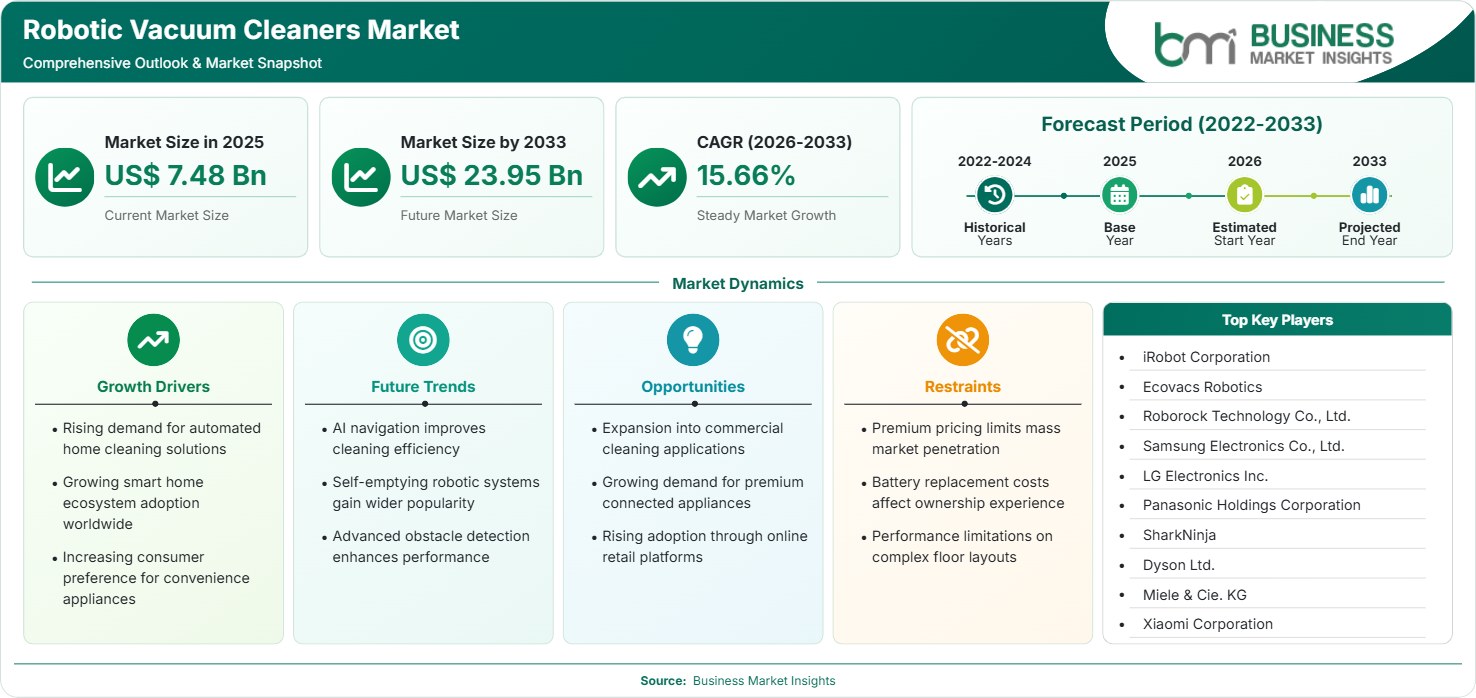
The Robotic Vacuum Cleaners Market size was valued at US$ 7.48 billion in 2025 and is projected to reach US$ 23.95 billion by 2033, growing at a CAGR of 15.66% during 2026–2033. Rising demand for automated home cleaning solutions, expanding smart home ecosystems, and increasing consumer preference for convenient household appliances continue accelerating market expansion.

Report Coverage
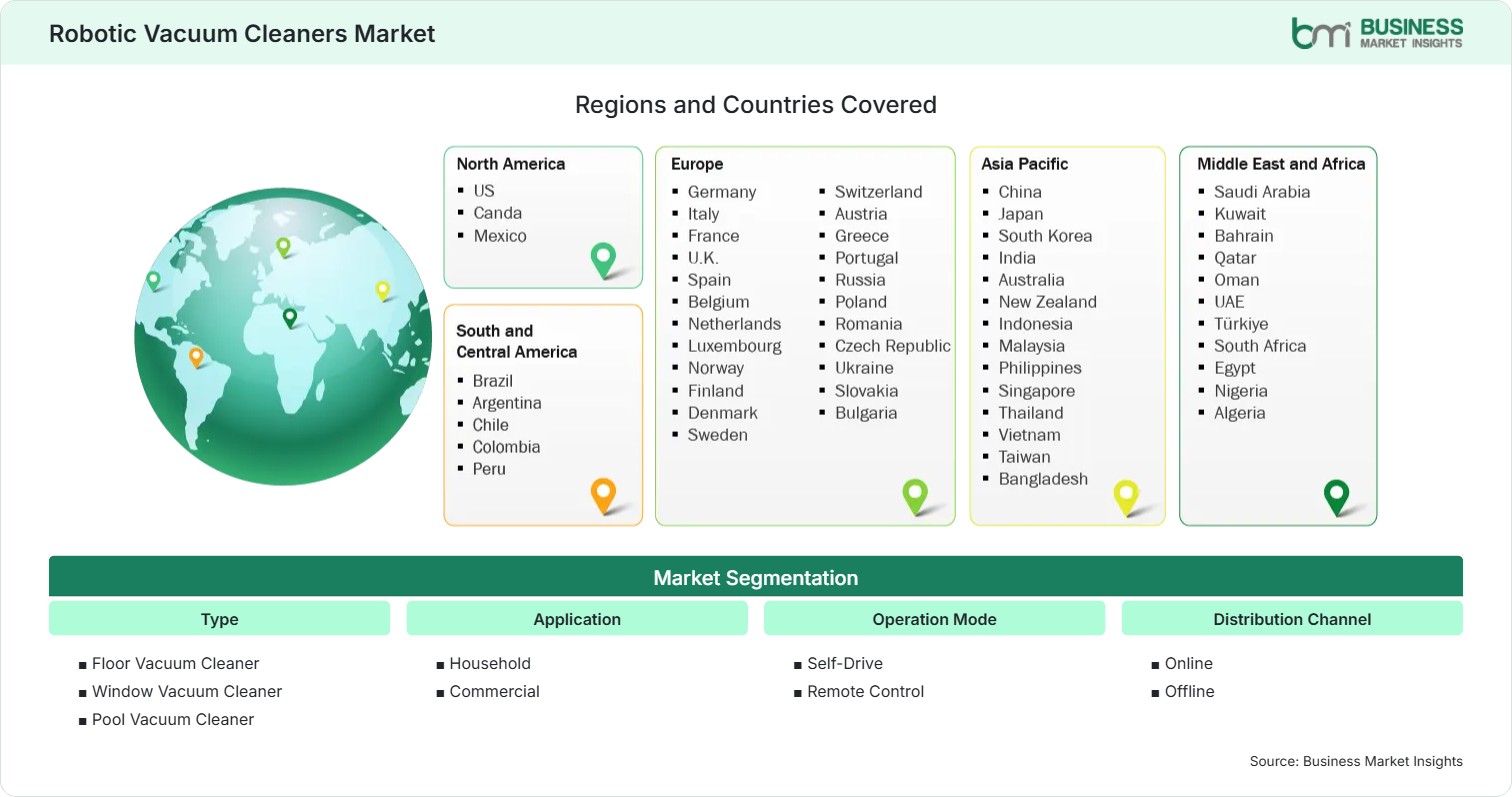
  • Type: Floor Vacuum Cleaner, Window Vacuum Cleaner, Pool Vacuum Cleaner
  • Application: Household, Commercial
  • Operation Mode: Self-Drive, Remote Control
  • Distribution Channel: Online, Offline
  • Price: Below USD 150, USD 150-300, USD 300-500, Above USD 500
US$ 7.48 Bn Market size in 2025
US$ 23.95 Bn Market Size by 2033
15.66% CAGR, 2026 - 2033
2026-2033 Forecast Period

01 AI Overview

Robotic Vacuum Cleaners Market Summary

  • North America Region: North America accounts for 34%–37% market share in 2025 and is projected to grow at a CAGR of 14.8%–15.3% during 2026–2033. High smart home penetration, premium appliance adoption, and growing consumer spending on connected home technologies continue supporting regional expansion. The U.S. remains the leading contributor with a CAGR of 14.9%–15.4%, driven by rising demand for intelligent home automation solutions.
  • Fastest Growing Region: Asia Pacific represents 30%–33% market share in 2025 and is expected to register a CAGR of 16.7%–17.3%, supported by rising disposable income, expanding urban populations, rapid smart home adoption, and increasing e-commerce penetration.
  • Leading Segment: Floor Vacuum Cleaner accounts for 71%–74% market share in 2025 and is anticipated to expand at a CAGR of 15.8%–16.4%, owing to widespread household adoption and continuous product innovation.
  • High Growth Segment: Household captures 76%–79% market share in 2025 and is projected to record a CAGR of 16.1%–16.7%, supported by rising dual-income households, busy lifestyles, and increasing preference for automated cleaning.
  • Key Market Opportunity: Artificial intelligence-powered navigation, connected home integration, and expansion into commercial cleaning applications continue creating long-term growth opportunities for robotic cleaning solution providers.
  • Major Market Players: iRobot Corporation, Ecovacs Robotics, Roborock Technology Co., Ltd., Samsung Electronics Co., Ltd., LG Electronics Inc., Panasonic Holdings Corporation, SharkNinja, Dyson Ltd., Miele & Cie. KG, and Xiaomi Corporation.
02 Strategic Insights

Robotic Vacuum Cleaners Market: Strategic Insights

Robotic Vacuum Cleaners Market Strategic Framework
FREE PDF
Request your free sample
Request free sample
03 Stakeholder View

Key Takeaways

  • Growing adoption of connected home ecosystems continues strengthening demand for intelligent robotic cleaning appliances integrated with mobile applications and voice-controlled platforms.
  • Artificial intelligence, advanced navigation systems, and self-maintenance features are becoming major competitive differentiators among leading manufacturers.
  • Household applications remain the largest revenue contributor, while commercial cleaning represents the fastest emerging opportunity for future expansion.
  • Asia Pacific offers the strongest long-term investment potential due to increasing urbanization, expanding middle-class populations, and rapid smart appliance adoption.
  • Online retail channels continue reshaping purchasing behavior by improving product accessibility, competitive pricing, and customer engagement through digital platforms.
  • Manufacturers continue investing in premium product innovation, software upgrades, and connected services to improve customer retention and strengthen long-term brand competitiveness.
04 Geographic Outlook

Robotic Vacuum Cleaners Market Regional Highlights

North America Robotic Vacuum Cleaners Market

North America accounts for 34%–37% Robotic Vacuum Cleaners Market share in 2025 and is expected to register a CAGR of 14.8%–15.3% during 2026–2033. Strong consumer purchasing power, high smart home adoption, and increasing investment in connected household appliances continue supporting regional demand. Manufacturers are introducing premium robotic cleaning systems equipped with AI-based navigation, self-emptying technology, and advanced mapping capabilities to improve cleaning efficiency and customer experience.

  • High adoption of connected home devices continues increasing demand for intelligent robotic cleaning solutions across residential households.
  • Premium appliance manufacturers focus on AI-powered navigation, automated maintenance, and enhanced battery performance.
  • E-commerce platforms strengthen product availability and accelerate market penetration across urban and suburban regions.
  • Rising awareness of time-saving household appliances supports continued replacement of conventional vacuum cleaners.

US Robotic Vacuum Cleaners Market

The United States contributes 83%–86% of North American revenue and is projected to expand at a CAGR of 14.9%–15.4% through 2026–2033. Increasing smart home adoption, premium appliance spending, and consumer preference for automated household technologies continue driving sustained demand.

  • AI-enabled robotic cleaners gain popularity among homeowners seeking fully automated cleaning experiences.
  • Connected home ecosystems strengthen integration with voice assistants and mobile applications.
  • Growing online retail activity improves product availability across multiple consumer segments.
  • Premium product launches continue expanding customer choice across different price categories.

Europe Robotic Vacuum Cleaners Market

Europe represents 25%–28% market share in 2025 and is expected to grow at a CAGR of 14.3%–14.9% during the forecast period. Demand is supported by increasing home automation, aging populations seeking convenience, and growing awareness of energy-efficient household appliances. Germany leads regional sales, while Spain records the fastest growth through expanding smart home adoption and consumer electronics spending.

  • Rising demand for connected appliances supports wider adoption of robotic floor cleaning solutions.
  • Manufacturers continue introducing environmentally efficient products with lower energy consumption.
  • Smart home investments strengthen sales of premium robotic vacuum cleaners across residential markets.
  • Expanding organized retail and online distribution improve consumer access to advanced cleaning technologies.

Asia Pacific Robotic Vacuum Cleaners Market

Asia Pacific holds 30%–33% market share in 2025 and is expected to register the fastest 16.7%–17.3% CAGR through 2026–2033. Rising urbanization, growing middle-income households, increasing consumer electronics spending, and strong regional manufacturing capabilities continue supporting rapid market expansion. China remains the leading regional market, while India records the fastest growth through increasing smart appliance adoption and expanding e-commerce infrastructure.

  • Rapid growth of smart homes continues driving demand for connected robotic cleaning appliances.
  • Local manufacturers introduce technologically advanced products across multiple price segments.
  • Expanding digital commerce platforms improve accessibility in both metropolitan and emerging cities.
  • Rising disposable income supports premium household appliance purchases throughout the region.

Rest of World Robotic Vacuum Cleaners Market

The Rest of World region accounts for 5%–8% market share in 2025 and is projected to expand at a CAGR of 14.6%–15.2% during 2026–2033. Improving living standards, increasing urban residential development, and expanding smart home awareness continue supporting market demand across Latin America, the Middle East, and Africa.

  • Brazil leads regional demand through expanding consumer electronics adoption and online retail growth.
  • GCC countries continue investing in premium smart home technologies and automated household appliances.
  • Growing urban populations encourage adoption of convenient home cleaning solutions.
  • Improved retail distribution networks strengthen market accessibility across developing economies.
Global Market Geography
FREE PDF
Request your free sample
Request free sample
05 Segment Analysis

Robotic Vacuum Cleaners Market Segmentation

Type

The type segment remains the largest contributor as consumers increasingly seek automated cleaning solutions that reduce manual effort while improving cleaning efficiency. It accounted for 71%–74% market share in 2025 and is expected to register a CAGR of 15.8%–16.4% during 2026–2033. Continuous innovation in navigation technology, artificial intelligence, and battery performance continues expanding the Robotic Vacuum Cleaners Market scope, enabling manufacturers to address diverse residential and commercial cleaning requirements.

  • Floor Vacuum Cleaner: Dominates the segment because of broad household adoption, advanced mapping capabilities, automatic charging functions, and compatibility with multiple flooring surfaces including hardwood, tiles, and carpets.
  • Window Vacuum Cleaner: Gains popularity among consumers seeking automated glass cleaning solutions for residential buildings, offices, hotels, and commercial facilities with minimal manual intervention.
  • Pool Vacuum Cleaner: Experiences increasing demand from residential and commercial swimming pool owners due to automated debris removal, reduced maintenance effort, and improved cleaning efficiency.

Application

The application segment continues expanding as intelligent cleaning technologies become more affordable and widely accepted across residential and commercial environments. It represented 76%–79% market share in 2025 and is projected to grow at a CAGR of 16.1%–16.7% during 2026–2033. Current Robotic Vacuum Cleaners Market trends indicate increasing investment in connected appliances that improve operational efficiency, convenience, and cleaning consistency.

  • Household: Represents the largest application area as homeowners increasingly adopt robotic cleaning devices to simplify daily cleaning routines while integrating them into broader smart home ecosystems.
  • Commercial: Continues expanding across offices, hotels, healthcare facilities, educational institutions, and retail establishments seeking automated floor maintenance solutions that improve productivity and reduce labor requirements.

Operation Mode

Operation mode plays a significant role in determining user convenience, automation capability, and cleaning efficiency across different environments. The segment accounted for 67%–70% market share in 2025 and is expected to register a CAGR of 15.7%–16.3% through 2026–2033. Artificial intelligence, advanced sensors, and wireless connectivity continue supporting fully autonomous cleaning operations across multiple applications.

  • Self-Drive: Leads the segment through intelligent navigation, automatic obstacle avoidance, scheduled cleaning, self-charging capability, and minimal user intervention for routine floor maintenance.
  • Remote Control: Maintains stable demand among users seeking greater operational flexibility through mobile applications, handheld controllers, and voice assistant integration for customized cleaning routines.

Distribution Channel

Distribution channels continue evolving as manufacturers strengthen omnichannel sales strategies to improve customer reach and product accessibility. This segment represented 58%–61% market share in 2025 and is projected to expand at a CAGR of 15.9%–16.5% during the forecast period. Growing digital commerce and direct-to-consumer platforms continue influencing purchasing decisions worldwide.

  • Online: Continues recording strong demand due to wider product availability, competitive pricing, customer reviews, convenient delivery services, and promotional offers through major e-commerce platforms.
  • Offline: Maintains importance through electronics retailers, specialty appliance stores, and branded showrooms where consumers prefer live product demonstrations and personalized purchasing assistance.

Price

Price segmentation reflects the growing availability of robotic vacuum cleaners across multiple consumer budgets and performance categories. It accounted for 38%–41% market share in 2025 and is expected to register a CAGR of 16.3%–16.9% during 2026–2033. Manufacturers continue introducing differentiated products that balance affordability, intelligent features, and premium cleaning performance.

  • Below USD 150: Appeals primarily to first-time buyers seeking affordable automated cleaning with essential navigation and floor cleaning capabilities.
  • USD 150–300: Represents strong consumer demand by offering an effective balance between intelligent features, product quality, and competitive pricing.
  • USD 300–500: Attracts consumers seeking enhanced navigation technologies, larger batteries, smart connectivity, and improved cleaning performance for larger homes.
  • Above USD 500: Targets premium households through advanced artificial intelligence, self-emptying docks, LiDAR mapping, multifunction cleaning capabilities, and seamless smart home integration.
06 Market Forces

Robotic Vacuum Cleaners Market Dynamics

Key Market Drivers

Rising demand for automated home cleaning solutions

Consumers are increasingly seeking household appliances that reduce manual effort and save time, making robotic vacuum cleaners an attractive solution for modern lifestyles. Urban growth, hectic work commitments, and an increased number of dual-income families continue to facilitate the use of robotic cleaning solutions. Technology manufacturers have improved the efficiency of the products using artificial intelligence, navigation systems, object detection systems, and self-emptying features. Increased durability of batteries, better cleaning accuracy, and mobile phone controls add further confidence to the customers. These developments continue supporting Robotic Vacuum Cleaners Market growth, particularly in urban households where convenience, automation, and consistent cleaning performance are becoming essential purchasing considerations.

Growing smart home ecosystem adoption worldwide

The rapid expansion of connected home ecosystems is significantly increasing demand for intelligent household appliances capable of seamless integration with digital platforms. Robotic vacuum cleaners are now integrated with voice assistants, smart speakers, mobile apps, and automated home control systems enabling users to program their cleaning cycles and observe the status of the device. The developments in Wi-Fi technology, cloud computing, and artificial intelligence have led to increased accuracy and customized cleaning. Companies continue developing and improving software in order to increase efficiency. These innovations are accelerating product adoption across developed and emerging economies where smart home technologies continue gaining widespread acceptance.

Increasing consumer preference for convenience appliances

Consumer purchasing behavior increasingly favors appliances that simplify everyday household activities while minimizing maintenance requirements. Robotic vacuum cleaners cater to this need by offering an automated cleaning system that requires little human intervention, which makes it easier for people to concentrate on their other tasks. Improved navigation technology, automatic recharging, automatic cleaning operations, and versatility in cleaning different types of floors have added to the desirability of the products among different consumer groups. These advancements continue influencing Robotic Vacuum Cleaners Market trends, encouraging replacement of traditional vacuum cleaners with intelligent automated alternatives.

Key Market Opportunities

Expansion into commercial cleaning applications

Commercial facilities are increasingly adopting robotic cleaning equipment to improve operational efficiency while reducing labor requirements. Autonomous cleaning systems have been implemented by offices, hotels, hospitals, educational establishments, airports, and shopping complexes that ensure high-quality cleaning of large surfaces with constant performance. Manufacturers continue producing commercial robots with increased dust bin capacity, longer battery time, fleet management system, and enhanced obstacle detection technology. As labor shortages and operational costs continue rising across service industries, automated commercial cleaning solutions are expected to become an increasingly important revenue opportunity for manufacturers and facility management providers.

Growing demand for premium connected appliances

Consumers are increasingly showing more readiness to spend on premium robot vacuum cleaners with sophisticated features such as automation, smart mapping, self-cleaning stations, and built-in smart home capability. Factors such as disposable income, increased usage of connected devices, and recognition of the advantages of home automation are expected to remain supportive of premium products. Manufacturers are distinguishing themselves by using AI and machine learning, custom scheduling and UI. Robotic Vacuum Cleaners Market Forecasts indicate that premium connected appliances will remain a major growth area as technology continues improving overall user experience and operational efficiency.

Rising adoption through online retail platforms

E-commerce has become a critical distribution channel for robotic vacuum cleaner manufacturers by improving product accessibility across both developed and emerging markets. Consumers can easily compare specifications, review feedback from previous buyers, find discounts on their products, and purchase these through the online platform. The manufacturers are also enhancing their direct-to-consumer approaches while using various marketing campaigns in the online arena. Expansion of organized e-commerce infrastructure and digital payment systems is expected to create sustained opportunities for companies introducing innovative robotic cleaning solutions across multiple price segments.

Market Restraints and Challenges

Premium pricing limits mass market penetration

Advanced robotic vacuum cleaners equipped with artificial intelligence, LiDAR navigation, self-emptying stations, and multifunction cleaning technologies often carry significantly higher purchase prices than conventional vacuum cleaners. Factor: High cost of the product hinders adoption by budget-conscious buyers, especially in developing countries where family budgets are tight. Impact: Limited penetration of the mass market affects growth in sales despite heightened awareness about automated cleaning technologies. Companies keep launching mid-range product lines with easy payment terms in order to keep prices affordable without compromising on product attributes and value.

Battery replacement costs affect ownership experience

Battery performance gradually declines with prolonged product usage, making periodic replacement necessary to maintain cleaning efficiency and operating time. Factor: The replacement batteries and servicing charges add to the cost of owning these products and create an extra maintenance burden on customers. Impact: Increased costs could reduce the likelihood of repeat business or delayed product upgrades, especially from cost-sensitive consumers. The manufacturers are constantly striving to develop better batteries and charging systems that make their products more energy efficient.

07 Company Analysis

Competitive Landscape

Competition remains intense as manufacturers focus on artificial intelligence, LiDAR navigation, self-emptying technology, and seamless smart home connectivity to differentiate their offerings. According to Robotic Vacuum Cleaners Market analysis, major investments are being made in software improvements, cloud-based device management, enhanced suction technology, and superior automation systems. Partnership with online platforms, development of commercial cleaning robots, and innovations in the product portfolio still remain some of the major strategies adopted by the companies.

Company Name

Overview

Products and Services Relevant to this Market

iRobot Corporation

Pioneer in robotic floor cleaning with extensive experience in intelligent household automation technologies.

Roomba robotic vacuum cleaners, Braava robotic mops, AI navigation software, self-emptying docks, and connected cleaning platforms.

Ecovacs Robotics

Global robotics manufacturer offering intelligent cleaning products for residential and commercial users.

DEEBOT robotic vacuum cleaners, robotic window cleaners, AI navigation, smart mapping software, and automatic dust collection systems.

Roborock Technology Co., Ltd.

Leading smart cleaning technology company recognized for premium robotic vacuum innovations.

Robotic vacuum and mop combinations, LiDAR navigation, intelligent mapping software, multifunction docking stations, and mobile application control.

Samsung Electronics Co., Ltd.

Global electronics company expanding AI-enabled smart home appliance solutions.

Jet Bot robotic vacuum cleaners, AI object recognition, smart home connectivity, automated cleaning technologies, and cloud-based appliance management.

LG Electronics Inc.

Consumer electronics manufacturer focusing on connected home appliances and intelligent automation.

Robotic vacuum cleaners, AI-powered navigation, smart appliance platforms, automated cleaning systems, and connected home technologies.

Panasonic Holdings Corporation

Technology company providing innovative consumer appliances and intelligent household products.

Robotic vacuum cleaners, home automation solutions, intelligent navigation technologies, and energy-efficient cleaning appliances.

SharkNinja

Household appliance manufacturer developing innovative floor care products for residential consumers.

Shark robotic vacuum cleaners, self-emptying systems, intelligent mapping technology, cordless cleaning products, and smart home integration.

Dyson Ltd.

Premium engineering company specializing in high-performance household cleaning technologies.

Intelligent robotic vacuum cleaners, digital motor technology, advanced filtration systems, smart navigation, and automated cleaning solutions.

Miele & Cie. KG

Premium appliance manufacturer serving residential customers with durable home cleaning equipment.

Robotic vacuum cleaners, premium floor care products, intelligent navigation systems, and connected cleaning technologies.

Xiaomi Corporation

Consumer electronics company offering affordable smart home products through an integrated digital ecosystem.

Mi Robot Vacuum series, AI-powered navigation, smart home connectivity, mobile application control, and automated cleaning solutions.

10 Trust & Transparency

Research Methodology

The market analysis combines proprietary research with secondary data from government agencies, company disclosures, regulatory filings, industry databases and expert interviews. Market estimates are validated through data triangulation, cross-market benchmarking and analyst review.

View Full Research Methodology

11 Questions Answered

Frequently Asked Questions

What does the Robotic Vacuum Cleaners Market Report cover?

The Market Report includes comprehensive analysis of market size, competitive landscape, regional outlook, segmentation, technology trends, investment opportunities, strategic developments, and long-term growth prospects.

How is artificial intelligence improving robotic vacuum cleaners?

Artificial intelligence enables intelligent room mapping, obstacle detection, adaptive cleaning routes, voice assistant compatibility, automatic scheduling, and continuous software improvements that enhance cleaning performance and user experience.

Which region is expected to grow the fastest?

Asia Pacific is forecast to register the highest growth due to increasing urbanization, expanding middle-class populations, strong consumer electronics manufacturing, and wider adoption of connected household appliances.

Which application accounts for the largest market share?

Household applications dominate the market because residential consumers increasingly prefer automated floor cleaning systems that reduce manual effort while improving cleaning consistency and everyday convenience.

What is driving demand in the Robotic Vacuum Cleaners Market?

Demand is supported by rising smart home adoption, increasing consumer preference for automated household appliances, technological advancements in artificial intelligence, and growing interest in convenient, time-saving home cleaning solutions.

Access the Full Robotic Vacuum Cleaners Market Report

Get segment-level forecasts, regional estimates, competitive benchmarking, company profiles and downloadable Excel datasets.

Access the full Robotic Vacuum Cleaners Market Report
350 pages PDF & Excel | 2026-08-12