
Skin Care Market Outlook: Size, Share, Trends, Growth Analysis, Competitive Landscape & Forecast, 2026-2033

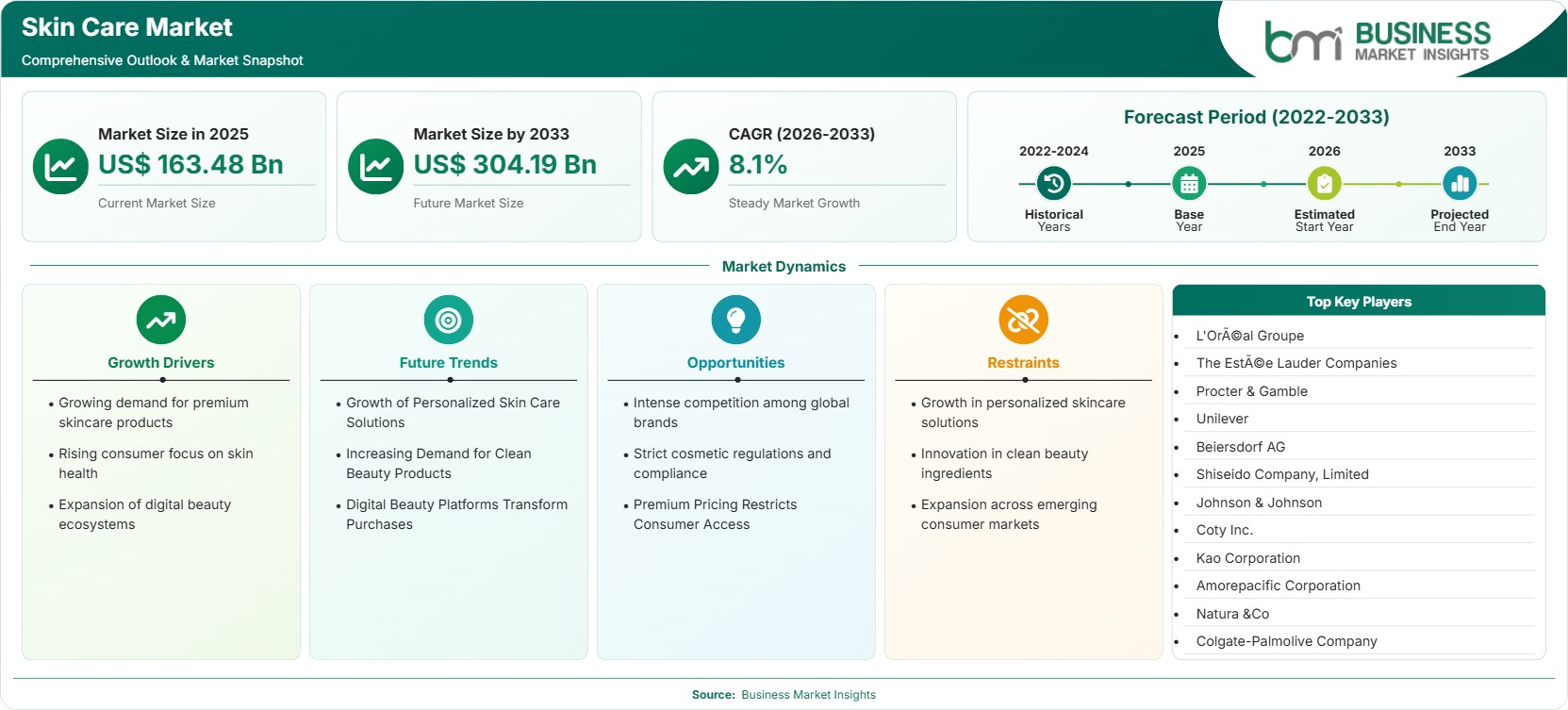
The Skin Care Market size was valued at US$ 163.48 billion in 2025 and is expected to reach USD 304.19 billion by 2033, exhibiting a growth rate of 8.1% from 2026 to 2033, owing to increasing consumer consciousness about skin health, high-end beauty products, customized skincare treatment, increase in online retailing, and innovative ingredients.

Report Coverage
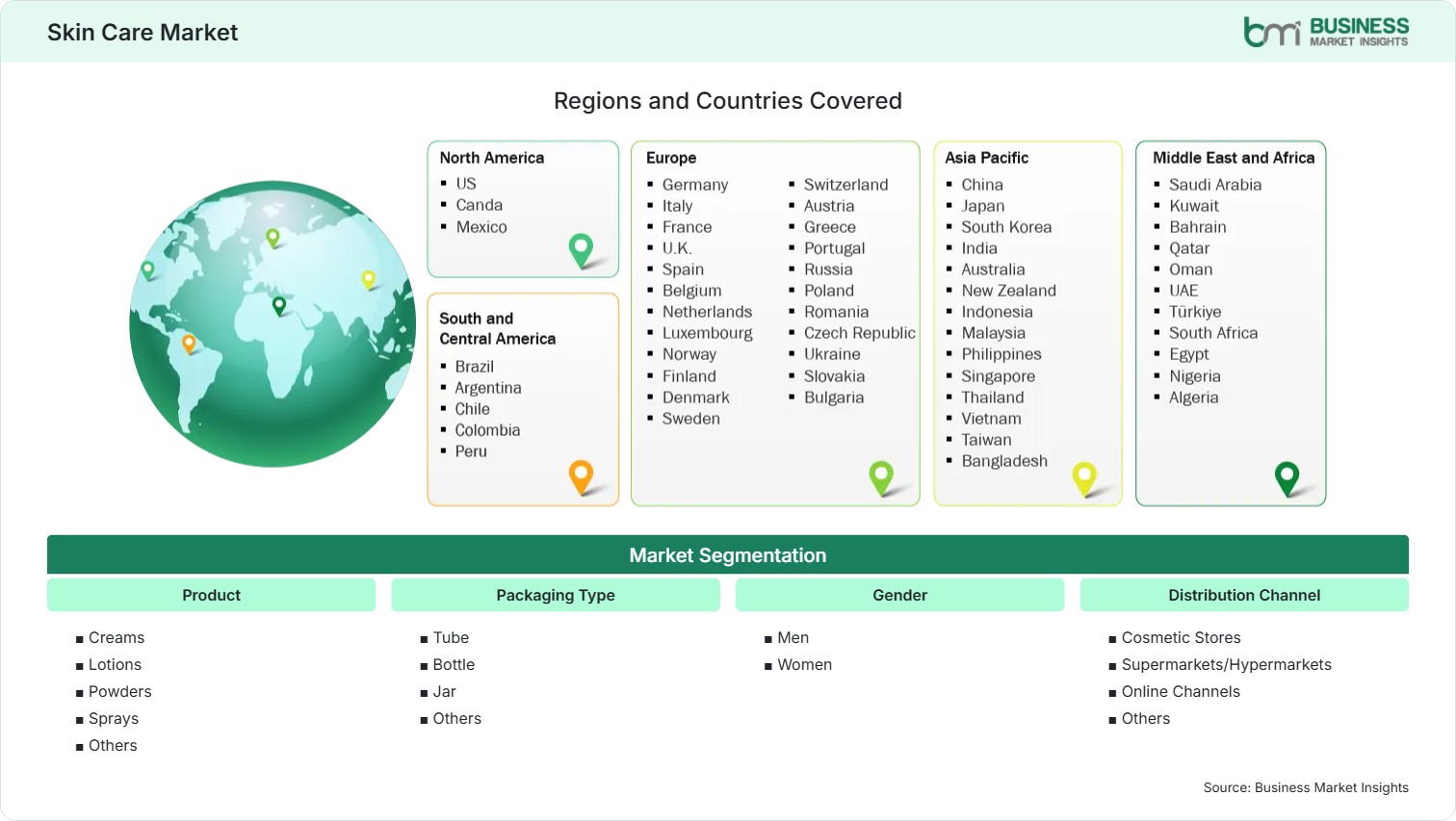
  • Product: Creams, Lotions, Powders, Sprays, Others
  • Packaging Type: Tube, Bottle, Jar, Others
  • Gender: Men, Women
  • Distribution Channel: Cosmetic Stores, Supermarkets/Hypermarkets, Online Channels, Others
US$ 163.48 Bn Market size in 2025
US$ 304.19 Bn Market Size by 2033
8.1% CAGR, 2026 - 2033
2026-2033 Forecast Period

01 AI Overview

Skin Care Market Summary

  • North America Region: North America holds a market share of 26%–29% in 2025 and is projected to expand at a CAGR of 7.6%–8.3% during 2026–2033, supported by premium beauty demand, dermatological product adoption, strong e-commerce penetration, and continuous product innovation. The US dominates the regional industry with a CAGR of 7.8%–8.5%, driven by high consumer spending and established cosmetic brands.
  • Fastest Growing Region: Asia Pacific accounts for 39%–42% of the global market in 2025 and is anticipated to grow at a CAGR of 8.8%–9.5% during 2026–2033. Expanding middle-class populations, increasing disposable income, K-beauty influence, and digital commerce continue accelerating regional product consumption and investment.
  • Leading Segment: Creams account for 41%–44% of market revenue in 2025 and are expected to register a CAGR of 7.9%–8.6% through 2026–2033. Strong demand for moisturizers, anti-aging formulations, barrier repair products, and multifunctional skincare solutions continues supporting segment leadership.
  • High Growth Segment: Online Channels represent 24%–27% of distribution revenue in 2025 and are projected to expand at a CAGR of 10.0%–10.8% during 2026–2033. Digital shopping convenience, influencer marketing, personalized recommendations, and direct-to-consumer strategies are driving rapid expansion.
  • Key Market Opportunity: Growing demand for clean-label formulations, biotechnology-derived ingredients, AI-powered skin analysis, and personalized skincare routines is creating long-term opportunities for manufacturers investing in premium and science-backed product development.
  • Major Market Players: L'Oréal Groupe; The Estée Lauder Companies Inc.; Procter & Gamble Company; Unilever PLC; Beiersdorf AG; Shiseido Company, Limited; Johnson & Johnson; Coty Inc.; Kao Corporation; Amorepacific Corporation; Natura &Co Holding S.A.; Colgate-Palmolive Company; Revlon, Inc.; Mary Kay Inc.; Oriflame Holding AG.
02 Strategic Insights

Skin Care Market: Strategic Insights

Skin Care Market Strategic Framework
FREE PDF
Request your free sample
Request free sample
03 Stakeholder View

Key Takeaways

  • The value chain continues integrating ingredient suppliers, formulation specialists, packaging manufacturers, beauty brands, retailers, dermatology clinics, and digital commerce platforms to improve innovation and consumer accessibility.
  • Cream-based skincare products remain the largest revenue contributor, while online retail channels present the strongest growth opportunities through expanding digital beauty ecosystems and personalized shopping experiences.
  • Scientific skincare innovation is shifting toward biotechnology-derived actives, microbiome-friendly formulations, AI-powered skin diagnostics, and sustainable ingredient sourcing to improve efficacy and customer engagement.
  • Asia Pacific offers the strongest long-term investment potential due to expanding middle-income populations, premium beauty adoption, and increasing influence of regional skincare trends across international markets.
  • Beauty companies continue strengthening market positions through acquisitions, brand portfolio expansion, strategic collaborations, and investments in premium skincare technologies and sustainable product development.
  • Consumer preference for ingredient transparency, refillable packaging, and environmentally responsible production practices is encouraging companies to accelerate sustainability initiatives across the skincare value chain.
04 Geographic Outlook

Skin Care Market Regional Highlights

North America Skin Care Market

The North American skin care market share holds a percentage of 26%-29% in 2025 while growing at a CAGR of 7.6%-8.3% from 2026 to 2033. High purchasing power, high-end skin care needs, dermatological skin care, and increased use of e-commerce in the region will fuel the growth of the market.

  • The United States remains the largest regional contributor through strong premium skincare consumption, product innovation, and widespread adoption of dermatologist-endorsed cosmetic products.
  • Beauty companies continue investing in biotechnology ingredients, personalized skincare platforms, and AI-enabled skin analysis to improve consumer engagement and brand differentiation.
  • Growing preference for clean-label formulations and sustainable packaging is encouraging manufacturers to redesign product portfolios across premium and mass-market categories.
  • Retailers continue strengthening omnichannel strategies by integrating physical stores with digital commerce platforms to improve customer convenience and product accessibility.
  • Rising consumer awareness regarding preventive skincare routines continues supporting long-term Skin Care Market growth throughout the region.

US Skin Care Market

The United States represents the largest national market in North America, accounting for 22%–24% of global revenue in 2025 while expanding at a CAGR of 7.8%–8.5% during 2026–2033. Strong premium beauty spending, increasing dermatological awareness, and extensive digital retail infrastructure continue supporting robust product demand across multiple skincare categories.

  • Premium anti-aging products, moisturizers, and sun protection formulations remain among the strongest revenue-generating skincare categories.
  • E-commerce platforms and social commerce continue accelerating product discovery through influencer marketing, personalized recommendations, and subscription-based purchasing models.
  • Dermatologists increasingly recommend clinically tested skincare products containing scientifically validated active ingredients to address specific skin concerns.
  • Domestic manufacturers continue investing in research, sustainable packaging, and personalized skincare technologies to strengthen competitive positioning.

Europe Skin Care Market

Europe contributes 24%-27% of the total revenue globally in 2025 and has a CAGR of 7.4%-8.1% from 2026-2033. Premium skin care preferences, stringent cosmetic policies, and sustainable practices keep driving the growth of this region. Germany and France represent two major countries within this region whereas Spain is growing rapidly.

  • Germany maintains regional leadership through strong premium cosmetic demand, advanced skincare innovation, and established beauty manufacturing capabilities.
  • Spain records one of the fastest regional growth rates with a CAGR of 8.5%–9.2%, supported by premium beauty consumption and expanding online cosmetic retail.
  • European consumers increasingly prioritize natural ingredients, vegan formulations, and environmentally sustainable packaging solutions.
  • Regulatory emphasis on ingredient transparency continues encouraging manufacturers to improve product quality and consumer confidence.
  • Beauty companies continue introducing premium skincare ranges targeting anti-aging, hydration, and sensitive skin applications.

Asia Pacific Skin Care Market

Asia Pacific represents 39%–42% of global revenue in 2025 and is projected to register the fastest CAGR of 8.8%–9.5% during 2026–2033. Rising disposable income, urbanization, digital commerce expansion, and strong beauty culture continue supporting robust regional demand. China remains the largest market, while India demonstrates the fastest investment momentum.

  • China dominates regional demand through large consumer populations, premium skincare adoption, and extensive domestic beauty manufacturing capabilities.
  • India is expected to record a CAGR of 9.8%–10.5%, driven by rising disposable income, expanding organized retail, and growing awareness of skincare routines.
  • South Korea and Japan continue leading innovation through advanced cosmetic research, biotechnology, and globally recognized skincare brands.
  • Social media platforms and beauty influencers significantly influence purchasing decisions among younger consumers throughout the region.
  • Manufacturers continue expanding local production facilities and premium product portfolios to address growing domestic demand.

Rest of World Skin Care Market

The Rest of World region accounts for 7%–9% of global revenue in 2025 while expanding at a CAGR of 7.8%–8.6% during 2026–2033.

There is an increase in consumption of premium beauty care in Latin America due to the growth in retail infrastructure, while the Middle East & Africa are witnessing increasing demand for skin care products due to factors such as urbanization, higher disposable income, and increased awareness about beauty products.

  • Brazil remains the leading Latin American market, while Mexico records faster growth with a CAGR of 8.8%–9.5% supported by expanding premium beauty retail.
  • Gulf countries continue experiencing increasing demand for luxury skincare products driven by higher disposable income and premium brand availability.
  • African markets present long-term opportunities through expanding urban populations, modern retail development, and increasing skincare awareness.
  • International beauty companies continue strengthening regional distribution partnerships to improve product availability and market penetration.
  • Growing demand for multifunctional skincare products continues supporting steady regional market expansion.
Global Market Geography
FREE PDF
Request your free sample
Request free sample
05 Segment Analysis

Skin Care Market Segmentation

Product

The product segment remains the primary revenue contributor as consumers increasingly seek specialized skincare solutions addressing hydration, anti-aging, pigmentation, acne, and sun protection. The segment accounted for 100% of market demand in 2025 and is projected to grow at a CAGR of 8.1% during 2026–2033. Continuous product innovation, premium formulations, and ingredient advancements continue expanding the Skin Care Market scope across both mass-market and premium cosmetic categories.

  • Creams: Creams dominate the market owing to their extensive use in moisturization, anti-aging, skin repair, and barrier protection. Manufacturers continue introducing multifunctional formulations enriched with peptides, ceramides, hyaluronic acid, and botanical extracts.
  • Lotions: Lotions maintain strong consumer demand due to lightweight formulations suitable for daily hydration, body care, and sensitive skin applications. Increasing preference for fast-absorbing products supports continued segment expansion.
  • Powders: Powder-based skincare products are gaining attention for oil control, mineral formulations, and multifunctional cosmetic applications. Product innovation is improving convenience, portability, and suitability for diverse skin types.
  • Sprays: Facial mists and skincare sprays are witnessing rising adoption due to convenient application, instant hydration, and increasing demand for travel-friendly skincare products among younger consumers.

Packaging Type

Packaging plays an important role in influencing consumer purchases, as it enhances ease of use, sustainability, and brand distinctiveness. It accounted for 100% of the industry’s total demand in 2025 and will grow at a CAGR of 8.1% from 2026 to 2033. Sustainability, refills, and premium looks have become an integral part of the Skin Care Market share.

  • Tube: Tube packaging remains widely adopted because it offers convenience, controlled dispensing, hygiene, portability, and cost-effective production for creams, lotions, and gel-based skincare products.
  • Bottle: Bottles are extensively used for serums, lotions, cleansers, and liquid skincare products, supporting premium branding while providing compatibility with pumps and dispensing systems.
  • Jar: Jar packaging continues serving premium creams and masks requiring wider openings for consumer access while offering enhanced product presentation and premium shelf appeal.

Gender

Gender-based segmentation continues evolving as skincare becomes an essential component of daily personal care routines across broader demographic groups. The segment accounted for 100% of industry demand in 2025 and is projected to expand at a CAGR of 8.1% during 2026–2033. Growing inclusivity, premium product development, and changing consumer preferences continue driving Skin Care Market trends worldwide.

  • Men: Men's skincare continues expanding through increasing awareness of grooming, facial care, anti-aging products, and dermatologist-recommended skincare routines supported by targeted marketing strategies.
  • Women: Women remain the largest consumer segment due to extensive product usage across moisturizing, anti-aging, cleansing, brightening, and specialized skincare treatments throughout different age groups.

Distribution Channel

Distribution channel trends will continue evolving through the integration of e-commerce alongside physical stores, thereby making products more accessible and engaging for consumers. This segment comprised 100% of market activities in 2025 and is expected to grow at a CAGR of 8.1% between 2026 and 2033.

  • Cosmetic Stores: Cosmetic stores remain important for premium skincare purchases by providing product demonstrations, expert recommendations, personalized consultations, and extensive product selections.
  • Supermarkets/Hypermarkets: Supermarkets and hypermarkets continue generating significant sales through broad product availability, competitive pricing, promotional campaigns, and convenient shopping experiences.
  • Online Channels: Online channels are expanding rapidly as consumers increasingly purchase skincare products through e-commerce platforms offering personalized recommendations, subscription services, and wider product availability.
06 Market Forces

Skin Care Market Dynamics

Key Market Drivers

Growing demand for premium skincare products

Premium skincare products remain highly sought after among consumers because of the current trend towards preventative skincare, proven science, and high performing cosmetic ingredients. The combination of higher disposable incomes, increased skin health awareness, and beauty education via digital media is contributing to the rise in premium product use. As per the market trends that are backed by various organizations including Cosmetics Europe, there has been an increasing preference of customers towards efficiency, safety, and transparency in products. The growth in market can be attributed to innovations in anti-aging, hydration, and micro-biome friendly formulations, along with Skin Care Market trends showing high demand for clinically tested skincare products.

Rising consumer focus on skin health

Rising awareness about exposure to environment, UV rays, pollution, and skin conditions due to lifestyle factors has resulted in an increased demand for skincare products. People are adopting a preventative skincare regimen at younger ages and are looking for products which will help in improving hydration and skin barrier. Physicians and other skincare professionals are still impacting consumer decision-making process on basis of product recommendations supported by scientific research. Brands are catering to rising consumer demands with formulation based on ingredients like niacinamide, ceramides, retinol, peptides, and antioxidants.

Expansion of digital beauty ecosystems

The skincare industry has been greatly impacted by the changes in digital commerce, AI, and social media that have changed the way in which customers engage in this space. Skincare companies are increasingly using the power of AI for skin analysis, virtual consultation, and personalized recommendation along with collaborating with influencers. Digital commerce enables skincare brands to educate their consumers about different products and release new products quickly. The blend of beauty technology and digital commerce is providing better purchase experience and consumer-brand relationship management.

Key Market Opportunities

Growth in personalized skincare solutions

Personalized skin care is poised to be one of the biggest trends going forward, since more people want products that cater to their specific skin type, environment, and life situation. Firms are making use of technology such as artificial intelligence and genomics and digital diagnostic tools to suggest personalized formulas. This allows firms to charge higher prices while fostering loyalty through personalized skin care routines. According to the Skin Care Market Forecasts, firms will continue to invest in beauty technologies that can improve results and build customer loyalty.

Innovation in clean beauty ingredients

The demand for clean-label, vegan, cruelty-free, and nature-derived skin care products continues to present great opportunities for cosmetics companies. Increasingly, consumers look at what ingredients the product contains, how sustainable it is, and how transparent the whole process is before making purchases. Biotechnologically sourced ingredients, natural actives, recyclable packaging, and eco-friendly production are among the ways to enhance competitiveness in the industry.

Expansion across emerging consumer markets

The trend towards fast urbanization, increased middle-class communities, and higher levels of beauty consciousness in Asia, Latin America, and even some African countries have created a conducive environment for skin care producers. The expansion of organized retail, increased online presence, and rising demand for high-quality beauty products give opportunities to international and regional companies. Firms are adjusting their product formulation, pricing, and marketing to suit regional tastes and improving their distribution channels.

Market Restraints and Challenges

Intense competition among global brands

Factor: The skincare industry is highly competitive with multinational corporations, regional manufacturers, dermatologist brands, and emerging direct-to-consumer companies continuously introducing new products.

Impact: Intense competition requires higher spending on marketing, product development, and price. The companies need to innovate continually, promote branding, and engage customers in order to retain their market position.

Strict cosmetic regulations and compliance

Factor: Cosmetic products must comply with evolving regulations covering ingredient safety, product testing, labeling, environmental standards, and marketing claims across multiple international markets.

Impact: Regulatory compliance leads to increased cost in terms of research, testing, documentation, and re-formulation of products. Those firms operating internationally have to be in constant reformulation of their products to meet the ever-changing regional regulatory standards.

07 Company Analysis

Competitive Landscape

The competitive environment includes multinationals in the beauty industry, premium skincare providers, direct sellers, and natural cosmetics companies competing through innovations in ingredients, research in dermatology, digital business growth, and sustainable products development. According to the Skin Care Market analysis, companies are enhancing their competitive position through launching premium products, biotechnologically based formulations, mergers and acquisitions, omnichannel retailing, and AI-based personalized skincare services.

Company Name

Overview

Products and Services Relevant to this Market

L'Oréal Groupe

Global beauty leader offering diversified skincare brands across luxury, dermatological, and consumer segments.

Facial creams, serums, cleansers, sunscreens, anti-aging products, dermatologist-developed skincare solutions.

The Estée Lauder Companies Inc.

Premium cosmetics company with an extensive portfolio of prestige skincare brands.

Luxury skincare, moisturizers, facial serums, eye care products, anti-aging treatments, cleansers.

Procter & Gamble Company

Consumer goods company with strong presence in personal care and skincare products.

Facial cleansers, moisturizers, anti-aging products, acne care, skincare innovations.

Unilever PLC

Global FMCG company focused on mass-market and premium skincare solutions.

Skin creams, lotions, cleansers, facial care products, sustainable skincare formulations.

Beiersdorf AG

German skincare specialist recognized for scientifically developed skincare products.

Moisturizers, body care, sun care, dermatological skincare, sensitive skin products.

Shiseido Company, Limited

Japanese beauty company specializing in advanced skincare research and innovation.

Premium skincare, anti-aging products, facial treatments, sun protection, cosmetic formulations.

Johnson & Johnson

Global healthcare company with consumer skincare and dermatological product offerings.

Baby skincare, moisturizers, therapeutic skincare, wound care, dermatology products.

Coty Inc.

International beauty company expanding premium skincare and cosmetic offerings.

Premium skincare products, facial care solutions, beauty innovations, personal care products.

Kao Corporation

Japanese consumer goods manufacturer with advanced skincare technologies.

Cleansers, facial lotions, moisturizers, anti-aging products, skincare ingredients.

Amorepacific Corporation

South Korean beauty company known for premium skincare innovation and K-beauty expertise.

Serums, facial creams, botanical skincare, anti-aging products, luxury skincare solutions.

Natura &Co Holding S.A.

Sustainable beauty company focusing on naturally derived skincare products.

Natural skincare, moisturizers, facial oils, body care products, sustainable beauty solutions.

Colgate-Palmolive Company

Consumer products company expanding its personal care and skincare portfolio.

Facial cleansers, skin health products, personal care solutions, dermatologist-backed skincare.

Revlon, Inc.

Global cosmetics manufacturer with diversified skincare and beauty products.

Moisturizers, facial care, cosmetic skincare, beauty treatments, skin-enhancing formulations.

Mary Kay Inc.

Direct-selling beauty company focused on personalized skincare solutions.

Anti-aging products, cleansers, moisturizers, facial masks, skincare regimens.

Oriflame Holding AG

Beauty and wellness company specializing in naturally inspired skincare products.

Facial care, anti-aging creams, cleansers, skincare systems, wellness-oriented beauty products.

08 Industry Activity

Recent Developments

April 2026

The Estee Lauder Companies announced a minority investment in luxury clinical skincare brand 111SKIN, supporting global expansion, innovation, and growth of its prestige skincare portfolio.

August 2025

Beiersdorf AG introduced NIVEA Cellular Epigenetics Rejuvenating Serum, the company’s first mass-market skincare product featuring the epigenetic ingredient EPICELLINE. The launch extended Beiersdorf’s longevity-focused skincare research from its Eucerin dermatological portfolio into the broader NIVEA brand.

March 2025

Shiseido Company, Limited, launched a new generation of SHISEIDO ULTIMUNE serum, supported by more than 30 years of skin research and featuring the company’s patented Power Fermented Camellia+ technology to strengthen aging-care skincare innovation.

February 2025

Procter & Gamble (P&G) OLAY launched Super Serum Body Wash, extending facial skincare technology into body care. The new body wash combines OLAY’s serum-inspired skincare technology with advanced skin delivery technology and more than five skincare ingredients, including niacinamide, vitamins C and E, beta-hydroxy acid (BHA), and collagen peptide.

10 Trust & Transparency

Research Methodology

The market analysis combines proprietary research with secondary data from government agencies, company disclosures, regulatory filings, industry databases and expert interviews. Market estimates are validated through data triangulation, cross-market benchmarking and analyst review.

View Full Research Methodology

11 Questions Answered

Frequently Asked Questions

Which distribution channel is expected to grow the fastest?

Online channels are projected to record the highest growth due to expanding e-commerce platforms, social commerce, direct-to-consumer strategies, personalized recommendations, and increasing consumer preference for convenient digital shopping.

How is technology influencing skincare products?

Artificial intelligence, skin diagnostics, biotechnology, and digital personalization are helping brands develop customized skincare solutions, improve product recommendations, and enhance overall consumer experiences.

Why is Asia Pacific the fastest-growing regional Skin Care market?

Asia Pacific benefits from rising disposable income, expanding middle-class populations, strong beauty culture, rapid digital commerce growth, and continuous innovation led by major K-beauty and J-beauty manufacturers.

Which product segment dominates the market?

Creams remain the leading product segment because of their widespread use in moisturizing, anti-aging, skin repair, hydration, and daily skincare routines across all consumer demographics.

What is driving the growth of the market?

The market is expanding due to increasing consumer awareness of skin health, premium beauty demand, scientific ingredient innovation, personalized skincare solutions, and growing online retail channels that improve product accessibility worldwide, as highlighted in the Skin Care Market Report.

Access the Full Skin Care Market Report

Get segment-level forecasts, regional estimates, competitive benchmarking, company profiles and downloadable Excel datasets.

Access the full Skin Care Market Report
350 pages PDF & Excel | 2026-07-28