
Luxury Hair Care Market Outlook: Size, Share, Trends, Growth Analysis, Competitive Landscape & Forecast, 2026–2033

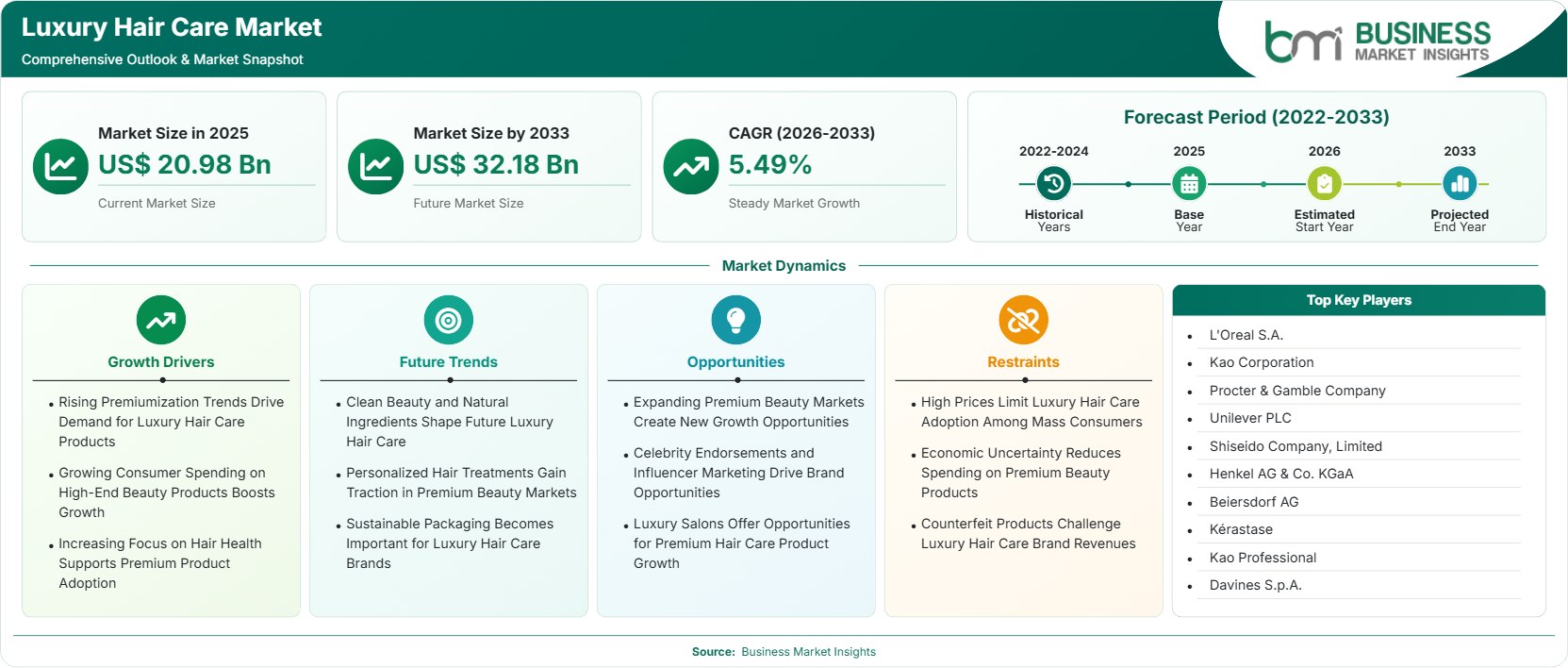
The Luxury Hair Care Market size was valued at US$ 20.98 Billion in 2025 and is projected to reach US$ 32.18 Billion by 2033, growing at a CAGR of 5.49% during 2026–2033, driven by premiumization, rising beauty expenditure, hair health awareness, salon demand, digital commerce, and innovation in high-performance formulations.

Report Coverage
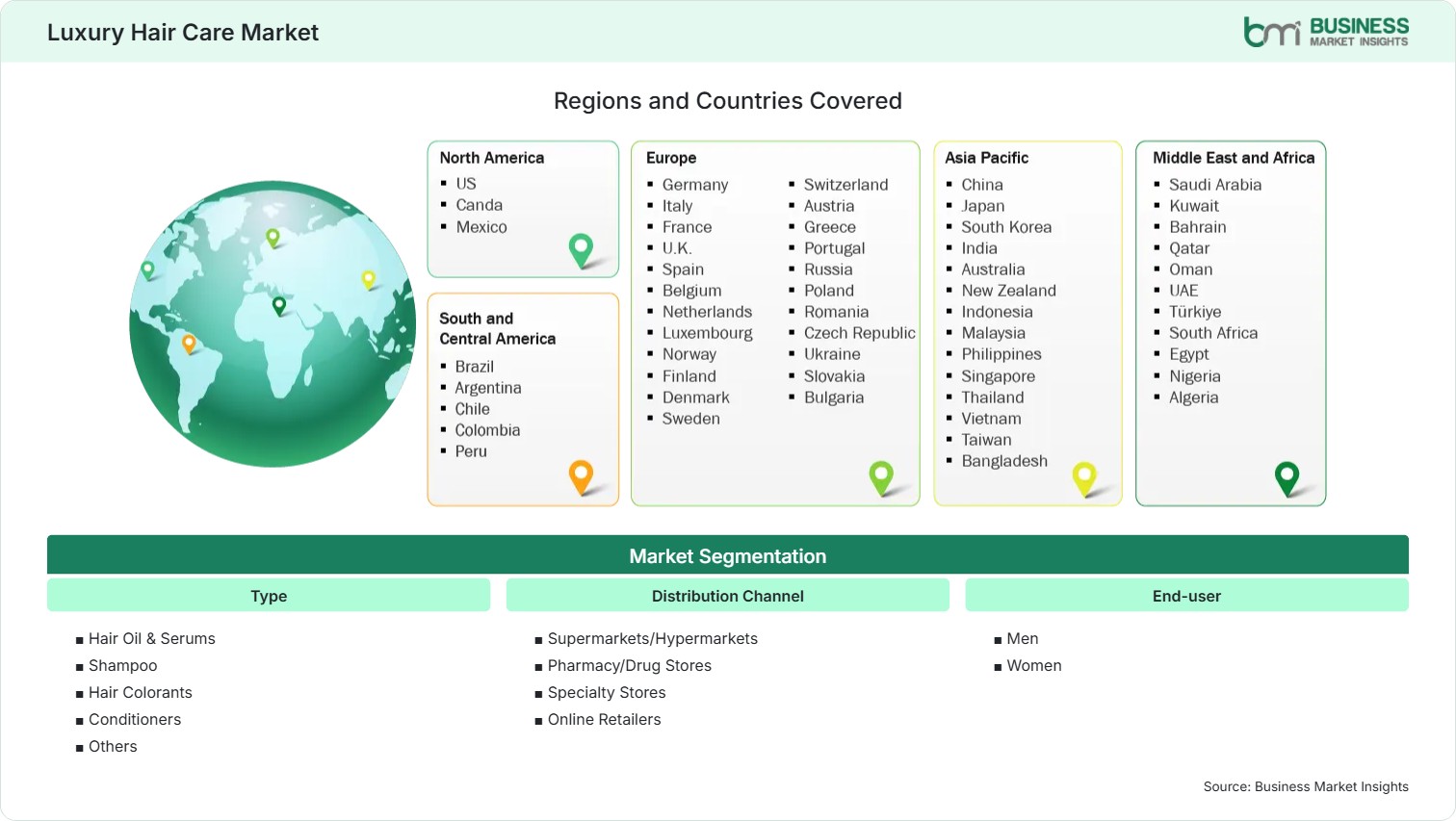
  • Type: Hair Oil & Serums, Shampoo, Hair Colorants, Conditioners, Others
  • Distribution Channel: Supermarkets/Hypermarkets, Pharmacy/Drug Stores, Specialty Stores, and Online Retailers
  • End-user: Men, Women
US$ 20.98 Bn Market size in 2025
US$ 32.18 Bn Market Size by 2033
5.49% CAGR, 2026 - 2033
2026-2033 Forecast Period

01 AI Overview

Luxury Hair Care Market Summary

  • North America Region: North America holds a market share of 25%–29% in 2025, growing at a CAGR of 4.80%–5.40%, supported by premium beauty spending, advanced salon infrastructure, and growing consumer interest in science-led hair health solutions. The US remains the regional anchor, with a 4.70%–5.30% CAGR through 2033, supported by premium product innovation and omnichannel distribution.
  • Fastest Growing Region: Asia Pacific holds a market share of 24%–28% in 2025, expanding at a CAGR of 6.80%–7.60%, driven by rising disposable income, beauty premiumization, professional salon development, and increasing consumer focus on personalized hair and scalp care.
  • Leading Segment: Hair Oil & Serums account for a 27%–31% share in 2025, growing at a CAGR of 5.80%–6.40%, supported by concentrated formulations, premium positioning, scalp health awareness, and consumer preference for targeted treatments addressing damage, dryness, and hair fall.
  • High Growth Segment: Online Retailers represent a 19%–23% share in 2025 and expand at a CAGR of 9.00%–10.00%, supported by direct-to-consumer models, social commerce, personalized recommendations, digital education, subscription purchasing, and convenient access to premium international brands.
  • Key Market Opportunity: Premium hair and scalp diagnostics, personalized formulations, professional salon partnerships, digital commerce, and sustainable packaging provide opportunities to strengthen brand differentiation and increase consumer lifetime value.
  • Major Market Players: L'Oreal S.A., Kao Corporation, Procter & Gamble Company, Unilever PLC, Shiseido Company, Limited, Henkel AG & Co. KGaA, Beiersdorf AG, Kerastase, Kao Professional, and Davines S.p.A.
02 Strategic Insights

Luxury Hair Care Market: Strategic Insights

Luxury Hair Care Market Strategic Framework
FREE PDF
Request your free sample
Request free sample
03 Stakeholder View

Key Takeaways

  • The value chain is evolving in favor of ecosystems that integrate ingredient suppliers, formulators, professionals, specialty retail, e-commerce, and direct-to-consumer channels.
  • Hair Oil & Serums are growth categories due to their concentrated nature being suitable for people looking for hair-specific remedies for problems like scalp condition, dryness, damage, strengthening, etc.
  • Innovation is moving toward personalized haircare, scalp diagnostics, biomimetic ingredients, bond repair, skinification, and technology-enabled treatment recommendations.
  • Asia Pacific offers a compelling expansion opportunity as premium beauty consumption increases across urban populations. Localized formulations, culturally relevant communication, and professional salon networks can support stronger market penetration.
  • Competitive intensity is increasing as established beauty groups, professional haircare specialists, and premium independent brands invest in innovation, selective distribution, influencer-led discovery, and omnichannel strategies.
  • Sustainable packaging and responsible formulation are becoming important purchasing considerations among premium consumers. Companies that combine environmental positioning with demonstrable product performance can strengthen differentiation.
04 Geographic Outlook

Luxury Hair Care Market Regional Highlights

North America Luxury Hair Care Market

North America luxury hair care market represents 25%–29% of global demand in 2025 and records a 4.80%–5.40% CAGR through 2033. The region benefits from mature premium beauty infrastructure, high salon penetration, sophisticated e-commerce, and strong consumer awareness of hair health. The US remains the largest contributor, while Canada provides additional demand through premium retail and professional channels.

  • Premium consumers are becoming more health- and treatment-oriented when it comes to hair care, making consumers more receptive toward serums, oils, repair systems, and other scalp products featuring clinically formulated ingredients and performance results.
  • The influence of professional salons is high due to the importance that consumers place on professional advice and custom-tailored treatments and services.
  • Online retail continues gaining importance as consumers compare formulations, reviews, ingredient profiles, and professional recommendations before purchasing higher-priced haircare products through digital channels.

US Luxury Hair Care Market

The US luxury hair care market represents 20%–24% of global demand in 2025 and grows at a 4.70%–5.30% CAGR through 2033. Demand is supported by high beauty expenditure, strong professional salon networks, extensive premium retail infrastructure, and rapid adoption of digital commerce. Consumers increasingly seek specialized solutions for hair damage, scalp health, texture management, and aging-related concerns.

  • Premium treatment products are gaining importance as consumers increasingly prioritize hair repair, scalp health, strengthening, and hydration alongside conventional cleansing and conditioning routines.
  • Professional beauty channels influence purchasing decisions through stylist recommendations and salon services, creating opportunities for brands to connect professional treatments with premium home-care regimens.
  • Digital commerce supports product discovery and repeats purchases by providing access to detailed ingredient information, consumer reviews, educational content, and personalized recommendations.

Europe Luxury Hair Care Market

Europe luxury hair care market accounts for 22%–26% of global demand in 2025 and expands at a 4.20%–4.90% CAGR through 2033. France, Germany, Italy, the UK, and Spain represent leading markets supported by established beauty industries and professional salon networks. France and Italy provide strong luxury positioning, while Germany and the UK support premium retail and digital expansion. Spain offers attractive growth through beauty tourism, salon culture, and premium consumer adoption.

  • France and Italy maintain strong premium beauty ecosystems, supporting luxury haircare through professional salons, selective retail, brand heritage, and consumer preference for sophisticated formulations.
  • Germany and the UK provide substantial opportunities through advanced retail infrastructure, high e-commerce penetration, and consumer demand for performance-oriented premium hair and scalp treatments.
  • Spain offers growth opportunities as premium beauty consumption expands across professional salons, tourism-linked retail, and digitally influenced purchasing behavior.

Asia Pacific Luxury Hair Care Market

Asia Pacific holds 24%–28% of global demand in 2025 and Asia Pacific luxury hair care market forecast to grow at 6.80%–7.60% through 2033. China, Japan, South Korea, Australia, and India are leading markets, while India, Southeast Asia, and selected urban markets offer higher growth potential. Rising disposable income, premium beauty adoption, digital commerce, and professional salon expansion support demand.

  • China remains a major premium beauty market, with digital commerce, selective distribution, luxury retail, and sophisticated consumer expectations shaping competition across high-end haircare categories.
  • Japan supports premium demand through established beauty culture, advanced formulation capabilities, and consumer interest in high-quality products addressing aging, hair damage, and scalp condition.
  • India provides strong growth potential as disposable income rises, premium beauty awareness expands, and urban consumers increasingly adopt professional and treatment-oriented haircare routines.
  • Southeast Asia offers attractive opportunities through expanding middle-class populations, social commerce, premium salon development, and rising consumer engagement with international beauty brands.

Rest of World Luxury Hair Care Market

Latin America and the Middle East and Africa represent a combined 21%–25% share in 2025 and grow at a 5.80%–6.60% CAGR through 2033. Brazil, Mexico, UAE, Saudi Arabia, and South Africa are some of the leading markets, whereas Colombia, Chile, and certain Gulf nations offer promising opportunities for growth. Premium hair treatments and specific products have become more relevant since customers have started paying more attention to visible results and professional-level treatment. South Africa offers an ideal entry point for premium beauty product distribution in the region.

  • Brazil and Mexico offer substantial commercial scale because of strong beauty consumption, extensive salon networks, and increasing interest in premium treatment products addressing damage, texture, and hair health.
  • Gulf markets provide premium opportunities through high purchasing power, luxury retail infrastructure, hospitality-linked beauty services, and consumer interest in sophisticated hair and scalp routines.
  • South Africa offers regional expansion potential through established beauty retail and professional channels, while premiumization increasingly supports demand for specialized products.
  • Colombia and Chile provide additional growth opportunities as urban consumers increasingly engage with premium beauty brands through specialty retail, salons, and digital commerce.
  • Regional market expansion requires careful pricing strategies because currency movements, import costs, and economic uncertainty can influence consumers' willingness to purchase premium haircare products.
Global Market Geography
FREE PDF
Request your free sample
Request free sample
05 Segment Analysis

Luxury Hair Care Market Segmentation

Type

Hair Oil & Serums account for 27%–31% luxury hair care market share and grow at a 5.80%–6.40% CAGR through 2033, supported by targeted treatment positioning and premium ingredient innovation. Shampoos and conditioners remain essential routine categories, while hair colorants benefit from professional services and at-home premiumization. The Luxury Hair Care Market scope increasingly reflects treatment-led routines, personalization, and scalp-focused product development.

  • Hair Oil & Serums: Premium oils and serums benefit from targeted positioning around strengthening, hydration, shine, scalp health, and damage repair, supporting higher value perception and repeat purchasing.
  • Shampoo: Premium shampoos increasingly incorporate specialized ingredients and scalp-focused benefits, encouraging consumers to trade upward from basic cleansing products toward performance-oriented formulations.
  • Hair Colorants: Premium hair colorants gain demand through salon services, personalized color management, reduced-damage formulations, and increasing consumer interest in maintaining hair quality alongside color performance.
  • Conditioners: Premium conditioners support routine-based consumption by delivering targeted benefits including hydration, smoothness, strengthening, detangling, and damage management, reinforcing cross-selling opportunities within complete haircare systems.

Distribution Channel

Specialty Stores and premium professional channels remain important for brand discovery and product credibility, while Online Retailers represent 19%–23% of 2025 demand and grow at 9.00%–10.00% through 2033. Supermarkets and hypermarkets provide broad accessibility, while pharmacies support treatment-oriented positioning.

  • Supermarkets/Hypermarkets: These channels provide broad consumer reach and product visibility, although premium brands typically use selective positioning and differentiated shelf presentation to preserve exclusivity.
  • Pharmacy/Drug Stores: Pharmacies support premium haircare positioned around scalp health, hair loss concerns, dermatological needs, and ingredient credibility, benefiting from consumer trust in health-oriented retail environments.
  • Specialty Stores: Specialty beauty stores provide curated environments, expert assistance, premium merchandising, and experiential discovery that support higher-value products and strengthen brand differentiation.
  • Online Retailers: Online retailers deliver rapid growth through direct-to-consumer models, digital education, social commerce, personalized recommendations, subscription purchasing, and broad geographic accessibility.

End-user

Women account for 72%–76% of 2025 demand and grow at a 5.30%–5.90% CAGR through 2033, supported by higher product engagement and broader treatment routines. Men represent a smaller but faster-developing consumer base, with demand increasing for scalp care, styling, hair loss management, and premium grooming.

  • Men: Premium male grooming is expanding as consumers increasingly prioritize scalp health, styling performance, hair strengthening, and specialized grooming routines, creating opportunities for targeted premium portfolios.
  • Women: Women remain the dominant consumer base because of broader product usage, higher routine frequency, and stronger adoption of specialized treatments addressing damage, hydration, color maintenance, and scalp health.
06 Market Forces

Luxury Hair Care Market Dynamics

Key Market Drivers

Rising Premiumization Trends Drive Demand for Luxury Hair Care Products

The trend of premiumization is enhancing demand as consumers now place greater emphasis on performance, sensoriality, formulation excellence, and authenticity compared to functionality. This luxury hair care market trend can clearly be seen in treatment-based categories because consumers are willing to pay more for the benefits that come from repair, strengthening, scalp care, hydration, and color protection. This environment encourages manufacturers to invest in differentiated formulations, elevated packaging, professional endorsements, and selective distribution to sustain premium pricing.

Growing Consumer Spending on High-End Beauty Products Boosts Growth

The growing consumer willingness of using discretionary income on beauty and personal care products is helping premium hair care gain ground in developed and developing countries. There is a growing perception among consumers that hair care products are an important part of their self-care regime, thus, consumers want to use specialized hair care routines. Consumers will benefit from using high-end hair care products as they will be looking for brands with professional expertise, innovative ingredients, and sensory experience.

Increasing Focus on Hair Health Supports Premium Product Adoption

Increased consumer interest in scalp and hair health is transforming consumer purchase behaviour from simple cleansing into more specific treatments that solve these concerns. Consumers today look to products that solve issues related to damage, breakage, dryness, thinning, scalp issues, and environmental damage, providing avenues for creating high-value products. This trend is bringing together hair care and skin care through the development of premium hair care products that incorporate skinification ingredients. Consumers are becoming more knowledgeable about ingredients and their benefits, justifying high prices through effectiveness.

Key Market Opportunities

Expanding Premium Beauty Markets Create New Growth Opportunities

Expansion of premium beauty consumption in emerging markets opens up a lot of prospects for luxury hair care firms looking for geographical diversification. Growing disposable income, urbanization, modern retail, development of premium salons, and e-commerce have made it easier to access higher-end products. Market growth will be especially high where the consumers are progressing from basic hair care to more advanced treatments and professional hair care regimes. Geographic market penetration can be enhanced by offering locally designed products, adopting geographically based pricing, selective distribution, and partnering with premium salons.

Celebrity Endorsements and Influencer Marketing Drive Brand Opportunities

Influencer and celebrity marketing will keep on shaping premium beauty discovery, through which brands will be able to connect to consumers via reliable influencers and professional creators. The luxury hair care companies could use these marketing channels to promote the benefits of their products, show how to apply the products, and create aspirational brand identities. Moreover, social commerce will reduce the gap between awareness and purchase for premium brands and enable them to make sales from the engagement.

Luxury Salons Offer Opportunities for Premium Hair Care Product Growth

Luxury salons provide an important platform for premium haircare growth because professional recommendations can influence product selection and reinforce perceived value. Salon environments allow brands to connect product performance with expert services, creating opportunities for treatment programs that extend into at-home routines. Partnerships can also generate recurring demand through professional retail, loyalty programs, customized consultations, and treatment-led product recommendations.

Market Restraints and Challenges

High Prices Limit Luxury Hair Care Adoption Among Mass Consumers

Factors: Premium formulations, special ingredients, complex packaging, professional positioning, and restricted distribution result in higher prices than general market hair care products. Impact: The price factor might limit the product’s use among people with limited disposable income, prompting them to trade down during tough economic times. This becomes an important issue for luxury goods in developing countries, where there is increasing demand for premium products alongside large income disparities.

Economic Uncertainty Reduces Spending on Premium Beauty Products

Factor: Inflation, currency instability, job uncertainty, and diminished consumer confidence could limit discretionary spending on luxury cosmetic products. Impact: Consumers will be inclined to defer their purchases, decrease product use, purchase less expensive substitutes, and buy more from essential hair products as compared to the luxury ones. The impact is felt more on premium brands due to higher average cost per unit.

07 Company Analysis

Competitive Landscape

The Luxury Hair Care Market analysis shows that the competition will be determined by high-end brand equity, formulation technology, professional distribution channels, e-commerce, and customized hair care solutions. Omnichannel trends will be developed in luxury hair care as high-end brands integrate retail, professional, direct to consumer, and online distribution.

Company Name

Overview

Products and Services relevant to this market

L'Oréal S.A.

Global beauty company with extensive professional and luxury haircare capabilities, supported by research, innovation, salons, and omnichannel distribution.

Kérastase, L'Oréal Professionnel, premium shampoos, conditioners, serums, oils, hair colorants, treatments, and professional salon solutions.

Kao Corporation

Japanese consumer and beauty company investing in premium haircare transformation and advanced beauty research across international markets.

Premium haircare, shampoos, conditioners, treatment products, professional solutions, and advanced hair and scalp technologies.

Procter & Gamble Company

Global consumer goods company with extensive beauty and personal care operations and broad international distribution capabilities.

Premium haircare products, shampoos, conditioners, treatments, hair styling products, and specialized beauty formulations.

Unilever PLC

Global consumer goods company with established beauty and personal care brands spanning multiple geographic and consumer segments.

Premium haircare, shampoos, conditioners, treatments, hair oils, styling products, and beauty care solutions.

Shiseido Company, Limited

Japanese beauty company with strong prestige positioning, advanced research capabilities, and international premium consumer reach.

Prestige haircare, shampoos, conditioners, scalp treatments, hair masks, and specialized beauty products.

Henkel AG & Co. KGaA

Global company with strong adhesive and consumer brands, including professional haircare and salon-focused product capabilities.

Professional haircare, shampoos, conditioners, colorants, styling products, treatments, and salon solutions.

Beiersdorf AG

Global skincare-focused company with expanding personal care capabilities and strong consumer brand recognition across international markets.

Haircare products, scalp care, conditioners, treatments, and personal care solutions supporting premium beauty portfolios.

Kérastase

Premium professional haircare brand focused on advanced formulations, personalized care, salon expertise, and elevated consumer experiences.

Luxury shampoos, conditioners, masks, oils, serums, scalp care, diagnostic services, and professional salon treatments.

Kao Professional

Professional beauty business serving salon professionals through specialized haircare technologies and products designed for professional applications.

Professional shampoos, conditioners, treatments, hair colorants, styling products, salon care systems, and technical support.

Davines S.p.A.

Italian professional beauty company recognized for premium haircare, salon expertise, sustainability positioning, and specialized product development.

Premium shampoos, conditioners, masks, treatments, styling products, hair colorants, and professional salon solutions.

10 Trust & Transparency

Research Methodology

The market analysis combines proprietary research with secondary data from government agencies, company disclosures, regulatory filings, industry databases and expert interviews. Market estimates are validated through data triangulation, cross-market benchmarking and analyst review.

View Full Research Methodology

11 Questions Answered

Frequently Asked Questions

What are the main challenges facing luxury haircare companies?

High prices, economic uncertainty, intense competition, changing consumer preferences, sustainability expectations, and the need to demonstrate measurable product performance can limit adoption and increase pressure on premium brands.

Why are luxury salons important to premium haircare brands?

Luxury salons strengthen professional credibility through expert recommendations, personalized treatments, diagnostics, and product education. They also create opportunities to connect salon services with premium at-home treatment routines and repeat purchases.

How is online retail changing luxury haircare purchasing in luxury hair care market report?

Online retail expands access to premium brands through direct-to-consumer platforms, social commerce, personalized recommendations, digital education, subscription models, and convenient delivery, while enabling brands to build direct consumer relationships.

Why are hair oils and serums gaining popularity?

Hair oils and serums offer concentrated, targeted benefits for damage, dryness, strengthening, shine, and scalp care. Their treatment positioning also supports premium pricing and frequent integration into multi-step haircare routines.

What is driving premium haircare demand worldwide?

Demand is supported by premiumization, greater focus on hair and scalp health, rising beauty expenditure, advanced formulations, professional salon influence, and increasing consumer willingness to pay for targeted treatment benefits.

Access the Full Luxury Hair Care Market Report

Get segment-level forecasts, regional estimates, competitive benchmarking, company profiles and downloadable Excel datasets.

Access the full Luxury Hair Care Market Report
350 pages PDF & Excel | 2026-08-12