Home Care Market Outlook: Size, Share, Trends, Growth Analysis, Competitive Landscape & Forecast, 2022-2033

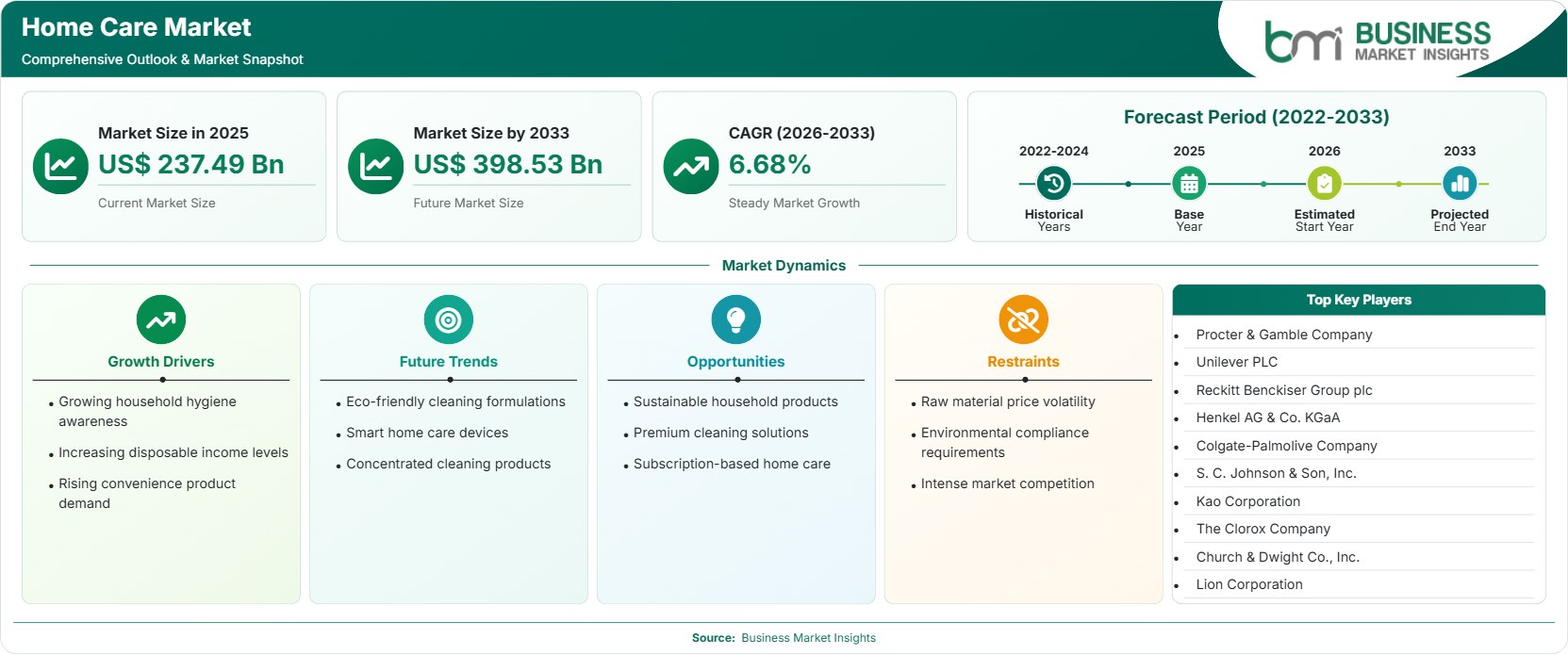
The Home Care Market size was valued at US$ 237.49 billion in 2025 and is projected to reach US$ 398.53 billion by 2033, growing at a CAGR of 6.68% during 2026–2033. Growing household hygiene awareness, increasing disposable income levels, and rising demand for convenient cleaning products are driving consistent market expansion. Furthermore, sustainable household products, premium cleaning solutions, and subscription-based home care services are expected to create substantial long-term opportunities for manufacturers and consumer goods companies.

Report Coverage
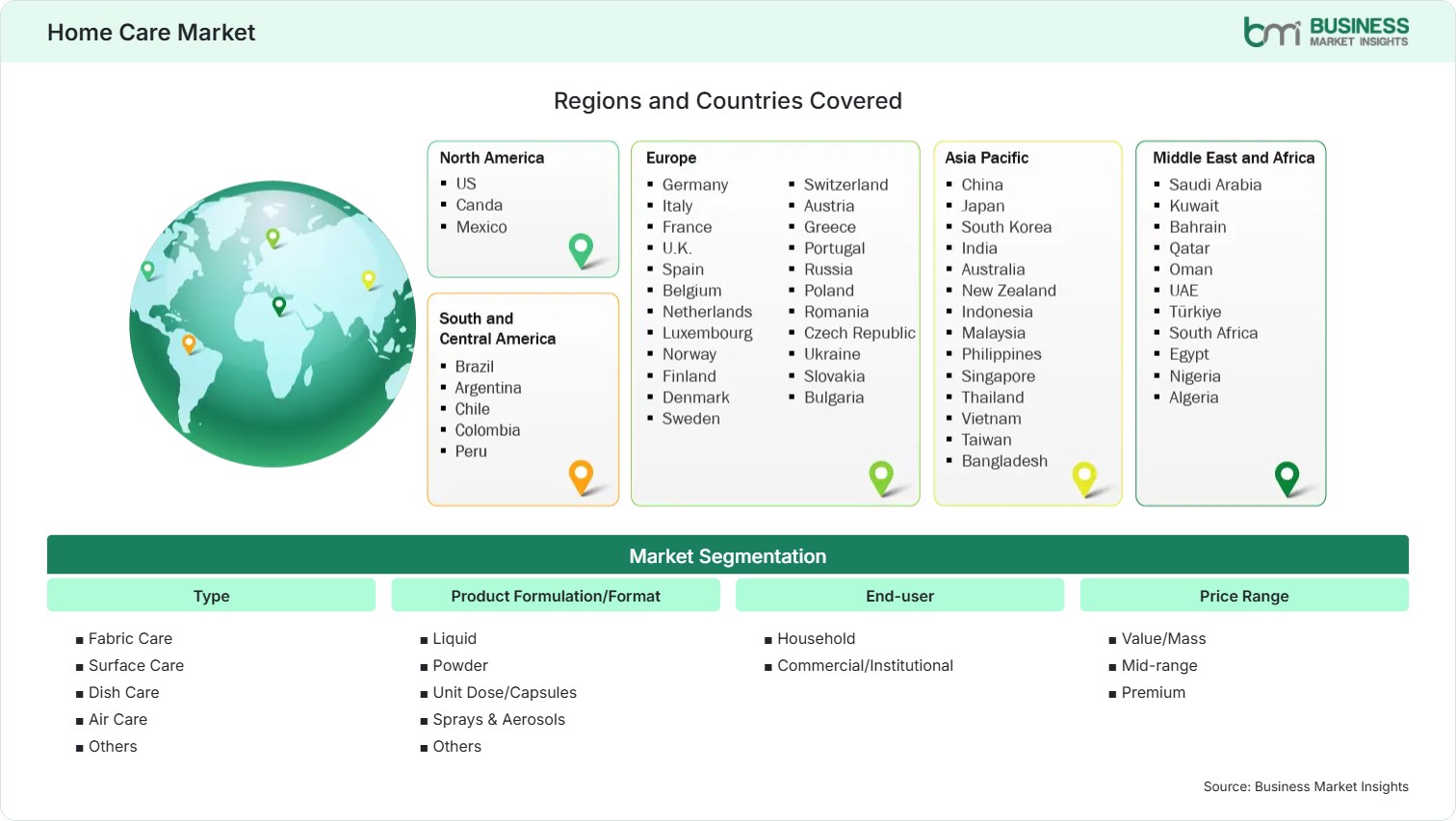
  • Type: Fabric Care, Surface Care, Dish Care, Air Care, Others
  • Product Formulation/Format: Liquid, Powder, Unit Dose/Capsules, Sprays & Aerosols, Others
  • End-user: Household, Commercial/Institutional
  • Price Range: Value/Mass, Mid-range, Premium
  • Primary Claim: Cleaning, Disinfecting/Anti-bacterial, Stain Removal/Whitening, Deodorizing/Fragrance, Eco-friendly/Sustainable, Multi-purpose
US$ 237.49 Bn Market size in 2025
US$ 398.53 Bn Market Size by 2033
6.68% CAGR, 2026 - 2033
2026-2033 Forecast Period

01 AI Overview

Home Care Market Summary

  • North America: North America accounts for 30%–33% of the global market in 2025 and is projected to grow at a CAGR of 6.2%–7.0% through 2033. High consumer spending on household care products, growing demand for premium cleaning solutions, increasing adoption of eco-friendly products, and widespread product innovation continue supporting regional market growth. The U.S. market is anticipated to register a CAGR of 6.3%–7.1% during the forecast period.
  • Fastest Growing Region: Asia Pacific holds 35%–38% market share in 2025 and is forecast to register the highest CAGR of 7.2%–8.0% through 2033. Rapid urbanization, rising disposable incomes, increasing household formation, expanding modern retail infrastructure, and growing awareness regarding hygiene and sanitation continue strengthening regional demand.
  • Leading Segment: Fabric Care represents 31%–34% of the market in 2025 and is projected to expand at a CAGR of 6.5%–7.3% during 2026–2033. Rising demand for laundry detergents, fabric conditioners, stain removers, and specialized garment care products continues supporting segment leadership.
  • High Growth Segment: Eco-friendly/Sustainable products account for 18%–21% market share in 2025 and are expected to register the fastest CAGR of 8.2%–9.0% through 2033. Increasing environmental awareness, demand for biodegradable formulations, recyclable packaging, and plant-based ingredients continues accelerating segment growth.
  • Key Market Opportunity: Expanding investments in sustainable household products, premium cleaning solutions, smart dispensing systems, refillable packaging, and subscription-based home care services are creating significant growth opportunities across the global home care industry.
  • Major Market Players: Procter & Gamble Company, Unilever PLC, Reckitt Benckiser Group plc, Henkel AG & Co. KGaA, Colgate-Palmolive Company, S. C. Johnson & Son Inc., Kao Corporation, The Clorox Company, Church & Dwight Co., Inc., and Lion Corporation.
02 Strategic Insights

Home Care Market: Strategic Insights

Home Care Market Strategic Framework
FREE PDF
Request your free sample
Request free sample
03 Stakeholder View

Key Takeaways

  • The market ecosystem continues evolving through raw material suppliers, chemical manufacturers, consumer goods companies, packaging providers, retailers, e-commerce platforms, distributors, and institutional cleaning service providers.
  • Laundry care, surface cleaning, dishwashing, air care, disinfectants, multipurpose cleaners, and eco-friendly household products represent the largest commercial opportunities across the industry.
  • Continuous innovation in biodegradable ingredients, concentrated formulations, refillable packaging, smart dispensing technologies, premium fragrances, and plant-based cleaning solutions is significantly improving product differentiation and sustainability.
  • Asia Pacific offers the strongest long-term investment potential due to rapid urbanization, expanding middle-class populations, increasing disposable incomes, growing hygiene awareness, and rising adoption of branded home care products.
  • Strategic collaborations among consumer goods manufacturers, retailers, technology providers, packaging companies, and sustainability-focused organizations continue accelerating innovation and commercialization of next-generation home care products.
04 Geographic Outlook

Home Care Market Regional Highlights

North America Home Care Market

North America accounts for 30%–33% of the global market in 2025 and is projected to expand at a CAGR of 6.2%–7.0% through 2033. Strong consumer spending, widespread product innovation, growing demand for premium home care products, and increasing adoption of sustainable cleaning solutions continue supporting regional growth. The Home Care Market share remains substantial due to mature retail infrastructure and strong brand penetration.

  • Premium products drive consumer spending.
  • Sustainable formulations gain market acceptance.
  • Smart cleaning innovations support growth.
  • Retail expansion strengthens product availability.

US Home Care Market

The United States dominates regional revenue and is expected to register a CAGR of 6.3%–7.1% during the forecast period. Rising demand for disinfectants, premium laundry products, eco-friendly cleaning solutions, and convenient subscription-based home care services continues supporting sustained Home Care Market expansion.

  • Hygiene awareness supports product demand.
  • Subscription services improve customer retention.
  • Premium formulations drive market growth.

Europe Home Care Market

Europe represents 25%–28% of the global Home Care Market in 2025 and is projected to grow at a CAGR of 6.1%–6.9% during 2026–2033. Germany leads regional demand, while Poland records the fastest growth owing to increasing sustainability initiatives, expanding premium home care product adoption, and rising consumer awareness regarding environmentally responsible cleaning solutions.

  • Eco-friendly products gain wider adoption.
  • Germany leads regional market demand.
  • Premium home care solutions expand rapidly.
  • Regulatory standards encourage innovation.

Asia Pacific Home Care Market

Asia Pacific accounts for 35%–38% of global revenue in 2025 and is expected to register the highest CAGR of 7.2%–8.0% through 2033. China dominates regional demand, while India records the fastest growth due to rapid urbanization, rising disposable incomes, increasing household formation, expanding organized retail, and growing awareness regarding household hygiene and sanitation.

  • Urbanization increases cleaning product demand.
  • Organized retail strengthens market access.
  • Hygiene awareness accelerates product adoption.
  • Premiumization supports long-term growth.

Rest of World Home Care Market

The Rest of World region accounts for 7%–9% of the global market in 2025 and is projected to grow at a CAGR of 6.0%–6.8% during the forecast period. Brazil, the UAE, and South Africa continue witnessing increasing consumption of household cleaning products, premium detergents, disinfectants, and sustainable home care solutions as living standards and hygiene awareness continue improving.

  • Household hygiene supports steady demand.
  • Premium products gain consumer preference.
  • Sustainable packaging strengthens market growth.
  • Retail development improves product accessibility.
Global Market Geography
FREE PDF
Request your free sample
Request free sample
05 Segment Analysis

Home Care Market Segmentation

Type

The Type segment accounted for 31%–34% of the overall market in 2025 and is projected to grow at a CAGR of 6.5%–7.3% during 2026–2033. Growing household hygiene awareness, increasing consumer preference for high-performance cleaning products, and expanding urban populations continue driving the Home Care Market expansion. Manufacturers are introducing advanced formulations with improved stain removal, antibacterial protection, odor control, fabric conditioning, and environmentally friendly ingredients to address evolving consumer expectations. Continuous innovation in concentrated cleaning solutions, biodegradable ingredients, refillable packaging, and multifunctional products is further strengthening demand across residential and commercial applications worldwide.

  • Fabric Care: Fabric care represents the largest segment owing to increasing consumption of laundry detergents, fabric softeners, stain removers, bleach products, and specialty garment care solutions. Rising ownership of washing machines, premium laundry care preferences, and growing demand for fabric protection products continue supporting segment dominance.
  • Surface Care: Surface care products continue experiencing strong demand due to increasing emphasis on household sanitation, disinfecting surfaces, kitchen hygiene, bathroom cleanliness, and protection against germs and bacteria in residential and commercial environments.
  • Dish Care: Dish care products remain an essential household category supported by rising consumption of dishwashing liquids, automatic dishwasher detergents, rinse aids, and eco-friendly cleaning formulations that improve cleaning efficiency while minimizing water usage.
  • Air Care: Air care products continue expanding owing to increasing demand for air fresheners, odor eliminators, scented diffusers, room sprays, and fragrance-enhancing solutions that improve indoor comfort and living environments.
  • Others: Other home care products include toilet cleaners, drain maintenance products, floor cleaners, furniture care products, glass cleaners, insect control solutions, and specialized cleaning agents designed for targeted household applications.

Product Formulation/Format

The Product Formulation/Format segment continues evolving as manufacturers develop convenient, efficient, and environmentally responsible cleaning formats that improve usability and product performance. The Home Care Market trends indicate increasing consumer preference for concentrated formulations, lightweight packaging, easy-to-use dispensing systems, and innovative delivery formats that simplify household cleaning while reducing storage space and packaging waste.

  • Liquid: Liquid formulations account for the largest market share due to their versatility, ease of application, rapid dissolution, superior cleaning performance, and broad usage across fabric care, dishwashing, surface cleaning, and multipurpose household applications.
  • Powder: Powder-based products continue maintaining significant demand because of their cost-effectiveness, longer shelf life, effective stain removal capabilities, and suitability for large-scale laundry and institutional cleaning applications.
  • Unit Dose/Capsules: Unit dose capsules are expected to register rapid growth owing to their convenience, precise dosing, reduced product waste, compact packaging, and increasing consumer preference for mess-free cleaning solutions.
  • Sprays & Aerosols: Spray and aerosol products continue gaining popularity across surface care, disinfecting, air care, and specialty cleaning applications due to their ease of use, targeted application, and fast-acting performance.
  • Others: Other product formats include wipes, gels, tablets, foams, concentrates, refill packs, and dissolvable sheets designed to enhance convenience, sustainability, and product effectiveness.

End-User

The End-User segment continues expanding as household consumption remains dominant while commercial and institutional demand steadily increases. Rising hygiene standards across residential buildings, hotels, healthcare facilities, educational institutions, offices, restaurants, and industrial workplaces continue driving consistent demand for high-quality cleaning and sanitation products.

  • Household: Households represent the largest end-user segment owing to daily consumption of laundry detergents, dishwashing products, disinfectants, floor cleaners, air fresheners, and multipurpose cleaning solutions that support cleanliness, hygiene, and overall household maintenance.
  • Commercial/Institutional: Commercial and institutional users continue experiencing strong growth due to increasing hygiene requirements across hospitals, hotels, schools, restaurants, corporate offices, shopping centers, and public facilities where large-scale cleaning operations require specialized and high-performance home care products.

Price Range

The Price Range segment reflects evolving consumer purchasing behavior across different income groups and product categories. Rising disposable incomes, premiumization trends, and growing demand for value-added cleaning products continue supporting balanced growth across multiple pricing tiers.

  • Value/Mass: Value and mass-market products maintain the largest share owing to their affordability, widespread retail availability, and strong demand among price-sensitive consumers across both developed and emerging markets.
  • Mid-range: Mid-range products continue witnessing stable growth as consumers increasingly seek an optimal balance between affordability, cleaning performance, product quality, and trusted brand reputation.
  • Premium: Premium products are expected to register the fastest growth supported by increasing consumer demand for concentrated formulations, luxury fragrances, sustainable ingredients, specialized cleaning performance, and premium packaging.

Primary Claim

The Primary Claim segment continues evolving as consumers increasingly select products based on functional performance, hygiene benefits, sustainability attributes, and specialized cleaning capabilities. Manufacturers are strengthening product positioning through scientifically validated claims and multifunctional formulations that address multiple household cleaning needs simultaneously.

  • Cleaning: Cleaning remains the largest product claim, supported by continuous demand for efficient removal of dirt, grease, stains, dust, and everyday household contaminants.
  • Disinfecting/Anti-bacterial: Antibacterial and disinfecting products continue witnessing strong demand due to heightened consumer awareness regarding hygiene, infection prevention, and household sanitation.
  • Stain Removal/Whitening: Products featuring advanced stain removal and whitening technologies remain highly popular across laundry and surface care applications.
  • Deodorizing/Fragrance: Fragrance-enhancing products continue expanding with increasing demand for long-lasting freshness, odor elimination, and premium scent experiences throughout residential environments.
  • Eco-friendly/Sustainable: Eco-friendly and sustainable products represent the fastest-growing category owing to increasing consumer preference for biodegradable ingredients, recyclable packaging, plant-based formulations, and reduced environmental impact.
  • Multi-purpose: Multipurpose cleaners continue gaining popularity by offering versatility, convenience, reduced storage requirements, and cost-effective cleaning across multiple household surfaces.
06 Market Forces

Home Care Market Dynamics

Key Market Drivers

Growing household hygiene awareness

Consumers worldwide are placing greater emphasis on maintaining clean, healthy, and hygienic living environments due to increasing awareness of infectious diseases, allergies, indoor air quality, and overall household wellness. Rising public health campaigns, growing consumer education regarding sanitation, and heightened focus on preventive hygiene have significantly increased demand for disinfectants, surface cleaners, fabric care products, dishwashing solutions, and air care products. In addition, the growing adoption of advanced cleaning routines across residential households, educational institutions, healthcare facilities, and workplaces continues to support sustained demand for innovative home care products with antibacterial, antiviral, and multifunctional cleaning capabilities.

Increasing disposable income levels

Steady growth in disposable income across both developed and emerging economies is enabling consumers to spend more on premium, branded, and specialized home care products that offer superior cleaning performance, convenience, and enhanced fragrance experiences. Rising living standards, rapid urbanization, and changing consumer lifestyles are encouraging households to upgrade from basic cleaning products to value-added solutions such as concentrated detergents, premium laundry care products, specialty surface cleaners, and eco-friendly formulations. This increase in purchasing power also supports higher spending on premium packaging, innovative dispensing systems, and technologically advanced household cleaning products.

Rising convenience product demand

Modern lifestyles characterized by busy work schedules, dual-income households, and limited time for household chores are significantly increasing demand for convenient and easy-to-use cleaning products. Consumers increasingly prefer ready-to-use sprays, unit-dose capsules, concentrated liquid detergents, multipurpose cleaners, disposable cleaning wipes, and refill systems that simplify cleaning routines while delivering consistent results. Manufacturers continue introducing innovative packaging formats, ergonomic dispensing solutions, and multifunctional formulations that reduce cleaning effort, minimize product wastage, and improve user convenience, further strengthening overall market growth.

Key Market Opportunities

Sustainable household products

Environmental consciousness amongst consumers, firms, and governmental organizations has presented major prospects for companies that produce biodegradable cleaning products, organic components, recyclable packaging materials, reusable bottles, and low-emissions production facilities. Growing government support for sustainable goods, as well as higher consumer interest in environmentally friendly purchasing behavior, has led companies to invest significant effort in green chemistry, renewable resources, efficient water use, and packaging reuse. These innovations are expected to drive long-term growth while helping manufacturers strengthen brand loyalty and meet evolving sustainability expectations.

Premium cleaning solutions

The global trend toward premiumization is creating significant growth opportunities for companies offering high-performance cleaning products with advanced formulations, luxury fragrances, specialized stain removal technologies, antimicrobial protection, and superior fabric care properties. Consumers are increasingly willing to pay premium prices for products that provide enhanced convenience, longer-lasting performance, attractive packaging, and multifunctional cleaning benefits. Premium household care solutions targeting specific surfaces, delicate fabrics, pet care, and smart home environments are further expanding Home Care Market potential across residential and commercial sectors.

Subscription-based home care

The rapid growth of e-commerce platforms and direct-to-consumer business models is creating attractive opportunities for subscription-based home care services. Automated replenishment programs, personalized product recommendations, flexible delivery schedules, bundled product offerings, and loyalty-based subscription models improve customer convenience while ensuring continuous product availability. These digital distribution models also provide manufacturers with valuable consumer insights, strengthen customer retention, reduce marketing costs, and create recurring revenue streams, making subscription-based home care one of the fastest-growing opportunities in the industry.

Market Restraints and Challenges

Raw material price volatility

Factor: Home care manufacturers depend heavily on surfactants, specialty chemicals, fragrances, enzymes, packaging materials, petrochemical derivatives, paper products, and transportation services, all of which are subject to frequent price fluctuations caused by supply chain disruptions, geopolitical uncertainties, inflationary pressures, energy costs, and changing global commodity markets. Variability in raw material availability further increases procurement challenges for manufacturers operating on a global scale.

Impact: Fluctuating raw material prices significantly increase production costs, reduce operating margins, complicate long-term procurement planning, and create uncertainty in pricing strategies. Manufacturers often face difficulties balancing cost optimization with product quality and profitability, while frequent price adjustments may also affect consumer purchasing decisions and overall Home Care Market competitiveness.

Environmental compliance requirements

Factor: Regulations governing the chemistry of their ingredients, safety, packaging waste, wastewater discharge, emission levels, recyclability, and sustainability continue to be tightened globally by governments and regulatory agencies. Home care product manufacturers have to adhere to the changing regulations concerning biodegradability, limited use of chemicals, labeling, and producer responsibility programs internationally.

Impact: Stricter environmental regulations require significant investment to reformulate products, adopt sustainable packaging, modify manufacturing processes, obtain certifications, conduct regulatory tests, and ensure compliance monitoring. All this adds complexity for manufacturers seeking to bring innovative products to the diverse global Home Care Market.

07 Company Analysis

Competitive Landscape

The competitive landscape of the Home Care Market analysis is highly competitive, with multinational consumer goods companies, household cleaning product manufacturers, and regional brands competing through continuous product innovation, sustainability initiatives, premium product development, and omnichannel distribution strategies. Manufacturers are increasingly focusing on developing biodegradable formulations, concentrated formulations, reusable packaging systems, intelligent dispensing systems, and plant-based products to enhance their competitive advantages. Mergers and acquisitions, increasing production capacities, working together with retailers, and venturing into e-commerce remain the major trends that are impacting the industry. An increased consumer inclination toward eco-friendly, efficient, and convenient home care products has prompted manufacturers to expand their product ranges.

Company Name

Overview

Products and Services Relevant to this Market

Procter & Gamble Company

Global consumer goods company with a broad portfolio of household care brands.

Laundry detergents, fabric conditioners, dishwashing products, surface cleaners, air care solutions, household cleaning products.

Unilever PLC

Multinational consumer products company specializing in home and personal care solutions.

Fabric care products, surface cleaners, dishwashing liquids, disinfectants, sustainable home care products.

Reckitt Benckiser Group plc

Global manufacturer of hygiene, health, and home care products.

Disinfectants, multipurpose cleaners, surface care solutions, air fresheners, household hygiene products.

Henkel AG & Co. KGaA

International company specializing in laundry, home care, and adhesive technologies.

Laundry detergents, fabric conditioners, stain removers, dishwashing solutions, premium cleaning products.

Colgate-Palmolive Company

Global consumer products company with home care and cleaning product offerings.

Household cleaners, dishwashing liquids, fabric care products, surface cleaning solutions.

S. C. Johnson & Son Inc.

Family-owned manufacturer of household cleaning and air care products.

Air fresheners, disinfectants, surface cleaners, insect control products, household cleaning solutions.

Kao Corporation

Japanese consumer goods company specializing in fabric and home care products.

Laundry detergents, fabric softeners, kitchen cleaners, household hygiene products, premium cleaning solutions.

The Clorox Company

Leading manufacturer of cleaning and disinfecting products.

Bleach, disinfectants, multipurpose cleaners, stain removers, household sanitation products.

Church & Dwight Co., Inc.

Consumer goods company focused on household and personal care products.

Laundry detergents, baking soda-based cleaners, fabric care solutions, specialty household cleaning products.

Lion Corporation

Consumer products company serving home care and hygiene markets across Asia.

Laundry detergents, dishwashing products, household cleaners, antibacterial cleaning solutions.

08 Industry Activity

Recent Developments

July 2025

Reckitt announced that it had agreed to divest its Essential Home business to Advent International, enabling the business to operate independently while strengthening the growth of home care brands including Air Wick, Cillit Bang, Calgon, Woolite, and Easy-Off.

April 2025

Unilever launched Cif Infinite Clean, a probiotic-based surface cleaning spray that continues cleaning after application using beneficial microorganisms, expanding its innovative home care product portfolio.

April 2025

Henkel highlighted the commercial rollout of its Smartwash technology, an AI-enabled detergent dosing system for laundry and dishwashing designed to optimize detergent usage and improve cleaning performance.

January 2025

Henkel officially unveiled Smartwash at CES 2025, introducing an AI-driven cartridge-based detergent dosing system for washing machines and dishwashers, marking a significant innovation in home care technology.

10 Trust & Transparency

Research Methodology

The market analysis combines proprietary research with secondary data from government agencies, company disclosures, regulatory filings, industry databases and expert interviews. Market estimates are validated through data triangulation, cross-market benchmarking and analyst review.

View Full Research Methodology

11 Questions Answered

Frequently Asked Questions

What future opportunities are expected in the market?

The Home Care Market report highlights major opportunities, including sustainable household products, premium cleaning solutions, subscription-based home care services, refillable packaging systems, biodegradable formulations, plant-based cleaning ingredients, and smart dispensing technologies.

Who are the major companies operating in the market?

Leading companies include Procter & Gamble Company, Unilever PLC, Reckitt Benckiser Group plc, Henkel AG & Co. KGaA, Colgate-Palmolive Company, S. C. Johnson & Son Inc., Kao Corporation, The Clorox Company, Church & Dwight Co., Inc., and Lion Corporation.

Which type holds the largest market share?

Fabric Care dominates the market with a 31%–34% share in 2025 owing to increasing consumption of laundry detergents, fabric conditioners, stain removers, and premium garment care products across residential and commercial applications.

Which region dominates the market?

Asia Pacific holds the largest market share of 35%–38% in 2025 and is expected to register the fastest growth due to rapid urbanization, rising disposable incomes, expanding organized retail, and increasing household hygiene awareness.

What is driving the growth of the Home Care Market?

The market is driven by growing household hygiene awareness, increasing disposable income levels, rising demand for convenient cleaning products, expanding premium product adoption, and continuous innovation in sustainable household care solutions.

Access the Full Home Care Market Report

Get segment-level forecasts, regional estimates, competitive benchmarking, company profiles and downloadable Excel datasets.

Access the full Home Care Market Report
350 pages PDF & Excel | 2026-07-28