
Vinyl Flooring Market Outlook: Size, Share, Trends, Growth Analysis, Competitive Landscape & Forecast, 2026-2033

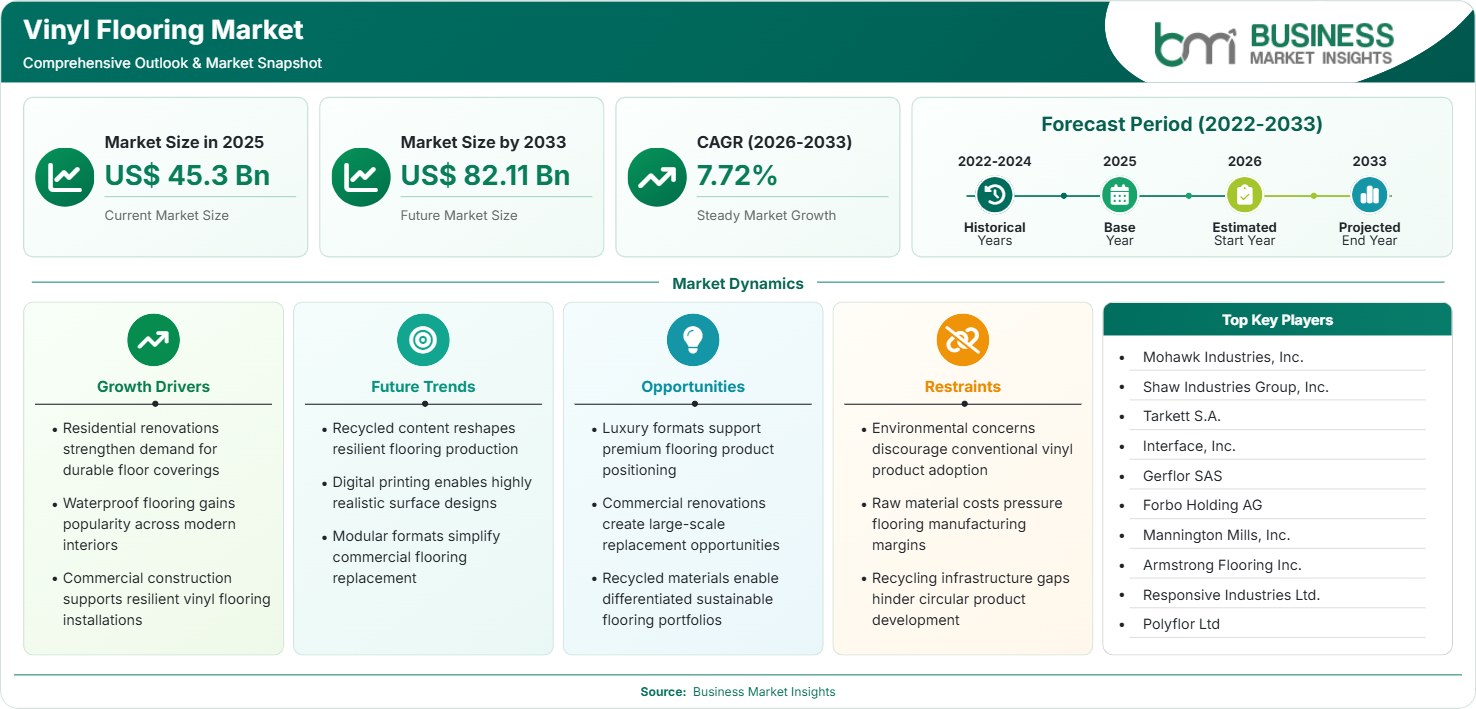
The Vinyl Flooring Market size was valued at US$ 45.3 Billion in 2025 and is projected to reach US$ 82.11 Billion by 2033, growing at a CAGR of 7.72% during 2026–2033. Rising residential renovation activity, expanding commercial construction, enhanced durability, waterproof flooring demand, and increasing adoption of luxury vinyl products create significant growth opportunities across global markets.

Report Coverage
  • Type: Vinyl Sheets, Vinyl Tiles, Luxury Vinyl Tiles
  • End-Use: Residential, Non-Residential
US$ 45.3 Bn Market size in 2025
US$ 82.11 Bn Market Size by 2033
7.72% CAGR, 2026 - 2033
2026-2033 Forecast Period

AI Overview

Vinyl Flooring Market Summary

  • North America Region: North America holds a market share of 34%–37% in 2025, growing with a CAGR of 6.8%–7.2% during 2026–2033. Demand is supported by remodeling expenditure, premium flooring replacement cycles, waterproof product adoption, institutional renovation programs, commercial redevelopment, and sustainability-focused construction initiatives across major economies. The U.S. market represents the majority share within the region and is anticipated to register a CAGR of 6.9%–7.3% through 2033, supported by strong remodeling investment and commercial flooring upgrades.
  • Fastest Growing Region: Asia Pacific holds a market share of 28%–31% in 2025, growing with a CAGR of 8.8%–9.4% during 2026–2033. Urbanization, housing development, manufacturing expansion, increasing disposable incomes, smart-city investments, modern retail construction, healthcare infrastructure projects, and improving flooring distribution networks continue stimulating regional demand.
  • Leading Segment: Luxury Vinyl Tiles holds a market share of 44%–48% in 2025, growing with a CAGR of 8.3%–8.8% during 2026–2033. Attractive aesthetics, durability, water resistance, simplified installation, low maintenance requirements, expanding designer collections, commercial acceptance, and replacement demand support broad adoption across residential and institutional projects.
  • High Growth Segment: Residential end-use holds a market share of 57%–61% in 2025, growing with a CAGR of 8.5%–9.0% during 2026–2033. Rising home renovation activity, housing construction, consumer preference for resilient flooring, digital retail channels, affordable premium products, and easy installation technologies continue accelerating market penetration.
  • Key Market Opportunity: Growing demand for sustainable, phthalate-free, recyclable flooring solutions creates opportunities for manufacturers to introduce advanced materials, circular economy initiatives, low-emission products, and differentiated premium offerings across residential and commercial projects.
  • Major Market Players: Mohawk Industries, Inc.; Shaw Industries Group, Inc.; Tarkett S.A.; Interface, Inc.; Gerflor SAS; Forbo Holding AG; Mannington Mills, Inc.; Armstrong Flooring Inc.; Responsive Industries Ltd.; Polyflor Ltd.
Strategic Insights

Vinyl Flooring Market: Strategic Insights

Vinyl Flooring Market Strategic Framework
FREE PDF
Request your free sample
Request free sample
Stakeholder View

Key Takeaways

  • The industry's value chain is becoming more integrated as manufacturers enhance their sourcing, production, digital distribution, and installation networks to increase their margins and ensure a reliable supply.
  • In residential renovation and institutional refurbishment projects, luxury vinyl tile installations deliver the greatest revenue increase due to their excellent appearance, durability, and performance throughout their lifecycle.
  • Product innovation is now focusing on rigid-core construction, acoustic enhancement, antimicrobial finishes, low-VOC formulations, and recyclable material systems to achieve sustainability objectives.
  • Asia Pacific is a highly attractive place in which to make an investment because of the rapid process of urbanization, the growing spending by its middle class, the level of commercial construction, and the large infrastructure development programs.
  • Across the industry, there are increasing numbers of strategic acquisitions, manufacturing expansion projects, and distribution partnerships as suppliers aim to strengthen their presence in various regions and diversify their products.
  • Digital visualization tools and omnichannel sales models are transforming the way customers purchase products, enabling better product customization and accelerating conversion rates.
Geographic Outlook

Vinyl Flooring Market Regional Highlights

North America Vinyl Flooring Market

North America accounted for approximately 34%–37% of global revenue in 2025 and is expected to expand at a 6.8%–7.2% CAGR during 2026–2033. Strong residential remodeling activity, rising replacement flooring expenditure, and increasing adoption of waterproof resilient flooring continue supporting regional demand. Commercial projects across healthcare, education, retail, and hospitality sectors also contribute significantly. The Vinyl Flooring Market share remains concentrated in the U.S. and Canada due to mature distribution networks, premium product availability, and widespread acceptance of luxury vinyl flooring across both renovation and new construction environments.

  • Continued spending on residential remodeling is fueling demand for flooring replacements, especially for waterproof, low-maintenance options that homeowners prefer when renovating their kitchens, bathrooms, and basements.
  • Because of the hygiene benefits, durability and lower lifecycle costs, healthcare facilities are becoming more inclined to choose resilient floor solutions, which in turn provides manufacturers who serve the market for institutional construction with opportunities.
  • There is ongoing demand for high-end flooring products with improved design appeal as commercial properties in retail centres, hotels and office buildings are being upgraded.
  • The need to meet sustainability certifications and the requirement for low-VOC products are having an effect on purchasing decisions, which is prompting suppliers to launch environmentally responsible ranges of flooring.
  • Updating distribution channels, including e-commerce and digital visualization platforms, keeps making it easier for customers to buy and helps them decide faster.

US Vinyl Flooring Market

The United States represents approximately 78%–82% of the North American Vinyl Flooring Market demand and is projected to expand at a 6.9%–7.3% CAGR through 2033. High spending on housing renovation activities, commercial property improvements, and consumer preference for luxurious vinyl products will drive market growth. Rising popularity in multi-family housing constructions and health care facility developments will increase the demand in the industry. Manufacturers are continually improving their domestic logistics operations and offering higher-quality products in response to changing consumer needs.

  • The main source of spending on residential renovations is due to the fact that the housing stock is ageing and homeowners prefer durable flooring materials.
  • Because of their advantageous maintenance features and lifecycle economics, multifamily housing developments are increasingly using luxury vinyl solutions.
  • In the field of education and healthcare, construction projects are still choosing resilient flooring systems that satisfy rigorous demands in terms of durability and sanitation.
  • Digital retail platforms and visualization technologies are improving customers' experiences when selecting products and are helping to achieve greater market penetration.

Europe Vinyl Flooring Market

Europe held approximately 24%–27% of the global Vinyl Flooring Market revenue in 2025 and is anticipated to register a 6.5%–6.9% CAGR through 2033. There is high demand because of renovation programs that involve efficient use of energy, modernization of commercial buildings, and preference for sustainable building materials. Germany still holds the top position in national markets because of vigorous construction and renovation activities. There are higher growth prospects in Eastern European countries due to improved infrastructure and development in the commercial real estate sector.

  • Germany retains its leading position due to its renovation investments, its work on institutional construction, and its extensive network for distributing flooring in both the residential and commercial sectors.
  • France and the United Kingdom are still creating steady demand as a result of projects related to the modernization of their hospitality, healthcare, and educational facilities.
  • Poland is one of the European markets with the fastest rate of growth, due to industrial development, urban expansion, and various infrastructure investment programs.
  • The rules concerning sustainability promote the use of floorings that are recyclable and have low emissions in both public and private building projects.
  • Consumers' strong preference for design-focused interiors is still encouraging higher uptake of premium flooring products in the area.

Asia Pacific Vinyl Flooring Market

Asia Pacific accounted for approximately 28%–31% of the global Vinyl Flooring Market demand in 2025 and is forecast to achieve the highest regional CAGR of 8.8%–9.4% during 2026–2033. Urbanization, housing development, healthcare facilities expansion, and rising disposable income fuel the increase in demand. China continues to dominate the regional market due to its strong construction industry and manufacturing base. India is fast becoming the country with the highest growth rate, driven by urban housing and commercial development and the use of modern flooring materials.

  • China is leading consumption in the region as a result of its large-scale residential construction, the wide range of renovation projects it is carrying out, and its strong capacity for manufacturing building materials.
  • India has strong growth potential due to government housing schemes, its urban development programs, and the increasing purchasing power of its middle class.
  • The nations of Southeast Asia are still drawing in investments for infrastructure in the fields of hospitality, retail, and healthcare, which in turn is increasing the demand for flooring materials.
  • The expansion of organized retail and e-commerce channels is having a positive effect on market access and is helping to promote consumer uptake of premium products.
  • Manufacturers are now setting up more production facilities right in each region to boost their regional competitiveness and improve supply chain efficiency.

Rest of World Vinyl Flooring Market

The Rest of World region accounted for approximately 9%–12% of global Vinyl Flooring Market revenue in 2025 and is projected to record a 7.4%–7.9% CAGR during 2026–2033. Growth in residential building and commercial real estate development contributes to the growth of South and Central American markets. In the Middle East and Africa, tourism and healthcare projects help grow markets, alongside hotel investments and urban development projects. Brazil is the biggest market in South America, while Saudi Arabia and the United Arab Emirates are growing due to construction megaprojects.

  • Brazil is at the head of regional demand due to the expansion of residential areas and the modernization of its commercial and institutional infrastructure.
  • Mexico gains as a result of the expansion of its manufacturing sector, the demand for urban housing, and the growing level of investment in modern construction materials.
  • Saudi Arabia is continuing to generate demand for flooring as a result of its initiatives in the areas of hospitality, tourism, and mixed-use developments, which are part of its economic diversification programs.
  • The United Arab Emirates meets the demand for premium products by making investments in commercial construction and in luxury real estate projects.
  • International suppliers are entering into more partnerships with regional distributors to improve their market penetration and deal with the increasing number of projects.
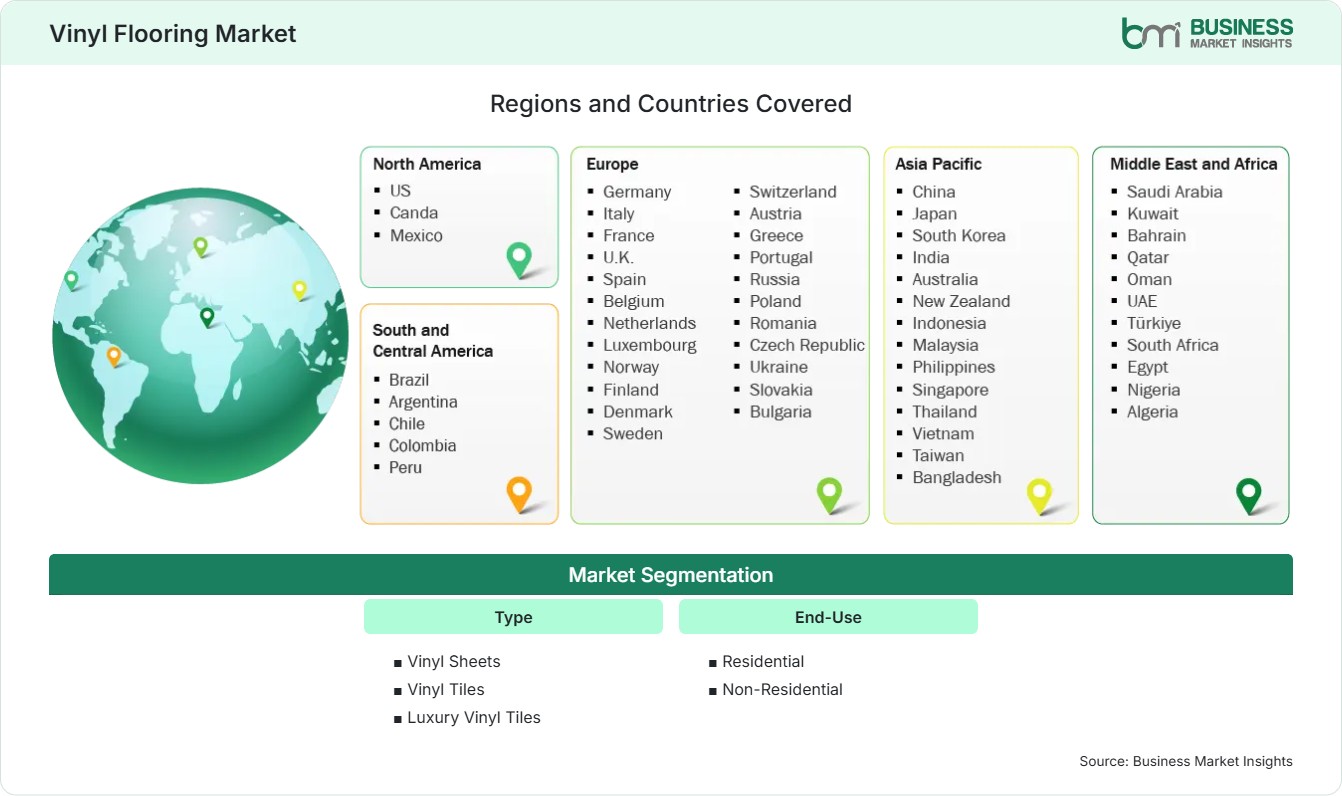
Global Market Geography
FREE PDF
Request your free sample
Request free sample
Segment Analysis

Vinyl Flooring Market Segmentation

Type

The type segment represents a critical component of the industry structure. Luxury vinyl products collectively account for the largest revenue contribution due to superior design flexibility and performance characteristics. The segment demonstrates a strong Vinyl Flooring Market scope across residential and commercial projects. Luxury Vinyl Tiles held approximately 44%–48% share in 2025 and are projected to grow at a CAGR of 8.3%–8.8% through 2033, benefiting from premiumization trends and replacement demand.

  • Vinyl Sheets: Widely used in healthcare, education, and residential applications because of seamless installation, moisture resistance, cost effectiveness, and ease of maintenance across high-traffic environments.
  • Vinyl Tiles: Preferred in commercial spaces requiring modular installation and replacement flexibility. Product versatility and design customization continue to support adoption across offices, retail facilities, and institutions.
  • Luxury Vinyl Tiles: Premium aesthetics, realistic wood and stone appearances, enhanced durability, waterproof performance, and growing consumer preference continue driving substantial adoption across residential and commercial projects.

End-Use

The end-use segment reflects strong demand across renovation and new construction activities. Residential applications dominate due to increasing home improvement spending, rising housing developments, and preference for durable flooring alternatives. The residential category accounted for approximately 57%–61% Vinyl Flooring Market share in 2025 and is projected to expand at a CAGR of 8.5%–9.0% during 2026–2033. Ongoing remodeling activity remains a major driver of demand.

  • Residential: Homeowners increasingly select resilient flooring products because of waterproof benefits, aesthetic appeal, durability, and simplified installation processes suitable for renovation projects.
  • Non-Residential: Commercial, healthcare, hospitality, education, and retail facilities continue utilizing resilient flooring systems to achieve cost efficiency, durability, hygiene performance, and long-term maintenance advantages.
Market Forces

Vinyl Flooring Market Dynamics

Key Market Drivers

Rising Residential Renovation and Remodeling Expenditure

Growing renovation spending across developed and emerging economies continues to support demand for resilient flooring materials. Homeowners increasingly prioritize flooring replacement projects that improve aesthetics, durability, and maintenance efficiency. Waterproof and scratch-resistant products are witnessing strong traction, particularly in kitchens, bathrooms, and multifamily housing units. The Vinyl Flooring Market growth is supported by aging residential building stock and increasing home improvement expenditures. Digital flooring visualization tools further enhance consumer purchase confidence. In addition, growing demand for cost-effective alternatives to hardwood and stone flooring encourages broader adoption. Expanding housing renovation activity across North America, Europe, and the Asia Pacific remains a fundamental demand driver throughout the forecast period.

Expansion of Commercial and Institutional Construction

Demand for floor coverings is still being generated by commercial buildings, healthcare facilities, educational institutions, hotels, and retail complexes. Facility managers are becoming more inclined to choose floor materials that are durable, have low total cost of ownership, perform well in terms of hygiene, and are easy to maintain. Vinyl floor products satisfy these needs while offering design flexibility for modern interior spaces. In healthcare facilities, there is a particular preference for seamless, easy-to-clean floor surfaces to help achieve infection control goals. The process of urbanization, together with increased infrastructure investment in developing economies, is also helping to boost the number of installations. The rising number of occupants in the hospitality and mixed-use sectors is leading to more renovation activities. All of these factors are therefore supporting continued growth in the market for both new builds and refurbishments.

Advancements in Luxury Vinyl and Rigid-Core Technologies

Product innovation in areas such as rigid core technology, advanced wear layers, digital printing, antimicrobial treatments, and improved click-lock installation systems is ongoing among manufacturers. Improvements in both performance and aesthetics are realized through these innovations. Today’s luxury vinyl products provide an exact match to higher-cost products such as hardwood, ceramics, and stone products. Current Vinyl Flooring Market trends indicate increasing consumer preference for aesthetically sophisticated flooring products that combine durability with sustainability. Product innovation also supports penetration into commercial segments requiring high-performance flooring solutions. Continuous technological advancement strengthens product differentiation and creates additional revenue opportunities across various application categories.

Key Market Opportunities

Sustainable and Low-Emission Flooring Solutions

Increased emphasis on environmental sustainability is a good opportunity for the manufacturing industry. Environmental certifications now encourage the use of low-VOC and recyclable materials. Building owners are also placing more emphasis on products that meet the ESG principles and Indoor Air Quality standards. Flooring companies that develop phthalate-free compounds and circular economies gain competitive advantages. Investments in recycled content technologies and responsible manufacturing processes are expected to accelerate. Vinyl Flooring Market Forecasts increasingly highlight sustainability-driven purchasing as a major differentiator. Suppliers capable of providing transparent environmental product declarations and lifecycle assessments are positioned to capture emerging opportunities across institutional, commercial, and residential applications worldwide.

Rapid Urbanization Across Emerging Markets

Urban population growth across Asia Pacific, the Middle East, Africa, and parts of Latin America continues to support demand for housing, healthcare facilities, educational infrastructure, and commercial developments. Rising disposable incomes are encouraging the adoption of premium interior products. Governments are allocating substantial investments toward affordable housing and urban modernization projects that require durable flooring materials. Expanding middle-class populations further stimulate renovation and replacement demand. Manufacturers can benefit through regional production expansion, strategic partnerships, and localized distribution networks. Countries such as India, Indonesia, Vietnam, Saudi Arabia, and the United Arab Emirates present attractive opportunities due to sustained construction and infrastructure development activity.

Digital Sales Ecosystems and Product Customization

The increasing use of e-commerce platforms, virtual room visualization tools, and digital product configuration applications is transforming flooring procurement. Customers are seeking personalized designs, faster ordering processes, and integrated installation services. Manufacturers that leverage digital technologies can improve customer engagement and conversion rates while reducing sales cycle complexity. Data-driven marketing strategies also allow suppliers to better understand consumer preferences and regional demand patterns. Enhanced customization capabilities support premium product positioning and higher margins. As acceptance of online purchasing expands globally, digital channels are expected to become an increasingly important growth avenue for flooring manufacturers and distributors.

Market Restraints and Challenges

Raw Material Price Volatility and Supply Chain Risks

Factor: Vinyl flooring production depends on petrochemical-derived materials, additives, and plasticizers, as well as transportation networks, all of which remain vulnerable to cost fluctuations. Impact: Variable input costs can compress manufacturer margins and create pricing uncertainty for distributors and project developers. Fluctuations in energy prices further increase production expenses. International supply chain disruptions may extend lead times and affect project schedules. While manufacturers continue to diversify their sourcing strategies and invest in operational efficiency, unpredictable raw material pricing remains a significant challenge. Smaller market participants are particularly exposed to procurement pressures, creating competitive disadvantages relative to larger vertically integrated flooring manufacturers with broader sourcing capabilities.

Environmental Concerns Regarding Synthetic Floor Materials

Factor: Regulatory scrutiny related to emissions, recyclability, and environmental impact of synthetic construction materials continues to increase globally. Impact: Compliance requirements may increase production costs and necessitate additional investment in sustainable materials technologies. Some project developers and consumers are evaluating alternative flooring solutions perceived as more environmentally friendly. Manufacturers must continuously innovate to address sustainability concerns while maintaining competitive pricing and product performance. The need for certification compliance, recycling infrastructure development, and environmentally responsible sourcing practices creates operational complexity. Companies unable to adapt efficiently could face slower adoption rates in sustainability-focused construction and renovation projects.

Company Analysis

Competitive Landscape

The competitive environment remains moderately consolidated, with leading participants focusing on product innovation, sustainability initiatives, manufacturing expansion, and distribution optimization. Current Vinyl Flooring Market analysis indicates increasing emphasis on premium luxury vinyl solutions and regional production capabilities.

Company Name

Overview

Products and Services relevant to this market

Mohawk Industries, Inc.

Global flooring manufacturer with extensive presence across residential and commercial flooring markets and diversified manufacturing capabilities.

Luxury vinyl tile, sheet vinyl, rigid core flooring, commercial flooring systems, and flooring installation solutions.

Shaw Industries Group, Inc.

Major flooring producer serving residential, commercial, healthcare, hospitality, and institutional customers worldwide.

Luxury vinyl flooring, resilient flooring products, commercial flooring systems, and sustainability-focused flooring solutions.

Tarkett S.A.

International flooring company recognized for innovation, sustainability initiatives, and broad resilient flooring portfolio.

Vinyl sheets, luxury vinyl tiles, commercial flooring products, sports flooring, and surface material solutions.

Interface, Inc.

Global flooring specialist focused on sustainable flooring technologies and commercial environments.

Luxury vinyl tile products, modular flooring systems, carbon-reduction solutions, and commercial flooring services.

Gerflor SAS

Resilient flooring manufacturer serving healthcare, education, sports, transportation, and commercial sectors.

Vinyl flooring solutions, safety flooring, luxury vinyl tiles, wall protection systems, and specialized surfaces.

Forbo Holding AG

International flooring and material solutions company with strong presence across institutional applications.

Vinyl flooring, commercial flooring systems, transportation flooring, and building interior surface solutions.

Mannington Mills, Inc.

Privately held flooring manufacturer with diversified product portfolio and established North American presence.

Luxury vinyl tiles, sheet vinyl products, rigid flooring solutions, and resilient flooring systems.

Armstrong Flooring Inc.

Recognized flooring supplier with long-standing presence across institutional and commercial flooring categories.

Vinyl sheet products, resilient flooring solutions, commercial flooring materials, and specialty applications.

Responsive Industries Ltd.

Global manufacturer supplying resilient flooring products across residential and commercial sectors.

Vinyl flooring products, luxury vinyl tiles, synthetic flooring materials, and flooring surface solutions.

Polyflor Ltd.

Specialist resilient flooring company serving healthcare, education, retail, and commercial environments.

Vinyl tiles, sheet vinyl flooring, safety flooring solutions, and commercial flooring installations.

Trust & Transparency

Research Methodology

The market analysis combines proprietary research with secondary data from government agencies, company disclosures, regulatory filings, industry databases and expert interviews. Market estimates are validated through data triangulation, cross-market benchmarking and analyst review.

View Full Research Methodology

Questions Answered

Frequently Asked Questions

What does a Vinyl Flooring Market Report typically evaluate?

A comprehensive study assesses market size, competitive positioning, segment performance, regional opportunities, regulatory influences, technology developments, investment trends, and future growth prospects across the value chain.

What industries generate the highest commercial demand?

Healthcare, education, hospitality, retail, office, and multifamily residential sectors account for significant commercial demand because of requirements for durable, hygienic, and cost-effective flooring solutions.

How is sustainability influencing product development?

Manufacturers are investing in recyclable materials, low-VOC formulations, phthalate-free products, and circular economy programs to meet evolving environmental regulations and customer sustainability objectives.

Which region offers the strongest future investment opportunity?

Asia Pacific presents the most attractive long-term opportunity due to rapid urbanization, housing construction growth, infrastructure development, and increasing spending on modern building materials across emerging economies.

What factors are driving adoption of luxury vinyl flooring products?

Luxury vinyl products combine realistic visual aesthetics, durability, water resistance, easy installation, and lower maintenance costs than many traditional flooring materials, making them attractive for residential and commercial applications.

Access the Full Vinyl Flooring Market Report

Get segment-level forecasts, regional estimates, competitive benchmarking, company profiles and downloadable Excel datasets.

Access the full Vinyl Flooring Market Report
350 pages PDF & Excel | 2026-09-17
Similar Research

Related Market Reports