
Ethyl Vinyl Acetate (EVA) Market Outlook: Size, Share, Trends, Growth Analysis, Competitive Landscape & Forecast, 2026-2033

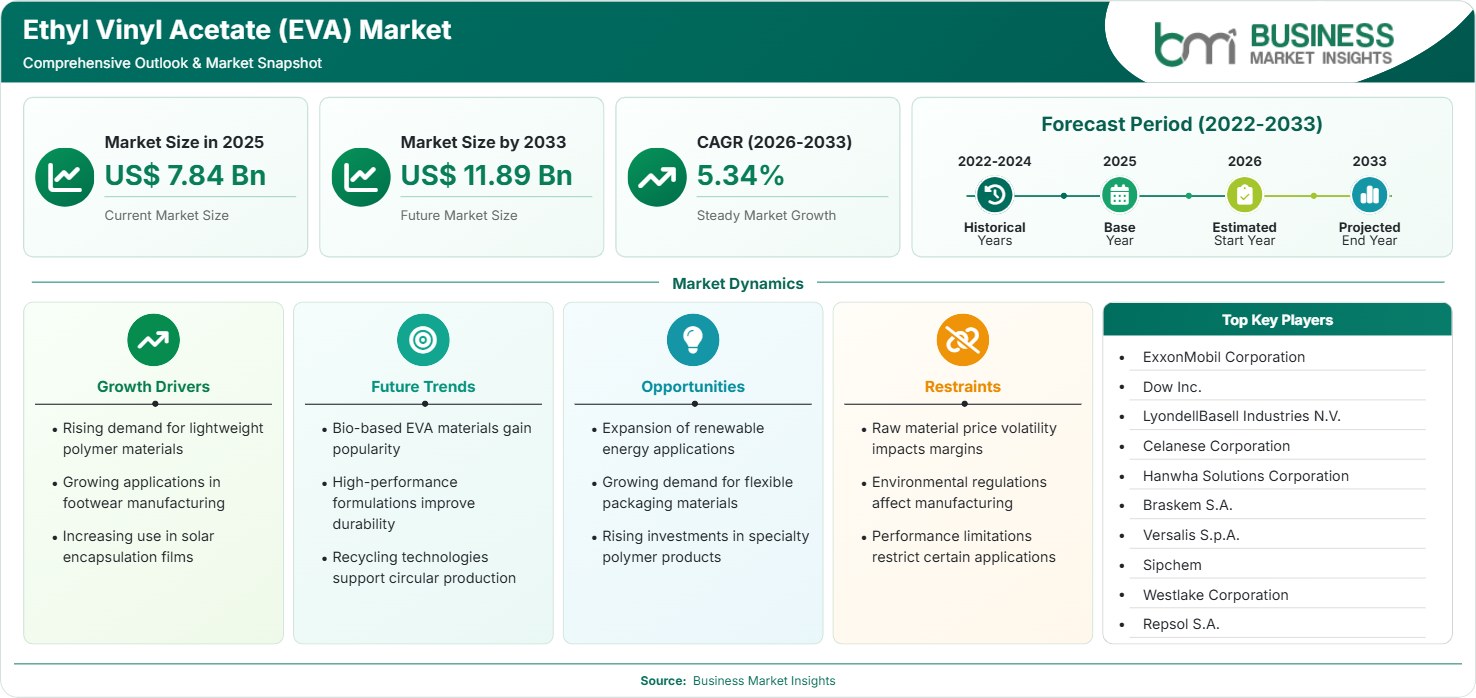
The Ethyl Vinyl Acetate EVA Market size was valued at US$ 7.84 billion in 2025 and is projected to reach US$ 11.89 billion by 2033, growing at a CAGR of 5.34% during 2026–2033. Rising demand for lightweight polymers, expanding footwear production, increasing solar encapsulation requirements, and growing adoption of flexible packaging materials are supporting long-term industry opportunities.

Report Coverage
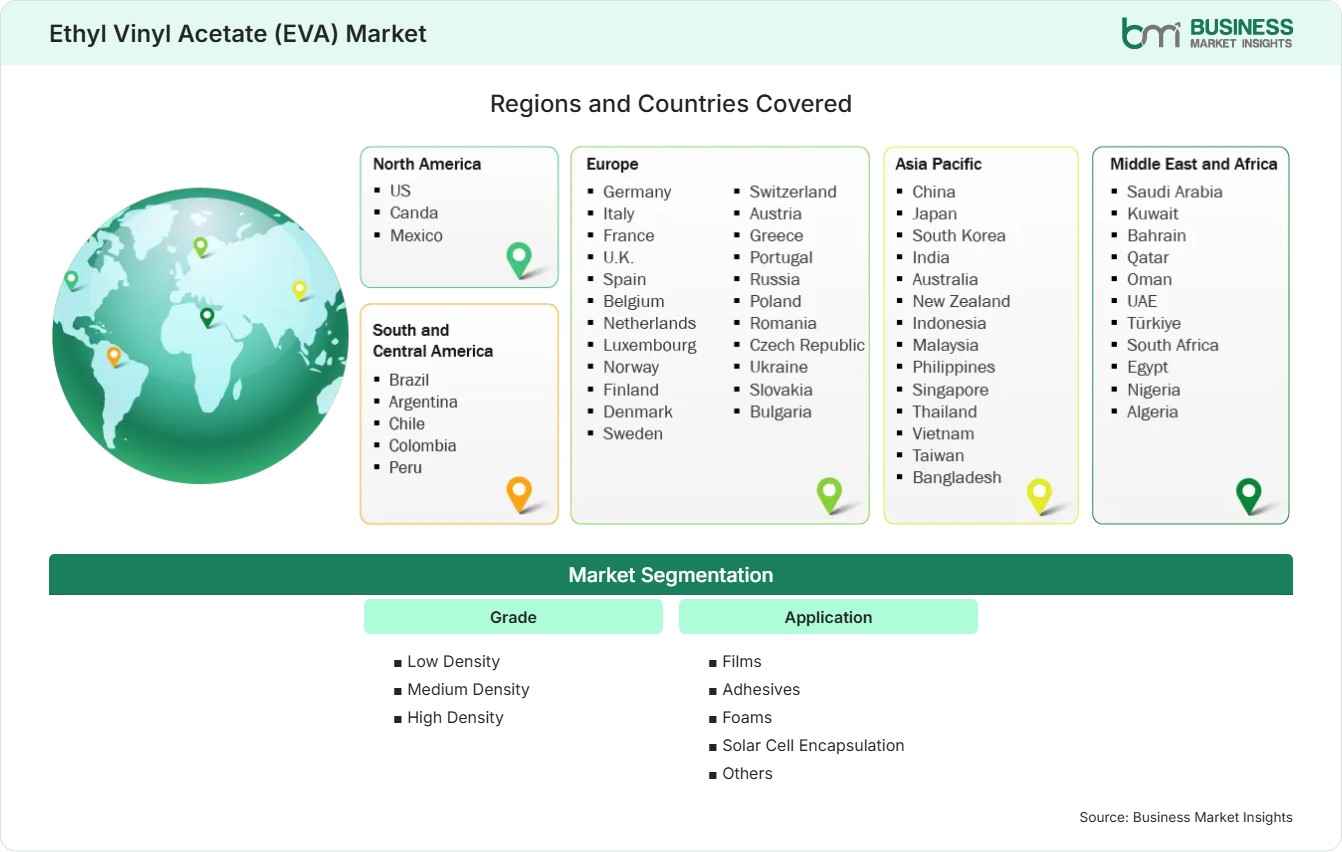
  • Grade: Low Density, Medium Density, High Density
  • Application: Films, Adhesives, Foams, Solar Cell Encapsulation, Others
US$ 7.84 Bn Market size in 2025
US$ 11.89 Bn Market Size by 2033
5.34% CAGR, 2026 - 2033
2026-2033 Forecast Period

AI Overview

Ethyl Vinyl Acetate (EVA) Market Summary

  • North America Region: North America accounts for 24%–27% market share in 2025 and is projected to grow at a CAGR of 4.8%–5.3% during 2026–2033, supported by packaging innovation, solar energy expansion, specialty polymer demand, and advanced manufacturing applications. The U.S. remains the regional leader due to strong polymer processing capabilities, renewable energy investments, and demand from industrial applications, growing at approximately 5.0%–5.5% CAGR.
  • Fastest Growing Region: Asia Pacific holds 42%–45% market share in 2025 and is expected to expand at a CAGR of 5.8%–6.3%, driven by footwear manufacturing growth, packaging demand, solar installations, expanding chemical production capacity, and increasing polymer consumption across emerging economies.
  • Leading Segment: Films represent 32%–35% market share in 2025 and are estimated to grow at a CAGR of 5.5%–6.0%, supported by flexible packaging applications, agricultural films, industrial packaging, and growing demand for durable polymer-based materials.
  • High Growth Segment: Solar Cell Encapsulation captures 18%–21% market share in 2025 and is projected to expand at a CAGR of 6.2%–6.8%, driven by photovoltaic installations, renewable energy investments, and demand for protective encapsulation materials.
  • Key Market Opportunity: Increasing renewable energy deployment, specialty polymer development, sustainable packaging solutions, and demand for high-performance materials are creating new growth avenues for manufacturers across multiple end-use industries.
  • Major Market Players: ExxonMobil Corporation, Dow Inc., LyondellBasell Industries N.V., Celanese Corporation, Hanwha Solutions Corporation, Braskem S.A., Versalis S.p.A., Sipchem, Westlake Corporation, Repsol S.A.
Strategic Insights

Ethyl Vinyl Acetate (EVA) Market: Strategic Insights

Ethyl Vinyl Acetate (EVA) Market Strategic Framework
FREE PDF
Request your free sample
Request free sample
Stakeholder View

Key Takeaways

  • EVA manufacturers are increasingly focusing on application-specific grades to address diverse requirements across packaging, footwear, adhesives, and photovoltaic industries.
  • Solar encapsulation represents a major opportunity area as photovoltaic manufacturers require durable polymer materials offering protection, flexibility, and long-term performance.
  • Specialty polymer innovation is shifting toward improved processing characteristics, enhanced durability, and formulations designed for renewable energy and sustainable packaging applications.
  • Asia Pacific remains the strongest investment region due to expanding chemical production, footwear manufacturing clusters, and increasing solar energy deployment.
  • Strategic capacity expansion and technology partnerships among polymer producers are strengthening supply chain resilience and improving access to high-value applications.
  • Growing environmental regulations are encouraging manufacturers to develop more efficient production processes and explore recyclable or lower-impact polymer solutions.
Geographic Outlook

Ethyl Vinyl Acetate (EVA) Market Regional Highlights

North America Ethyl Vinyl Acetate EVA Market

North America represents 24%–27% Ethyl Vinyl Acetate EVA Market share in 2025 and is projected to grow at a CAGR of 4.8%–5.3% during 2026–2033. The region benefits from established chemical manufacturing infrastructure, increasing renewable energy adoption, advanced packaging applications, and demand for specialty polymer materials. The U.S. dominates regional consumption due to strong downstream industries, while manufacturers continue investing in efficient production technologies and higher-performance EVA formulations.

  • Solar energy expansion is increasing demand for EVA encapsulation materials used in photovoltaic module protection and durability improvement.
  • Packaging manufacturers are adopting flexible polymer solutions to improve product protection, lightweight characteristics, and processing efficiency.
  • Advanced footwear production continues supporting demand for EVA foams due to cushioning, flexibility, and comfort properties.
  • Specialty chemical companies are developing application-focused EVA grades to meet evolving industrial performance requirements.

US Ethyl Vinyl Acetate EVA Market

The U.S. contributes approximately 78%–82% of North American demand and is expected to grow at a CAGR of 5.0%–5.5% during 2026–2033. Strong chemical production capabilities, renewable energy investments, and demand from packaging and industrial sectors continue supporting market development. Domestic manufacturers are increasingly emphasizing specialty formulations and advanced polymer applications.

  • Increasing solar installations are strengthening demand for photovoltaic encapsulation materials.
  • Packaging companies continue adopting flexible polymer films for improved durability and product protection.
  • Footwear and sports product manufacturers utilize EVA foams for lightweight and comfort-focused designs.
  • Industrial users increasingly prefer engineered polymer materials for specialized applications.

Europe Ethyl Vinyl Acetate EVA Market

Europe accounts for 20%–23% market share in 2025 and is forecast to expand at a CAGR of 4.5%–5.1% during 2026–2033. Sustainability initiatives, renewable energy targets, and demand for high-performance materials support regional adoption. Germany leads consumption, while Italy and Spain show increasing demand through packaging, footwear, and solar-related applications.

  • Renewable energy policies continue increasing demand for solar encapsulation materials across European markets.
  • Packaging producers are adopting flexible polymer solutions aligned with lightweight material trends.
  • Chemical manufacturers are investing in sustainable production methods and improved polymer efficiency.
  • Automotive and industrial applications continue supporting demand for specialty EVA formulations.

Asia Pacific Ethyl Vinyl Acetate EVA Market

Asia Pacific holds 42%–45% market share in 2025 and is projected to register the fastest 5.8%–6.3% CAGR during 2026–2033. Strong manufacturing ecosystems, expanding solar installations, footwear production growth, and increasing packaging consumption support regional leadership. China dominates regional demand, while India and Southeast Asian countries continue attracting investment due to expanding industrial and renewable energy sectors.

  • Footwear manufacturing hubs continue generating significant demand for EVA foam materials.
  • Solar capacity expansion is accelerating consumption of EVA encapsulation films.
  • Growing packaging industries support increasing adoption of flexible polymer films.
  • Chemical production investments are strengthening regional EVA supply capabilities.

Rest of World Ethyl Vinyl Acetate EVA Market

The Rest of World region accounts for 8%–11% market share in 2025 and is expected to grow at a CAGR of 4.9%–5.5% during 2026–2033. Latin America and the Middle East are witnessing rising demand due to renewable energy projects, industrial development, and packaging expansion. Brazil and GCC countries represent important growth markets due to increasing infrastructure and energy investments.

  • Solar projects in Middle Eastern countries are supporting demand for EVA photovoltaic encapsulation materials.
  • Latin American packaging industries are increasing adoption of flexible polymer solutions.
  • Industrial development is creating demand for specialty adhesive and foam applications.
  • Regional chemical investments are improving access to advanced polymer materials.
Global Market Geography
FREE PDF
Request your free sample
Request free sample
Segment Analysis

Ethyl Vinyl Acetate (EVA) Market Segmentation

Grade

The grade segment plays a vital role in determining material performance across packaging, footwear, industrial, and renewable energy applications. It accounted for 48%–51% market share in 2025 and is projected to expand at a CAGR of 5.2%–5.7% during 2026–2033. Manufacturers continue introducing customized vinyl acetate concentrations to improve flexibility, durability, and processing efficiency, broadening the Ethyl Vinyl Acetate EVA Market scope across multiple end-use industries.

  • Low Density: Widely utilized in flexible films, extrusion coatings, and packaging products where softness, transparency, and excellent sealing characteristics improve product performance and manufacturing efficiency.
  • Medium Density: Preferred for adhesives, molded products, and industrial applications requiring a balance of flexibility, mechanical strength, and consistent processing across diverse manufacturing environments.
  • High Density: Increasingly adopted in demanding industrial applications requiring superior durability, improved stiffness, enhanced chemical resistance, and long-term structural performance under varying operating conditions.

Application

Application diversity continues to support stable demand as EVA serves industries ranging from packaging and footwear to renewable energy and industrial manufacturing. This segment represented 32%–35% market share in 2025 and is anticipated to grow at a CAGR of 5.5%–6.0% during 2026–2033. Expanding flexible packaging requirements, solar energy deployment, and continuous product innovation reflect evolving Ethyl Vinyl Acetate EVA Market trends across global manufacturing sectors.

  • Films: Represent the largest application owing to extensive use in flexible packaging, agricultural films, laminated structures, and industrial protective films requiring excellent flexibility, clarity, and sealing performance.
  • Adhesives: Widely used in packaging, woodworking, automotive, construction, and consumer products because EVA provides reliable bonding performance, processing versatility, and compatibility with different substrates.
  • Foams: Extensively utilized in footwear, sports equipment, protective packaging, and cushioning products where lightweight structure, resilience, shock absorption, and user comfort remain essential performance characteristics.
  • Solar Cell Encapsulation: Experiencing strong demand due to increasing photovoltaic installations, providing durable encapsulation that protects solar cells from moisture, temperature variations, and long-term environmental exposure.
  • Others: Includes wire and cable compounds, medical products, molded components, consumer goods, and specialty industrial applications requiring flexible, durable, and easy-to-process polymer materials.
Market Forces

Ethyl Vinyl Acetate (EVA) Market Dynamics

Key Market Drivers

Rising demand for lightweight polymer materials

Polymer products that are light-weight continue being preferred in packaging, automobiles, consumer goods and even industrial production because they reduce the consumption of material but still offer strength and efficient processing. Ethyl vinyl acetate provides flexibility, impact strength and good sealing characteristics which make it appropriate for various converting applications. Advanced copolymer products are increasingly being used in place of heavy conventional products. These developments continue supporting Ethyl Vinyl Acetate EVA Market growth, particularly in industries focused on material efficiency, product innovation, and sustainable manufacturing practices.

Growing applications in footwear manufacturing

The footwear sector continues to be one of the biggest buyers of EVA materials due to its lightweight nature, cushioning capabilities, and properties. The athletic shoes, casual shoes, kids’ shoes, and other sports footwear now make use of EVA foams to make their product better. Increasing disposable incomes and the popularity of sports contribute to increasing demand for quality footwear from manufacturers. Innovation and expansion of production capacities in the Asia Pacific region further boost the demand for EVA materials in the footwear segment.

Increasing use in solar encapsulation films

The rapid growth of solar cell installations is generating an ongoing need for EVA encapsulant films that can safeguard the solar cells from moisture, UV rays, and mechanical stress. The IEA continues to make reports of unprecedented installation levels of solar PV capacity across the world, thereby driving the consumption of encapsulating films in module production. EVA film continues to dominate the market due to its optical clarity and longevity. Growing renewable energy investments and expanding domestic solar manufacturing capabilities continue reinforcing Ethyl Vinyl Acetate EVA Market trends across developed and emerging economies.

Key Market Opportunities

Expansion of renewable energy applications

Global investments in renewable energy are still offering good prospects for the manufacturers of EVA that provide materials for encapsulation of photovoltaic modules. Clean energy initiatives from governments, along with investments by the private sector for setting up huge solar power plants and manufacturing of PV modules domestically are driving the market towards product innovations. According to Ethyl Vinyl Acetate EVA Market Forecasts, renewable energy applications are expected to remain one of the strongest long-term growth areas for specialty EVA products.

Growing demand for flexible packaging materials

Packaging manufacturers increasingly prefer flexible polymer materials that offer excellent sealing performance, durability, and lightweight characteristics. Food packaging, pharmaceutical packaging, industrial wrapping, and consumer goods applications continue expanding the use of EVA films and multilayer packaging structures. Improvements in packaging machinery and converting technologies further support demand for specialty polymer grades capable of delivering enhanced product protection and processing efficiency. These developments present attractive opportunities for manufacturers developing application-specific EVA formulations.

Rising investments in specialty polymer products

Chemical companies are expanding investment in specialty polymers to address evolving customer requirements across industrial, healthcare, renewable energy, and consumer markets. Product differentiation through improved flexibility, processability, thermal stability, and customized formulations enables manufacturers to serve higher-value applications. Strategic investments in research, production efficiency, and advanced polymer technologies are also helping producers strengthen competitiveness while expanding their presence across specialized downstream industries.

Market Restraints and Challenges

Raw material price volatility impacts margins

Raw material pricing remains a significant challenge for EVA producers because ethylene and vinyl acetate monomer costs are closely linked to fluctuations in energy markets and petrochemical supply chains. Factor: Frequent variations in feedstock prices increase production costs and reduce pricing stability for manufacturers. Impact: Profit margins become more difficult to maintain, particularly under long-term supply agreements where cost increases cannot be immediately transferred to customers. As a result, manufacturers continue emphasizing procurement strategies, operational efficiency, and production optimization to reduce exposure to raw material volatility.

Environmental regulations affect manufacturing

Environmental compliance requirements continue becoming more stringent across major polymer-producing regions. Factor: Regulations governing industrial emissions, waste management, energy efficiency, and sustainable manufacturing require ongoing investments in cleaner production technologies and compliance systems. Impact: Higher capital expenditure and operating costs may slow capacity expansion and increase production expenses, especially for facilities requiring modernization. Consequently, manufacturers are investing in energy-efficient production processes, improved recycling initiatives, and environmentally responsible manufacturing practices to maintain long-term competitiveness.

Company Analysis

Competitive Landscape

The competitive environment is characterized by capacity expansion, product innovation, and strategic collaborations across the petrochemical value chain. Ethyl Vinyl Acetate (EVA) Market analysis indicates that manufacturers are prioritizing specialty grades, renewable energy applications, high-performance packaging materials, and process optimization to strengthen their market position while meeting evolving customer requirements.

Company Name

Overview

Products and Services Relevant to this Market

ExxonMobil Corporation

Global integrated energy and chemical company with a diversified portfolio of petrochemical products serving industrial and consumer markets.

EVA resins, polyethylene products, specialty polymers, packaging materials, industrial polymers, and chemical manufacturing solutions.

Dow Inc.

Leading materials science company offering advanced polymer technologies for packaging, infrastructure, mobility, and consumer applications.

EVA copolymers, adhesive resins, flexible packaging materials, industrial polymers, and specialty chemical solutions.

LyondellBasell Industries N.V.

International chemical producer focused on polyolefins and advanced polymer materials for multiple industrial sectors.

EVA resins, polymer compounds, packaging materials, adhesive applications, and specialty plastic solutions.

Celanese Corporation

Global specialty materials company developing engineered polymers and advanced chemical solutions for industrial applications.

EVA materials, engineered polymers, specialty compounds, adhesive materials, and performance chemical products.

Hanwha Solutions Corporation

Diversified chemical and renewable energy company with strong presence in polymer materials and solar technologies.

EVA for photovoltaic encapsulation, specialty polymers, packaging materials, and renewable energy solutions.

Braskem S.A.

Major petrochemical manufacturer supplying thermoplastic resins and sustainable polymer solutions to global industries.

EVA copolymers, polyethylene resins, industrial polymers, packaging materials, and specialty plastic products.

Versalis S.p.A.

Chemical business of Eni focused on polymer innovation, circular economy initiatives, and specialty material development.

EVA resins, elastomers, polymer compounds, industrial materials, and packaging resin solutions.

Sipchem

Integrated petrochemical producer supplying performance chemicals and polymer feedstocks to regional and international markets.

EVA feedstock materials, petrochemical products, industrial chemicals, and polymer manufacturing solutions.

Westlake Corporation

Global manufacturer of petrochemicals, polymers, and building products supporting industrial and consumer markets.

EVA resins, polyethylene products, flexible packaging materials, adhesive polymers, and specialty compounds.

Repsol S.A.

International energy and petrochemical company producing advanced polyolefins and specialty polymer materials.

EVA copolymers, polyolefins, packaging polymers, industrial materials, and specialty chemical products.

Trust & Transparency

Research Methodology

The market analysis combines proprietary research with secondary data from government agencies, company disclosures, regulatory filings, industry databases and expert interviews. Market estimates are validated through data triangulation, cross-market benchmarking and analyst review.

View Full Research Methodology

Questions Answered

Frequently Asked Questions

What does the Ethyl Vinyl Acetate (EVA) Market Report offer to stakeholders?

The Market Report provides detailed insights into market dynamics, competitive positioning, regional developments, technology trends, segmentation, investment opportunities, and future business strategies to support informed decision-making.

How are renewable energy projects influencing the market?

The rapid expansion of solar power generation is increasing the need for high-quality encapsulation materials that protect photovoltaic cells from moisture, temperature fluctuations, and environmental exposure, creating sustained demand for EVA products.

Why is Asia Pacific the largest regional market?

Asia Pacific benefits from large-scale chemical production, strong footwear manufacturing, expanding packaging industries, and significant investments in photovoltaic module manufacturing, particularly across China, India, and Southeast Asia.

Which application accounts for the largest market share?

Films remain the leading application because EVA offers excellent flexibility, transparency, sealing performance, and durability, making it suitable for packaging, agriculture, industrial protection, and multilayer film structures.

What factors are driving demand for EVA materials globally?

Growing demand from flexible packaging, footwear manufacturing, renewable energy, industrial adhesives, and specialty polymer applications continues to support global consumption. Expanding photovoltaic installations further strengthen long-term demand for EVA encapsulation materials.

Access the Full Ethyl Vinyl Acetate (EVA) Market Report

Get segment-level forecasts, regional estimates, competitive benchmarking, company profiles and downloadable Excel datasets.

Access the full Ethyl Vinyl Acetate (EVA) Market Report
350 pages PDF & Excel | 2026-08-10
Similar Research

Related Market Reports