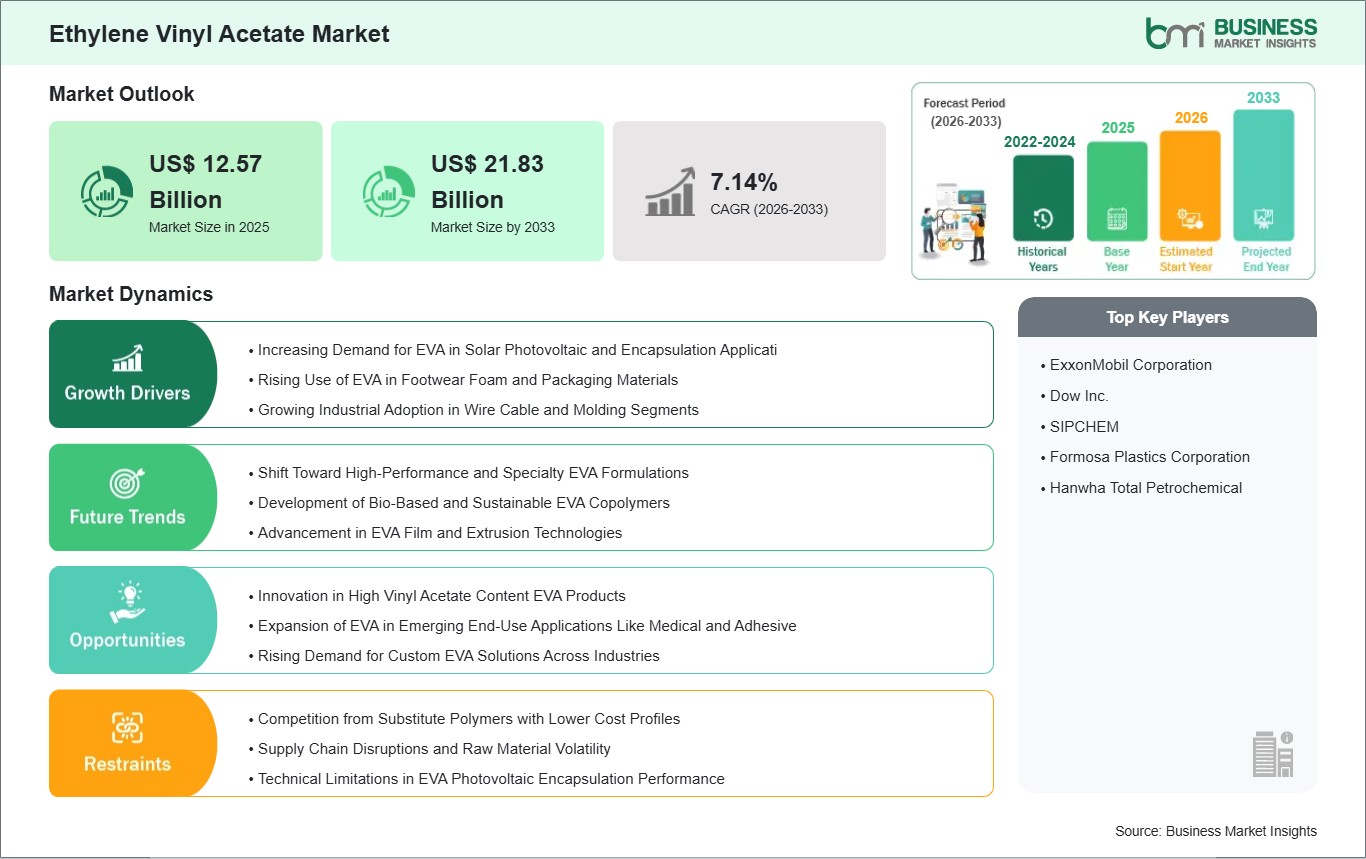
The Ethylene Vinyl Acetate Market size is expected to reach US$ 21.83 Billion by 2033 from US$ 12.57 Billion in 2025. The market is estimated to record a CAGR of 7.14% from 2026 to 2033.
The global market for ethylene vinyl acetate (EVA) is growing steadily, driven by increasing demand in a broad range of industries due to its unique combination of flexibility, impact resistance, transparency, and adhesive properties. EVA is a copolymer of vinyl acetate and ethylene, and its properties can be modified according to the composition of vinyl acetate. The global market for EVA is being driven by several factors, including the increasing market for solar energy, which is using more and more EVA sheets as encapsulants in solar photovoltaic cells. The solar energy sector is a major driver of the market, as it provides a protective cover for the PV cells. The market is also driven by the footwear industry, which continues to rely on EVA as a midsole and insole material due to its lightness and flexibility. Packaging is also a driver of the market, especially in flexible packaging and hot melt adhesives. At the same time, there are challenges related to the price volatility of feedstocks and the presence of other polymers, such as polypropylene and polyethylene blends, which provide a more economical solution in some applications. Environmental issues also affect the market`s demand patterns, as companies are increasingly encouraged to create bio-based or recyclable products, which necessitate more R&D expenditures. However, the constant drive towards new performance products and new end-user industries will help maintain the market`s significance in the foreseeable future.

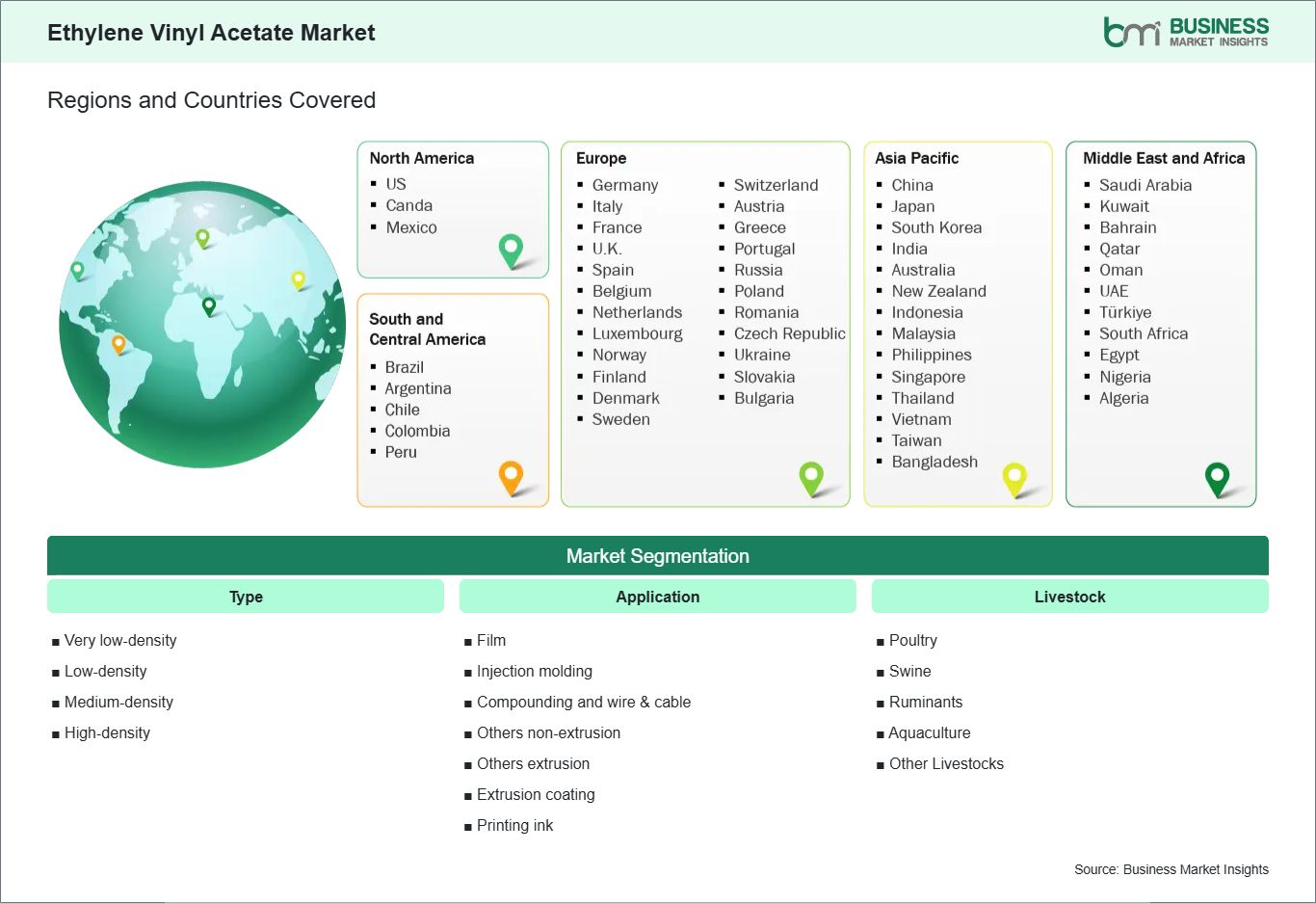
Key segments that contributed to the derivation of the ethylene vinyl acetate market analysis are type and application.
The use of EVA in solar photovoltaic panels and other encapsulation applications has grown significantly as industries focus on long-lasting, high-performance materials. EVA provides an essential protective layer that preserves the efficiency and lifespan of solar modules, shielding them from moisture, dust, and temperature fluctuations. Its flexibility, clarity, and durability make it ideal for use in harsh environmental conditions, ensuring consistent performance over years of exposure. This reliability is increasingly valued as more industries and applications depend on sustainable energy solutions and resilient protective materials.
Besides its use in solar panels, EVA can be found in various electronic devices and packaging where impact resistance and bonding are important. Its versatility helps manufacturers to simplify production processes because they can use EVA in different applications while maintaining quality and functionality. Devices that need impact resistance, moisture resistance, and chemical protection can take advantage of EVA`s special characteristics.
Sustainability is another factor that can contribute to its popularity. EVA can be processed in an environmentally friendly manner with low emissions. In addition to its protective characteristics, its long lifespan can provide long-term benefits to the environment. Therefore, EVA is a material that meets expectations in modern industrial applications in terms of functionality and sustainability.
Increasing attention is being given to EVA products with higher vinyl acetate content, which offer greater flexibility, adhesion, and clarity. These properties make them particularly useful for premium packaging, lamination, and high-performance films, where strength and pliability are both critical. By adjusting the vinyl acetate content, manufacturers can fine-tune the material`s elasticity and bonding capabilities, allowing it to meet the demands of more specialized applications and challenging conditions.
New developments in formulations and processing are also helping to open up new possibilities. High vinyl acetate EVA has the potential to offer higher transparency, thermal stability, and adhesion properties to different materials, which is helping to create lighter, stronger, and more reliable products. These developments are particularly important in industries where materials are needed to withstand physical stress while maintaining their functionality and appearance over time.
Environmental and performance issues are key factors in the use of this product. The environmental-friendly formulations, reduced processing energy, and recyclable properties of this product are making the high vinyl acetate EVA products attractive to organizations seeking to minimize environmental impact. The product is also offering greater flexibility, impact, and adhesion properties, making it suitable for a range of applications where environmental and performance issues are becoming increasingly important.

The ethylene vinyl acetate market is experiencing steady growth, with market size and share analysis reflecting evolving treatment preferences and competitive dynamics among key players. The report evaluates important subsegments categorized within type and application, highlighting their respective contributions to overall market performance.
By type, the High-Density subsegment dominated the Ethylene Vinyl Acetate market in 2025. High-density EVA offers superior strength, durability, and thermal stability, making it highly suitable for a wide range of industrial, packaging, and consumer applications, which drives its widespread adoption.
Based on application, the Film subsegment dominated the Ethylene Vinyl Acetate market in 2025. Film applications require flexibility, transparency, and excellent barrier properties, reinforcing strong demand for EVA in packaging, laminates, and protective films.
| Report Attribute | Details |
|---|---|
| Market size in 2025 | US$ 12.57 Billion |
| Market Size by 2033 | US$ 21.83 Billion |
| Global CAGR (2026 - 2033) | 7.14% |
| Historical Data | 2022-2024 |
| Forecast period | 2026-2033 |
| Segments Covered | By Type
|
|
Regions and Countries Covered
| |
| North America | US, Canada, Mexico |
| Europe | Belgium, Austria, Finland, Denmark, Greece, Poland, Romania, Russia, Ukraine, Czech Republic, Slovakia, Bulgaria, Italy, Luxembourg, Germany, Switzerland, France, Netherlands, Norway, Portugal, Spain, Sweden, United Kingdom |
| Asia-Pacific | Australia, China, India, Japan, South Korea, Indonesia, Malaysia, Philippines, Singapore, Thailand, Vietnam, Bangladesh, New Zealand, Taiwan |
| South and Central America | Brazil, Argentina, Peru, Chile, Colombia |
| Middle East and Africa | Bahrain, Kuwait, Oman, Qatar, Saudi Arabia, United Arab Emirates, Turkiye, South Africa, Egypt, Algeria, Nigeria |
| Market leaders and key company profiles |
|
The "Ethylene Vinyl Acetate Market Size and Forecast (2022 - 2033)" report provides a detailed analysis of the market covering below areas:
The geographical scope of the Ethylene Vinyl Acetate market report is divided into five regions: North America, Asia Pacific, Europe, Middle East & Africa, and South & Central America. The Ethylene Vinyl Acetate market in North America is expected to grow during the forecast period.
North America stands out as a dominant force in the global EVA market, rooted in the region`s strong industrial base and diversified demand across end‑use sectors. The United States and Canada are centers for advanced manufacturing, where EVA`s versatility is leveraged in automotive interior components, consumer goods, and industrial adhesives. The solar energy sector is particularly vibrant in North America, with increasing adoption of solar installations driving robust demand for high‑performance EVA encapsulants that protect photovoltaic modules from environmental stressors and prolong service life. This segment is increasingly influenced by sustainability goals and incentives that encourage clean energy deployment. Another industry where EVA materials have a major influence is the footwear and sports apparel sector, where regional products emphasize comfort, functionality, and lightweight properties, all of which are properties of EVA materials. Packaging is another area where EVA materials have a strong influence, particularly in flexible films and lamination adhesives, which are used in food packaging and consumer products.
North American producers face challenges like fluctuations in cost components of feedstocks, which could influence pricing models, as well as environmental regulations that are encouraging sustainable material use. These challenges are encouraging North American producers to be innovative in developing recyclable EVA blends. Strong relationships between suppliers, formulators, and users have been instrumental in sustaining North America's position as a market leader by providing EVA solutions that meet regional performance needs.

The ethylene vinyl acetate market is evaluated by gathering qualitative and quantitative data post primary and secondary research, which includes important corporate publications, association data, and databases. A few of the key developments in the ethylene vinyl acetate market are:
The Ethylene Vinyl Acetate Market is valued at US$ 12.57 Billion in 2025, it is projected to reach US$ 21.83 Billion by 2033.
As per our report Ethylene Vinyl Acetate Market, the market size is valued at US$ 12.57 Billion in 2025, projecting it to reach US$ 21.83 Billion by 2033. This translates to a CAGR of approximately 7.14% during the forecast period.
The Ethylene Vinyl Acetate Market report typically cover these key segments-
The historic period, base year, and forecast period can vary slightly depending on the specific market research report. However, for the Ethylene Vinyl Acetate Market report:
The Ethylene Vinyl Acetate Market is populated by several key players, each contributing to its growth and innovation. Some of the major players include:
The Ethylene Vinyl Acetate Market report is valuable for diverse stakeholders, including:
Essentially, anyone involved in or considering involvement in the Ethylene Vinyl Acetate Market value chain can benefit from the information contained in a comprehensive market report.
Please tell us your area of interest
(Market Segments/ Regions and Countries/ Companies)