
Elastomers Market Outlook: Size, Share, Trends, Growth Analysis, Competitive Landscape & Forecast, 2026-2033

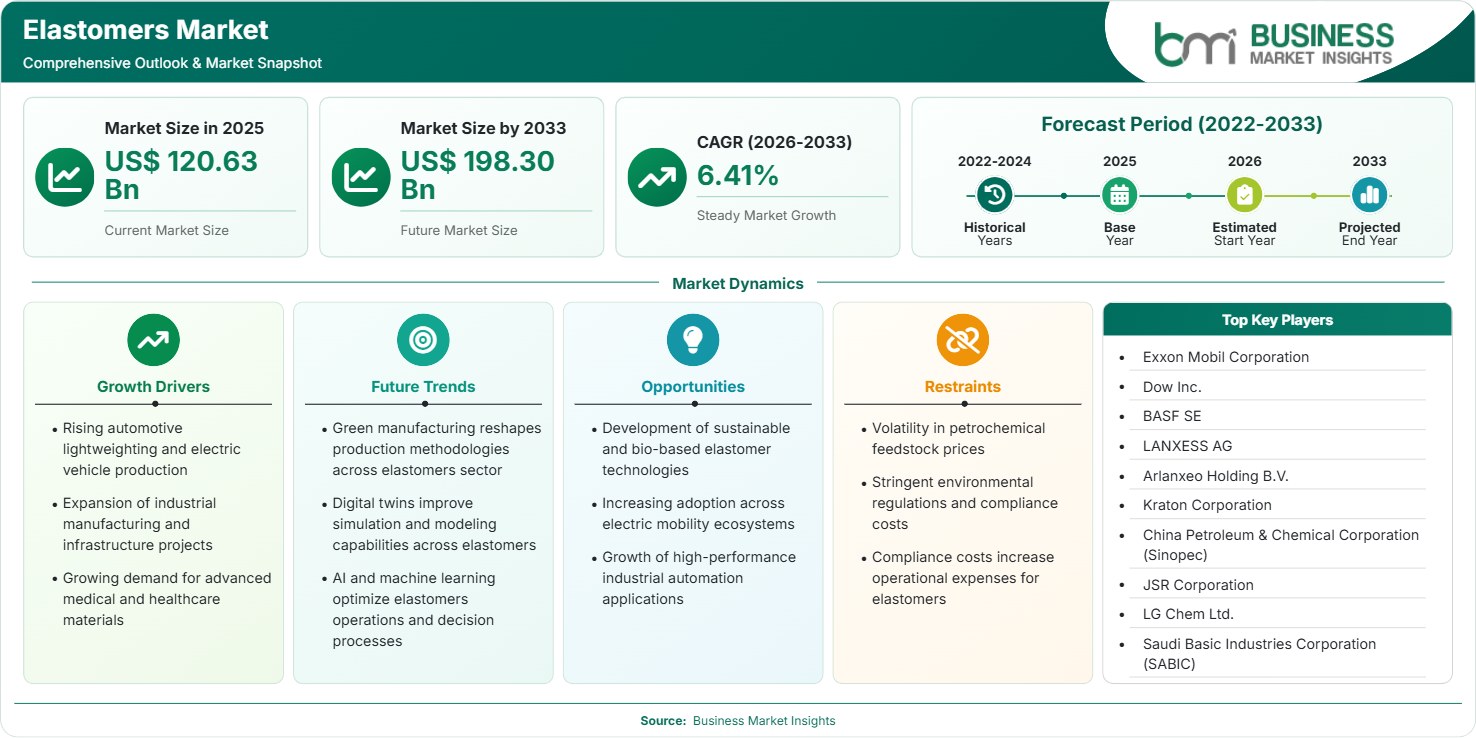
The Elastomers Market size was valued at US$ 120.63 Billion in 2025 and is projected to reach US$ 198.3 Billion by 2033, growing at a CAGR of 6.41% during 2026–2033. Rising automotive production, expanding infrastructure investments, increasing demand for lightweight materials, rapid industrial automation, and sustainable elastomer innovations continue creating long-term opportunities across transportation, healthcare, consumer goods, and advanced manufacturing applications.

Report Coverage
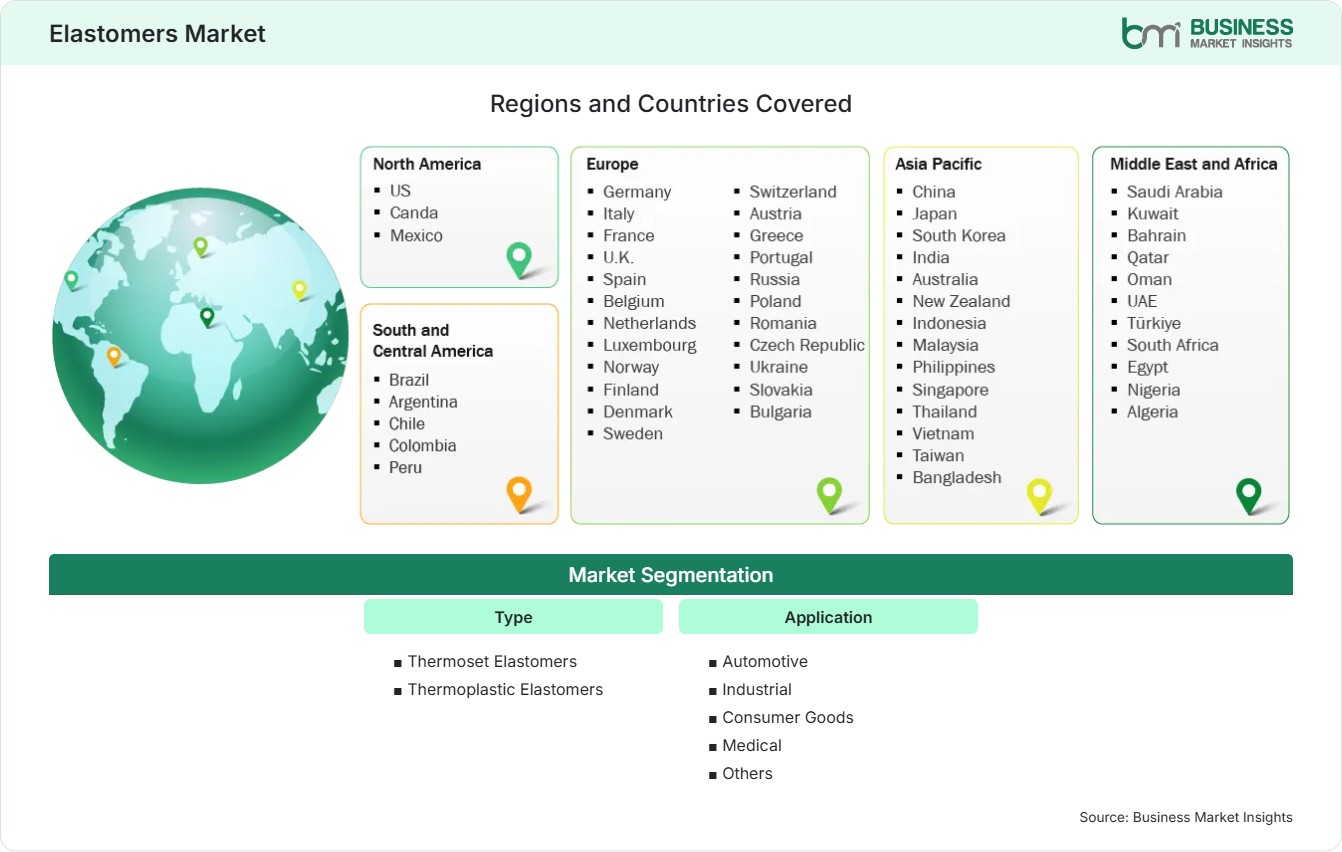
  • Type: Thermoset Elastomers, Thermoplastic Elastomers
  • Application: Automotive, Industrial, Consumer Goods, Medical, Others
US$ 120.63 Bn Market size in 2025
US$ 198.30 Bn Market Size by 2033
6.41% CAGR, 2026 - 2033
2026-2033 Forecast Period

AI Overview

Elastomers Market Summary

  • North America Region: North America holds a market share of 34%–37% in 2025, expanding at a 5.8%–6.2% CAGR during 2026–2033. Strong automotive manufacturing, advanced polymer innovation, shale-based feedstock availability, and sustainable material investments continue supporting industrial demand and premium product development across multiple applications. The U.S. dominates regional production with extensive automotive, healthcare, and industrial manufacturing investments, supporting a 5.9%–6.3% CAGR through 2033.
  • Fastest Growing Region: Asia Pacific accounts for 30%–33% market share in 2025 while advancing at a 7.2%–7.8% CAGR during 2026–2033. Expanding manufacturing capacity, rising electric vehicle production, infrastructure development, urbanization, and increasing domestic polymer consumption continue strengthening long-term regional competitiveness.
  • Leading Segment: Thermoplastic Elastomers (TPEs) represent 56%–60% elastomers market share in 2025 and are expected to register a 6.8%–7.3% CAGR through 2033. Recyclability, lightweight characteristics, efficient processing, and compatibility with advanced manufacturing technologies encourage adoption across automotive, medical devices, electronics, and consumer products.
  • High Growth Segment: Medical applications account for 12%–15% market share in 2025 while expanding at a 7.6%–8.2% CAGR during 2026–2033. Increasing healthcare investments, aging populations, stringent hygiene standards, biocompatible material innovation, and expanding medical device manufacturing continue strengthening long-term demand.
  • Key Market Opportunity: Growing investments in recyclable elastomer formulations, bio-based feedstocks, electric mobility components, additive manufacturing materials, and circular economy initiatives encourage manufacturers to commercialize sustainable, high-performance elastomer technologies serving diverse industrial applications.
  • Major Market Players: Exxon Mobil Corporation, Dow Inc., BASF SE, LANXESS AG, Arlanxeo Holding B.V., Kraton Corporation, China Petroleum & Chemical Corporation (Sinopec), JSR Corporation, LG Chem Ltd., Saudi Basic Industries Corporation (SABIC).
Strategic Insights

Elastomers Market: Strategic Insights

Elastomers Market Strategic Framework
FREE PDF
Request your free sample
Request free sample
Stakeholder View

Key Takeaways

  • The value chain is increasingly integrating feedstock providers, compounders, converters, component makers, and OEMs to enhance supply security, product personalization, and operational efficiency.
  • Electric mobility, medical devices, industrial automation, and advanced infrastructure applications represent the best long-term growth prospects as a result of growing demand for tough, light, and sustainable elastomer materials.
  • Innovations will keep centering around recyclable thermoplastic elastomers, renewable feedstocks, smart manufacturing, digital process improvements, and material engineering innovations for sustainable industrial growth.
  • Asia Pacific offers the best investment prospects due to production growth, favorable industrial policies, efficient production economics, and growing local demand in automotive and electronics industries.
  • Acquisitions, licenses, production expansions, and sustainable partnerships keep transforming industry competition and drive commercialization of specialty elastomer technologies.
  • Sustainability through circular economy, recycling, diversified feedstock supplies, and innovations in specialty materials will be key to future competitiveness.
Geographic Outlook

Elastomers Market Regional Highlights

North America Elastomers Market

North America accounted for 34%–37% of global demand in 2025 and is projected to expand at a 5.8%–6.2% CAGR during 2026–2033. Advanced polymer manufacturing, integrated petrochemical infrastructure, strong automotive production, and healthcare manufacturing continue supporting regional expansion. Elastomers Market share remains highest in North America due to sustained investments in lightweight materials, specialty polymers, sustainable manufacturing technologies, and established OEM supply chains serving transportation, industrial equipment, healthcare, and construction applications.

  • The strong presence of automotive manufacturing in the United States, Canada, and Mexico drives the increasing demand for seals, hoses, vibration control systems, weather strips, and light-weighted elastomer components.
  • The integrated petrochemical supply network helps to boost feedstock availability, efficiencies in the manufacturing process, reliable supplies, competitive pricing, and downstream manufacturing performance.
  • Increasing sustainability drives the efforts toward recyclable thermoplastic elastomers, bio-based materials, and environmentally friendly manufacturing process technologies.
  • Sustainable investments in manufacturing, healthcare engineering, industrial automation, and aerospace engineering increase the premium elastomer market opportunities and drive the commercialization of specialized elastomers.
  • The growing manufacture of electric vehicles drives demand for innovative thermal management, sealing, insulation, and vibration dampening materials.

US Elastomers Market

The United States represented 76%–80% of North American demand during 2025 and is expected to register a 5.9%–6.3% CAGR through 2033. Strong domestic petrochemical production, advanced manufacturing capabilities, expanding healthcare infrastructure, and continuous investments in electric vehicle manufacturing reinforce long-term industrial competitiveness.

  • Elastomers are being extensively used by automotive manufacturers to enhance fuel economy, occupant comfort, battery protection, and vehicle longevity on both conventional and electric platforms.
  • The growing medical device market is driving the demand for biocompatible elastomers that can be used in tubing, wearable devices, pharmaceutical equipment, and surgery.
  • The initiatives undertaken in the process of industrial modernization include the use of sealing systems, conveyor system components, vibration control products, and custom-made elastomers.
  • The collaboration between the chemical industry, universities, and OEMs is leading to fast commercialization of sustainable elastomers and polymer processing technology.

Europe Elastomers Market

Europe represented 24%–27% of global demand in 2025 and is forecast to expand at a 5.6%–6.0% CAGR during 2026–2033. Germany leads regional demand through automotive and specialty chemicals manufacturing, while Poland and the Czech Republic demonstrate faster industrial expansion with CAGR approaching 6.3%–6.8% supported by increasing manufacturing investments and export-oriented production.

  • Germany continues leading specialty polymer innovation supported by premium automotive manufacturing and advanced industrial machinery production.
  • France and Italy strengthen demand through healthcare equipment, industrial automation, consumer products, and sustainable manufacturing initiatives.
  • Central European economies attract increasing foreign investment supporting automotive component production and polymer processing expansion.
  • Carbon reduction policies encourage adoption of recyclable elastomers, renewable feedstocks, and energy-efficient production technologies.
  • Research collaborations accelerate commercialization of advanced elastomer formulations for electric mobility and industrial applications.

Asia Pacific Elastomers Market

Asia Pacific accounted for 30%–33% of global demand in 2025 and is expected to achieve the fastest regional expansion with a 7.2%–7.8% CAGR through 2033. China remains the largest producer and consumer, while India records the highest regional growth with CAGR ranging between 7.8%–8.5% due to infrastructure development, industrial expansion, and rising domestic manufacturing investments.

  • China maintains leadership through integrated petrochemical production, extensive manufacturing capacity, and strong automotive and electronics industries.
  • India continues recording rapid industrial expansion supported by infrastructure investment, localization policies, and electric mobility initiatives.
  • Japan and South Korea emphasize specialty elastomer development, precision manufacturing, and advanced polymer research supporting high-value applications.
  • Southeast Asian economies attract investment in footwear, consumer goods, industrial processing, and export-oriented manufacturing operations.
  • Regional manufacturing diversification improves supply resilience while encouraging multinational companies to establish new production facilities.

Rest of World Elastomers Market

The Rest of World region accounted for 9%–11% of global demand in 2025 and is projected to expand at a 6.3%–6.8% CAGR through 2033. South & Central America benefit from automotive manufacturing and mining investments, while the Middle East & Africa leverage petrochemical integration, industrial diversification, and infrastructure modernization to strengthen regional elastomer consumption.

  • Brazil continues expanding automotive production, industrial processing, and polymer manufacturing, supporting stable elastomer consumption.
  • Saudi Arabia strengthens downstream specialty material production through integrated petrochemical investments and manufacturing diversification strategies.
  • South Africa benefits from mining modernization, infrastructure projects, and industrial equipment demand requiring durable elastomer components.
  • Growing construction activities and consumer goods manufacturing create additional opportunities across emerging economies.
  • International producers continue expanding partnerships, localized production, and distribution networks to improve regional supply responsiveness.
Global Market Geography
FREE PDF
Request your free sample
Request free sample
Segment Analysis

Elastomers Market Segmentation

Type

Type remains the largest value-generating segment across the industry. Thermoplastic Elastomers (TPEs) accounted for 56%–60% market share in 2025 and are projected to expand at a 6.8%–7.3% CAGR through 2033. Recyclability, lightweight characteristics, simplified processing, and compatibility with automated manufacturing continue expanding the Elastomers Market scope across transportation, healthcare, electronics, industrial equipment, and consumer products.

  • Thermoset Elastomers: Deliver excellent heat resistance, dimensional stability, chemical durability, and long-term mechanical performance, making them suitable for automotive sealing systems, industrial machinery, heavy engineering equipment, and construction applications.
  • Thermoplastic Elastomers (TPEs): Support lightweight manufacturing, recyclability, design flexibility, and efficient processing while expanding adoption across automotive, medical devices, electronics, and consumer goods manufacturing worldwide.

Application

Applications continue diversifying as manufacturers develop advanced elastomer formulations addressing increasingly demanding industrial requirements. Automotive accounted for 31%–35% market share in 2025 and is forecast to grow at a 6.5%–6.9% CAGR through 2033. Elastomers Market trends continue favor lightweight materials, electric mobility, durability improvements, and sustainable polymer engineering supporting high-performance applications across multiple industries.

  • Automotive: Lightweight seals, hoses, bushings, weatherstrips, battery insulation, and vibration-control components improve efficiency, safety, durability, and performance across conventional and electric vehicles.
  • Industrial: Automation, heavy equipment modernization, manufacturing expansion, and infrastructure investments continue increasing demand for durable elastomer products operating under demanding industrial conditions.
  • Consumer Goods: Rising disposable incomes, ergonomic product designs, customization trends, and improved aesthetics continue strengthening elastomer consumption across footwear, household products, sporting goods, and electronics.
  • Medical: Healthcare manufacturers increasingly utilize specialty elastomers in tubing, wearable devices, pharmaceutical packaging, surgical instruments, and diagnostic equipment requiring flexibility, sterilization compatibility, and biocompatibility.
Market Forces

Elastomers Market Dynamics

Key Market Drivers

Rising Automotive Lightweighting and Electric Vehicle Production

Car makers keep substituting traditional materials with high-tech elastomers to cut down on the car’s weight and increase its energy efficiency along with ensuring protection of batteries in electric cars. Based on the International Energy Agency (IEA), the number of electric vehicles keeps growing fast all over the world. Elastomers Market growth is supported by OEM investments in lightweight engineering, recyclable materials, and advanced thermal management systems. High-performance elastomers improve durability, flexibility, chemical resistance, and operational reliability while helping manufacturers comply with stricter emission regulations and sustainability objectives across global transportation supply chains.

Expansion of Industrial Manufacturing and Infrastructure Projects

The demand for high-performance elastomeric parts continues to increase due to industrial automation, infrastructure upgrading, and manufacturing investments. The growth in production in mining, construction, renewable energy, heavy industry, and processing industries results in increased use of seals, hoses, belts, gaskets, and vibration isolation made from elastomers. The industrial investment forecasts by OECD and the International Monetary Fund remain positive for manufacturing in the Asia Pacific and North American regions. New elastomers are developed providing enhanced wear resistance, longer lifespan, and reduced maintenance needs.

Growing Demand for Advanced Medical and Healthcare Materials

Health care investments, aging population demographics, and increasing manufacturing of medical devices will result in sustained growth for biocompatible elastomer materials. The World Health Organization stresses the need for improved health care facilities and availability of health care technologies, thereby promoting increased use of advanced polymers. The use of elastomers is on the rise in diagnostic devices, tubes, respiratory equipment, wearable health care items, and pharmaceutical equipment due to their elasticity, sterilization tolerance, and chemical resistance. Higher expenditure on health care in both developed and developing nations will promote continued innovation.

Key Market Opportunities

Development of Sustainable and Bio-Based Elastomer Technologies

Sustainability commitments and circular economy initiatives are encouraging manufacturers to commercialize recyclable thermoplastic elastomers, renewable feedstocks, and bio-based polymer technologies. Governments continue supporting lower-carbon manufacturing through environmental regulations and green industrial policies. Elastomers Market Forecasts indicate sustainable material portfolios will become increasingly important across automotive, healthcare, packaging, electronics, and consumer industries. Companies investing in chemical recycling, renewable raw materials, and low-emission manufacturing processes are expected to strengthen competitive positioning while addressing evolving regulatory requirements and customer sustainability expectations.

Increasing Adoption Across Electric Mobility Ecosystems

Expansion of electric mobility offers many avenues for using specialty elastomers that go beyond traditional automotive parts. The need for special seals for battery packs, electrical charging systems, cables, vibration dampers, thermal insulation, and lightweight structural components calls for advanced elastomers that can withstand tough environments. Governmental incentives for manufacturing of electric cars and charging stations keep pushing towards making long term investments. Specialty elastomers manufacturers working on developing fireproof and electrically robust elastomers are likely to establish strong ties with auto and battery manufacturers.

Growth of High-Performance Industrial Automation Applications

The need for high-grade elastomers is set to increase due to advancements in digital manufacturing, robots, predictive maintenance, and smart factories. Automation systems use state-of-the-art elastomers in robotic actuators, pneumatic devices, industrial seals, conveyors, and precision machines which work in constantly stressed conditions. With modernization of factories in developed and developing countries, manufacturers are incentivized to formulate tailor-made compounds that exhibit high wear resistance and reliability.

Market Restraints and Challenges

Volatility in Petrochemical Feedstock Prices

Factor: Conventional elastomer production depends heavily on petrochemical feedstocks including butadiene, styrene, ethylene, and propylene, exposing manufacturers to fluctuations in global raw material and energy prices. Impact: Cost volatility reduces profitability, complicates procurement planning, and creates uncertainty within long-term supply agreements. Producers frequently experience margin pressure when feedstock prices rise faster than customer contract adjustments. This challenge is particularly significant for manufacturers supplying highly competitive automotive and industrial sectors where pricing flexibility remains limited.

Stringent Environmental Regulations and Compliance Costs

Factor: Governments continue strengthening regulations governing emissions, chemical safety, waste management, product recyclability, and manufacturing sustainability across major industrial economies. Impact: Compliance requires continuous investment in cleaner production technologies, certification programs, advanced recycling systems, and sustainable material development. Smaller manufacturers often face higher operational costs and slower commercialization timelines compared with multinational producers possessing greater financial resources. Increasing regulatory complexity also extends product qualification processes across healthcare, automotive, and industrial applications.

Company Analysis

Competitive Landscape

The competitive environment is characterized by continuous investments in specialty polymer technologies, sustainable material development, capacity expansion, and digital manufacturing. Elastomers Market analysis indicates that leading manufacturers are strengthening their positions through innovation, strategic partnerships, and expansion of high-performance product portfolios serving automotive, industrial, medical, and consumer goods applications.

Company Name

Overview

Products and Services Relevant to this Market

Exxon Mobil Corporation

Global integrated energy and chemical company with extensive petrochemical operations supporting elastomer feedstocks and specialty materials.

Synthetic rubber feedstocks, specialty polymers, performance elastomers, petrochemical intermediates, and industrial material solutions.

Dow Inc.

Leading materials science company focused on advanced polymer innovation across mobility, packaging, infrastructure, and consumer applications.

Thermoplastic elastomers, specialty polymers, adhesives, sealants, performance materials, and sustainable polymer technologies.

BASF SE

Global chemical manufacturer emphasizing advanced materials, specialty chemicals, and sustainable product innovation.

Engineering plastics, thermoplastic polyurethanes, elastomer compounds, performance additives, and industrial material solutions.

LANXESS AG

Specialty chemicals producer recognized for high-performance rubber technologies serving global industrial sectors.

Synthetic rubber, specialty elastomers, additives, performance chemicals, and industrial material technologies.

Arlanxeo Holding B.V.

Leading producer specializing in synthetic elastomer technologies for automotive, industrial, and energy applications.

EPDM rubber, butyl rubber, nitrile rubber, polybutadiene rubber, and specialty elastomer products.

Kraton Corporation

Specialty polymer company focused on innovative performance materials and sustainable product development.

Styrenic block copolymers, specialty elastomers, pine chemicals, adhesives, and performance materials.

China Petroleum & Chemical Corporation (Sinopec)

Integrated energy and chemical enterprise supporting global elastomer supply through large-scale petrochemical operations.

Synthetic rubber, petrochemical feedstocks, specialty polymers, industrial chemicals, and thermoplastic materials.

JSR Corporation

Japanese materials technology company specializing in advanced synthetic rubber and functional materials.

Synthetic elastomers, specialty polymers, electronic materials, advanced rubber compounds, and industrial materials.

LG Chem Ltd.

Diversified chemical manufacturer investing in advanced materials and next-generation polymer technologies.

Engineering plastics, thermoplastic elastomers, specialty polymers, battery materials, and industrial chemicals.

Saudi Basic Industries Corporation (SABIC)

Global diversified chemicals producer leveraging integrated feedstocks for high-performance material innovation.

Engineering thermoplastics, elastomer materials, specialty polymers, petrochemicals, and industrial performance products.

Trust & Transparency

Research Methodology

The market analysis combines proprietary research with secondary data from government agencies, company disclosures, regulatory filings, industry databases and expert interviews. Market estimates are validated through data triangulation, cross-market benchmarking and analyst review.

View Full Research Methodology

Questions Answered

Frequently Asked Questions

What competitive strategies are most common among leading manufacturers?

Major companies emphasize specialty product innovation, regional capacity expansion, strategic partnerships, digital manufacturing, supply-chain integration, and investments in sustainable material technologies.

How does sustainability influence an market Report?

An Elastomers Market Report evaluates how bio-based feedstocks, recyclable materials, chemical recycling technologies, environmental regulations, and circular economy initiatives influence product innovation, investment priorities, and competitive positioning.

Which end-use industries offer the strongest future opportunities?

Electric mobility, medical devices, renewable energy equipment, industrial automation, electronics, and consumer products are expected to generate the strongest long-term demand for advanced elastomer solutions.

Why are thermoplastic elastomers gaining wider commercial acceptance?

They combine rubber-like flexibility with thermoplastic processing advantages, enabling recyclability, lower manufacturing costs, improved design flexibility, and efficient high-volume production across multiple industries.

What factors are driving long-term demand for elastomers?

Demand is supported by vehicle lightweighting, industrial automation, healthcare expansion, infrastructure development, and increasing adoption of high-performance materials for sealing, insulation, vibration control, and engineered industrial components.

Access the Full Elastomers Market Report

Get segment-level forecasts, regional estimates, competitive benchmarking, company profiles and downloadable Excel datasets.

Access the full Elastomers Market Report
350 pages PDF & Excel | 2026-08-21
Similar Research

Related Market Reports