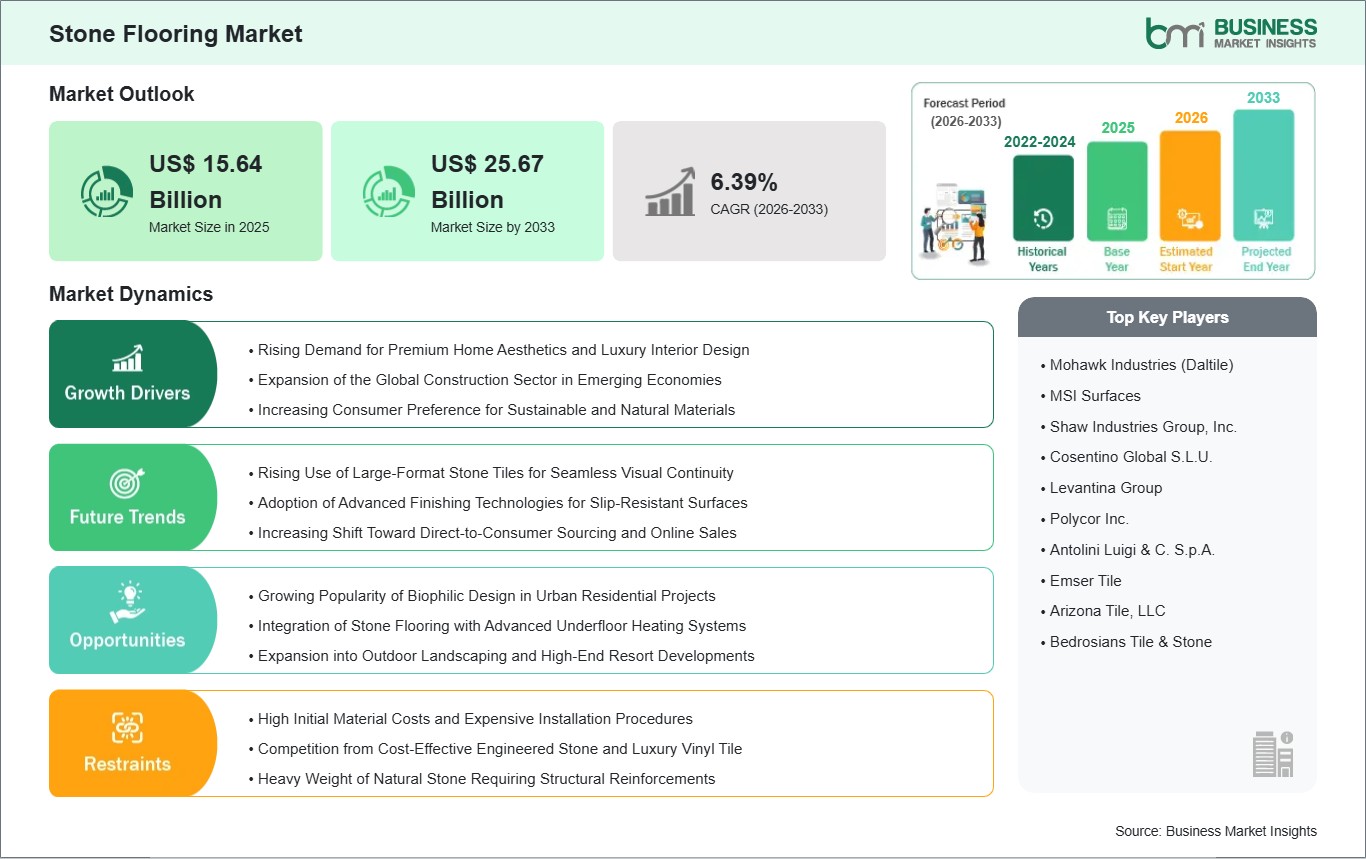
The Stone Flooring Market size is expected to reach US$ 25.67 billion by 2033 from US$ 15.64 billion in 2025. The market is estimated to record a CAGR of 6.39% from 2026 to 2033.
The Global Stone Flooring Market in 2025 was characterized by a resilient recovery in the construction sector and a heightened consumer focus on sustainable luxury. As urbanization continues to accelerate, the demand for durable and aesthetically pleasing flooring solutions has seen stone emerge as a preferred choice for both high-end residential renovations and commercial hospitality projects. The market is primarily supported by the timeless appeal of marble and the rugged durability of granite, which cater to different functional needs across the built environment. While the industry faces stiff competition from versatile engineered alternatives, the inherent value, longevity, and low maintenance of natural stone remain unmatched, particularly in luxury segments where material authenticity is non-negotiable.
Strategically, 2025 marked an era of technological integration within the stone sector, from digital slab selection tools to precision water-jet cutting. These advancements have made stone more accessible and easier to install, addressing traditional pain points regarding cost and complexity. The residential segment continues to lead in volume, but the commercial sector is rapidly closing the gap with large-scale infrastructure projects in the Asia-Pacific region. As environmental regulations tighten, the market is successfully pivoting toward transparent sourcing and lower-carbon fabrication processes, ensuring that stone flooring remains a cornerstone of modern, eco-conscious architectural design for the foreseeable future.

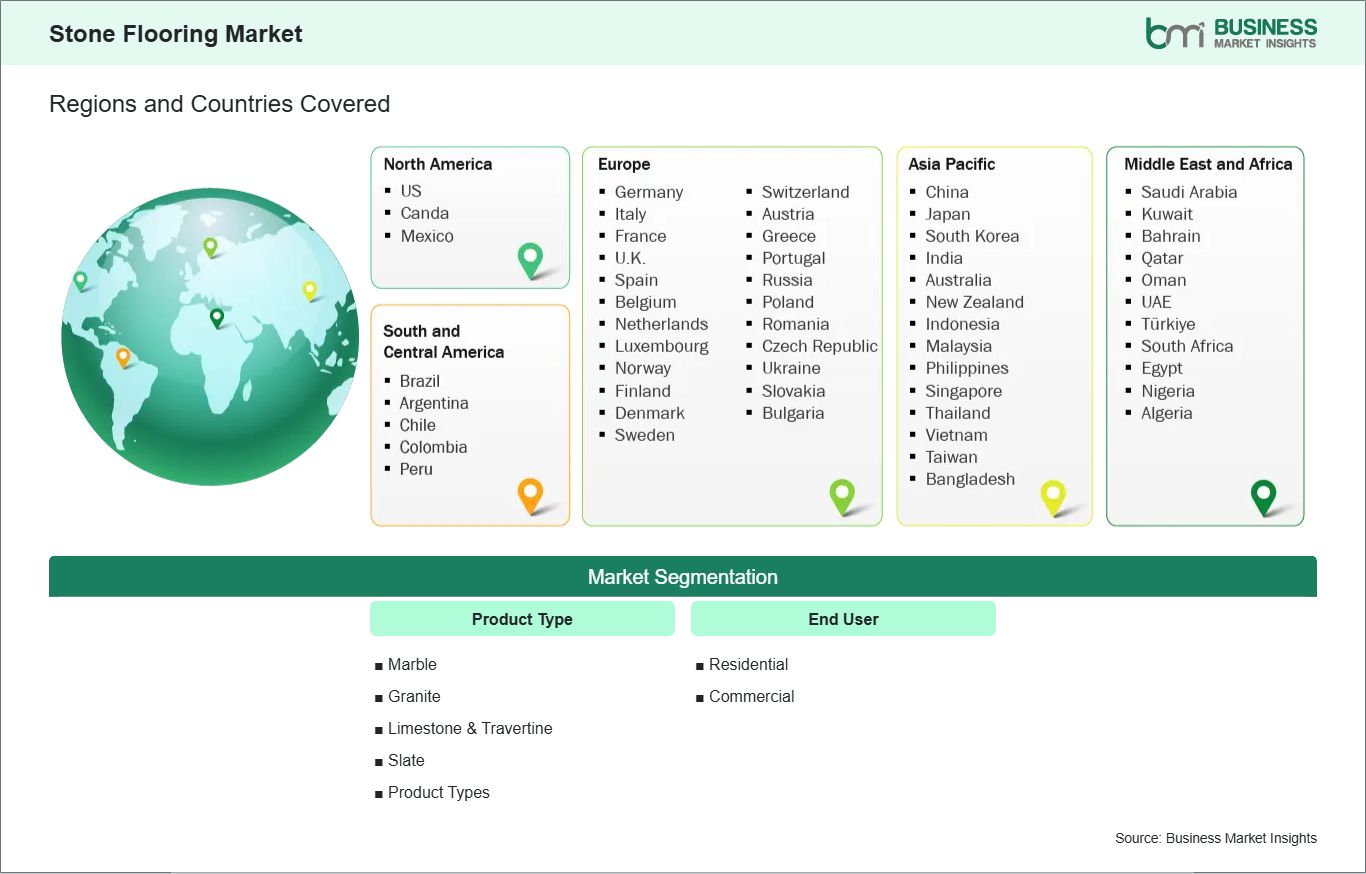
Key segments that contributed to the derivation of the Stone Flooring market analysis are product type and end use.
The modern residential landscape is increasingly defined by a consumer shift toward "quiet luxury" and high-end interior finishes. As disposable incomes rise globally, particularly in emerging middle-class brackets, homeowners are prioritizing materials that offer both visual sophistication and long-term value. Natural stone flooring, with its unique textures and organic color variations, has become the primary choice for those seeking to create a distinctive and upscale living environment. This demand is not limited to new builds but is heavily present in the remodeling sector, where upgrading to stone is viewed as a strategic investment.
Furthermore, the influence of social media and digital design platforms has accelerated the desire for Instagram friendly home interiors. Marble and granite are frequently showcased as centerpieces in contemporary architectural designs, influencing mass-market trends. This aspiration for premium aesthetics is particularly strong in the kitchen and living area segments, where stone flooring provides a seamless transition between functional spaces. The material's ability to maintain its luster over decades while resisting wear and tear makes it a more attractive proposition than transient flooring trends, encouraging long-cycle investments by affluent consumers.
The psychological impact of using natural materials also plays a significant role in this driver. Consumers are moving away from the plastic feel of synthetic flooring, opting instead for the cooling touch and solid underfoot sensation of natural stone. This tactile preference, combined with the material's association with permanence and heritage, ensures that the demand for premium stone remains robust even during periods of economic fluctuation. As luxury real estate markets continue to expand in regions like North America and the Middle East, the push for high-end stone finishes remains a dominant force in the industry.
Biophilic design, which focuses on increasing connectivity between building occupants and the natural environment, has transitioned from a niche architectural concept to a mainstream design philosophy. This movement presents a massive opportunity for the stone flooring market, as natural stone is one of the most authentic materials available for creating indoor-outdoor transitions. Architects are increasingly specifying stone floors that extend from the interior living room out onto the patio or garden, utilizing consistent material palettes to blur the boundaries between the home and nature.
In urban environments, where access to green space is often limited, the use of natural stone helps to create a sanctuary effect within residential and commercial interiors. The inherent irregularities and earthy tones of slate, limestone, and travertine provide a grounding element that synthetic materials cannot replicate. This opportunity is being amplified by the wellness trend in real estate, where developers market properties based on their use of healthy, non-toxic materials. Unlike carpets or some laminates, stone does not harbor allergens or off-gas volatile organic compounds, making it a key enabler for biophilic and health-conscious projects.
The trend toward biophilic design also encourages the use of diverse stone finishes, such as honed, tumbled, or leathered surfaces, which mimic the feel of weathered rock. This diversification allows manufacturers to market a wider range of products that were previously considered rustic or imperfect. As corporate offices and healthcare facilities also adopt biophilic principles to improve employee productivity and patient recovery rates, the stone flooring market is set to capture a larger share of the commercial sector by positioning itself as the premier natural material for human-centric architecture.

The global Stone Flooring market is experiencing steady growth, with market size and share analysis reflecting evolving treatment preferences and competitive dynamics among key players. The report evaluates important subsegments categorized within product type and end use highlighting their respective contributions to overall market performance.
By product type, the Marble subsegment dominated the market in 2025 due to its extensive use in high-end indoor applications and the hospitality sector, where its polished finish and cooling properties make it an ideal choice for large-scale premium flooring installations.
By end user, the Residential subsegment dominated the market in 2025 driven by the massive scale of the global housing stock and a surge in custom-built single-family homes, where natural stone is favored for its ability to improve indoor air quality and aesthetics.
| Report Attribute | Details |
|---|---|
| Market size in 2025 | US$ 15.64 Billion |
| Market Size by 2033 | US$ 25.67 Billion |
| Global CAGR (2026 - 2033) | 6.39% |
| Historical Data | 2022-2024 |
| Forecast period | 2026-2033 |
| Segments Covered | By Product Type
|
|
Regions and Countries Covered
| |
| North America | US, Canada, Mexico |
| Europe | Belgium, Austria, Finland, Denmark, Greece, Poland, Romania, Russia, Ukraine, Czech Republic, Slovakia, Bulgaria, Italy, Luxembourg, Germany, Switzerland, France, Netherlands, Norway, Portugal, Spain, Sweden, United Kingdom |
| Asia-Pacific | Australia, China, India, Japan, South Korea, Indonesia, Malaysia, Philippines, Singapore, Thailand, Vietnam, Bangladesh, New Zealand, Taiwan |
| South and Central America | Brazil, Argentina, Peru, Chile, Colombia |
| Middle East and Africa | Bahrain, Kuwait, Oman, Qatar, Saudi Arabia, United Arab Emirates, Turkiye, South Africa, Egypt, Algeria, Nigeria |
| Market leaders and key company profiles |
|
The "Stone Flooring Market Size and Forecast (2022 - 2033)" report provides a detailed analysis of the market covering below areas:
The geographical scope of the Stone Flooring market report is divided into: North America, Asia Pacific, Europe, Middle East & Africa, and South & Central America. North America held the largest share in 2025.
North America maintained its position as the leading region in the Stone Flooring Market in 2025, driven by a powerful combination of high home equity and a robust culture of residential remodeling. The United States market is particularly buoyant, supported by a significant increase in high-end single-family housing completions and a growing trend toward "hard-surface" flooring across all living areas. The dominance of this region is further reinforced by a sophisticated distribution network and the presence of major industry leaders who have invested heavily in localized fabrication facilities. This infrastructure allows for shorter lead times and a greater variety of bespoke stone products, satisfying the American consumer's demand for customization and premium quality. Beyond the residential sector, North America`s dominance is anchored by massive investments in the hospitality and corporate office segments. Large-scale developments in metropolitan hubs consistently specify high-grade marble and granite for lobbies and public spaces to meet brand-standard requirements for durability and luxury.
While the Asia-Pacific region leads in terms of raw production and volume growth, North America captures the highest market value due to the premium pricing of exotic stone imports and advanced installation services. The regional market is also at the forefront of the sustainability movement, with a high adoption rate of stones certified for green building standards, ensuring continued leadership in the global value-added stone market.

The Stone Flooring market is evaluated by gathering qualitative and quantitative data post primary and secondary research, which includes important corporate publications, association data, and databases. A few of the key developments in the Stone Flooring market are:
The Stone Flooring Market is valued at US$ 15.64 Billion in 2025, it is projected to reach US$ 25.67 Billion by 2033.
As per our report Stone Flooring Market, the market size is valued at US$ 15.64 Billion in 2025, projecting it to reach US$ 25.67 Billion by 2033. This translates to a CAGR of approximately 6.39% during the forecast period.
The Stone Flooring Market report typically cover these key segments-
The historic period, base year, and forecast period can vary slightly depending on the specific market research report. However, for the Stone Flooring Market report:
The Stone Flooring Market is populated by several key players, each contributing to its growth and innovation. Some of the major players include:
The Stone Flooring Market report is valuable for diverse stakeholders, including:
Essentially, anyone involved in or considering involvement in the Stone Flooring Market value chain can benefit from the information contained in a comprehensive market report.
Please tell us your area of interest
(Market Segments/ Regions and Countries/ Companies)