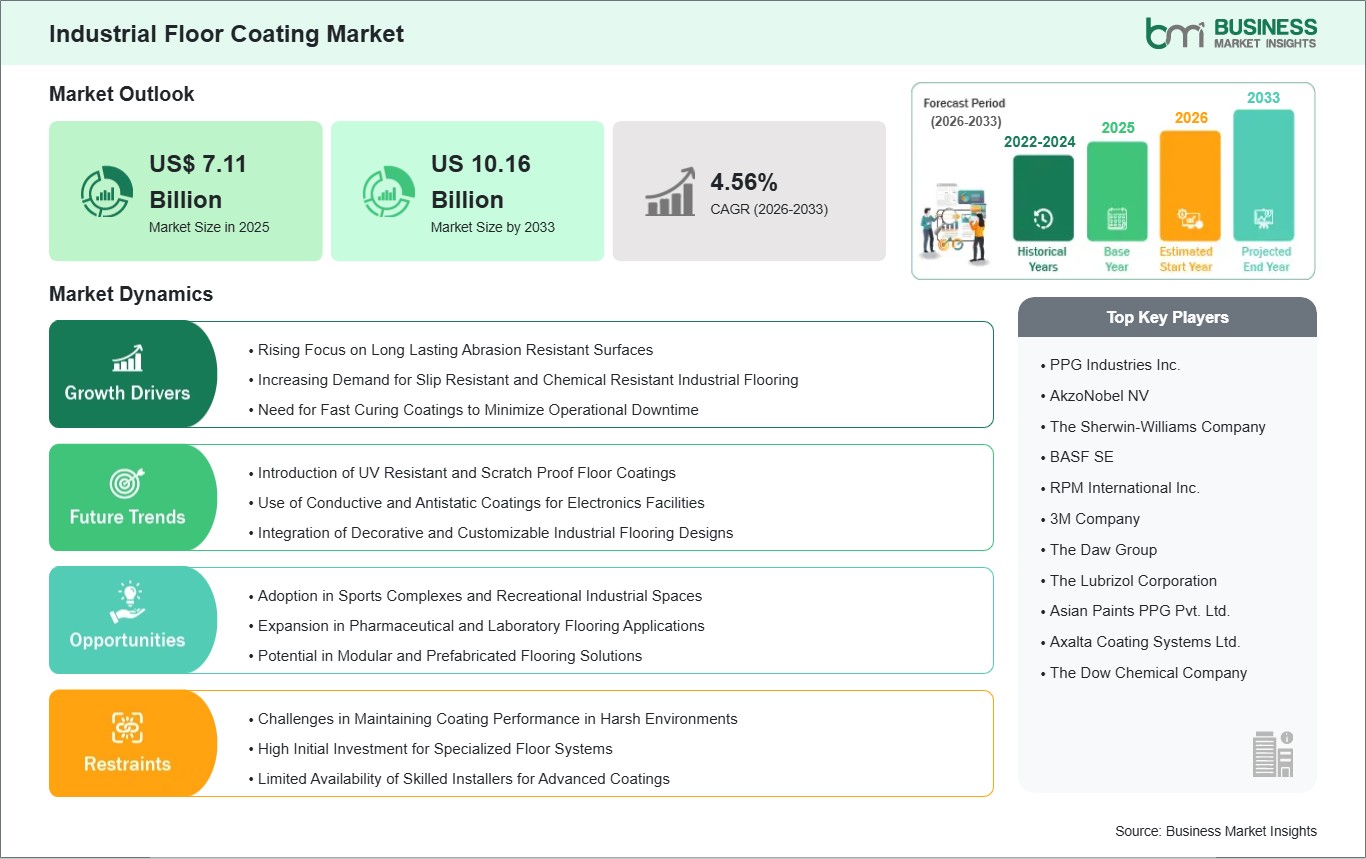
The Industrial Floor Coating Market size is expected to reach US$ 10.16 Billion by 2033 from US$ 7.11 Billion in 2025. The market is estimated to record a CAGR of 4.56% from 2026 to 2033.
The global industrial floor coating market primarily revolves around the application of industrial coatings on the surface of the floor with the aim of improving the durability and safety of the floors in industrial settings. Industrial coatings are applied on the floors of industrial settings with the aim of withstanding various forms of stress and strain associated with industrial operations. Industrial coatings are applied in various industrial settings such as manufacturing industries, warehouses, food processing industries, automobile industries, pharmaceutical industries, and logistics and transportation industries. Industrial coatings offer various benefits, such as improved durability and safety of the floors through improved resistance to wear and tear, improved hygiene of the floors through the application of seamless coatings, and protection of the floors against corrosive substances.
The demand for industrial floor coatings is mainly dependent on the growth of industrial infrastructure around the world. In this context, industrial manufacturers and industry managers are increasingly using advanced floor coating technologies to enhance efficiencies and comply with changing safety regulations. In this context, industry sectors such as food and beverage processing and pharmaceuticals, which require stringent cleanliness and control of contamination risks, are increasingly using advanced coating solutions that inhibit microbial growth and facilitate easy cleaning. Additionally, advances in coating chemistry, such as polyurethane, epoxy blends, and hybrids, enable specific performance characteristics that can match specific operational requirements. In spite of this growing demand for industrial floor coatings, there are specific restraints that are associated with this industry. These restraints include installation complexities that require skilled coating applicators.
Additionally, volatile raw material costs and supply chain risks pose specific challenges to manufacturers and industry users. Nevertheless, advances in coating technology and material science continue to enhance the scope of industrial floor coatings in global industrial operations.

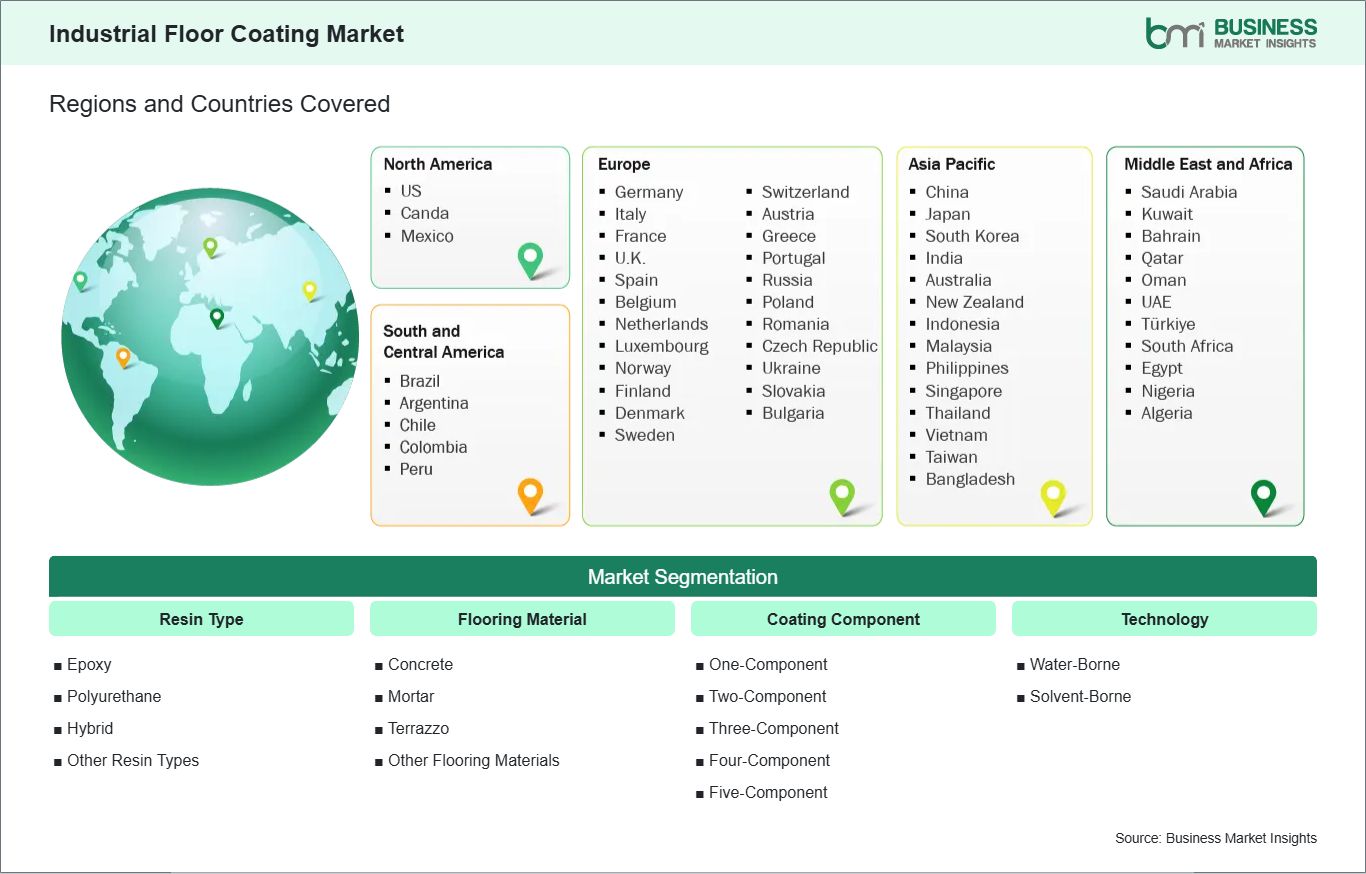
Key segments that contributed to the derivation of the industrial floor coating market analysis are resin type, flooring material, coating component, technology, and end‑use sector.
The global industrial floor coatings market is increasingly influenced by factors like the need for floor coatings that can last for a long time and can withstand abrasion in industries and facilities. Floors in industries are often subjected to high levels of abrasion and can be exposed to chemicals and heavy equipment. In this context, industrial floors are in need of high-performance coatings that can last for a long time and can withstand abrasion and chemicals. High-performance epoxy, polyurethane, and hybrid resin-based coatings are playing a vital role in meeting this need by offering floors that are not only chemically resistant and abrasion-resistant but also have a high lifespan.
In addition to durability, industrial floor coatings are increasingly valued for their protective and safety-enhancing properties. Coatings with anti-slip textures, chemical resistance, and impact absorption capabilities prevent workplace accidents, protect sensitive equipment, and reduce long-term repair costs. Facilities involved in heavy industrial processes, such as automotive plants, chemical processing units, and logistics hubs, benefit from coatings that combine mechanical strength with resistance to oil, solvents, and other corrosive substances. The global trend toward operational efficiency and workplace safety has therefore driven widespread adoption of abrasion-resistant flooring solutions across diverse industrial sectors.
Furthermore, industrial floor coatings contribute to sustainability and environmental compliance. Many modern coating systems are designed with low volatile organic compound (VOC) formulations, improving indoor air quality and minimizing environmental impact. Their long lifespan reduces the frequency of recoating and material waste, aligning with global initiatives to create more sustainable industrial facilities. As manufacturing and storage environments become more complex and high-performance, abrasion-resistant floor coatings are increasingly recognized as essential components for operational reliability, workplace safety, and long-term facility management on a global scale.
Industrial floor coatings are also seeing growing adoption in sports complexes, recreational facilities, and multipurpose industrial spaces. These environments require flooring solutions that can withstand heavy foot traffic, dynamic impact, and frequent cleaning, while maintaining aesthetic appeal and functional performance. Coatings such as polyurethane, acrylic, and epoxy-based systems provide durable, resilient surfaces suitable for indoor arenas, gyms, skating rinks, and multifunctional recreational areas. They combine shock absorption, chemical resistance, and slip-resistant properties, creating safe and high-performing spaces for athletes and the public.
Apart from sports complexes, recreational areas in industrial spaces, such as employee well-being areas, training areas, and recreational areas, are increasingly adopting industrial floor coatings. Apart from the durability and safety that the coatings provide, the coatings also provide the advantage of customizing the floors with different colors, activity areas, and the inclusion of non-slip floors. As organizations increasingly seek to provide a healthy environment for their employees, industrial floor coatings have emerged as a vital component in recreational areas and industrial spaces.
Furthermore, the adoption of industrial floor coatings in sports and recreational areas has also coincided with the overall trend in the modernization of industrial spaces. Apart from the functionality that the coatings provide, industrial floor coatings also provide the advantage of enhancing the overall aesthetic appeal of the spaces in which they are applied. As a result, sports and recreational areas that are used for a variety of functions, including community functions, fitness, and sports, are increasingly adopting industrial floor coatings. Overall, the adoption of industrial floor coatings has resulted in the creation of a new market for industrial coatings that are highly durable, impact-resistant, and abrasion-resistant worldwide.

The industrial floor coatingmarket is experiencing steady growth, with market size and share analysis reflecting evolving treatment preferences and competitive dynamics among key players. The report evaluates important subsegments categorized within resin type, flooring material, coating component, technology, and end‑use sector, highlighting their respective contributions to overall market performance.
By resin type, the Epoxy subsegment dominated the Industrial Floor Coating market in 2025. Epoxy resins offer excellent adhesion, chemical resistance, and durability, making them highly suitable for industrial flooring applications, driving their widespread adoption.
Based on flooring material, the Concrete subsegment dominated the Industrial Floor Coating market in 2025. Concrete floors require robust and long-lasting coatings to withstand heavy loads and abrasion, supporting strong demand for epoxy-based coatings.
In terms of coating component, the Two‑Component subsegment dominated the Industrial Floor Coating market in 2025. Two-component systems provide enhanced performance, chemical resistance, and curing control, reinforcing their preference in industrial flooring solutions.
By technology, the Solvent‑Borne subsegment dominated the Industrial Floor Coating market in 2025. Solvent-borne coatings offer superior film formation, durability, and chemical resistance, driving their widespread use in industrial environments.
In terms of end-use sector, the Manufacturing subsegment dominated the Industrial Floor Coating market in 2025. Manufacturing facilities demand durable, chemical-resistant, and high-performance flooring solutions, reinforcing the dominance of this segment in the market.
| Report Attribute | Details |
|---|---|
| Market size in 2025 | US$ 7.11 Billion |
| Market Size by 2033 | US 10.16 Billion |
| Global CAGR (2026 - 2033) | 4.56% |
| Historical Data | 2022-2024 |
| Forecast period | 2026-2033 |
| Segments Covered | By Resin Type
|
|
Regions and Countries Covered
| |
| North America | US, Canada, Mexico |
| Europe | Belgium, Austria, Finland, Denmark, Greece, Poland, Romania, Russia, Ukraine, Czech Republic, Slovakia, Bulgaria, Italy, Luxembourg, Germany, Switzerland, France, Netherlands, Norway, Portugal, Spain, Sweden, United Kingdom |
| Asia-Pacific | Australia, China, India, Japan, South Korea, Indonesia, Malaysia, Philippines, Singapore, Thailand, Vietnam, Bangladesh, New Zealand, Taiwan |
| South and Central America | Brazil, Argentina, Peru, Chile, Colombia |
| Middle East and Africa | Bahrain, Kuwait, Oman, Qatar, Saudi Arabia, United Arab Emirates, Turkiye, South Africa, Egypt, Algeria, Nigeria |
| Market leaders and key company profiles |
|
The "Industrial Floor Coating Market Size and Forecast (2022 - 2033)" report provides a detailed analysis of the market covering below areas:
The geographical scope of the Industrial Floor Coating market report is divided into five regions: North America, Asia Pacific, Europe, Middle East & Africa, and South & Central America. The Industrial Floor Coating market in North America is expected to grow during the forecast period.
North America holds the leading position in the worldwide industrial floor coating market due to its large industrial base, highly developed manufacturing industry, and high standards in workplace safety and quality of infrastructure. The region covers a wide range of industries, including the automotive, aerospace, food processing, pharmaceutical, logistics, and manufacturing sectors. All these industries require floor coatings with the potential to withstand harsh working conditions. Industries where equipment movement, forklifts, and heavy machinery are common require strong floor coatings to prevent degradation.
The food and beverage industry also contributes to the dominance in the market. Seamless floors are critical in these industries to meet the requirements of health regulations. The maturity of the North American industrial ecosystem in the development of industrialization is further seen in the use of advanced coating technologies that not only provide functional performance but also consider environmental and safety aspects. There is a trend towards the use of coatings that provide sustainability, as seen in the interest in coatings that have lower volatile compound emissions during application. They also provide improved long-term indoor air quality.
Moreover, the availability of established suppliers, coating applicators, and researchers helps in the development of innovative efficiency in the application of coatings to meet the complexities required in the industrial floor coating market. Although challenges in the use of coatings, such as application expertise, surface preparation, and costs of installation, exist, the dedication to excellence in the North American industrial floor coating market continues to hold the top position in the world market.

The industrial floor coating market is evaluated by gathering qualitative and quantitative data post primary and secondary research, which includes important corporate publications, association data, and databases. A few of the key developments in the industrial floor coating market are:
The Industrial Floor Coating Market is valued at US$ 7.11 Billion in 2025, it is projected to reach US 10.16 Billion by 2033.
As per our report Industrial Floor Coating Market, the market size is valued at US$ 7.11 Billion in 2025, projecting it to reach US 10.16 Billion by 2033. This translates to a CAGR of approximately 4.56% during the forecast period.
The Industrial Floor Coating Market report typically cover these key segments-
The historic period, base year, and forecast period can vary slightly depending on the specific market research report. However, for the Industrial Floor Coating Market report:
The Industrial Floor Coating Market is populated by several key players, each contributing to its growth and innovation. Some of the major players include:
The Industrial Floor Coating Market report is valuable for diverse stakeholders, including:
Essentially, anyone involved in or considering involvement in the Industrial Floor Coating Market value chain can benefit from the information contained in a comprehensive market report.
Please tell us your area of interest
(Market Segments/ Regions and Countries/ Companies)