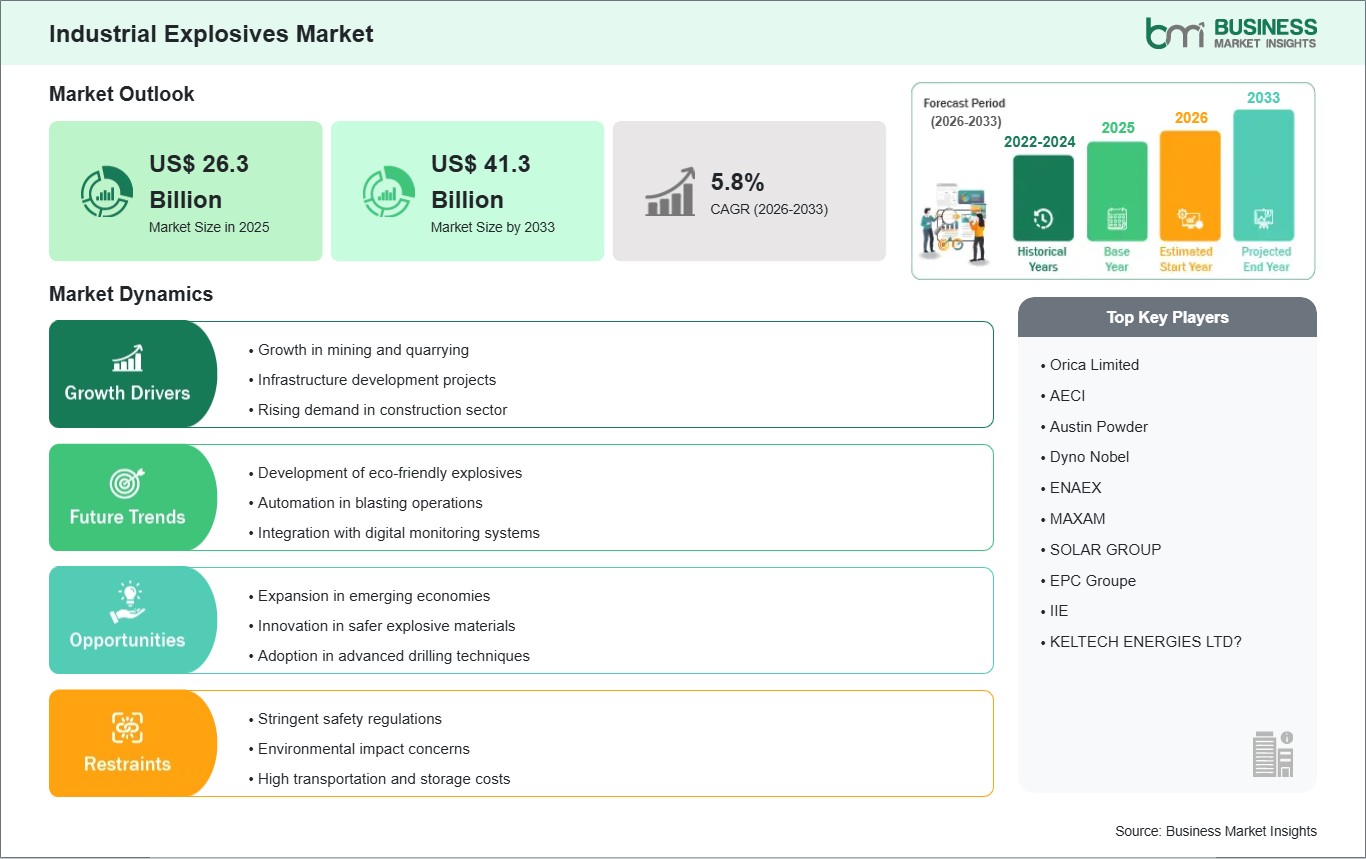
The Industrial Explosives Market size is expected to reach US$ 41.3 billion by 2033 from US$ 26.3 billion in 2025. The market is estimated to record a CAGR of 5.8% from 2026 to 2033.
Industrial Explosives are chemical compounds and detonators used for controlled blasting in mining, quarrying, and construction. These products enable efficient resource extraction and large-scale infrastructure development, making them indispensable for industries driving urbanization and technological progress.
Despite its importance, the market faces significant challenges. Stringent regulatory frameworks and licensing requirements impose operational complexity, while volatility in raw material prices, particularly ammonium nitrate, creates cost uncertainty. Safety risks and environmental concerns, such as ground vibrations and toxic emissions, further restrict blasting activities near populated or ecologically sensitive areas. Additionally, demand remains closely tied to cyclical commodity markets, exposing the industry to fluctuations in metals and energy sectors.
Nevertheless, opportunities abound. The accelerating global shift toward renewable energy and electric vehicles has fueled demand for minerals like lithium, copper, and nickel, requiring precision blasting in mining operations. Government-backed infrastructure projects, especially in the Asia-Pacific, continue to create long-term demand for explosives in tunneling and quarrying. Technological advancements, including wireless electronic detonators, eco-friendly emulsions, and IoT-enabled blast optimization systems, promise enhanced safety, efficiency, and sustainability, positioning the industry for transformative growth despite prevailing challenges.

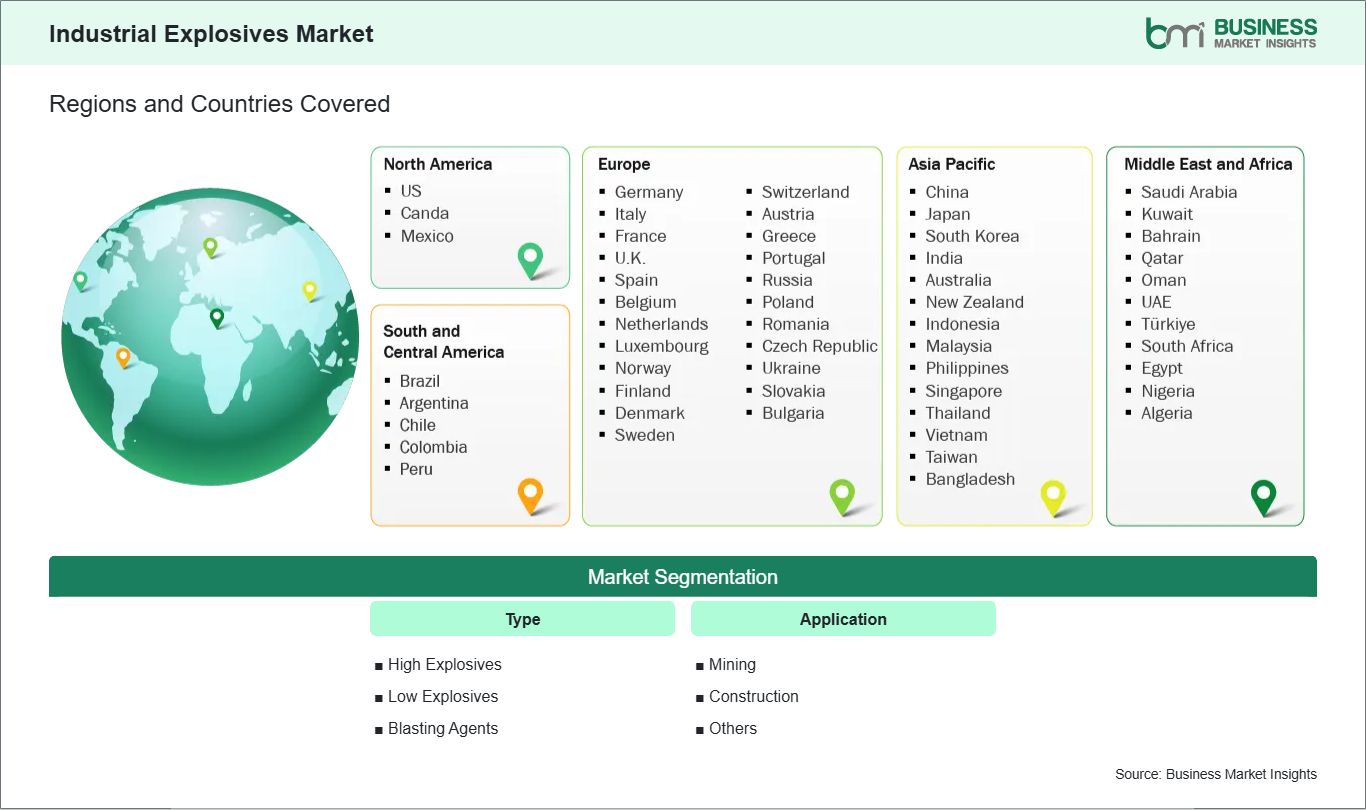
Key segments that contributed to the derivation of the Industrial Explosives market analysis are type and application.
The rapid expansion of Electric Vehicles (EVs) and renewable energy technologies is significantly increasing global demand for critical minerals such as lithium, copper, nickel, and rare earth elements. These minerals form the backbone of battery manufacturing, electric drivetrain components, wind turbines, and grid-scale storage systems. As automakers accelerate electrification targets and governments push for clean energy adoption, mining companies are under pressure to boost output while maintaining ore quality and operational efficiency. This shift is driving the need for high-volume, highly precise blasting operations that ensure optimal fragmentation, reduce dilution, and support efficient downstream processing.
Parallel to this trend, government-led megaprojects—particularly in the Asia Pacific—are creating sustained demand for commercial explosives. Large-scale initiatives such as China’s Belt and Road Initiative and India’s ambitious infrastructure expansion programs involve extensive development of highways, rail corridors, metro systems, hydropower facilities, and industrial zones. These projects require substantial tunneling, deep foundation work, and quarrying activities, all of which rely on controlled blasting to manage excavation rates and geological complexities. The scale and continuity of these projects support long-term demand for high-performance explosives, electronic detonators, and digital blasting solutions. Together, these structural shifts in global energy systems and infrastructure development are reinforcing strong, multi-year growth prospects for the explosives industry.
Growing regulatory pressures around safety, environmental protection, and operational transparency are prompting significant innovation within the explosives and blasting industry. As mining and infrastructure projects strive for higher productivity with lower risk, demand is rising for advanced solutions such as electronic detonators, environmentally responsible explosive formulations, and integrated digital blasting platforms. Electronic detonators, in particular, enable highly precise blast timing and sequencing, which leads to more consistent rock fragmentation, reduced overbreak, and lower downstream processing costs. This precision also enhances overall productivity by improving shovel efficiency, mill throughput, and material flow across the value chain.
At the same time, sustainability concerns are driving the adoption of new water-based emulsions and low-emission explosive formulations. These products reduce the release of harmful fumes, minimize groundwater contamination risks, and support compliance with increasingly stringent environmental regulations. Their performance benefits—combined with their sustainability profile—offer suppliers meaningful market differentiation.
Digitalization is further transforming blasting operations. IoT-enabled sensors, cloud-connected monitoring tools, and real-time analytics platforms allow operators to model blast behavior, track energy distribution, and continuously optimize blast patterns. These technologies enhance both efficiency and safety by providing actionable insights, enabling proactive risk management, and ensuring more predictable blasting outcomes.

The Industrial Explosives Market demonstrates steady growth, with size and share analysis revealing trends and competitive positioning among key players. The report further examines subsegments categorized within type and application, offering insights into their contribution to overall market performance.
For instance, High Explosives, such as dynamite and RDX, remain essential for hard-rock mining due to their high detonation velocity and brisance. ANFO, a widely used low explosive, dominates bulk mining applications due to its cost-effectiveness and ease of deployment. Blasting agents, including emulsion blends, serve as the backbone for large-scale construction and quarrying projects, offering optimized safety and operational efficiency in bulk blasting scenarios.
| Report Attribute | Details |
|---|---|
| Market size in 2025 | US$ 26.3 Billion |
| Market Size by 2033 | US$ 41.3 Billion |
| Global CAGR (2026 - 2033) | 5.8% |
| Historical Data | 2022-2024 |
| Forecast period | 2026-2033 |
| Segments Covered | By Type
|
|
Regions and Countries Covered
| |
| North America | US, Canada, Mexico |
| Europe | Belgium, Austria, Finland, Denmark, Greece, Poland, Romania, Russia, Ukraine, Czech Republic, Slovakia, Bulgaria, Italy, Luxembourg, Germany, Switzerland, France, Netherlands, Norway, Portugal, Spain, Sweden, United Kingdom |
| Asia-Pacific | Australia, China, India, Japan, South Korea, Indonesia, Malaysia, Philippines, Singapore, Thailand, Vietnam, Bangladesh, New Zealand, Taiwan |
| South and Central America | Brazil, Argentina, Peru, Chile, Colombia |
| Middle East and Africa | Bahrain, Kuwait, Oman, Qatar, Saudi Arabia, United Arab Emirates, Turkiye, South Africa, Egypt, Algeria, Nigeria |
| Market leaders and key company profiles |
|
The "Industrial Explosives Market Size and Forecast (2022–2033)" report provides a detailed analysis of the market covering below areas:
The geographical scope of the Industrial Explosives Market report is divided into five regions: Asia Pacific, North America, Europe, the Middle East & Africa, and South & Central America.
Asia Pacific continues to benefit from infrastructure megaprojects and mineral extraction initiatives. North America emphasizes advanced electronic detonators and emulsions to improve safety and productivity. Europe prioritizes environmental compliance, driving innovation in low-emission explosive formulations. South & Central America leverage commodity-driven growth for bulk emulsion applications in mining. The Middle East & Africa see emerging opportunities through government-backed infrastructure and resource development projects.

The Industrial Explosives market is evaluated by gathering qualitative and quantitative data post-primary and secondary research, which includes important corporate publications, association data, and databases. A few of the key developments in the Industrial Explosives market are:
The Industrial Explosives Market is valued at US$ 26.3 Billion in 2025, it is projected to reach US$ 41.3 Billion by 2033.
As per our report Industrial Explosives Market, the market size is valued at US$ 26.3 Billion in 2025, projecting it to reach US$ 41.3 Billion by 2033. This translates to a CAGR of approximately 5.8% during the forecast period.
The Industrial Explosives Market report typically cover these key segments-
The historic period, base year, and forecast period can vary slightly depending on the specific market research report. However, for the Industrial Explosives Market report:
The Industrial Explosives Market is populated by several key players, each contributing to its growth and innovation. Some of the major players include:
The Industrial Explosives Market report is valuable for diverse stakeholders, including:
Essentially, anyone involved in or considering involvement in the Industrial Explosives Market value chain can benefit from the information contained in a comprehensive market report.
Please tell us your area of interest
(Market Segments/ Regions and Countries/ Companies)