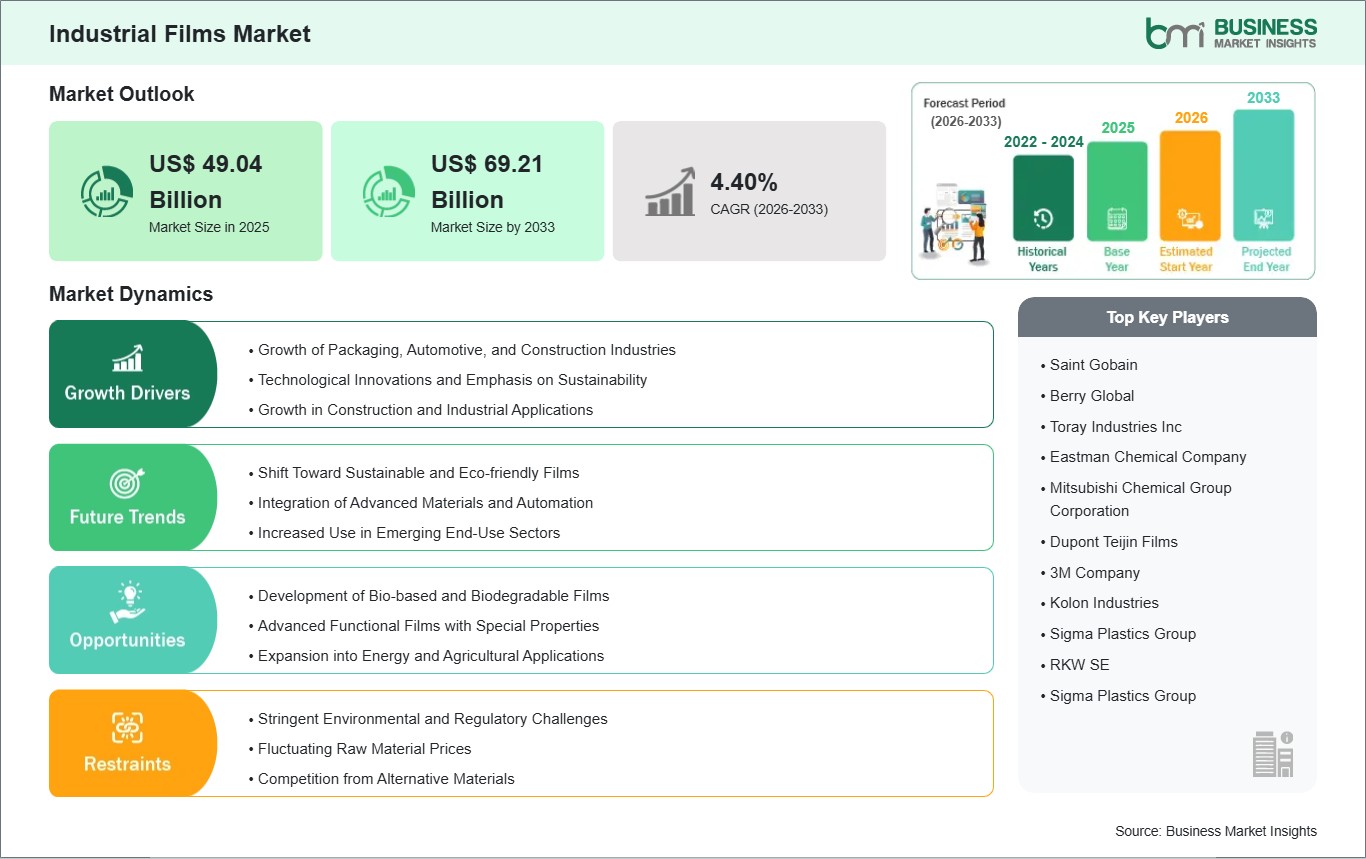
Industrial Films market size is expected to reach US$ 69.21 billion by 2033 from US$ 49.04 billion in 2025. The market is estimated to record a CAGR of 4.4% from 2026 to 2033.
The industrial films market is another sector that is critical and is used to support packaging, automotive, construction, electronics, healthcare, and agricultural industries. Industrial films are versatile polymer-based materials that are utilized due to their strength, flexibility, barrier, and protective characteristics that are essential during manufacturing, storage, transportation, and other specialized applications. Its major applications are flexible and protective packaging, greenhouse covers, vapor barriers, automotive protective films, electronic insulating films, and construction membranes. The emerging and developed market demands have grown substantially because of the expansion of packaging and industrial activities, the growth in automotive and electronics production, and the increasing adoption of advanced manufacturing technologies. The industrial films market is driven by the rising demand for packaging and protective solutions, increasing infrastructure and construction activities, and growth in automotive and electronics industries. High-performance industrial film consumption has been propelled by the increasing need for product protection, extended shelf life, and improved efficiency in logistics. New technologies in film manufacturing, including sustainable materials, nanotechnology, and recycling innovations, are assisting in enhancing performance and reliability of supply. Secondly, rapid industrialization and technological advancements have made the demand for high-quality, durable, and performance-optimized films even greater. Nevertheless, challenges related to volatility in raw material costs, strict environmental regulations, competition from alternative materials, and rising operational expenses remain relevant issues. Operation costs can also increase because of environmental compliance, polymer price fluctuations, and investment requirements for recycling and sustainable solutions. Despite these problems, growth prospects remain strong due to innovations in film technologies, the development of biodegradable and smart films, and expansion into new applications. The global industrial films market is expected to show stable evolution, being accompanied by technological progress and the rising demand for high-quality, reliable films across key sectors of activity.

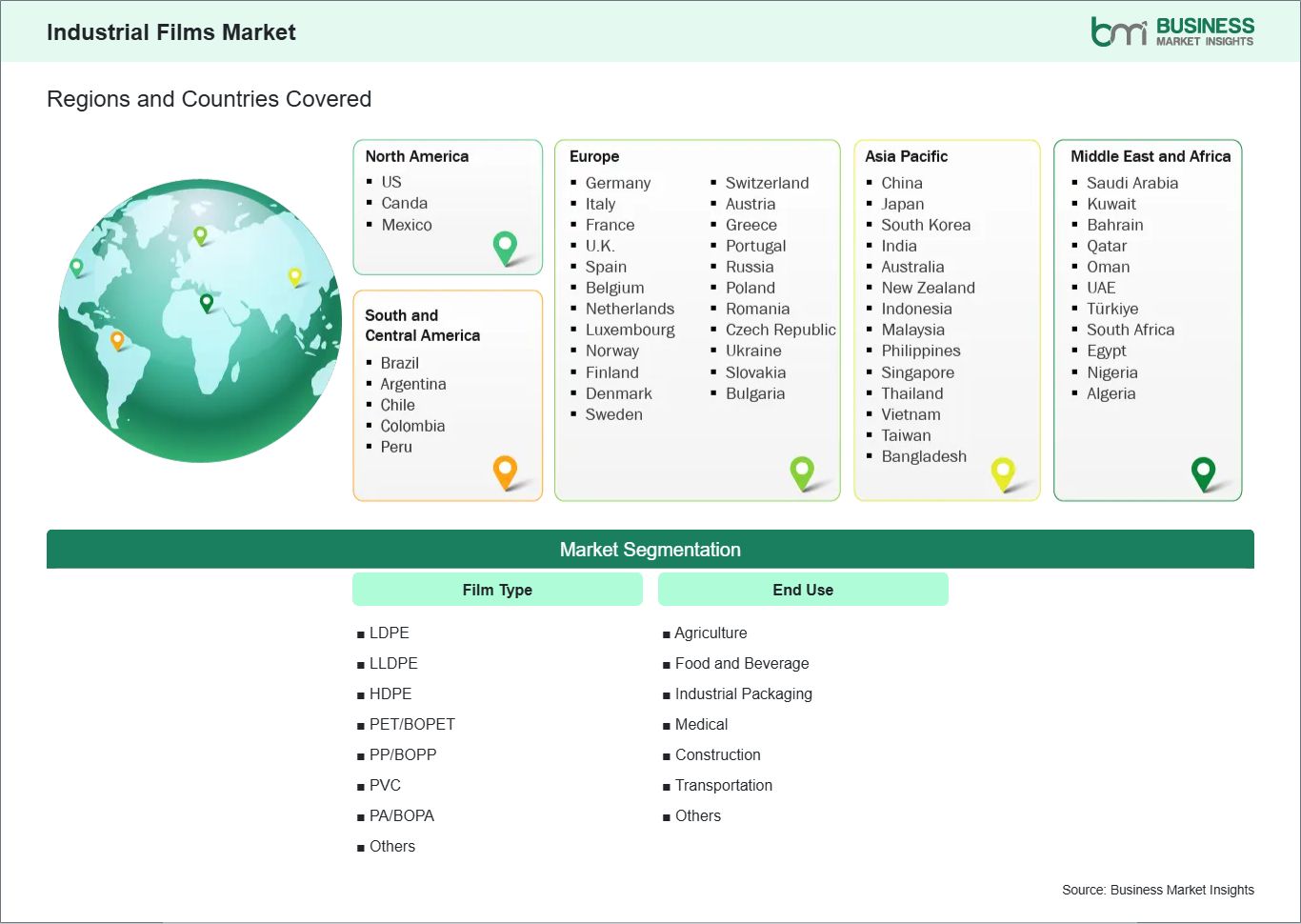
Key segments that contributed to the derivation of the Industrial Films market analysis are film type and end use.
It is noted that the increased focus on advanced packaging solutions, expansion in automotive manufacturing, and growth in construction activities worldwide has become one of the most significant growth factors in the industrial films market. These industries have led to an increase in the consumption of industrial films in key applications like protective packaging, greenhouse covers, vapor barriers, automotive protective layers, and construction membranes due to the growth of flexible packaging, insulation, and safety solutions. With the growth of these industries, there is an increase in demand for high-performance, durable, and reliable films.
An example is that the rising adoption of flexible and sustainable packaging in food and consumer goods has greatly increased the demand for industrial films, as they provide durability, barrier protection, and improved shelf life. On the same note, the fast growth of automotive manufacturing relies on films for surface protection, interior applications, and insulation purposes. The expansion of construction activities, including commercial and residential projects, has also contributed to the consumption of films for vapor barriers, protective coatings, and insulation. The demand for industrial films will continue to increase steadily as industrialization and adoption of modern manufacturing practices rise, particularly in emerging economies.
The other key factor impacting the industrial films market is the growing emphasis on technological innovation and sustainability of production. Manufacturers are investing in advanced film materials, biodegradable films, high-performance multilayer coatings, and recycling technologies to limit waste, improve efficiency, and provide environmentally friendly solutions. Such innovations can enhance the functionality of industrial films while reducing environmental impact and ensuring consistent supply for critical applications.
Industrial films are increasingly integrated into applications requiring durability, high barrier performance, and environmental compliance, including smart packaging, renewable energy systems, and electronic components. The growing adoption of sustainable materials and recycling practices has encouraged the development of closed-loop solutions and eco-friendly production methods. As regulatory standards tighten and industries demand high-quality, sustainable solutions, the need for technologically advanced and environmentally responsible industrial films is expected to grow continuously with the increasing global market requirements.
| Report Attribute | Details |
|---|---|
| Market size in 2025 | US$ 49.04 Billion |
| Market Size by 2033 | US$ 69.21 Billion |
| Global CAGR (2026 - 2033) | 4.40% |
| Historical Data | 2022 - 2024 |
| Forecast period | 2026-2033 |
| Segments Covered | By Film Type
|
|
Regions and Countries Covered
| |
| North America | US, Canada, Mexico |
| Europe | Belgium, Austria, Finland, Denmark, Greece, Poland, Romania, Russia, Ukraine, Czech Republic, Slovakia, Bulgaria, Italy, Luxembourg, Germany, Switzerland, France, Netherlands, Norway, Portugal, Spain, Sweden, United Kingdom |
| Asia-Pacific | Australia, China, India, Japan, South Korea, Indonesia, Malaysia, Philippines, Singapore, Thailand, Vietnam, Bangladesh, New Zealand, Taiwan |
| South and Central America | Brazil, Argentina, Peru, Chile, Colombia |
| Middle East and Africa | Bahrain, Kuwait, Oman, Qatar, Saudi Arabia, United Arab Emirates, Turkiye, South Africa, Egypt, Algeria, Nigeria |
| Market leaders and key company profiles |
|
The Industrial Films Market Size and Forecast (2022-2033) report provides a detailed analysis of the market covering below areas:
The geographical scope of the Industrial Films market report is divided into five regions: North America, Asia Pacific, Europe, Middle East & Africa, and South & Central America. The Industrial Films market in the Asia Pacific is expected to grow significantly during the forecast period.
The Asia-Pacific Industrial Films market is segmented into China, Japan, South Korea, India, Australia, New Zealand, Indonesia, Malaysia, the Philippines, Singapore, Thailand, Vietnam, Taiwan, Bangladesh, and the Rest of Asia.
The Asia-Pacific market is experiencing booming growth due to the high pace of industrialization, expansion in packaging and construction activities, growth in automotive and electronics manufacturing, and increasing investments in sustainable materials and advanced technologies in the region. China, Japan, South Korea, and India have a leading role to play with massive production facilities, expanding construction projects, growing automotive manufacturing, and a developing electronics base. The increasing number of factories, packaging units, and construction projects is also putting a strain on the availability of high-performance industrial films, especially for protective packaging, vapor barriers, greenhouse covers, and automotive applications. Moreover, the growth of export-based electronic, automotive, and consumer goods industries is also ensuring consolidation of industrial film usage in the region.
The other trend is the growing adoption of new and advanced technologies in industrial film manufacturing, including biodegradable films, multilayer high-barrier films, and recycling initiatives. Improved production technologies, automation in film processing, and enhanced quality control systems in the region are increasing both operational efficiency and supply reliability. Moreover, the rising demand for smart packaging, renewable energy solutions, and high-performance industrial films for automotive and construction applications is making Asia-Pacific a key consumption and production hub. The high position of the region in the global industrial films market is further strengthened by supportive government policies, investment in technology, and continuous industrial expansion.

The Industrial Films market is evaluated by gathering qualitative and quantitative data post primary and secondary research, which includes important corporate publications, association data, and databases. A few of the key developments in the Industrial Films market are:
The Industrial Films Market is valued at US$ 49.04 Billion in 2025, it is projected to reach US$ 69.21 Billion by 2033.
As per our report Industrial Films Market, the market size is valued at US$ 49.04 Billion in 2025, projecting it to reach US$ 69.21 Billion by 2033. This translates to a CAGR of approximately 4.40% during the forecast period.
The Industrial Films Market report typically cover these key segments-
The historic period, base year, and forecast period can vary slightly depending on the specific market research report. However, for the Industrial Films Market report:
The Industrial Films Market is populated by several key players, each contributing to its growth and innovation. Some of the major players include:
The Industrial Films Market report is valuable for diverse stakeholders, including:
Essentially, anyone involved in or considering involvement in the Industrial Films Market value chain can benefit from the information contained in a comprehensive market report.
Please tell us your area of interest
(Market Segments/ Regions and Countries/ Companies)