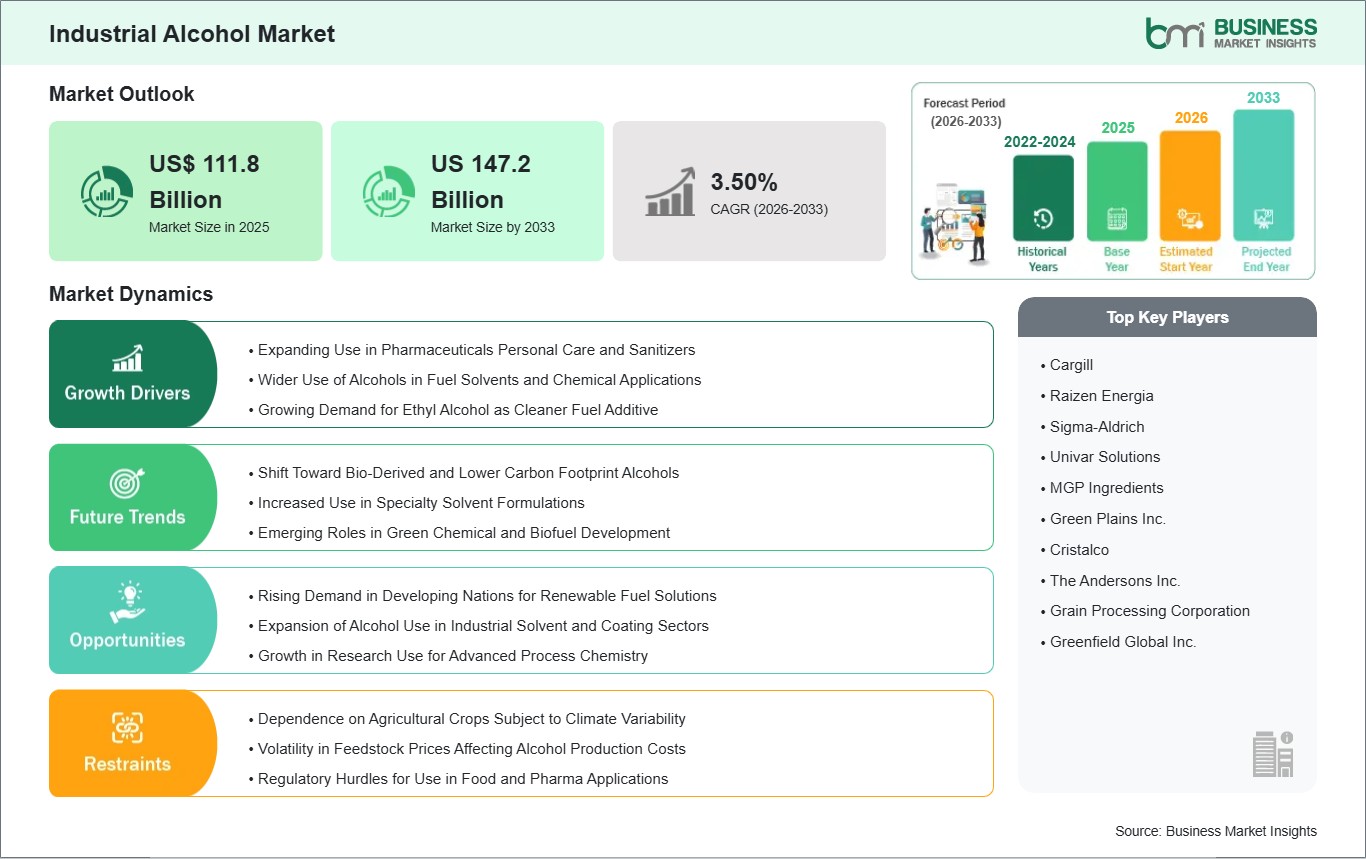
The Industrial Alcohol Market size is expected to reach US$ 147.2 Billion by 2033 from US$ 111.8 Billion in 2025. The market is estimated to record a CAGR of 3.50% from 2026 to 2033.
The global industrial alcohol market refers to a wide variety of alcohol types used as raw materials, solvents, intermediates, and functional ingredients in different industries. Industrial alcohol, including ethanol, methanol, butanol, and other alcohol derivatives, plays a vital role in the manufacturing processes of different products, including chemicals, pharmaceuticals, coatings, adhesives, personal care products, and fuels. The multi-functional nature of industrial alcohol results from its ability to act as a solvent, its reactivity in different processes, and its relative safety in different processes, making it a popular option in different processes that involve the efficient dissolution of substances, sterilization, and the fermentation of different products. The industrial alcohol market has a significant relationship with the developments in different end-use industries, especially in processes where reformulation and efficiency are major concerns.
A major factor in the growth of the industrial alcohol market is the increasing focus on green chemistry. Ethanol, for example, is not only being used as an increasingly green solvent, but it is also being seen as an increasingly green building block for polymers, cleaning agents, and fuel additives. The increasing focus on green chemistry is thus acting as an increasingly green driver for growth in this market. There are also challenges in this market. The prices of feedstocks for industrial alcohols tend to be volatile. Since these alcohols come from agricultural or petrochemical feedstocks, changes in feedstock prices can affect the prices of these alcohols. There is also an issue with safety standards for volatile alcohols. These alcohols need to be handled in very safe conditions, and this requires significant investment in infrastructure for meeting safety standards. Despite these challenges, this market is likely to grow in relevance as new technologies for making ethanol and other alcohols come to the forefront.

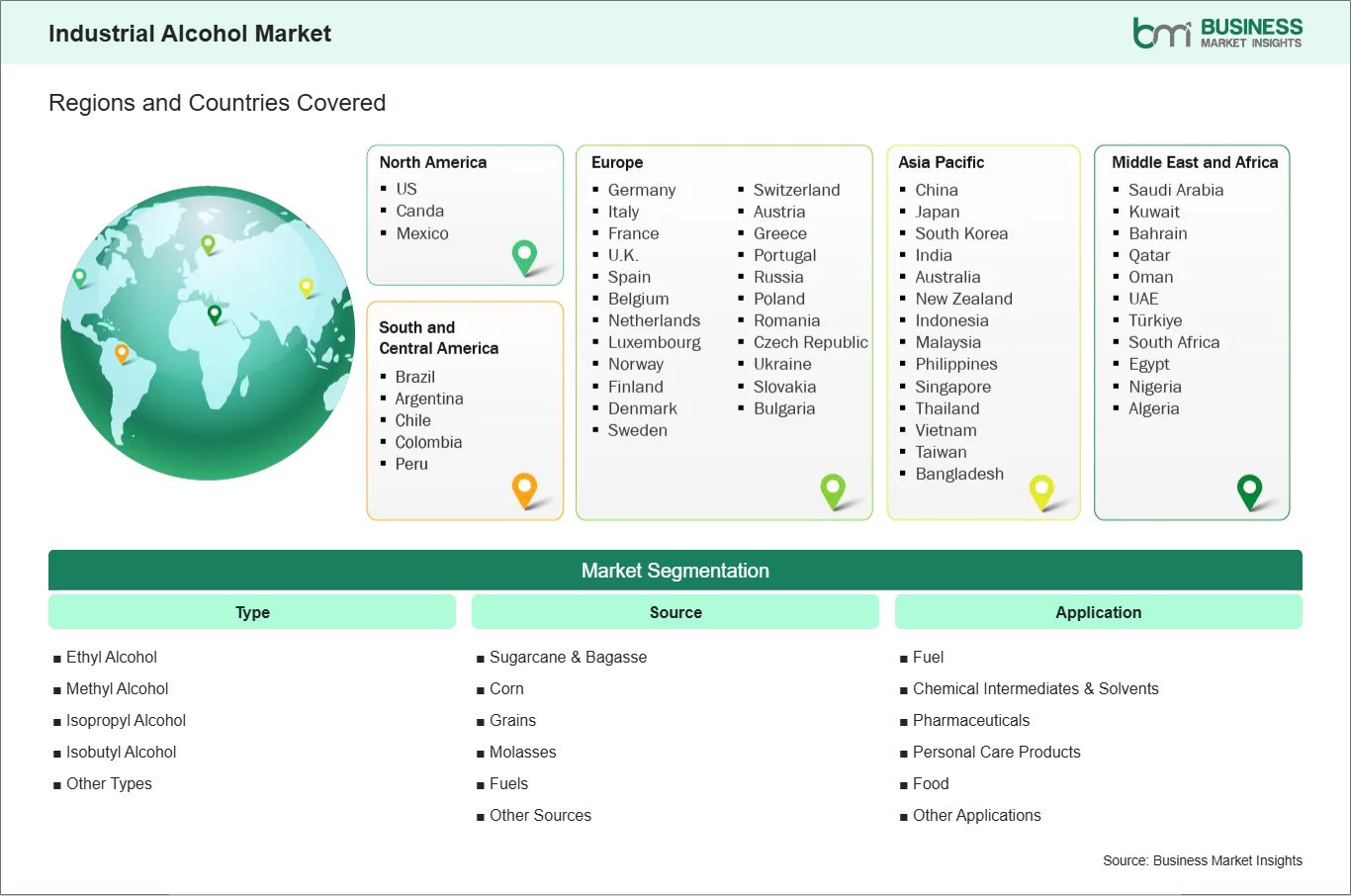
Key segments that contributed to the derivation of the industrial alcohol market analysis are type, source, and application.
The demand for industrial alcohol is being increasingly influenced globally by its critical role in pharmaceuticals, personal care products, and hygiene products. Industrial alcohol, which includes ethanol and isopropanol, is being used as an active ingredient in disinfectants, antiseptics, and hand sanitizers. These products are being used to control microbes rapidly while being safe for consumers. In addition, the awareness of hygiene and infection prevention, which is being accelerated globally due to various public health campaigns and crises, has elevated the role of alcohol-based products in hospitals, clinics, homes, and personal hygiene. This has made industrial alcohol an essential product for maintaining public health and safety.
In addition, industrial alcohol is used in pharmaceutical production, including solvents, preservatives, and API production. Its efficiency, purity, and ability to mix well with a variety of chemicals make it a preferred choice for pharmaceutical production. Its uses range from producing pharmaceutical tablets, liquids, injectables, and vaccines. Similarly, in the personal care segment, industrial alcohol is used in perfumes, lotions, and cosmetics. Its uses range from solvents, preservatives, and additives. For all these industries, there is a growing trend of using high-grade alcohol purity for producing pharmaceuticals, thus further emphasizing the role of industrial alcohol in pharmaceutical production.
Moreover, the role of industrial alcohol in hygiene and personal care is in line with global trends. Its role in hygiene and personal care is a move towards more sustainable production. Its uses range from replacing harsh chemicals in production, thus creating a safer, drier, and more effective formula for a variety of uses. As regulations on pharmaceuticals and personal care continue to rise, so does the demand for high-grade alcohol, thus further emphasizing global manufacturing standards. Industrial alcohol has emerged as a trendsetter in industries that value efficacy, hygiene, and quality.
Industrial alcohol is increasingly adopted in developing nations as a renewable fuel solution, driven by the need to reduce dependence on fossil fuels and promote sustainable energy alternatives. Ethanol, derived from biomass sources such as sugarcane, corn, and other agricultural residues, serves as a biofuel or blending agent in transportation fuels. Governments are encouraging bioethanol programs to improve energy security, lower greenhouse gas emissions, and support rural economies, creating a strong growth pathway for industrial alcohol in energy sectors across Asia, Africa, and Latin America. This shift highlights industrial alcohol’s dual role as both a chemical feedstock and a sustainable energy resource.
The use of industrial alcohol as a renewable fuel aligns with broader global initiatives targeting climate change mitigation and low-carbon transportation solutions. Flexible-fuel vehicles, ethanol-blended gasoline, and industrial heating applications are increasingly reliant on bioethanol, which offers a cleaner-burning alternative to conventional fuels. Developing nations, where transportation and energy infrastructure are rapidly expanding, view ethanol as a practical solution to balance energy needs with environmental considerations. Additionally, industrial alcohol can be locally produced from agricultural waste streams, contributing to rural development, job creation, and circular economy models, further driving adoption in these regions.
Furthermore, industrial alcohol’s role in renewable fuels is supported by technological advancements in production and purification processes. Innovations in fermentation, distillation, and dehydration have improved yield efficiency, reduced energy consumption, and enhanced product purity, making ethanol an economically viable fuel option even in resource-constrained environments. As developing nations pursue cleaner, renewable energy strategies, industrial alcohol is emerging as a key material that bridges agricultural productivity with energy sustainability. Its multifaceted applications—from biofuel to chemical intermediates—position it as an essential component of the global transition toward sustainable energy and environmentally responsible industrial practices.

The industrial alcoholmarket is experiencing steady growth, with market size and share analysis reflecting evolving treatment preferences and competitive dynamics among key players. The report evaluates important subsegments categorized within type, source, and application, highlighting their respective contributions to overall market performance.
By type, the Ethyl Alcohol subsegment dominated the Industrial Alcohol market in 2025. Ethyl alcohol offers high purity, versatility, and wide applicability across fuel, chemical, and pharmaceutical industries, driving its widespread adoption.
Based on source, the Fuels subsegment dominated the Industrial Alcohol market in 2025. Fuel-derived alcohol provides a cost-effective and scalable supply, supporting strong demand for industrial alcohol in energy and chemical applications.
In terms of application, the Fuel subsegment dominated the Industrial Alcohol market in 2025. Fuel applications require high-energy content and combustion efficiency, reinforcing the dominance of this segment in the industrial alcohol market.
| Report Attribute | Details |
|---|---|
| Market size in 2025 | US$ 111.8 Billion |
| Market Size by 2033 | US 147.2 Billion |
| Global CAGR (2026 - 2033) | 3.50% |
| Historical Data | 2022-2024 |
| Forecast period | 2026-2033 |
| Segments Covered | By Type
|
|
Regions and Countries Covered
| |
| North America | US, Canada, Mexico |
| Europe | Belgium, Austria, Finland, Denmark, Greece, Poland, Romania, Russia, Ukraine, Czech Republic, Slovakia, Bulgaria, Italy, Luxembourg, Germany, Switzerland, France, Netherlands, Norway, Portugal, Spain, Sweden, United Kingdom |
| Asia-Pacific | Australia, China, India, Japan, South Korea, Indonesia, Malaysia, Philippines, Singapore, Thailand, Vietnam, Bangladesh, New Zealand, Taiwan |
| South and Central America | Brazil, Argentina, Peru, Chile, Colombia |
| Middle East and Africa | Bahrain, Kuwait, Oman, Qatar, Saudi Arabia, United Arab Emirates, Turkiye, South Africa, Egypt, Algeria, Nigeria |
| Market leaders and key company profiles |
|
The "Industrial Alcohol Market Size and Forecast (2022 - 2033)" report provides a detailed analysis of the market covering below areas:
The geographical scope of the Industrial Alcohol market report is divided into five regions: North America, Asia Pacific, Europe, Middle East & Africa, and South & Central America. The Industrial Alcohol market in North America is expected to grow during the forecast period.
However, the region of North America has been observed to be the major contributor in the overall industrial alcohol market, with the support of well-established chemical manufacturing infrastructure and the vast industrial base in the region. In the region of North America, the chemical and pharmaceutical sectors have been observed to be major consumers of industrial alcohols with the production of various products such as coatings and adhesives, and active pharmaceutical ingredients. In the region of North America, well-established oil and petrochemical processing infrastructure has been observed to support the local production of major alcohol derivatives, thus reducing the risk of any disruption in the supply chain and allowing the region to respond quickly to the changing industrial demands.
In addition to the more traditional industrial activities, there has also been an increase in the interaction between industrial alcohol manufacturing in North America and the pursuit of sustainable development. This can be evidenced through the interest in bio-based ethanol and other renewable alcohols as alternatives to petrochemical-derived alcohols, driven by consumer demand for environmentally friendly products and government initiatives to encourage the development and use of more environmentally friendly technologies. Safety standards in North America are also highly developed, with very stringent requirements for the safe handling, storage, and emissions control of alcohol, which in turn has encouraged the development of more sophisticated technologies to ensure safe operation. While feedstocks and energy costs are considerations, the highly developed industrial infrastructure in North America, its technology, and its pursuit of sustainable development ensure its dominance in the industrial alcohol market.

The industrial alcohol market is evaluated by gathering qualitative and quantitative data post primary and secondary research, which includes important corporate publications, association data, and databases. A few of the key developments in the industrial alcohol market are:
The Industrial Alcohol Market is valued at US$ 111.8 Billion in 2025, it is projected to reach US 147.2 Billion by 2033.
As per our report Industrial Alcohol Market, the market size is valued at US$ 111.8 Billion in 2025, projecting it to reach US 147.2 Billion by 2033. This translates to a CAGR of approximately 3.50% during the forecast period.
The Industrial Alcohol Market report typically cover these key segments-
The historic period, base year, and forecast period can vary slightly depending on the specific market research report. However, for the Industrial Alcohol Market report:
The Industrial Alcohol Market is populated by several key players, each contributing to its growth and innovation. Some of the major players include:
The Industrial Alcohol Market report is valuable for diverse stakeholders, including:
Essentially, anyone involved in or considering involvement in the Industrial Alcohol Market value chain can benefit from the information contained in a comprehensive market report.
Please tell us your area of interest
(Market Segments/ Regions and Countries/ Companies)