
Flooring Market Outlook: Size, Share, Trends, Growth Analysis, Competitive Landscape & Forecast, 2026-2033

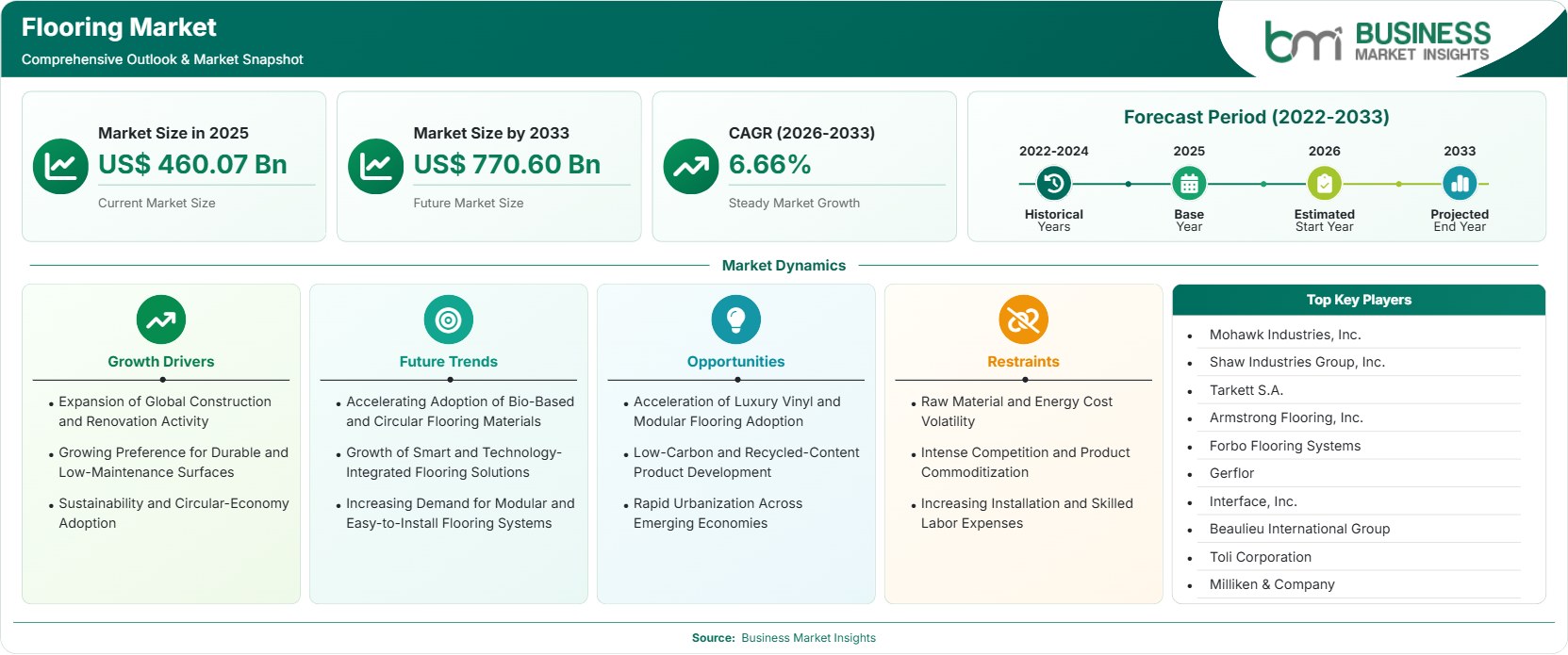
The Flooring Market size was valued at US$ 460.07 Billion in 2025 and is projected to reach US$ 770.60 Billion by 2033, growing at a CAGR of 6.66% during 2026–2033. Rising residential construction, renovation activity, premium surface materials adoption, and sustainable flooring innovations are accelerating demand, while digital design tools and circular-economy initiatives create long-term opportunities.

Report Coverage
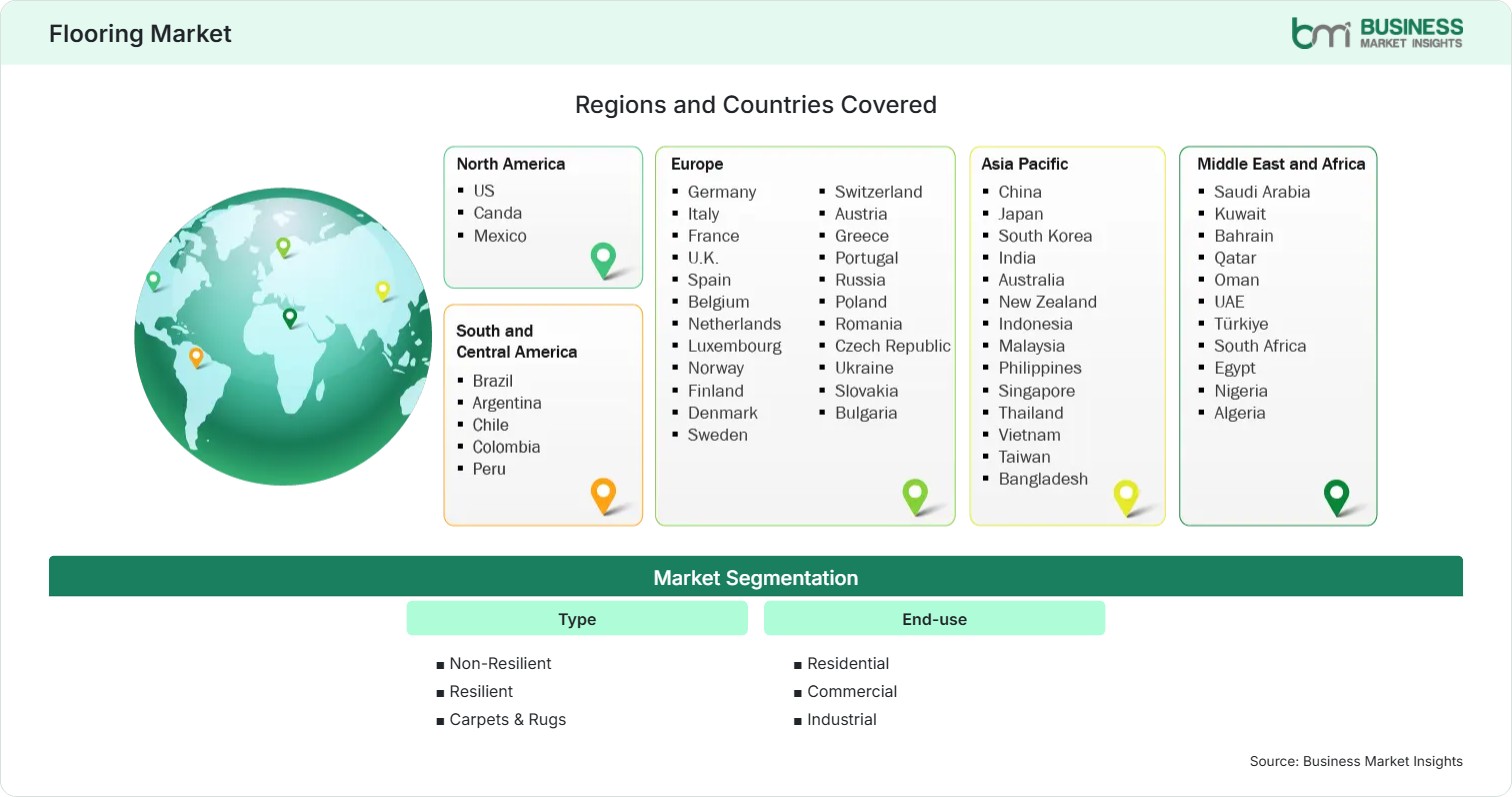
  • Type: Non-Resilient , Resilient , Carpets & Rugs
  • End-use: Residential, Commercial, Industrial
US$ 460.07 Bn Market size in 2025
US$ 770.60 Bn Market Size by 2033
6.66% CAGR, 2026 - 2033
2026-2033 Forecast Period

AI Overview

Flooring Market Summary

  • North America Region: North America holds a market share of 34%–37% in 2025, growing with a CAGR of 5.8%–6.3% during 2026–2033. Demand is supported by residential remodeling, resilient flooring adoption, commercial refurbishment spending, and sustainability-focused procurement strategies across institutional and healthcare projects. The U.S. market benefits from strong renovation spending and premium vinyl demand, advancing at a CAGR of 5.9%–6.4%.
  • Fastest Growing Region: Asia Pacific holds a market share of 28%–31% in 2025, growing with a CAGR of 7.8%–8.4% during 2026–2033. Urbanization, infrastructure investment, affordable housing programs, manufacturing expansion, and increasing consumer preference for durable flooring materials continue strengthening regional demand across diverse applications.
  • Leading Segment: Non-Resilient flooring accounts for 41%–44% share in 2025 and advances at a CAGR of 5.8%–6.2%. Ceramic and wood products remain preferred in residential and commercial spaces because of aesthetics, durability, premium positioning, and lifecycle performance advantages.
  • High Growth Segment: Resilient flooring represents 28%–31% share in 2025 and grows at 7.5%–8.0% CAGR. Waterproof performance, lower maintenance requirements, improved designs, and rapid installation capabilities support accelerating adoption across residential and commercial developments.
  • Key Market Opportunity: Carbon-reduced materials, recycled-content flooring, modular installation systems, and digitally enabled specification platforms are creating new revenue streams while helping manufacturers meet increasingly stringent sustainability requirements worldwide.
  • Major Market Players: Mohawk Industries, Inc., Shaw Industries Group, Inc., Tarkett S.A., Armstrong Flooring, Inc., Forbo Flooring Systems, Gerflor, Interface, Inc., Beaulieu International Group, Toli Corporation, Milliken & Company
Strategic Insights

Flooring Market: Strategic Insights

Flooring Market Strategic Framework
FREE PDF
Request your free sample
Request free sample
Stakeholder View

Key Takeaways

  • The industry’s value chain has become more integrated among the raw material suppliers, surface technology suppliers, recycling companies, distributors, and installation firms, making it possible for product customization and improved resilience within the supply chain.
  • Luxury vinyl tiles, modular commercial flooring systems, and residential renovation solutions have potential upside due to their faster replacement cycles as well as preference by consumers for low maintenance surfaces.
  • Innovative focus has moved towards products that incorporate recycled content, digital printing technology, antimicrobial solutions, and manufacturing process with less carbon footprint.
  • The Asia Pacific region offers an attractive investment opportunity due to rapid urbanization, increased investment in infrastructure development, industrial growth, and the use of high-end interior solutions in residential construction.
  • Mergers and acquisitions have been reshaping the competitive landscape as companies gain geographic expansion capabilities, strong distribution networks, and resilient flooring product lines to meet evolving customer needs.
  • Sustainability has become an important purchasing criterion for customers, especially in commercial construction projects.
Geographic Outlook

Flooring Market Regional Highlights

North America Flooring Market

North America accounted for approximately 34%–37% Flooring Market share in 2025 and is projected to expand at a 5.8%–6.3% CAGR during 2026–2033. This segment is aided by high spending on residential renovation, developed distribution networks, and extensive use of quality resilient floor coverings. Renovation of commercial establishments in health, education, and business segments contributes to the replacement requirements. Sustainable trends and durability preferences remain influential factors in buyer decisions.

  • Residential remodeling expenditure remains a major demand driver, supporting premium vinyl, laminate, and engineered wood adoption across replacement-focused projects.
  • Healthcare and education facilities increasingly prefer resilient flooring solutions offering durability, hygiene performance, and lifecycle cost advantages.
  • Sustainable procurement standards encourage greater use of recycled-content and low-emission flooring materials throughout commercial developments.
  • Digital visualization platforms are improving customer engagement and accelerating specification decisions across retail and contractor channels.

US Flooring Market

The United States represents approximately 78%–82% of North American demand and advances at a 5.9%–6.4% CAGR during 2026–2033. A combination of robust renovation expenditures, high-end residential construction projects, and commercial refurbishment activities sustains demand. The use of luxury vinyl floors keeps rising as their waterproof nature, flexibility in design, and ease of installation makes them popular substitutes to traditional flooring types.

  • Luxury vinyl tile adoption continues expanding across kitchens, bathrooms, healthcare facilities, and educational buildings.
  • Single-family renovation activity supports replacement demand for wood, laminate, and premium carpet products.
  • Sustainability certifications increasingly influence material selection in institutional and commercial construction projects.
  • Automation investments improve domestic manufacturing efficiency and support product innovation initiatives.

Europe Flooring Market

Europe holds approximately 25%–28% share in 2025 and is expected to grow at a 5.4%–5.9% CAGR during 2026–2033. Demand is driven by construction works based on renovations, energy-saving, and high environmental standards. Germany is still the dominant market, while Eastern European countries are growing faster. The circular economy, recycling, and use of sustainable materials have become key competitive factors among regional producers.

  • Germany leads regional demand due to commercial construction strength and renovation investments, expanding around 5.3%–5.8%.
  • Poland and Romania represent faster-growing markets, supported by infrastructure development and residential construction activity.
  • Sustainability regulations encourage manufacturers to expand recycling capabilities and recycled-content product portfolios.
  • Commercial refurbishment projects continue supporting resilient flooring demand throughout hospitality and office segments.

Asia Pacific Flooring Market

Asia Pacific accounted for approximately 28%–31% share in 2025 and is forecast to record the fastest CAGR of 7.8%–8.4% during 2026–2033. Urbanization, industrialization, infrastructure construction, and housing are major drivers of demand. China is the largest market, while India and Southeast Asia exhibit the highest growth rates. The growth of middle class and adoption of high-quality interior materials fuel regional growth.

  • China maintains leadership through extensive residential construction and manufacturing scale advantages.
  • India records one of the fastest growth trajectories, supported by urban housing and infrastructure investments.
  • Southeast Asian countries benefit from industrial development, hospitality projects, and expanding middle-income populations.
  • Premium vinyl and laminate categories gain momentum due to affordability and design flexibility.
  • International manufacturers continue expanding regional production and distribution networks to strengthen market presence.

Rest of World Flooring Market

The Rest of World region represents approximately 9%–12% share in 2025 and is expected to expand at a 6.4%–7.0% CAGR during 2026–2033 in Flooring Market. Residential developments and commercial modernization help South America and Central America, whereas the Middle East and Africa benefit through hospitality projects, tourism projects, and mixed-use developments. Urbanization and diversification of investments make their future brighter.

  • Brazil leads South and Central America, supported by residential demand and commercial renovation investments.
  • Mexico benefits from industrial expansion and cross-border manufacturing activity supporting construction demand.
  • Saudi Arabia records strong momentum from large-scale infrastructure and tourism development programs.
  • United Arab Emirates continues investing in hospitality and mixed-use projects requiring premium flooring solutions.
  • African urbanization trends support gradual increases in residential and commercial flooring consumption.
Global Market Geography
FREE PDF
Request your free sample
Request free sample
Segment Analysis

Flooring Market Segmentation

Type

The Type segment accounted for approximately 69%–72% share in 2025 and is projected to expand at a 6.5%–7.0% CAGR. Flooring Market scope within this category is shaped by evolving consumer preferences, durability requirements, aesthetic considerations, and sustainability objectives. Non-resilient products maintain leadership, while resilient materials demonstrate faster adoption across renovation and commercial applications.

  • Non-Resilient: Includes ceramic, wood, and laminate flooring, with strong demand driven by durability, aesthetic appeal, moisture resistance, installation flexibility, and suitability across residential and commercial applications.
    • Ceramic: Widely adopted in residential kitchens, bathrooms, and commercial environments because of moisture resistance, durability, and design versatility. Continuous innovation in large-format tiles supports ongoing demand expansion.
    • Wood: Premium aesthetics and natural appearance maintain strong consumer appeal. Engineered wood products increasingly address moisture and dimensional stability concerns while supporting renovation-focused applications.
    • Laminate: Cost-effective installation, realistic surface finishes, and improved durability continue supporting residential replacement demand and value-oriented construction projects.
  • Resilient: Includes vinyl, rubber, linoleum, and cork flooring, supported by growing demand for waterproof, low-maintenance, durable, sustainable, and comfortable flooring solutions across residential, healthcare, education, retail, and institutional applications.
    • Vinyl:Waterproof performance, ease of maintenance, and advanced digital designs drive widespread adoption across residential, healthcare, education, and retail applications.
    • Rubber: Preferred in healthcare, sports, transportation, and institutional settings due to comfort, durability, slip resistance, and acoustic performance characteristics.
    • Linoleum: Sustainability-focused projects increasingly select linoleum because of renewable material content, low emissions, and strong lifecycle performance.
    • Cork: Growing interest in sustainable interiors and acoustic comfort supports niche demand across residential and commercial applications.
  • Carpets & Rugs: Demand is supported by comfort, insulation, design flexibility, acoustic performance, and premium aesthetics, with strong adoption across residential, commercial, hospitality, and institutional spaces.
    • Tufted: Dominates carpet installations due to manufacturing efficiency, design flexibility, and broad suitability across residential and commercial environments.
    • Woven: Premium positioning, durability, and aesthetic appeal support demand in luxury residential and hospitality applications.

End-use

The End-use segment accounted for 28%–31% Flooring Market share in commercial applications, while residential demand remains the largest consumption base. Overall segment growth is projected at 6.4%–6.9% CAGR through the forecast period. The trends indicate increasing investment in residential upgrades, commercial refurbishment, and industrial facility modernization supporting broad-based demand expansion.

  • Residential: Renovation activity, homeownership trends, and consumer interest in premium interiors drive sustained demand across wood, vinyl, laminate, ceramic, and carpet categories.
  • Commercial: Office, healthcare, education, hospitality, and retail facilities prioritize durability, sustainability, maintenance efficiency, and lifecycle value when selecting flooring materials.
  • Industrial: Manufacturing facilities, warehouses, logistics centers, and processing plants require heavy-duty flooring capable of handling traffic, chemicals, and operational stresses.
Market Forces

Flooring Market Dynamics

Key Market Drivers

Expansion of Global Construction and Renovation Activity

Building construction remains the most influential demand catalyst. Expanding urban populations, housing shortages, and commercial infrastructure modernization continue increasing floor-covering requirements across developed and emerging economies. IMF and global infrastructure assessments indicate sustained investment in residential and non-residential assets, particularly across Asia and the Middle East. Flooring Market growth benefits from both new construction and replacement demand, creating a diversified revenue base. The trend towards renovations is more inclined towards products with quicker installation time and less lifecycle costs. The older construction stock in North America and Europe contributes to the replacement cycle, thereby making the demand for durable materials, ceramic tiles, engineered wood, and commercial floors stronger.

Growing Preference for Durable and Low-Maintenance Surfaces

Increasing consumer demand for durability, water resistance, hygiene, and ease of maintenance is driving rapid growth in luxury vinyl tiles, superior laminates, and engineered flooring systems. Healthcare establishments, schools, universities, and hospitality facilities look for flooring solutions that can withstand heavy traffic and reduce maintenance costs. Flooring Market trends also reflect stronger demand for products offering antimicrobial properties, stain resistance, and extended service life. Manufacturers continue investing in protective coatings, digital printing technologies, and improved wear layers to enhance performance. These innovations support higher-value product categories while encouraging replacement of traditional flooring materials in several application segments.

Sustainability and Circular-Economy Adoption

Environmental performance is emerging as an important factor for buying decisions. The producers are increasing their use of recycled content, take-back policies, and carbon-reduction programs to comply with evolving regulations and demands. For example, Tarkett claims to have collected more than 129,000 metric tons of flooring through its ReStart recycling program. The reason for this growth is not limited to construction activities; it is also related to sustainability requirements. The commercial developers tend to select environmentally certified material to build green buildings. The organizations that can offer performance and environment both can benefit more from such opportunities.

Key Market Opportunities

Acceleration of Luxury Vinyl and Modular Flooring Adoption

Luxury vinyl and modular flooring systems represent one of the most attractive investment opportunities. Demand continues expanding because these products combine design flexibility, durability, moisture resistance, and installation efficiency. Commercial facilities increasingly prefer modular solutions that minimize operational disruption during replacement projects. Flooring Market Forecasts indicate particularly strong potential across healthcare, education, hospitality, and multi-family residential applications. Firms that are willing to invest in top-tier design, digitalization, and improved performance characteristics have the potential to improve their bottom line and respond to changing consumer needs. Particularly lucrative areas include developing economies, where cost and easy installation play a role in decision-making.

Low-Carbon and Recycled-Content Product Development

The need for environmentally friendly materials is still rising due to the efforts of both government agencies and companies and individuals to ensure sustainable development. Manufacturers involved in developing environmentally oriented products such as biomaterials, recycled-content products, and products with reduced carbon content have competitive advantages. Interface developed the first carbon-negative rubber flooring. The rise of green-building certification programs means there are opportunities to position high-value products. Companies that can demonstrate their environmental benefits and maintain high-performance levels will gain a competitive advantage in their specifications.

Rapid Urbanization Across Emerging Economies

The growth of cities in India, Southeast Asia, the Middle East, and selected African economies is creating considerable demand for housing, transport, health care infrastructure, and office buildings. Increasing incomes also encourage the use of high-quality building materials. Growth in production capacities and distribution networks in rapidly growing regions can be advantageous due to positive demand dynamics. Localized production cuts down logistics costs and makes it easier to cater to customer needs. Increasing urban population and rapid construction give rise to many business opportunities in the categories of resilient flooring, ceramics, laminates, and commercial floorings.

Market Restraints and Challenges

Raw Material and Energy Cost Volatility

Factor: Flooring manufacturing depends heavily on petrochemical derivatives, wood inputs, minerals, transportation, and energy-intensive processing. Volatility in these inputs can significantly affect production economics. Impact: Higher costs compress margins, complicate pricing strategies, and reduce profitability, particularly in highly competitive product categories. Recent industry commentary highlights pressure from energy and polypropylene costs affecting flooring-related supply chains. Manufacturers often face delays in transferring cost increases to customers, especially during weaker construction cycles. Continued volatility may influence investment decisions, production planning, and procurement strategies across the value chain while creating uncertainty for both manufacturers and distributors.

Intense Competition and Product Commoditization

Factor: Numerous global and regional suppliers compete across similar product categories, creating significant pricing pressure. Standardized products in several segments increase substitution risks and limit differentiation opportunities. Impact: Competitive intensity can reduce margins, increase promotional spending, and extend payback periods for new product investments. Manufacturers must continuously innovate through sustainability initiatives, design enhancements, and performance improvements to maintain market positioning. Companies lacking scale, distribution strength, or product differentiation may face challenges retaining share. This environment encourages consolidation activity while increasing the importance of brand reputation, service quality, and technological innovation.

Company Analysis

Competitive Landscape

The Flooring Market analysis indicates competition is driven by product innovation, sustainability initiatives, distribution reach, manufacturing scale, and application-specific expertise. Leading manufacturers are focusing on advanced materials, improved product durability, and environmentally friendly solutions to strengthen their market position. Companies are also expanding product portfolios, strategic partnerships, and regional distribution networks to address evolving consumer preferences and growing demand across residential and commercial applications.

Company Name

Overview

Products and Services relevant to this market

Mohawk Industries, Inc.

Global flooring manufacturer with extensive production footprint across residential and commercial markets.

Ceramic tile, laminate, luxury vinyl, carpet, wood flooring, distribution solutions.

Shaw Industries Group, Inc.

Major North American producer focused on innovation, sustainability, and diversified flooring portfolios.

Carpet, resilient flooring, hardwood, laminate, synthetic turf, commercial flooring.

Tarkett S.A.

International flooring specialist emphasizing circular-economy and sustainable manufacturing initiatives.

Vinyl flooring, carpet tiles, linoleum, sports surfaces, wood flooring.

Armstrong Flooring, Inc.

Recognized flooring brand serving residential and commercial applications globally.

Vinyl sheet flooring, luxury vinyl tile, commercial flooring systems.

Forbo Flooring Systems

European specialist with strong sustainability focus and global distribution presence.

Linoleum, vinyl flooring, entrance systems, project flooring solutions.

Gerflor

Global resilient flooring producer serving healthcare, education, sports, and commercial sectors.

Vinyl flooring, sports flooring, wall protection, transport flooring.

Interface, Inc.

Leading commercial flooring company recognized for sustainability leadership.

Carpet tiles, resilient flooring, rubber flooring, modular solutions.

Beaulieu International Group

Diversified flooring manufacturer with broad international market coverage.

Vinyl flooring, laminate, carpet, engineered flooring products.

Toli Corporation

Japanese flooring specialist serving commercial and institutional projects.

Carpet tiles, vinyl tiles, sheets, specialized flooring systems.

Milliken & Company

Innovation-driven manufacturer focused on high-performance flooring solutions.

Carpet tiles, modular flooring, commercial interior solutions.

Congoleum Corporation

Established flooring company emphasizing resilient and decorative surfaces.

Vinyl flooring, sheet flooring, residential flooring solutions.

Flowcrete Group Ltd.

Specialist provider of industrial and commercial flooring technologies.

Resin flooring, industrial coatings, commercial flooring systems.

James Halstead plc

Global producer known for resilient flooring and healthcare applications.

Vinyl flooring, safety flooring, commercial flooring products.

The Dixie Group, Inc.

U.S.-based flooring company serving residential premium flooring segments.

Carpet, rugs, luxury residential flooring solutions.

Victoria PLC

International flooring group with diversified brand portfolio and acquisitions strategy.

Carpet, ceramic tiles, underlay products, flooring distribution.

Trust & Transparency

Research Methodology

The market analysis combines proprietary research with secondary data from government agencies, company disclosures, regulatory filings, industry databases and expert interviews. Market estimates are validated through data triangulation, cross-market benchmarking and analyst review.

View Full Research Methodology

Questions Answered

Frequently Asked Questions

What does a Flooring Market Report typically evaluate?

A report typically examines demand trends, regional performance, competitive positioning, technology developments, sustainability initiatives, growth opportunities, and forecast outlooks across key segments and end-use industries.

Which region offers the strongest growth potential?

Asia Pacific offers the strongest growth potential because of rapid urbanization, housing demand, industrialization, and significant investments in transportation, healthcare, and commercial infrastructure.

How is sustainability influencing purchasing decisions?

Commercial developers and institutional buyers increasingly prioritize recycled content, low emissions, take-back programs, and environmental certifications when selecting flooring materials.

What product category is expected to grow fastest through 2033 in Flooring Market?

Resilient flooring, particularly luxury vinyl products, is expected to expand fastest due to waterproof performance, lower maintenance requirements, design versatility, and competitive lifecycle costs.

What factors are driving long-term demand for flooring products?

Urbanization, residential renovation, commercial refurbishment, infrastructure development, and increasing preference for durable, sustainable materials are supporting long-term demand across both developed and emerging economies.

Access the Full Flooring Market Report

Get segment-level forecasts, regional estimates, competitive benchmarking, company profiles and downloadable Excel datasets.

Access the full Flooring Market Report
350 pages PDF & Excel | 2026-08-27