
Laminate Flooring Market Outlook: Size, Share, Trends, Growth Analysis, Competitive Landscape & Forecast, 2026–2033

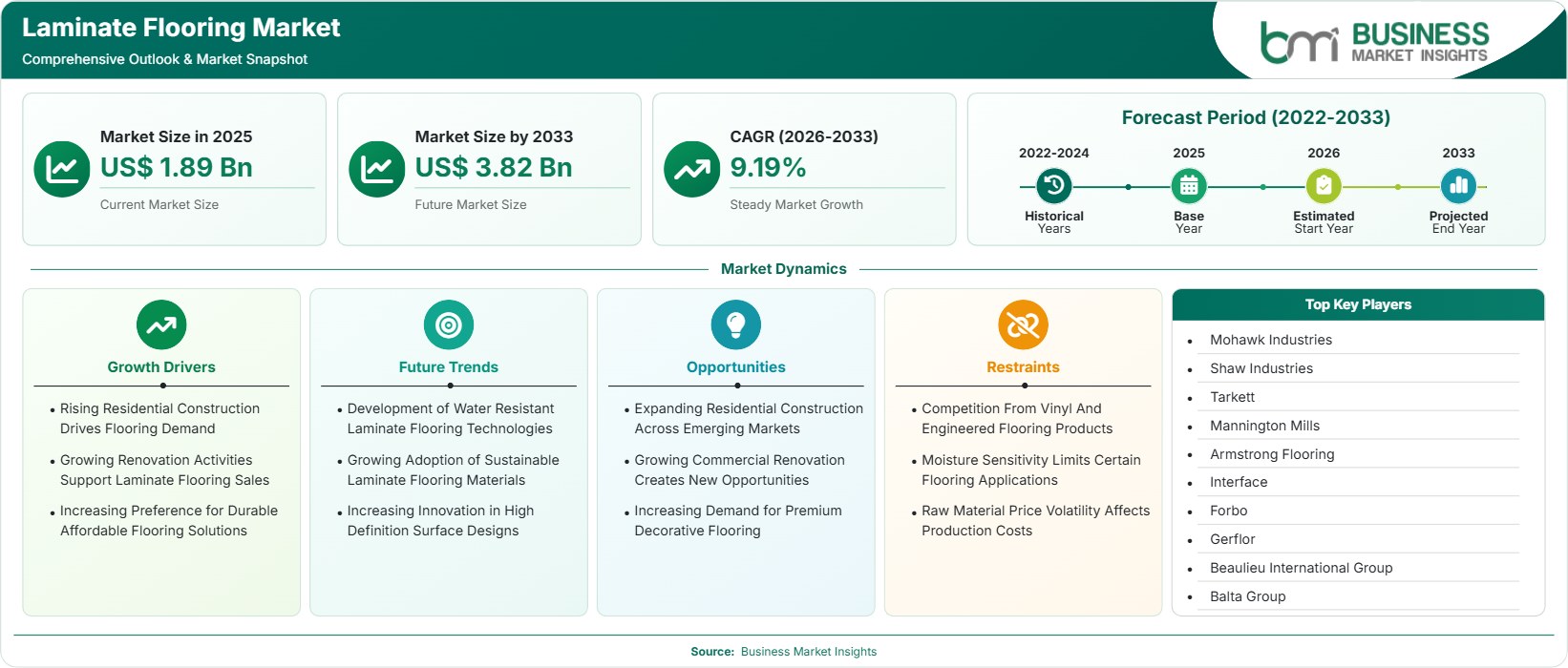
The Laminate Flooring Market size was valued at US$ 1.89 billion in 2025 and is projected to reach US$ 3.82 billion by 2033, growing at a CAGR of 9.19% during 2026–2033, driven by residential construction, renovation activity, affordability, durability, decorative design demand, and emerging-market housing development.

Report Coverage
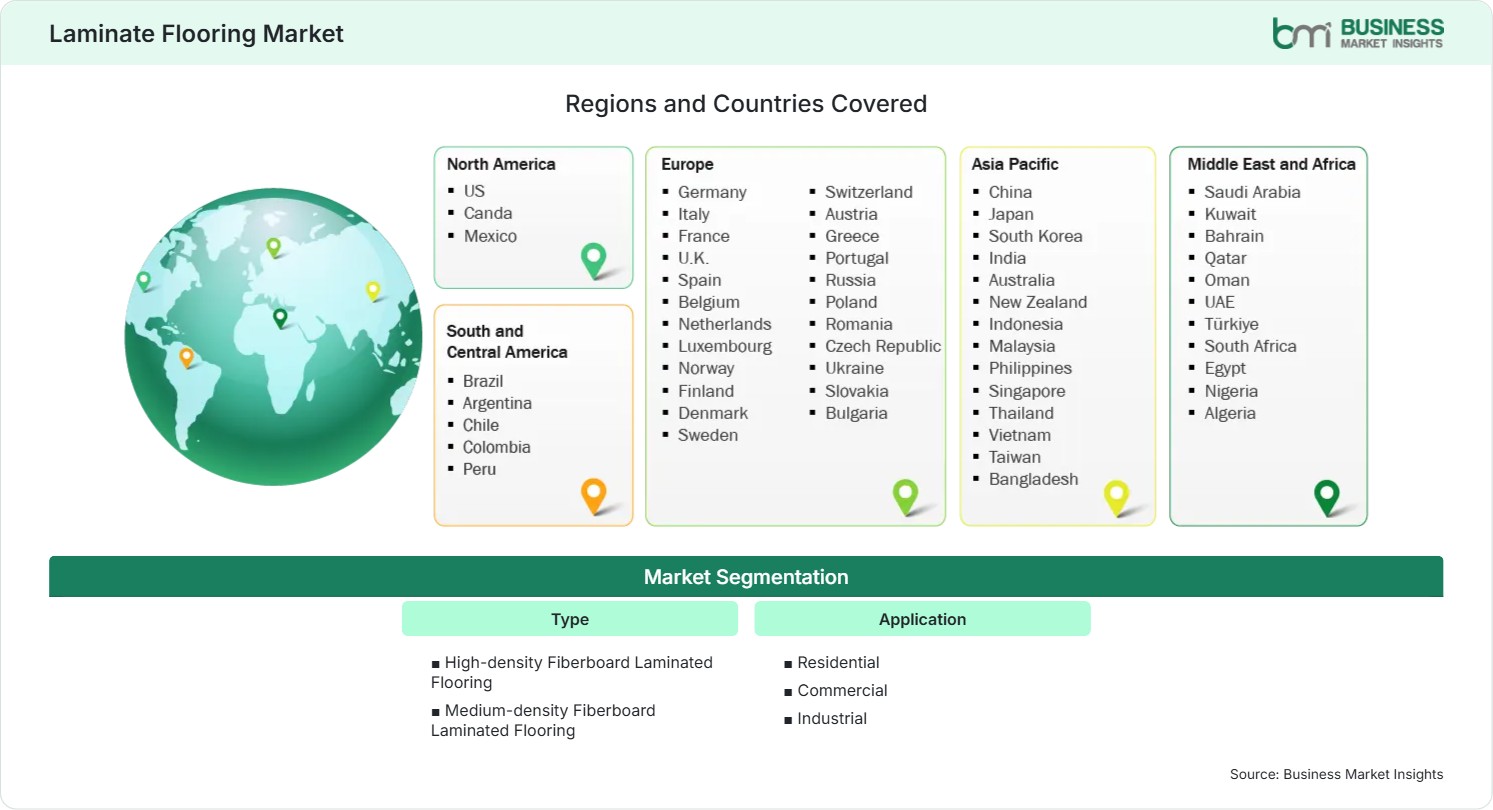
  • Type: High-density Fiberboard Laminated Flooring, Medium-density Fiberboard Laminated Flooring
  • Application: Residential, Commercial, Industrial
US$ 1.89 Bn Market size in 2025
US$ 3.82 Bn Market Size by 2033
9.19% CAGR, 2026 - 2033
2026-2033 Forecast Period

01 AI Overview

Laminate Flooring Market Summary

  • North America Region: North America holds a 27%–30% share in 2025 and is projected to grow at a 8.4%–9.0% CAGR through 2033, supported by residential remodeling, replacement flooring demand, decorative innovation, retailer networks, and consumer preference for durable surfaces.
  • Fastest Growing Region: Asia Pacific holds a 30%–33% share in 2025 and is projected to expand at a 10.2%–10.9% CAGR, supported by urbanization, housing construction, renovation activity, rising household spending, organized retail development, and broader access to decorative flooring.
  • Leading Segment: High-density Fiberboard Laminated Flooring holds a 62%–66% share in 2025 and is projected to grow at a 9.3%–9.8% CAGR, supported by durability, dimensional stability, design versatility, installation efficiency, and widespread residential application.
  • High Growth Segment: Commercial applications hold a 23%–26% share in 2025 and are projected to grow at a 9.7%–10.3% CAGR, supported by hospitality, retail refurbishment, offices, institutional projects, and demand for cost-effective decorative surfaces.
  • Key Market Opportunity: Emerging-market housing, commercial refurbishment, premium decorative designs, digitally printed surfaces, water-resistant constructions, and sustainable material development create attractive expansion opportunities.
  • Major Market Players: Mohawk Industries, Shaw Industries, Tarkett, Mannington Mills, Armstrong Flooring, Interface, Forbo, Gerflor, Beaulieu International Group, and Balta Group.
02 Strategic Insights

Laminate Flooring Market: Strategic Insights

Laminate Flooring Market Strategic Framework
FREE PDF
Request your free sample
Request free sample
03 Stakeholder View

Key Takeaways

  • The value chain is shifting toward integrated flooring portfolios combining laminate, resilient surfaces, engineered products, accessories, installation systems, and coordinated design collections.
  • Emerging residential construction offers substantial upside where housing development, urbanization, and organized retail are expanding simultaneously.
  • Product innovation is moving toward improved water resistance, realistic digital decoration, scratch protection, acoustic properties, and easier click-based installation.
  • Asia Pacific provides an attractive investment case because housing construction, urban development, retail modernization, and consumer spending are reinforcing flooring demand.
  • Commercial renovation creates opportunities for suppliers able to combine rapid installation, design consistency, durability, and competitive lifecycle economics.
  • Manufacturers can strengthen positioning through sustainable materials, differentiated visual collections, efficient distribution, and product portfolios addressing multiple price and application requirements.
04 Geographic Outlook

Laminate Flooring Market Regional Highlights

North America Laminate Flooring Market

North America held a 27%–30% share in 2025 and is projected to grow at a 8.4%–9.0% CAGR through 2033. Residential remodeling, replacement activity, commercial refurbishment, and established retail distribution support regional demand. The U.S. remains the principal Laminate Flooring Market, while Canada provides additional renovation and residential construction opportunities.

  • Residential replacement projects continue supporting laminate adoption where consumers prioritize wood-inspired aesthetics, installation convenience, durability, and comparatively accessible pricing.
  • Remodeling activity encourages demand for products that can provide visual upgrades without the cost and installation complexity associated with some premium flooring alternatives.
  • Commercial buyers increasingly evaluate flooring through maintenance requirements, replacement cycles, installation speed, and compatibility with contemporary interior design concepts.
  • Retailers and flooring specialists remain important because consumers often require guidance regarding thickness, wear resistance, installation methods, and suitability for different rooms.

US Laminate Flooring Market

The U.S. accounted for an estimated 25%–28% global share in 2025 and is projected to grow at a 8.3%–8.9% CAGR through 2033. Housing renovation, replacement flooring, residential construction, and commercial refurbishment support demand, while broad retail availability improves product accessibility across consumer and contractor channels.

  • Home improvement spending supports replacement demand as homeowners update kitchens, bedrooms, living areas, rental properties, and other residential spaces.
  • Contractors increasingly value click-installation systems because reduced installation complexity can support faster project completion and lower labor requirements.
  • Design-oriented consumers are encouraging manufacturers to expand realistic wood patterns, wider plank formats, textured surfaces, and coordinated color collections.

Europe Laminate Flooring Market

Europe held an estimated 24%–27% share in 2025 and is projected to expand at a 8.6%–9.2% CAGR. Germany, the U.K., France, and Italy represent leading markets, while Central and Eastern Europe provide additional growth opportunities. Germany is projected at 8.8%–9.4% CAGR and the U.K. at 8.7%–9.3%.

  • Germany benefits from established flooring distribution, residential renovation activity, and consumer familiarity with engineered decorative flooring solutions.
  • The U.K. supports demand through home improvement, rental-property refurbishment, commercial interiors, and strong consumer access to online flooring retailers.
  • France and Italy provide opportunities through residential renovation, hospitality refurbishment, and increasing preference for visually sophisticated flooring collections.
  • Central and Eastern Europe offer expansion potential as housing modernization and commercial construction increase demand for affordable decorative surfaces.

Asia Pacific Laminate Flooring Market

Asia Pacific held an estimated 30%–33% share in 2025 and is projected to achieve a 10.2%–10.9% CAGR, making it the fastest-growing region. China, India, Japan, and Southeast Asian markets are supported by housing development, urbanization, renovation, organized retail, and rising consumer interest in decorative interior products.

  • China provides substantial demand through residential development, refurbishment, large-scale retail distribution, and growing consumer preference for coordinated interior design.
  • India offers strong potential as urban housing, organized retail, home improvement, and middle-income consumer spending continue to expand.
  • Japan and South Korea provide mature demand supported by renovation, space-efficient interiors, design preferences, and established flooring distribution.
  • Southeast Asia presents opportunities as residential construction, hospitality development, and modern retail infrastructure expand across major urban centers.

Rest of World Laminate Flooring Market

Rest of World represented an estimated 13%–16% share in 2025 and is projected to grow at a 8.0%–8.7% CAGR. Latin America, the Middle East, and Africa offer opportunities as residential construction, renovation, commercial development, and modern retail channels expand.

Brazil is projected at a 8.4%–9.0% CAGR, while selected Middle Eastern markets are estimated at 8.8%–9.5%. Affordability and distribution remain important adoption considerations.

  • Brazil provides opportunities through residential development, renovation activity, commercial interiors, and broader availability of organized flooring products.
  • Gulf Laminate Flooring Markets offer potential through hospitality, commercial construction, premium residential interiors, and investment in modern building infrastructure.
  • African markets present longer-term opportunities as urban housing and commercial development increase, although distribution efficiency and affordability remain critical.
  • Latin American buyers increasingly seek flooring that combines decorative appearance, manageable installation, durability, and competitive lifecycle costs.
Global Market Geography
FREE PDF
Request your free sample
Request free sample
05 Segment Analysis

Laminate Flooring Market Segmentation

Type

High-density Fiberboard Laminated Flooring leads with a 62%–66% share in 2025 and is projected to grow at a 9.3%–9.8% CAGR through 2033. Its durability, structural stability, design flexibility, and broad residential suitability support continued adoption across developed and emerging markets.

  • High-density Fiberboard Laminated Flooring: High-density construction supports dimensional stability, durability, and realistic decorative finishes, making the category suitable for residential interiors requiring practical performance and attractive wood-inspired designs.
  • Medium-density Fiberboard Laminated Flooring: Medium-density construction provides a cost-conscious option for decorative flooring, supporting residential and selected commercial applications where affordability and appearance remain important purchasing factors.

Application

Residential applications represent the leading demand base, while commercial projects provide faster expansion potential. The Laminate Flooring Market share across applications reflects differences in traffic intensity, maintenance expectations, installation requirements, aesthetics, and project economics. Renovation remains important across both segments.

  • Residential: Residential flooring demand is supported by new construction, remodeling, replacement cycles, affordability, design variety, and consumer preference for wood-inspired decorative surfaces.
  • Commercial: Commercial applications benefit from office, retail, hospitality, and institutional refurbishment, where buyers prioritize durability, installation efficiency, design consistency, and manageable maintenance costs.
  • Industrial: Industrial applications remain more specialized, with demand concentrated in suitable low-to-moderate intensity environments where decorative appearance and practical installation requirements can justify laminate flooring.
06 Market Forces

Laminate Flooring Market Dynamics

Key Market Drivers

Rising Residential Construction Drives Flooring Demand

Construction activity in housing contributes to the direct increase in the market for laminate flooring installations in new residential units. A potential attraction of laminate flooring could be the combination of its visual attractiveness with relative ease of installation and affordable lifetime cost. The need for the product is especially driven when buyers want a wood-like look but are not prepared to use a more expensive material. The Laminate Flooring Market growth is driven by the variety of laminate flooring lines targeting various interior design styles, plank designs, surfaces, and price ranges. In addition, manufacturers improve laminate products, adding to their surface resistance and simplifying the installation process.

Growing Renovation Activities Support Laminate Flooring Sales

Renovation helps in the process of changing flooring since renovation is a process that involves changing the interior without necessarily changing the whole structure of the building. The advantage of laminate flooring is the fact that it provides flexible installation, a wide range of decoration options, and is suitable for different residential settings. Renovators are always on the lookout for solutions that will save them both time during installation and preparation. Wider plank sizes, texture, realistic wood designs, and designs suitable for modern interiors characterize the Laminate Flooring Market trends . Manufacturers have been meeting this challenge by designing various products that are scratch-resistant and moisture-resistant.

Increasing Preference for Durable Affordable Flooring Solutions

Consumers and commercial buyers become more concerned with comparisons of flooring materials on the basis of durability, appearance, installation conditions, maintenance, and overall costs of ownership. Laminate flooring holds a special place for buyers who are looking for decorative flooring but do not wish to proceed further to higher-priced floors. There have been some advances in technologies related to the increase in wearability, surface patterns, locking mechanisms, and print quality, which increase the performance of laminate flooring. The Laminate Flooring Market forecast is increasingly influenced by the compromise between low prices and improvements in product performance, primarily in the mainstream market of residential consumers.

Key Market Opportunities

Expanding Residential Construction Across Emerging Markets

There are huge opportunities provided by the emerging markets as there is a growth of urbanization, building of homes, households, and development of modern retail infrastructure. New buildings will need flooring for apartments, single-family homes, and multi-family homes, which means that there is going to be a need for products with good scalability and distribution. It is possible to localize collections by providing colors, textures, plank sizes, and pricing according to regional taste. It is possible to partner with companies from the region to better access new projects and minimize the costs of distribution. Digital retailing offers an opportunity to get into the consumer base beyond traditional flooring stores.

Growing Commercial Renovation Creates New Opportunities

Commercial renovations represent opportunities within the context of office buildings, retail stores, hospitality properties, schools, and select institutions. Consumers in such scenarios require floor surfaces that incorporate consistency in appearance, ease of installation, strength, and ease of maintenance. Producers can formulate product lines that will cater to higher traffic, contemporary office settings, hospitality settings, and quick installations. Collaborations between the producers and architects, interior designers, construction companies, and facility management companies will make for better specification opportunities. Larger volume orders for commercial projects offer greater business opportunities compared to single residential orders for manufacturers that have good production and distribution facilities.

Increasing Demand for Premium Decorative Flooring

The high-end decorative flooring offers manufacturers the chance to compete in ways other than pricing based on enhanced visual accuracy, textures, size of formats, complex finishes, and improved performance. Digital printing offers increased design variety and improved wood and stone imagery. Consumers now demand flooring that helps add to the interior décor of the home rather than being only a functional material. The challenge is applicable to premium residential remodeling projects, hotels, retail, and office buildings. The manufacturers can benefit from margin improvements by combining unique designs with advanced performance features like wear, waterproofing, sound, and installation systems.

Market Restraints and Challenges

Competition From Vinyl And Engineered Flooring Products

Factor: vinyl and engineered flooring products provide competition through their similar applications within residential and commercial settings, but present different mixes of appearance, water resistance, ease of installation, and longevity. Impact: substitution potential may become too high to allow for laminate floor pricing, availability, and use. As a result, manufacturers should be able to distinguish themselves with realistic looks, better performance, an economical product lifecycle, and easy installation. Waterproof constructions and innovative surfaces could become effective ways of overcoming weaknesses in the areas where other flooring types excel. Educating retail customers should be continued, too, as customers usually base their choices on compatibility with the room being fitted, maintenance needs, longevity, and the overall project cost.

Moisture Sensitivity Limits Certain Flooring Applications

Factor: the conventional methods of laminate construction may be susceptible to moisture since the water may penetrate the seams or affect the core of the material itself. Impact: The effect here will be that it will limit the suitability of the product in wet conditions and will encourage customers to consider different types of flooring in the bathroom and other moisture-intensive rooms. Manufacturers are now addressing this issue by improving the core materials, adding treatments to the edges, improving lock mechanisms, and designing moisture-resistant floors. The issue needs proper installation guidelines since the preparation of the subfloor, seams, and maintenance processes play a role in determining the effect.

07 Company Analysis

Competitive Landscape

The competitive environment includes diversified flooring manufacturers, surface specialists, commercial flooring suppliers, and companies with broad interior-surface portfolios. Laminate Flooring Market analysis indicates that differentiation increasingly centers on design realism, durability, moisture performance, installation technology, sustainability, distribution reach, and product breadth. Manufacturers are also targeting multiple price tiers to address residential and commercial purchasing requirements.

Company Name

Overview

Products and Services relevant to this market

Mohawk Industries

Diversified flooring manufacturer with broad residential and commercial surface capabilities.

Laminate flooring, carpet, hardwood, resilient flooring, ceramic products, and related flooring solutions.

Shaw Industries

Major flooring manufacturer serving residential and commercial customers through broad product portfolios.

Laminate flooring, carpet, hardwood, resilient surfaces, installation solutions, and flooring services.

Tarkett

Global flooring company serving residential, commercial, healthcare, education, and sports environments.

Laminate and resilient flooring, carpets, hardwood solutions, and commercial surface products.

Mannington Mills

Flooring manufacturer focused on residential and commercial surface solutions with strong design capabilities.

Laminate flooring, luxury vinyl, resilient flooring, hardwood, and commercial flooring products.

Armstrong Flooring

Flooring brand with established expertise in residential and commercial surface applications.

Laminate flooring, resilient surfaces, luxury vinyl products, and related flooring solutions.

Interface

Commercial flooring specialist recognized for modular and sustainable interior surface solutions.

Commercial flooring, modular carpet, resilient flooring, and related sustainable surface systems.

Forbo

Global flooring and building products company serving diverse commercial and residential applications.

Flooring systems, resilient surfaces, linoleum, carpet tiles, and complementary installation solutions.

Gerflor

Flooring manufacturer focused on resilient and decorative surface products for multiple end-use environments.

Flooring surfaces, resilient products, decorative solutions, commercial flooring, and installation systems.

Beaulieu International Group

Diversified flooring and materials company serving residential and commercial markets internationally.

Laminate flooring, carpet, resilient flooring, flooring components, and interior surface solutions.

Balta Group

Flooring manufacturer with broad expertise across residential and commercial floor covering categories.

Laminate flooring, carpets, rugs, and complementary flooring products for multiple applications.

10 Trust & Transparency

Research Methodology

The market analysis combines proprietary research with secondary data from government agencies, company disclosures, regulatory filings, industry databases and expert interviews. Market estimates are validated through data triangulation, cross-market benchmarking and analyst review.

View Full Research Methodology

11 Questions Answered

Frequently Asked Questions

What does the Laminate Flooring Market report indicate about future competition?

The report indicates that competition will increasingly focus on design realism, water resistance, durability, sustainability, installation efficiency, pricing, and distribution reach. Manufacturers that combine attractive aesthetics with measurable performance improvements can strengthen differentiation against vinyl, engineered flooring, and other competing surface categories.

Why are emerging markets creating new opportunities for laminate flooring?

Emerging markets are developing residential construction, urban housing, organized retail, and home improvement ecosystems. These changes increase demand for accessible decorative flooring across new homes and renovation projects. Manufacturers with localized distribution, competitive pricing, and regionally appropriate designs can capture expanding demand.

How are advanced surface technologies influencing laminate flooring adoption?

Improved wear layers, realistic digital decoration, textured finishes, stronger locking systems, and water-resistant constructions are broadening laminate flooring applications. These technologies can improve appearance and performance while helping manufacturers address consumer concerns about durability, moisture, maintenance, and installation.

Which applications present the strongest opportunity in the market?

Residential renovation and new construction represent major opportunities, while commercial refurbishment provides attractive expansion potential. Hospitality, offices, retail environments, multifamily housing, and premium residential interiors can benefit from flooring that combines decorative appeal, installation efficiency, durability, and manageable lifecycle costs.

What factors are improving Laminate Flooring Market return on investment?

Residential construction, renovation activity, demand for affordable decorative surfaces, improved installation systems, and product innovation are supporting return on investment. Manufacturers can strengthen economics by combining scalable production with differentiated designs, durable surface technologies, efficient distribution, and collections serving multiple residential and commercial price segments.

Access the Full Laminate Flooring Market Report

Get segment-level forecasts, regional estimates, competitive benchmarking, company profiles and downloadable Excel datasets.

Access the full Laminate Flooring Market Report
350 pages PDF & Excel | 2026-08-24