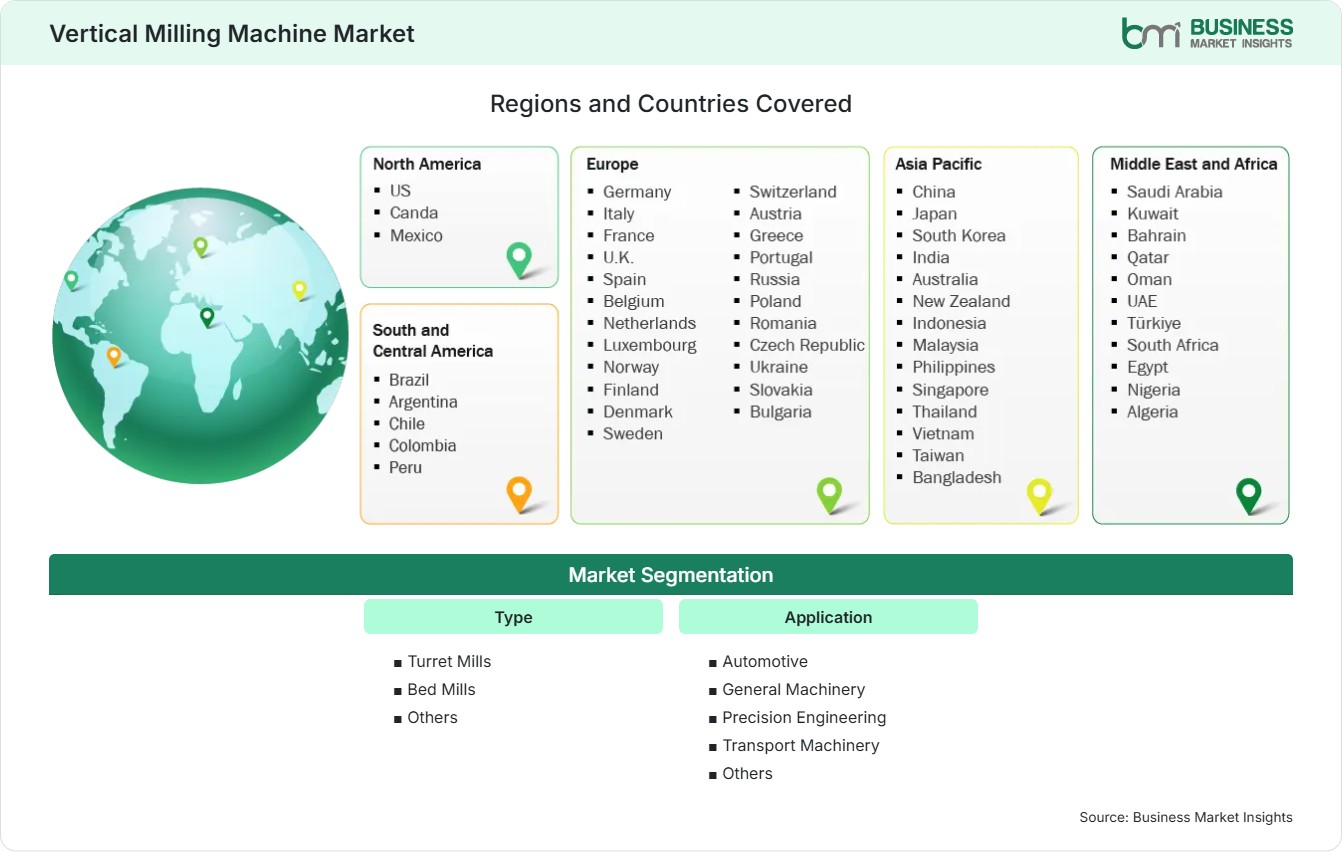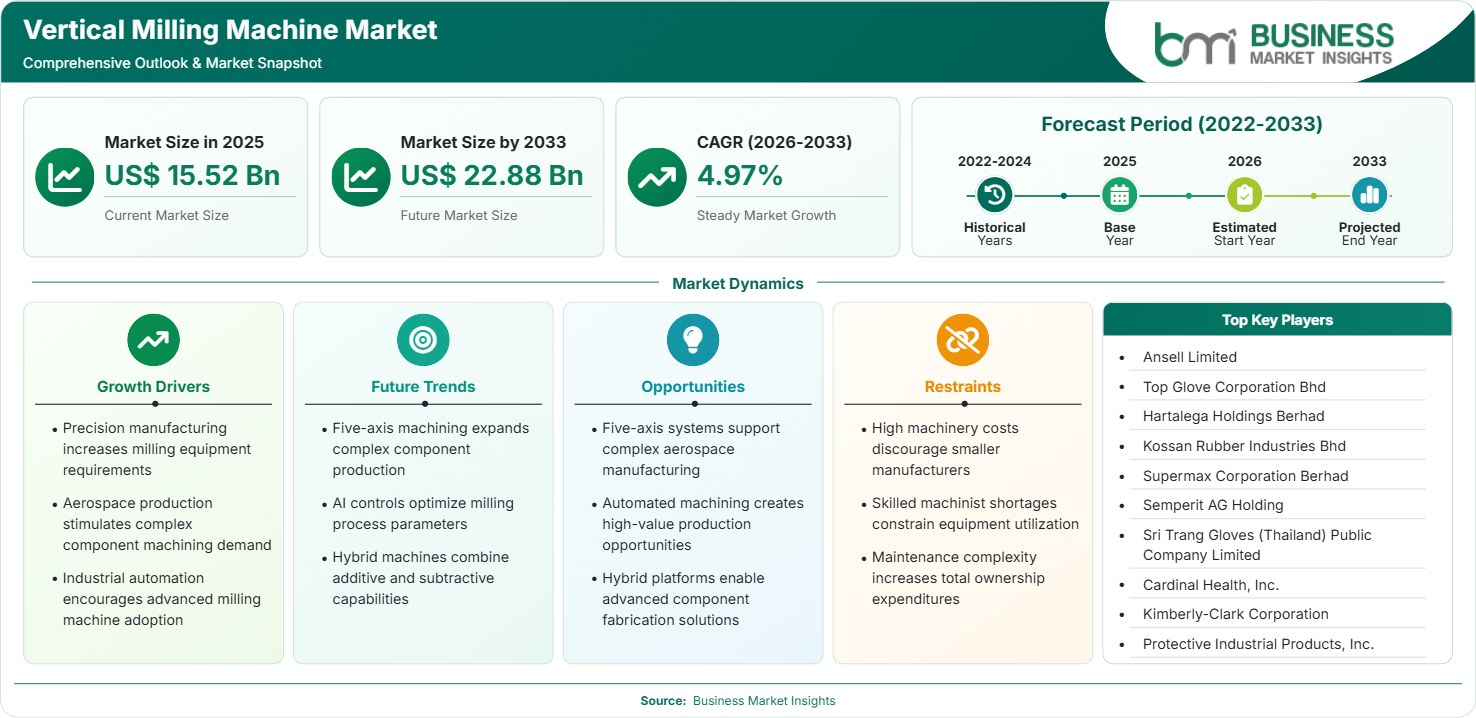
Vertical Milling Machine Market Regional Highlights
North America Vertical Milling Machine Market
North America accounted for approximately 30%–33% of global demand in 2025 and is projected to expand at a 4.4%–4.8% CAGR through 2033. Investment in aerospace manufacturing, energy infrastructure, defense production, and high-precision metalworking supports regional leadership. The Vertical Milling Machine Market share remains substantial in this region due to strong adoption of digital machining technologies, advanced manufacturing standards, and increasing demand for complex component production within industrial sectors.
- Aerospace manufacturers are still increasing their machining capacity for structural components, engines, and defence platforms, which in turn promotes the use of advanced CNC-equipped milling systems.
- Manufacturers who are aiming to improve their operational control and achieve greater supply-chain resilience are seeing a rise in their domestic equipment purchases as part of their reshoring efforts.
- Investing in smart factories promotes the integration of automation, analytics, and predictive maintenance features throughout industrial facilities.
- Because of the energy-sector projects, there is a demand for precision-machined components, and this requires reliable heavy-duty milling capabilities.
US Vertical Milling Machine Market
The United States contributes roughly 74%–78% of North American Vertical Milling Machine Market revenue and advances at 4.5%–4.9% CAGR through 2033. Defense procurement, aerospace manufacturing, industrial automation, and transportation equipment production sustain market demand. Ongoing capacity expansion across high-value manufacturing industries promotes investment in technologically advanced machine tools.
- Aerospace and defense programs need steady machining precision. This supports the ongoing need to replace high-tech equipment.
- The expansion of electric vehicle manufacturing drives greater demand for machining across drivetrains, battery systems, and structural components.
- The fact that there is a shortage of workers is leading companies to introduce automation to enhance operational efficiency and productivity.
Europe Vertical Milling Machine Market
Europe represents 24%–27% Vertical Milling Machine Market share in 2025 and is expected to register a 4.3%–4.7% CAGR through 2033. Germany leads regional demand, while Eastern European manufacturing hubs exhibit faster expansion. Industrial automation, automotive engineering, and machinery exports support investment activity.
- Germany still holds the leading position, due to its advanced ecosystems for producing automotive and industrial machinery.
- Poland and the Czech Republic have higher growth rates as a result of manufacturing being relocated and of industrial investments being made.
- The sustainability initiatives promote the replacement of older machinery with more energy-efficient alternatives.
- In the precision engineering sector, digital manufacturing and smart production platforms are becoming increasingly popular.
Asia Pacific Vertical Milling Machine Market
Asia Pacific commands 36%–39% share in 2025 and records the fastest regional expansion with a 5.8%–6.3% CAGR through 2033. The Vertical Milling Machine Market growth trajectory remains strongest in the region because of expanding factory capacity and ongoing manufacturing modernization initiatives.
- China meets the demands of the region due to its large-scale industrial production and its ability in the manufacture of machinery.
- India is recording an accelerated adoption of equipment, this being due to domestic manufacturing and industrial policy initiatives.
- The production of electronics and semiconductor-related items leads to an increased need for precise machining.
- As the EV ecosystems expand, there is greater demand for advanced milling systems within production networks.
Rest of World Vertical Milling Machine Market
Rest of World accounts for 8%–11% share in 2025 and grows at 4.7%–5.2% CAGR through 2033. South and Central America benefit from machinery and automotive investments, while the Middle East and Africa gain momentum through industrial diversification programs.
- Brazil is still the biggest market in Latin America as a result of its varied industrial activity.
- Mexico gains the advantages of being integrated into global supply chains through manufacturing.
- Saudi Arabia and the United Arab Emirates are investing in plans for industrial diversification and in advanced manufacturing.
- The mining and energy sectors provide opportunities for the use of heavy-duty machining.