
Variable Refrigerant Flow (VRF) Systems Market Outlook: Size, Share, Trends, Growth Analysis, Competitive Landscape & Forecast, 2026-2033

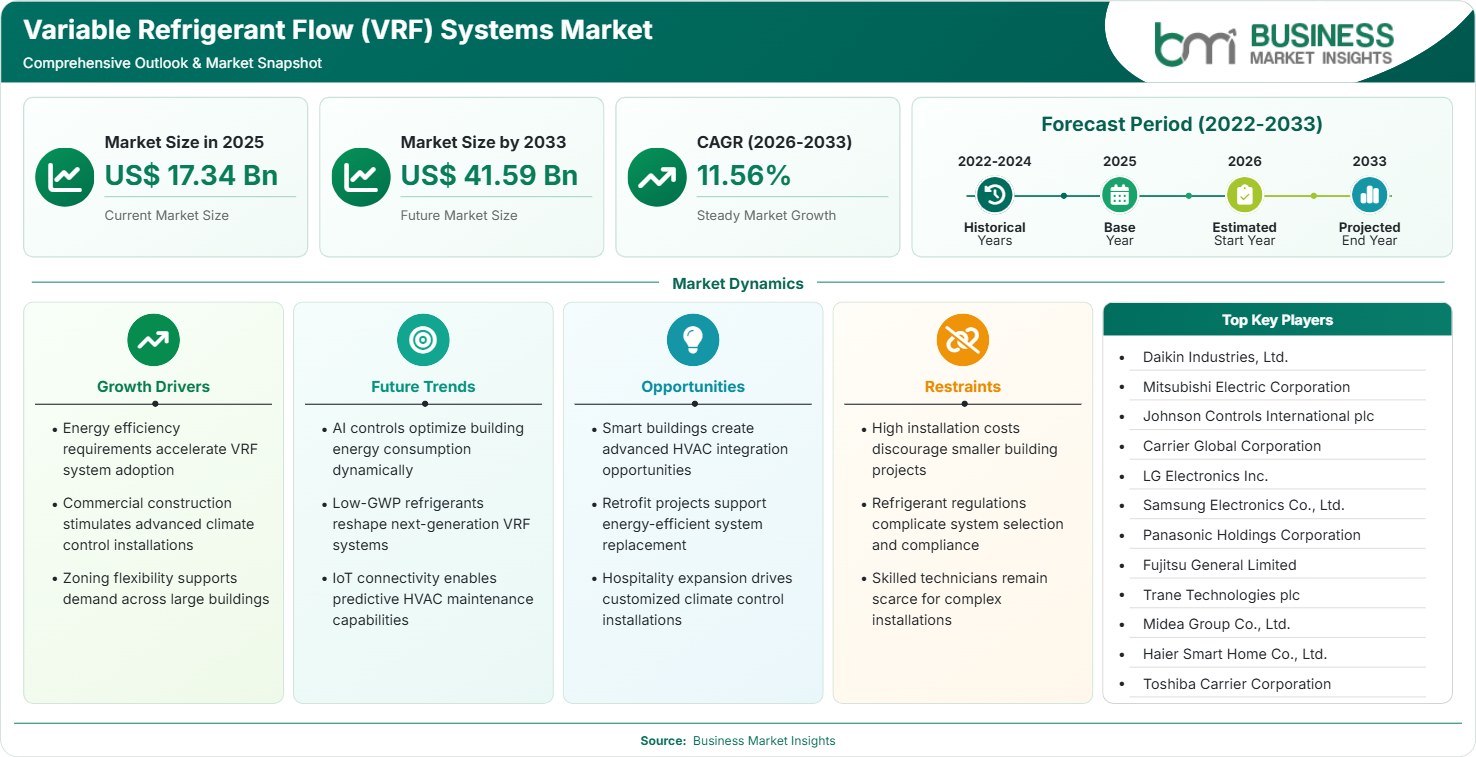
The Variable Refrigerant Flow (VRF) Systems Market size was valued at US$ 17.34 Billion in 2025 and is projected to reach US$ 41.59 Billion by 2033, growing at a CAGR of 11.56% during 2026–2033. Rising demand for energy-efficient HVAC systems, green building construction, smart controls integration, and decarbonization initiatives are driving adoption, while retrofit opportunities and sustainable refrigerant transitions create long-term growth potential.

Report Coverage
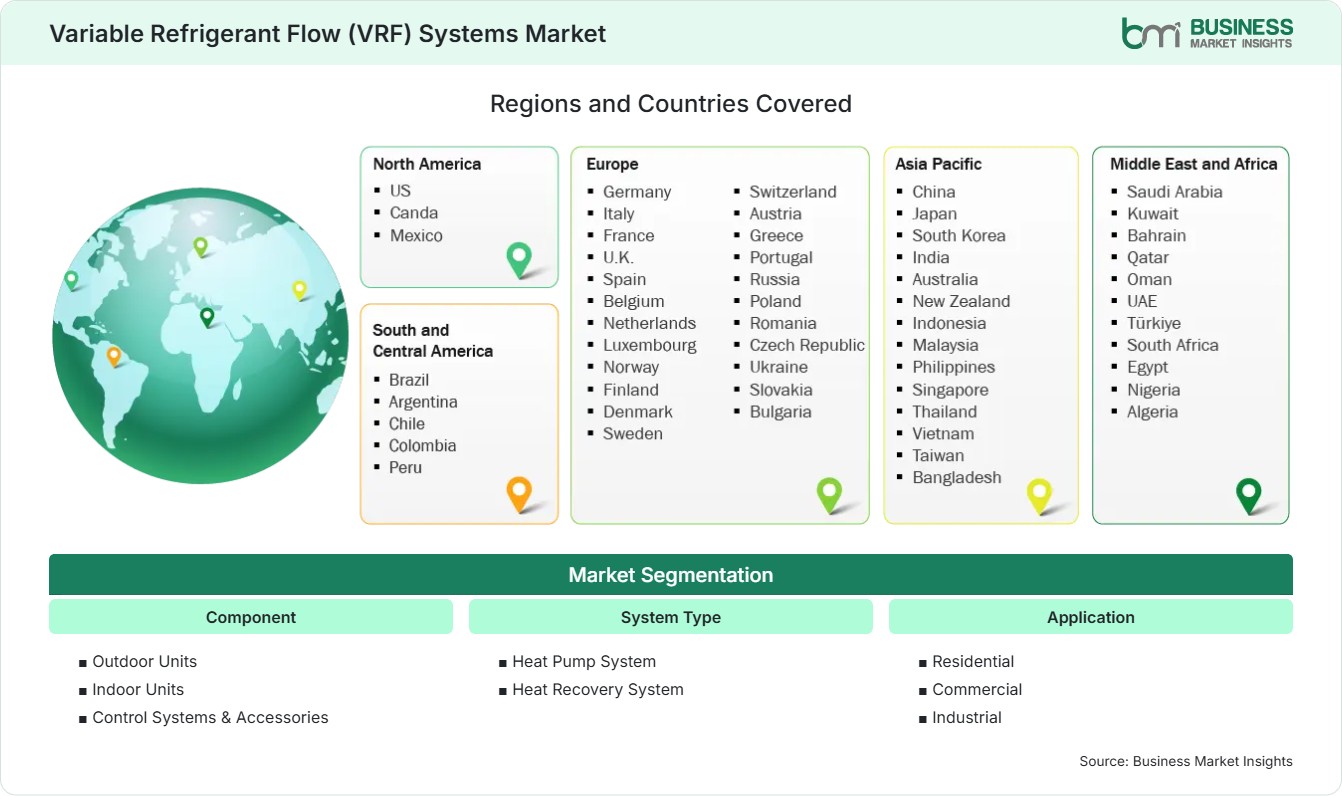
  • Component: Outdoor Units, Indoor Units, Control Systems & Accessories
  • System Type: Heat Pump System, Heat Recovery System
  • Application: Residential, Commercial, Industrial
US$ 17.34 Bn Market size in 2025
US$ 41.59 Bn Market Size by 2033
11.56% CAGR, 2026 - 2033
2026-2033 Forecast Period

AI Overview

Variable Refrigerant Flow (VRF) Systems Market Summary

  • North America Region: North America holds a market share of 24%–27% in 2025, growing with a CAGR of 10.2%–11.0% during 2026–2033, supported by commercial building retrofits, decarbonization mandates, electrification programs, advanced building automation integration, rising replacement demand, energy efficiency standards, sustainable refrigerant adoption, and increasing investments in intelligent climate control technologies. Brief US market analysis: The US dominates regional revenue through commercial retrofit projects, achieving an estimated 10.5%–11.3% CAGR through 2033.
  • Fastest Growing Region: Asia Pacific holds a market share of 39%–42% in 2025, growing with a CAGR of 12.8%–13.8% during 2026–2033, supported by urban development, expanding commercial infrastructure, high-rise construction, manufacturing investments, energy regulations, smart city deployment, rising middle-class spending, and accelerating HVAC modernization across major economies.
  • Leading Segment: Commercial application holds a market share of 46%–49% in 2025, growing with a CAGR of 11.2%–12.0% during 2026–2033, driven by office complexes, hospitality facilities, educational institutions, healthcare campuses, demand for zoning flexibility, lower operating costs, and increasing emphasis on energy performance compliance.
  • High Growth Segment: Heat Recovery System holds a market share of 33%–36% in 2025, growing with a CAGR of 12.6%–13.4% during 2026–2033, supported by simultaneous heating and cooling advantages, sustainability targets, energy optimization needs, renewable integration, premium commercial projects, and lifecycle cost reduction requirements.
  • Key Market Opportunity: Large-scale replacement of aging rooftop HVAC equipment with connected, low-GWP, AI-enabled systems creates opportunities across commercial offices, healthcare facilities, education campuses, mixed-use developments, and environmentally regulated building portfolios worldwide.
  • Major Market Players: Daikin Industries, Ltd.; Mitsubishi Electric Corporation; Johnson Controls International plc; Carrier Global Corporation; LG Electronics Inc.; Samsung Electronics Co., Ltd.; Panasonic Holdings Corporation; Fujitsu General Limited; Trane Technologies plc; Midea Group Co., Ltd.; Haier Smart Home Co., Ltd.; Toshiba Carrier Corporation.
Strategic Insights

Variable Refrigerant Flow (VRF) Systems Market: Strategic Insights

Variable Refrigerant Flow (VRF) Systems Market Strategic Framework
FREE PDF
Request your free sample
Request free sample
Stakeholder View

Key Takeaways

  • Global value chains increasingly emphasize inverter compressors, control electronics, sensors, and advanced refrigerants, making component innovation a major differentiator across the HVAC ecosystem.
  • The greatest revenue upside exists in commercial retrofit projects where aging centralized systems are replaced with high-efficiency zoned climate solutions across offices, healthcare campuses, and educational facilities.
  • R&D activity is shifting toward AI-enabled diagnostics, digital twins, cloud-based asset monitoring, predictive maintenance, and low-GWP refrigerants to improve lifecycle performance.
  • India, Indonesia, Vietnam, Saudi Arabia, and the UAE present compelling investment cases due to rapid infrastructure expansion, urbanization, and sustainability-focused building regulations.
  • Strategic partnerships between HVAC manufacturers, building automation vendors, and energy-management providers are increasing as integrated smart-building solutions become procurement priorities.
  • Service contracts, remote monitoring subscriptions, and after-sales optimization programs are becoming important recurring revenue streams alongside equipment sales.
Geographic Outlook

Variable Refrigerant Flow (VRF) Systems Market Regional Highlights

North America Variable Refrigerant Flow Systems Market

North America accounted for approximately 24%–27% of global revenue in 2025 and is projected to expand at a 10.2%–11.0% CAGR through 2033. Demand is supported by commercial retrofit activity, stricter building-efficiency requirements, and widespread adoption of smart building platforms. Facility owners increasingly prioritize decarbonization strategies and electrification initiatives that lower operational emissions. The Variable Refrigerant Flow Systems Market share in the region benefits from substantial investments in healthcare, education, hospitality, and mixed-use construction projects. Growing preference for low-GWP refrigerants further strengthens market penetration.

  • Energy-efficiency regulations across commercial buildings encourage replacement of conventional HVAC equipment with advanced zoning systems capable of lowering lifetime operating expenses while improving occupant comfort and environmental performance.
  • Data centers, institutional buildings, healthcare campuses, and universities increasingly deploy integrated climate control systems that support remote monitoring, predictive maintenance, and enhanced energy management capabilities.
  • The refrigerant transition toward lower-global-warming-potential alternatives is creating strong equipment upgrade cycles and opportunities for manufacturers introducing next-generation product portfolios.
  • Rising investments in green building certifications and sustainability reporting frameworks continue supporting system adoption among commercial property owners, developers, and public-sector infrastructure projects.
  • Building automation integration remains a major growth catalyst as facility managers seek centralized control, energy optimization, and enhanced indoor environmental quality across complex properties.

US Variable Refrigerant Flow Systems Market

The United States is the largest Variable Refrigerant Flow Systems Market region, accounting for 78%–82% of North American revenue in 2025. Growth is expected to occur on the back of commercial modernization initiatives and the gradual electrification of heating systems. The growth rate is expected to be between 10.5% and 11.3% from 2018 to 2033 as a result of the pursuit of sustainability goals and energy code regulations. Activity in sectors such as healthcare, hospitality, education, and offices remains high.

  • Federal and state efficiency programs encourage adoption of advanced HVAC systems that reduce energy intensity and support sustainable building operation objectives.
  • Growing demand for flexible climate control in hospitals, universities, offices, and mixed-use developments contributes to long-term equipment replacement opportunities.
  • Smart control platforms and cloud-based monitoring solutions improve operational efficiency while supporting predictive maintenance and lifecycle management strategies.
  • Increasing construction of premium residential developments creates additional demand for compact and energy-efficient zoning technologies throughout metropolitan areas.

Europe Variable Refrigerant Flow Systems Market

Europe held approximately 22%–25% of global Variable Refrigerant Flow Systems Market revenue in 2025 and is expected to register a 10.8%–11.8% CAGR through 2033. The regional uptake is driven by robust climatic targets, decarbonization plans, and the increase in investment in an energy-efficient building portfolio. Germany, France, and the United Kingdom continue to be prominent VRF Systems markets thanks to established commercial infrastructures and renovations in place. Poland and Spain, on the other hand, emerge as promising growth nations through the increase in commercial building construction, sustainable requirements, and intelligent buildings investment.

  • European Green Deal initiatives continue accelerating demand for efficient climate-control technologies that help reduce building emissions and energy consumption.
  • Commercial refurbishment projects drive adoption of advanced zoning systems capable of meeting modern energy performance requirements without extensive structural modifications.
  • Germany maintains leadership through strong industrial infrastructure and commercial modernization spending, while Poland records faster expansion driven by new construction activity.
  • Building owners increasingly integrate HVAC equipment with energy-management software to enhance sustainability reporting and operational efficiency.
  • Growing hospitality and mixed-use real estate developments create additional opportunities for premium climate-control deployments across urban centers.

Asia Pacific Variable Refrigerant Flow Systems Market

Asia Pacific accounted for approximately 39%–42% of global revenue in 2025 and is projected to achieve the fastest growth at 12.8%–13.8% CAGR through 2033. Rapid urbanization, commercial construction, manufacturing expansion, and smart-city projects support strong demand. China remains the dominant regional contributor, while India represents the fastest-growing national market due to infrastructure investments and urban development. The region continues to lead the Variable Refrigerant Flow Systems Market growth trajectory through sustained deployment across residential, commercial, and industrial end users.

  • China benefits from large-scale commercial construction activity, technological manufacturing capabilities, and strong domestic HVAC demand across multiple end-use sectors.
  • India records accelerated adoption due to urban infrastructure development, commercial real estate growth, and increasing focus on energy-efficient buildings.
  • Smart-city programs across Southeast Asia support demand for connected climate-control solutions integrated with modern building management systems.
  • Rising middle-class income levels encourage adoption of premium residential comfort technologies with higher energy efficiency and enhanced operational flexibility.
  • Expanding manufacturing facilities and logistics infrastructure create opportunities for advanced climate-control applications throughout industrial environments.

Rest of World Variable Refrigerant Flow Systems Market

The Rest of World region accounted for approximately 10%–13% of global Variable Refrigerant Flow Systems Market revenue in 2025 and is expected to register a 11.5%–12.4% CAGR through 2033. Growth is coming to South America and Central America via increased commercial construction, hotel investment, and urban development projects.

The Middle East and Africa have been aided by smart city projects, tourism, health care infrastructure, and growing energy efficiency in cooling technologies. Saudi Arabia and UAE are the leaders in that region, with Brazil being the main market in Latin America.

  • Large-scale tourism and mixed-use developments in Gulf countries support demand for sophisticated climate-control systems designed for harsh temperature conditions.
  • Saudi Arabia remains the leading regional VRF Systems market, while the UAE records strong investment activity linked to commercial and infrastructure expansion.
  • Brazil benefits from modernization of commercial buildings and increasing awareness regarding energy-efficient HVAC technologies.
  • Healthcare construction across emerging economies generates opportunities for precise temperature control systems and advanced indoor environmental management.
  • Rising sustainability initiatives encourage adoption of efficient climate-control equipment in both public and private construction projects.
Global Market Geography
FREE PDF
Request your free sample
Request free sample
Segment Analysis

Variable Refrigerant Flow (VRF) Systems Market Segmentation

Component

The Component segment accounted for the entire equipment value chain and remains central to industry profitability. The outdoor unit generates maximum revenue, whereas smart control maintains its importance strategically. This category is responsible for about 100% of market involvement, wherein the innovation of components leads to enhanced efficiencies. Increasing use of digital controls and low GWP refrigerants aids in growth at a market-aligned CAGR of 11.0%–12.0%. The Variable Refrigerant Flow Systems Market scope continues to broaden as technology complexity increases.

  • Outdoor Units: Outdoor units contain compressors and heat-exchange technologies that determine system performance. Manufacturers focus on inverter efficiency, refrigerant optimization, capacity enhancement, and improved reliability across diverse climate conditions.
  • Indoor Units: Indoor units support flexible zoning capabilities across commercial and residential spaces, enabling customized temperature management, energy efficiency, occupant comfort, and adaptable installation configurations.
  • Control Systems & Accessories: Smart controllers, sensors, software platforms, and communication modules improve energy optimization, predictive maintenance, remote monitoring, and integration with modern building management systems.

System Type

System type segmentation reflects differences in energy efficiency and application requirements. The Heat Pump Systems still maintain the lead position owing to their cost-effectiveness and flexible installation process. Nevertheless, there is greater momentum seen in the Heat Recovery System arrangements. The expansion in both segments is well-backed by the need for sustainability and high-precision climate control. The segment has shown great compliance with the decarbonization, achieving growth rates broadly consistent with overall industry expansion through the Variable Refrigerant Flow Systems Market forecast period.

  • Heat Pump System: Heat pump configurations provide efficient heating and cooling through simplified architecture, making them suitable for offices, retail facilities, educational institutions, and residential developments.
  • Heat Recovery System: Heat recovery systems simultaneously provide heating and cooling in different building zones, improving energy utilization and supporting high-performance commercial environments requiring superior operational efficiency.

Application

Application-based demand remains led by commercial installations, accounting for approximately 46%–49% market share in 2025 while expanding at a 11.2%–12.0% CAGR through 2033. Adoption is linked to growing construction of offices, hotels, healthcare facilities, and educational institutions. Residential demand continues accelerating due to premium housing developments, while industrial adoption expands in specialized environments requiring energy-efficient climate control. Emerging Variable Refrigerant Flow Systems Market trends increasingly favor digitally connected and intelligent climate-management solutions.

  • Residential: Residential demand is supported by premium housing projects, smart-home integration, improved comfort expectations, and increasing consumer interest in energy-efficient heating and cooling technologies.
  • Commercial: Commercial applications dominate revenue generation through office buildings, retail complexes, hotels, hospitals, and educational facilities requiring flexible zoning and superior operational efficiency.
  • Industrial: Industrial applications expand steadily across manufacturing plants, laboratories, technology facilities, and specialized environments where temperature consistency and energy optimization remain operational priorities.
Market Forces

Variable Refrigerant Flow (VRF) Systems Market Dynamics

Key Market Drivers

Stringent Energy Efficiency Regulations Accelerating Adoption

Governments worldwide continue tightening building energy-performance requirements, creating sustained demand for advanced HVAC systems capable of reducing electricity consumption. Buildings consume a sizable amount of the world’s energy, and this is one area where efficiency gains have become very important. VRF provides greater part-load efficiencies, customized zone control, and less wasted energy than centralized systems. High demand exists for VRF within commercial offices, hospitals, hotels, and university campuses, requiring green building certifications. Effective regulations favoring electrification efforts and decarbonization have made building operators consider changing out old HVAC equipment. This will help in sustaining growth both in developed and emerging markets.

Expansion of Commercial Infrastructure and Urban Development

Buildings consume a sizable amount of the world’s energy, and this is one area where efficiency gains have become very important. VRF provides greater part-load efficiencies, customized zone control, and less wasted energy than centralized systems. High demand exists for VRF within commercial offices, hospitals, hotels, and university campuses, requiring green building certifications. Effective regulations favoring electrification efforts and decarbonization have made building operators consider changing out old HVAC equipment. This will help in sustaining growth both in developed and emerging markets. Consequently, Variable Refrigerant Flow Systems Market growth continues to be closely aligned with infrastructure modernization and urban development spending worldwide.

Digital Building Management and Smart HVAC Integration

The integration of HVAC technology with building management systems is changing the priority factors in the real estate industry. There has been an increasing trend where facility management companies require their HVAC technology to have cloud-enabled monitoring, predictive maintenance, diagnostic support, and energy optimization through AI. VRF systems work well with building management systems as they enhance centralization and resource management. With digital connectivity, facility management companies can spot problems even before any failure takes place, thus reducing costs. As digitalization becomes central to property operations, connected climate-control technologies gain strategic importance across global VRF Systems markets.

Key Market Opportunities

Replacement Market Driven by Aging HVAC Infrastructure

Many of the installed HVAC systems for commercial buildings in developed nations are nearing the end of their lifecycles. Building owners are focusing on solutions that deliver cost savings and increased occupant comfort. New VRF systems can be installed easily into existing systems because of their advanced technology. Upgrading existing technology enables organizations to fulfill sustainability goals and reduce costs. Increased recognition of life cycle value is leading to higher demands for replacements in office buildings, hospitals, schools, and hotels. Long-term Variable Refrigerant Flow Systems Market Forecasts indicate significant revenue opportunities for manufacturers offering advanced retrofit solutions, digital services, and performance optimization capabilities.

Transition Toward Low-GWP Refrigerants and Sustainable HVAC

The global transition toward environmentally responsible refrigerants creates significant opportunities for equipment manufacturers and technology providers. Regulatory regimes are increasingly supporting the adoption of low global warming potential substances that minimize environmental harm. There are incentives for manufacturers of advanced refrigerant technology to take advantage of the need for replacements that are created by regulatory standards. The launch of new products that include R-32 and other environmentally-friendly refrigerants illustrates this trend on an international level. Companies seeking sustainability goals have another incentive to invest in environmentally friendly technologies.

Smart Cities and Integrated Building Ecosystems

Smart-city development initiatives are creating new opportunities for intelligent climate-control technologies. Large-scale urban projects increasingly incorporate digital infrastructure, automated building systems, and advanced energy-management platforms. VRF systems align well with these requirements because they support centralized monitoring, flexible operation, and integration with broader smart-building architectures. Demand is expected to increase across transportation hubs, government complexes, healthcare campuses, educational districts, and mixed-use developments. Investments in connected infrastructure throughout Asia Pacific, the Middle East, and selected European economies strengthen long-term growth prospects. This environment supports equipment suppliers offering interoperable and digitally enabled solutions.

Market Restraints and Challenges

High Initial Installation Costs and Complex Design Requirements

Factor: Advanced system architecture, specialized controls, and engineering-intensive installation requirements increase upfront capital expenditure. Impact: Cost-sensitive customers, particularly small businesses and residential buyers, may delay investment decisions despite favorable lifecycle economics. Project budgets often prioritize lower-cost conventional HVAC alternatives, especially where energy-cost savings are not immediately visible. Design complexity also requires specialized engineering expertise and trained contractors. Installation planning, refrigerant management, commissioning requirements, and integration procedures can increase project timelines. Although long-term efficiency benefits remain attractive, initial investment barriers continue limiting adoption within certain market segments and emerging economies.

Skilled Workforce Shortage and Refrigerant Transition Risks

Factor: The industry faces an ongoing shortage of technicians trained in advanced HVAC controls, digital diagnostics, and evolving refrigerant standards. Impact: Limited workforce availability can increase installation costs, prolong project schedules, and reduce service responsiveness. Transition toward new refrigerants requires additional training, certification, and safety awareness across the contractor ecosystem. Organizations operating in regions with inadequate technical expertise may encounter implementation challenges and maintenance difficulties. Manufacturers must invest heavily in education programs, installer support, and technical resources to maintain customer confidence. These workforce constraints present an ongoing challenge to accelerated market expansion.

Company Analysis

Competitive Landscape

The competitive environment remains highly dynamic, with multinational HVAC manufacturers emphasizing product innovation, refrigerant transition strategies, digital connectivity, and service-based differentiation. Current Variable Refrigerant Flow Systems Market analysis indicates that technological leadership, energy efficiency performance, and smart-building integration capabilities remain important competitive factors.

Company Name

Overview

Products and Services relevant to this market

Daikin Industries, Ltd.

Global HVAC leader with extensive VRV/VRF expertise and broad international distribution networks.

VRF systems, heat recovery solutions, controls, compressors, refrigerants, monitoring platforms, and aftermarket services.

Mitsubishi Electric Corporation

Major supplier of commercial and residential climate-control solutions with strong technology capabilities.

VRF systems, indoor units, smart controls, heat pumps, building management connectivity, and service support.

Johnson Controls International plc

Diversified building technology provider offering integrated HVAC and facility-management solutions.

VRF equipment, building automation systems, controls, energy management, maintenance, and lifecycle optimization services.

Carrier Global Corporation

Global climate solutions provider serving commercial, residential, and industrial customers worldwide.

VRF systems, air-conditioning equipment, controls, monitoring platforms, service contracts, and efficiency solutions.

LG Electronics Inc.

Leading HVAC innovator with strong presence across commercial and residential applications.

VRF systems, smart controls, connected HVAC technologies, indoor units, and energy-management platforms.

Samsung Electronics Co., Ltd.

Technology-focused company expanding intelligent HVAC solutions worldwide.

VRF equipment, cloud-enabled building controls, energy-efficient climate solutions, and integrated platforms.

Panasonic Holdings Corporation

Established electronics and HVAC manufacturer with strong energy-efficiency focus.

VRF systems, indoor climate products, ventilation solutions, controls, and building integration technologies.

Fujitsu General Limited

HVAC specialist recognized for advanced air-conditioning and climate-control technologies.

VRF systems, smart controllers, indoor units, outdoor units, and maintenance support offerings.

Trane Technologies plc

Global provider of sustainable climate and energy solutions for commercial facilities.

HVAC equipment, intelligent controls, energy services, building performance optimization, and system integration.

Midea Group Co., Ltd.

Major appliance and HVAC manufacturer with expanding international market presence.

VRF systems, commercial air-conditioning equipment, controls, automation capabilities, and service solutions.

Haier Smart Home Co., Ltd.

Diversified home and commercial appliance manufacturer with HVAC technology portfolio.

VRF equipment, air-conditioning systems, smart building applications, and connected climate-control solutions.

Toshiba Carrier Corporation

Joint venture specializing in advanced HVAC technologies and commercial applications.

VRF systems, sustainable cooling technologies, controls, refrigerant innovations, and commercial HVAC services.

Trust & Transparency

Research Methodology

The market analysis combines proprietary research with secondary data from government agencies, company disclosures, regulatory filings, industry databases and expert interviews. Market estimates are validated through data triangulation, cross-market benchmarking and analyst review.

View Full Research Methodology

Questions Answered

Frequently Asked Questions

Why is Asia Pacific considered the most attractive growth region?

Rapid urbanization, expanding commercial real estate, smart-city investments, manufacturing growth, rising disposable income, and strong infrastructure spending collectively support higher adoption rates than most other global regions.

What does the Variable Refrigerant Flow Systems Market Report indicate about future opportunities?

The Variable Refrigerant Flow Systems Market report highlights substantial opportunities in retrofit projects, smart-city developments, digital building ecosystems, low-GWP refrigerant technologies, and integrated building management platforms that improve operational efficiency and sustainability performance.

How are refrigerant regulations influencing industry development?

Governments are increasingly encouraging lower-global-warming-potential refrigerants. This transition is driving product innovation, replacement demand, research investment, and modernization programs across both mature and developing HVAC markets.

Which application segment generates the highest revenue?

Commercial applications generate the largest revenue contribution due to extensive adoption across offices, healthcare facilities, hotels, educational campuses, shopping complexes, and mixed-use developments requiring advanced climate-management capabilities.

What factors are accelerating adoption of VRF systems worldwide?

Rising energy-efficiency regulations, commercial infrastructure development, smart-building deployment, electrification initiatives, and increasing demand for flexible zoning capabilities are among the primary drivers supporting long-term demand across developed and emerging economies.

Access the Full Variable Refrigerant Flow (VRF) Systems Market Report

Get segment-level forecasts, regional estimates, competitive benchmarking, company profiles and downloadable Excel datasets.

Access the full Variable Refrigerant Flow (VRF) Systems Market Report
350 pages PDF & Excel | 2026-09-16
Similar Research

Related Market Reports