
Conveyor Systems Market Outlook: Size, Share, Trends, Growth Analysis, Competitive Landscape & Forecast, 2026-2033

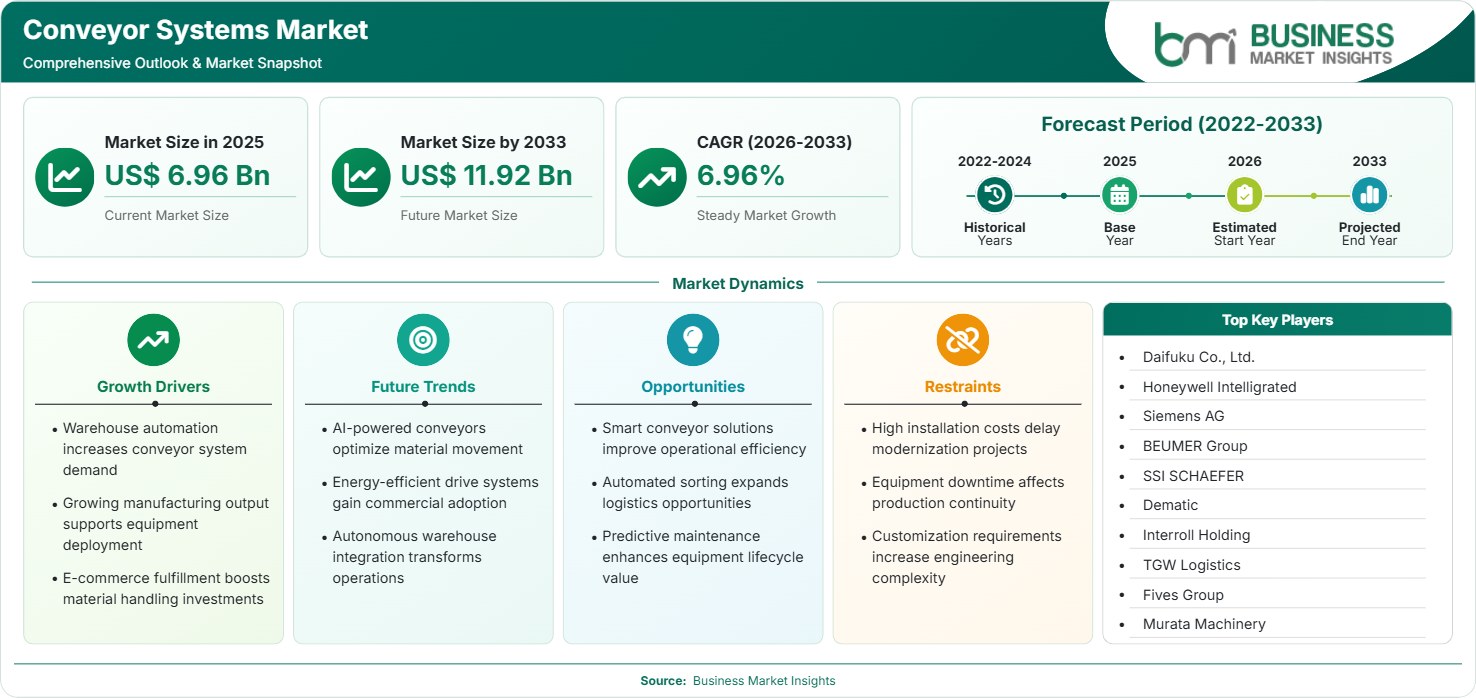
The Conveyor Systems Market size was valued at US$ 6.96 billion in 2025 and is projected to reach US$ 11.92 billion by 2033, growing at a CAGR of 9.96% during 2026–2033. Rising warehouse automation, expanding manufacturing capacity, and growing investments in intelligent material handling infrastructure continue creating long-term opportunities across industrial and logistics operations worldwide.

Report Coverage
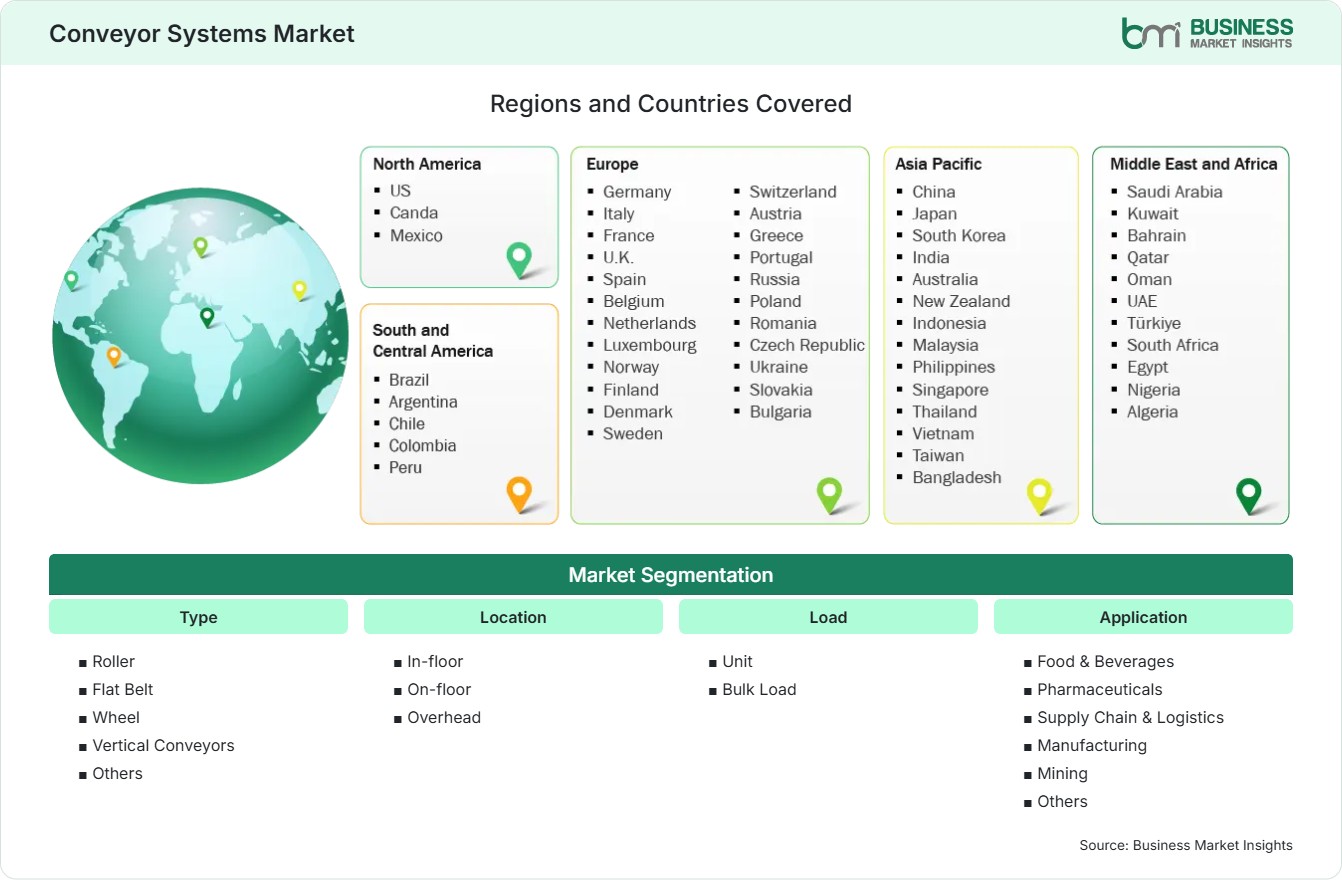
  • Type: Roller, Flat Belt, Wheel, Vertical Conveyors, Others
  • Location: In-floor, On-floor, Overhead
  • Load: Unit, Bulk Load
  • Application: Food & Beverages, Pharmaceuticals, Supply Chain & Logistics, Manufacturing, Mining, Others
US$ 6.96 Bn Market size in 2025
US$ 11.92 Bn Market Size by 2033
6.96% CAGR, 2026 - 2033
2026-2033 Forecast Period

AI Overview

Conveyor Systems Market Summary

  • North America Region: North America held 31%–34% market share in 2025 and is projected to grow at a CAGR of 9.3%–9.8% during 2026–2033. Strong warehouse automation investments, advanced manufacturing facilities, and rapid adoption of smart logistics technologies continue supporting regional expansion. The U.S. remains the largest contributor, registering a CAGR of 9.4%–9.9% through increasing fulfillment center automation and industrial modernization.
  • Fastest Growing Region: Asia Pacific accounted for 35%–38% market share in 2025 and is anticipated to record the fastest CAGR of 10.7%–11.3% during the forecast period. Expanding manufacturing output, rising industrial automation, and significant investments in logistics infrastructure continue accelerating regional demand.
  • Leading Segment: Flat Belt systems represented 29%–32% market share in 2025 and are expected to expand at a CAGR of 9.8%–10.3%, supported by broad applications across warehousing, manufacturing, and distribution facilities.
  • High Growth Segment: Supply Chain & Logistics captured 27%–30% market share in 2025 and is projected to register a CAGR of 10.5%–11.1% owing to rapid warehouse expansion, e-commerce fulfillment, and automated distribution centers.
  • Key Market Opportunity: Growing investment in intelligent warehouses, AI-enabled material handling equipment, and connected conveyor technologies continues creating new opportunities for equipment manufacturers and automation solution providers worldwide.
  • Major Market Players: Daifuku Co., Ltd., Honeywell Intelligrated, Siemens AG, BEUMER Group GmbH & Co. KG, SSI SCHAEFER Group, Dematic Corp., Interroll Holding AG, TGW Logistics Group GmbH, Fives Group, and Murata Machinery, Ltd.
Strategic Insights

Conveyor Systems Market: Strategic Insights

Conveyor Systems Market Strategic Framework
FREE PDF
Request your free sample
Request free sample
Stakeholder View

Key Takeaways

  • Increasing warehouse automation is strengthening demand for integrated conveyor systems capable of supporting robotics, automated storage systems, and intelligent material handling workflows.
  • Logistics and e-commerce sectors continue representing the strongest long-term investment opportunities due to sustained expansion of fulfillment centers and distribution infrastructure.
  • Digital technologies including predictive maintenance, real-time monitoring, and artificial intelligence are becoming important competitive differentiators across conveyor equipment portfolios.
  • Asia Pacific remains the most attractive regional investment destination because of expanding manufacturing activity, industrial automation programs, and logistics infrastructure development.
  • Strategic acquisitions, technology partnerships, and warehouse automation projects continue reshaping competitive dynamics among global conveyor system manufacturers.
  • Demand for modular, energy-efficient, and scalable conveyor solutions is encouraging continuous innovation across industrial material handling applications.
Geographic Outlook

Conveyor Systems Market Regional Highlights

North America Conveyor Systems Market

North America accounted for 31%–34% Conveyor Systems Market share in 2025 and is expected to expand at a CAGR of 9.3%–9.8% during 2026–2033. Strong industrial automation adoption, advanced manufacturing capabilities, and increasing warehouse modernization projects continue supporting regional demand. Companies are investing in intelligent conveyor technologies that improve productivity, reduce labor costs, and enhance supply chain efficiency across manufacturing, logistics, food processing, and pharmaceutical industries.

  • Expansion of automated fulfillment centers continues increasing demand for high-speed conveyor systems across distribution operations.
  • Manufacturers are integrating artificial intelligence and Industrial Internet of Things technologies to optimize equipment performance.
  • Food processing facilities increasingly adopt hygienic conveyor solutions supporting regulatory compliance and operational efficiency.
  • Rising investments in warehouse modernization continue accelerating replacement of conventional material handling equipment.

US Conveyor Systems Market

The United States contributes 83%–86% of North American revenue and is projected to register a CAGR of 9.4%–9.9% through 2033. Large-scale warehouse investments, strong manufacturing activity, and continuous deployment of advanced logistics technologies continue supporting sustained equipment demand.

  • E-commerce expansion continues driving automation across distribution and fulfillment facilities.
  • Manufacturing companies increasingly adopt digital conveyor monitoring to improve operational productivity.
  • Logistics providers continue expanding automated parcel handling infrastructure nationwide.
  • Investments in predictive maintenance technologies improve equipment reliability and reduce operational downtime.

Europe Conveyor Systems Market

Europe represented 24%–27% market share in 2025 and is forecast to grow at a CAGR of 9.1%–9.6% during the assessment period. Industry 4.0 adoption, advanced manufacturing, and sustainability initiatives continue driving demand for intelligent conveyor technologies. Germany remains the largest regional market, while Poland records the fastest growth owing to expanding manufacturing investments and logistics infrastructure.

  • Industrial automation projects continue supporting modernization across manufacturing facilities.
  • Automotive and food industries remain important consumers of automated conveyor equipment.
  • Warehouse operators increasingly implement energy-efficient conveyor technologies.
  • Digital factory initiatives continue encouraging integrated material handling solutions.

Asia Pacific Conveyor Systems Market

Asia Pacific accounted for 35%–38% market share in 2025 and is expected to register the fastest 10.7%–11.3% CAGR through 2033. Expanding industrial production, rising labor costs, and rapid growth of logistics infrastructure continue strengthening equipment demand. China leads regional revenue generation, while India records the highest growth due to manufacturing expansion, warehouse construction, and increasing automation investments.

  • Rapid industrialization continues driving conveyor installations across multiple manufacturing sectors.
  • E-commerce expansion supports significant investments in automated logistics infrastructure.
  • Electronics manufacturing increasingly utilizes precision conveyor systems for production efficiency.
  • Government initiatives promoting smart manufacturing continue accelerating industrial automation adoption.

Rest of World Conveyor Systems Market

The Rest of World region accounted for 7%–10% market share in 2025 and is projected to expand at a CAGR of 9.4%–10.0% during 2026–2033. Manufacturing diversification, mining investments, and logistics modernization continue supporting market development across Latin America, the Middle East, and Africa.

  • Brazil continues leading regional demand through manufacturing and food processing investments.
  • GCC countries are expanding logistics infrastructure supporting automated warehouse development.
  • Mining operations increasingly deploy heavy-duty conveyor technologies to improve operational efficiency.
  • Infrastructure modernization programs continue strengthening industrial equipment demand across emerging economies.
Global Market Geography
FREE PDF
Request your free sample
Request free sample
Segment Analysis

Conveyor Systems Market Segmentation

Type

The type segment forms the foundation of industry demand as conveyor selection depends on product characteristics, production speed, operational efficiency, and facility layout. It accounted for 29%–32% market share in 2025 and is projected to register a CAGR of 9.8%–10.3% during 2026–2033. Continuous product innovation, automation upgrades, and expanding industrial applications are broadening the Conveyor Systems Market scope across manufacturing, warehousing, mining, logistics, and food processing operations.

  • Roller: Widely deployed in warehouses, manufacturing plants, and distribution centers for transporting cartons, pallets, and heavy products with high operational efficiency and minimal maintenance requirements.
  • Flat Belt: Represents the leading product category due to its versatility, smooth material movement, cost-effective operation, and broad adoption across packaging, food processing, logistics, and assembly line applications.
  • Wheel: Commonly used for lightweight package handling and gravity-based transportation systems where flexible layouts, low operating costs, and simple installation are important operational considerations.
  • Vertical Conveyors: Increasingly adopted in facilities with limited floor space to move materials efficiently between multiple production levels while improving warehouse utilization and workflow optimization.

Location

Location-based system design directly influences operational efficiency, installation flexibility, and facility utilization across industrial environments. This segment accounted for 41%–44% market share in 2025 and is expected to register a CAGR of 10.1%–10.6% during the forecast period. Growing Conveyor Systems Market trends indicate increasing demand for modular installations that maximize throughput while reducing operating costs and supporting automated production environments.

  • In-floor: Preferred in automated manufacturing facilities where uninterrupted floor movement, operator safety, and integration with robotic production systems remain critical operational priorities.
  • On-floor: Maintains broad adoption because of easier installation, lower maintenance complexity, operational flexibility, and suitability for warehouses, factories, and distribution facilities.
  • Overhead: Supports efficient utilization of factory space by transporting products above workstations, making it suitable for automotive manufacturing, painting operations, and assembly applications.

Load

Load requirements determine conveyor system configuration, structural strength, and operational performance across industrial applications. The segment accounted for 62%–65% market share in 2025 and is projected to expand at a CAGR of 10.0%–10.5% through 2033. Rising warehouse automation and industrial material handling continue supporting demand for equipment capable of efficiently transporting products with varying weights and dimensions.

  • Unit: Dominates demand across logistics, e-commerce, packaging, and manufacturing facilities by enabling efficient transportation of cartons, pallets, totes, and packaged products throughout automated handling systems.
  • Bulk Load: Continues generating demand across mining, cement, agriculture, chemicals, and heavy industrial operations requiring continuous movement of loose materials over long distances with minimal operational interruptions.

Application

Application diversity remains a key growth driver as conveyor systems support automation across numerous industrial sectors requiring efficient and continuous material movement. This segment captured 27%–30% market share in 2025 and is forecast to register the fastest CAGR of 10.5%–11.1% during 2026–2033. Expanding Conveyor Systems Market share across logistics and manufacturing reflects growing investments in warehouse automation, production efficiency, and intelligent material handling technologies.

  • Food & Beverages: Widely utilizes hygienic conveyor systems designed for safe product handling, regulatory compliance, high-speed packaging, and efficient food processing operations.
  • Pharmaceuticals: Increasingly adopts precision conveyor technologies supporting contamination control, automated packaging, accurate product handling, and compliance with stringent manufacturing standards.
  • Supply Chain & Logistics: Represents the fastest-growing application due to expanding e-commerce fulfillment centers, parcel handling facilities, automated warehouses, and distribution networks requiring continuous material movement.
  • Manufacturing: Continues investing in conveyor automation to improve production efficiency, minimize manual handling, increase throughput, and support flexible manufacturing operations.
  • Mining: Relies on heavy-duty conveyor systems capable of transporting bulk materials efficiently while reducing operational costs, improving safety, and supporting continuous extraction activities.
Market Forces

Conveyor Systems Market Dynamics

Key Market Drivers

Warehouse automation increases conveyor system demand

Warehouse operators are increasingly replacing manual material handling with automated conveyor solutions to improve order processing speed, inventory accuracy, and labor productivity. The increased construction of distribution centers and omnichannel retail facilities has led to a greater need for conveyor systems capable of handling large order volumes without disruption. The addition of robotics, automation, storage, retrieval, and even warehouse management systems software has helped increase efficiency. With companies increasingly adopting intelligent logistics facilities, the need for modularity and scalability in conveyor systems has become more important.

Growing manufacturing output supports equipment deployment

Expanding manufacturing activities across automotive, electronics, food processing, pharmaceuticals, and consumer goods industries continue creating sustained demand for conveyor equipment. Modern manufacturers are upgrading their factories to increase productivity and achieve uniformity in product quality through automated processes. The conveyor system is now an important part of production lines that ensure uninterrupted transfer of material at various stages of production. Increased investments in industry in the developing world and modernization programs in factories have led to development of more efficient, robust and networked conveyor systems.

E-commerce fulfillment boosts material handling investments

The expansion of online retail continues reshaping warehouse operations worldwide, increasing demand for high-speed material handling equipment capable of processing thousands of orders every day. Conveyor systems must be coupled with automated sorting technology, barcodes, robots and inventory management systems in contemporary fulfillment centers to retain their efficiency levels. Retailers and third party logistics companies are increasingly making investments in automated systems to cut down delivery time. All this further reinforces the need for advanced conveyor technology.

Key Market Opportunities

Smart conveyor solutions improve operational efficiency

Smart conveyors with intelligent sensors, cloud-based connectivity, and real-time monitoring features are revolutionizing the process of material handling in the industries. They offer visibility into the equipment, improve production flow, and prevent unnecessary downtime through predictive diagnosis. The manufacturers are now increasingly deploying digital platforms which help in central monitoring across different locations. Conveyor Systems Market Forecasts indicate that growing adoption of Industry 4.0 technologies will continue creating attractive business opportunities for companies developing connected and intelligent conveyor solutions.

Automated sorting expands logistics opportunities

Rapid growth in parcel delivery, third-party logistics, and warehouse automation is increasing demand for automated sorting systems integrated with advanced conveyor technologies. Order accuracy is increased, there is minimum manual intervention required, and high speeds are ideal for sorting different sizes of packages efficiently. The logistics companies are still working on improving their automated distribution centers to be able to sort more shipments at lower costs. The equipment manufacturing companies will benefit from the increasing investments in logistics modernization.

Predictive maintenance enhances equipment lifecycle value

Predictive maintenance is becoming an important value-added capability within modern conveyor systems as manufacturers seek to maximize equipment availability and reduce maintenance costs. Artificial intelligence, machine learning, and sensor-based diagnostics enable operators to identify component wear before failures occur, minimizing production interruptions. Digital maintenance platforms also improve spare parts planning and optimize service schedules. Increasing customer preference for lifecycle management services presents significant opportunities for equipment suppliers to strengthen long-term customer relationships through advanced maintenance solutions.

Market Restraints and Challenges

High installation costs delay modernization projects

Factor: Large-scale conveyor installations require substantial investment in equipment procurement, civil works, electrical integration, automation software, and system commissioning. These capital requirements can be challenging for small and medium-sized manufacturers with limited modernization budgets. Impact: Many organizations postpone automation upgrades or adopt phased implementation strategies, slowing replacement of conventional material handling equipment and delaying productivity improvements despite the long-term operational benefits offered by advanced conveyor technologies.

Equipment downtime affects production continuity

Factor: Conveyor systems operate as critical links within manufacturing and logistics operations, making unexpected mechanical failures capable of disrupting entire production workflows. Equipment wear, inadequate maintenance, and component failures may interrupt continuous material movement and reduce operational efficiency. Impact: Production delays, missed delivery schedules, increased maintenance expenses, and lower equipment utilization can affect profitability, encouraging operators to prioritize preventive maintenance programs and invest in more reliable conveyor technologies.

Company Analysis

Competitive Landscape

The market remains highly competitive, with global automation companies emphasizing intelligent material handling, digital monitoring, and integrated warehouse solutions. Conveyor Systems Market analysis indicates that manufacturers are strengthening their positions through technology partnerships, automation software integration, product innovation, and expansion of regional manufacturing and service capabilities to address rising demand from logistics, manufacturing, mining, and food processing industries.

Company Name

Overview

Products and Services Relevant to this Market

Daifuku Co., Ltd.

Global leader in material handling systems serving manufacturing, airports, warehousing, and logistics industries with advanced automation technologies.

Conveyor systems, automated storage and retrieval systems, sorting equipment, warehouse automation solutions, and integrated material handling software.

Honeywell Intelligrated

Provides warehouse automation and supply chain technologies for distribution centers and industrial operations worldwide.

Conveyor systems, automated sortation systems, robotics integration, warehouse execution software, and lifecycle support services.

Siemens AG

Global industrial technology company delivering automation, digitalization, and intelligent manufacturing solutions across multiple industries.

Industrial automation platforms, conveyor control systems, motors, drives, PLCs, digital monitoring, and industrial software solutions.

BEUMER Group

International supplier specializing in intralogistics and bulk material handling technologies for industrial applications.

Belt conveyors, palletizing systems, sorting solutions, airport baggage handling systems, and bulk material handling equipment.

SSI SCHAEFER

Leading provider of warehouse automation and logistics solutions supporting distribution and manufacturing facilities.

Conveyor technology, automated storage systems, order fulfillment solutions, warehouse management software, and integrated logistics systems.

Dematic

Global warehouse automation company serving retail, manufacturing, food, and logistics industries.

Conveyor systems, robotic automation, automated guided vehicles, sortation systems, warehouse software, and lifecycle maintenance services.

Interroll Holding AG

Manufactures high-performance components and complete conveyor solutions for material flow applications worldwide.

Rollers, conveyor modules, drum motors, sorters, pallet handling equipment, and conveyor control technologies.

TGW Logistics Group GmbH

Develops automated warehouse and fulfillment technologies for retail, e-commerce, and industrial customers.

Conveyor systems, shuttle systems, robotic picking, warehouse software, automated storage, and distribution center solutions.

Fives Group

Industrial engineering company providing automation and material handling technologies across manufacturing sectors.

Conveyor equipment, automated handling systems, sorting technologies, production automation, and maintenance support services.

Murata Machinery, Ltd.

Supplies factory automation, logistics automation, and material handling equipment for industrial applications.

Conveyor systems, automated warehouses, cleanroom transport systems, logistics automation, and manufacturing handling equipment.

Trust & Transparency

Research Methodology

The market analysis combines proprietary research with secondary data from government agencies, company disclosures, regulatory filings, industry databases and expert interviews. Market estimates are validated through data triangulation, cross-market benchmarking and analyst review.

View Full Research Methodology

Questions Answered

Frequently Asked Questions

What does the Conveyor Systems Market Report include?

The Market Report provides detailed insights into market dynamics, competitive landscape, regional performance, segmentation, technology developments, strategic opportunities, and future industry outlook.

Which region presents the strongest investment opportunity?

Asia Pacific remains the most attractive investment destination due to expanding manufacturing capacity, logistics infrastructure development, industrial automation programs, and sustained warehouse construction activities.

How are smart technologies changing conveyor systems?

Artificial intelligence, Industrial Internet of Things, predictive maintenance, and real-time monitoring are improving operational efficiency, equipment reliability, energy management, and lifecycle performance across modern conveyor installations.

Which application segment offers the highest growth potential?

Supply Chain & Logistics is expected to witness the strongest expansion because of increasing warehouse automation, parcel handling requirements, and investments in high-speed distribution centers worldwide.

What factors are driving the Conveyor Systems Market?

Increasing warehouse automation, rapid growth of e-commerce fulfillment, expanding manufacturing output, and rising investments in intelligent material handling technologies continue driving demand across industrial sectors.

Access the Full Conveyor Systems Market Report

Get segment-level forecasts, regional estimates, competitive benchmarking, company profiles and downloadable Excel datasets.

Access the full Conveyor Systems Market Report
350 pages PDF & Excel | 2026-08-21