Market Summary
Executive Summary and Global Market Analysis
Automated carrier transport systems that move lightweight items through sealed tube networks have become increasingly relevant in facilities that depend on rapid internal distribution. These systems reduce walking time, shorten delivery cycles, and improve control over high-frequency movements inside hospitals, factories, offices, and retail premises. Their utility is strongest where items must travel securely between departments without adding congestion to staff workflows. As organizations digitize operations, pneumatic tube systems are being re-evaluated as practical infrastructure for internal logistics.
Market momentum is supported by the need to improve response speed, reduce manual transport steps, and strengthen operational traceability. Hospitals use these systems to move specimens, blood products, and medications between nursing stations, laboratories, and pharmacies, while commercial facilities apply them to cash and document handling. Industrial users also value them for the controlled transfer of small components and paperwork across production zones. This broad relevance supports steady deployment across settings where internal time savings translate directly into service efficiency.
Segment behavior differs according to installation scale and operational complexity. Single-phase systems remain appropriate for simpler routing environments, whereas three-phase systems align with higher-capacity and more demanding movement patterns. By configuration, multiline systems offer a stronger fit for larger facilities with multiple destinations, while point-to-point and single-line systems remain useful in more focused layouts. Fully automatic systems are gaining preference because they improve throughput consistency and reduce operator dependence in high-volume environments.
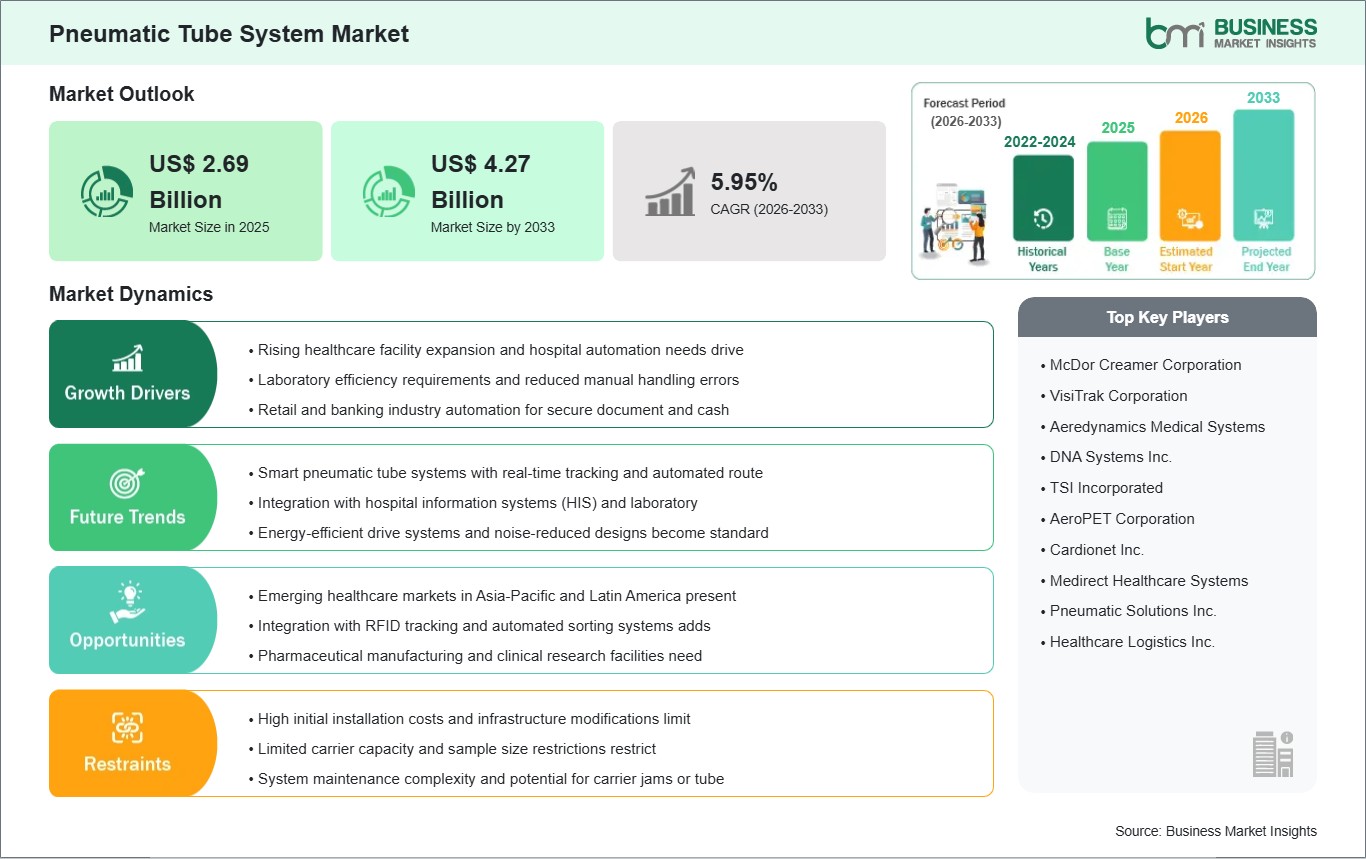
Technology development is moving toward smarter routing, real-time monitoring, and system integration with broader facility platforms. Modern systems incorporate sensors, software interfaces, and automation features that improve dispatch accuracy, visibility, and error reduction. Healthcare settings, in particular, are linking pneumatic tube workflows more closely with laboratory and hospital information systems. At the same time, product development is paying closer attention to operational reliability, noise control, and the safe transport of sensitive contents.
Competitive conditions are shaped by installation expertise, service capability, and the ability to tailor networks for different building types. Suppliers increasingly differentiate through automation depth, maintenance support, software integration, and design flexibility across healthcare and commercial environments. The market, therefore, reflects a gradual shift from basic transport functionality toward a more intelligent and facility-specific logistics platform.
Segment Analysis
Pneumatic Tube System Market Segmentation
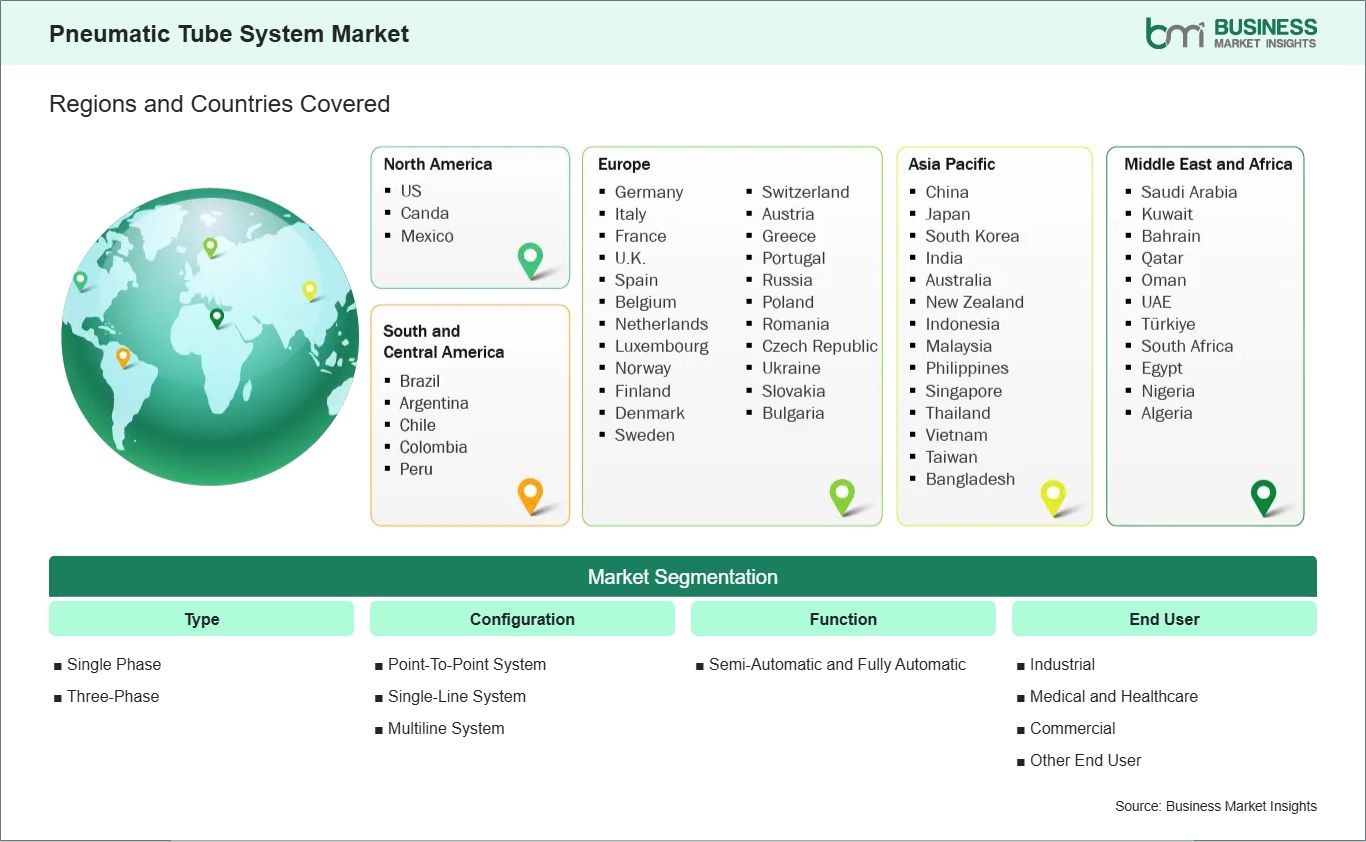
The pneumatic tube system market is segmented based on type, configuration, function, and end user, highlighting distinct operational priorities and evolving deployment strategies across various end uses.
By Type
- Single Phase – Fits facilities with straightforward transport demands and simpler electrical integration.
- Three-Phase – Supports larger systems requiring stronger operational continuity and network performance.
By Configuration
- Point-To-Point System – Serves direct transfers between fixed locations with minimal routing complexity.
- Single-Line System – Handles sequential carrier movement in compact facility layouts.
- Multiline System – Accommodates larger buildings with multiple departments and routing priorities.
By Function
- Semi-Automatic – Suits facilities balancing manual control with moderate transport efficiency.
- Fully Automatic – Enhances throughput, routing accuracy, and workflow consistency.
By End User
- Industrial – Moves documents, components, and small items across controlled work areas.
- Medical and Healthcare – Prioritizes rapid transport of samples, medicines, and blood products.
- Commercial – Supports secure internal transfer of cash, records, and small packages.
- Other End User – Covers specialized environments with time-sensitive internal logistics needs.
Market Forces
Pneumatic Tube System Market Drivers and Opportunities
Need for Faster and More Controlled Internal Logistics
Facilities are under greater pressure to reduce non-productive staff movement and improve the speed of internal item transfer. Manual transport methods consume labor time, introduce handoff delays, and complicate traceability in environments where timely delivery matters. Pneumatic tube systems address these issues by creating a dedicated internal transport network for high-frequency, lightweight loads. Their utility is particularly strong where service quality depends on dependable movement of samples, medicines, documents, or cash between operational nodes.
The effect of this need is especially visible in hospitals and commercial environments with repetitive internal delivery tasks. Healthcare operators seek faster turnaround between diagnostic, pharmacy, and clinical departments, while commercial users look for secure routing of cash and sensitive paperwork. Industrial sites also benefit where documents and components need controlled transit without interrupting production flows. This makes pneumatic tube systems increasingly relevant as infrastructure for labor efficiency and internal coordination rather than only as a convenience tool.
Smart Routing and Facility System Integration
A notable opportunity lies in the transition from standalone transport networks to integrated intelligent logistics systems. Newer pneumatic tube platforms incorporate software controls, sensors, and interfaces that allow routing decisions, performance monitoring, and dispatch workflows to operate more efficiently. In healthcare settings, this integration can align tube deliveries with hospital information systems, laboratory workflows, and contact-minimized operations. These capabilities elevate system value by improving accuracy, reducing bottlenecks, and strengthening visibility over carrier movement.
Future scope is likely to expand where facilities want automated infrastructure that connects physical movement with digital operations. Multiline and fully automatic networks are well positioned in this context because they support more destinations, higher carrier volumes, and reduced operator intervention. As building operators place greater emphasis on traceability, reliability, and integrated maintenance support, smarter pneumatic tube systems can move into a broader range of medical, industrial, and commercial use cases.
Size and Share Analysis
Pneumatic Tube System Market Size and Share Analysis
The pneumatic tube system market is projected to grow from US$ 2.69 billion in 2025 to US$ 4.27 billion by 2033. The market is estimated to record a CAGR of 5.95% from 2026 to 2033.
This growth profile indicates a market supported by consistent infrastructure spending on internal logistics, especially in sectors where time-sensitive movement and workflow efficiency remain important. The industry is advancing through application-led adoption rather than broad-based commoditization.
By type and configuration, three-phase and multiline systems hold stronger strategic relevance for larger and more complex facilities. Their suitability for higher-capacity and multi-destination movement aligns well with institutions seeking broader network coverage. Point-to-point and single-line systems continue to serve focused installations where route simplicity and direct transfer remain sufficient.
By end user, medical and healthcare accounts for the most influential application base because hospitals require rapid and repeatable transfer of sensitive items. Commercial facilities also contribute meaningful demand through secure internal movement of cash and documents. Industrial use adds further scope where controlled small-load transport supports plant coordination and administrative efficiency.
Report Coverage
Pneumatic Tube System Market Report Coverage and Deliverables
The "Pneumatic Tube System Market Size and Forecast (2022–2033)" report provides a detailed analysis of the market covering below areas:
- Market size and forecast at global, regional, and country levels for all the key market segments covered under the scope
- Market trends, as well as market dynamics such as drivers, restraints, and key opportunities
- Market analysis covering key market trends, global and regional framework, major players, regulations, and recent market developments
- Industry landscape and competition analysis covering market concentration, heat map analysis, prominent players, and recent developments for the market
- Detailed company profiles, including SWOT analysis
Geographic Insights
Pneumatic Tube System Market Geographic Insights
The Pneumatic Tube System market shows diverse regional adoption patterns influenced by healthcare infrastructure quality, facility automation priorities, commercial security needs, and internal logistics modernization. Across the global landscape, usage is concentrated in environments where rapid movement of small, time-sensitive loads improves service speed and workflow discipline. Adoption patterns therefore vary according to hospital investment, commercial building complexity, and the maturity of automated facility operations.
North America maintains a strong position because the region combines advanced hospital networks, established commercial applications, and a broad focus on workflow optimization. Healthcare facilities in particular value pneumatic tube systems for specimen transfer, medication dispatch, and internal logistics coordination across large campuses. Commercial and institutional sites also support demand where secure movement of cash and sensitive documents remains operationally important.
Asia Pacific shows expanding relevance as healthcare capacity, urban commercial infrastructure, and industrial modernization continue to develop across major economies. Facilities in the region are placing more emphasis on efficient intra-building transport that reduces manual workloads and supports service continuity. Public procurement and tender activity also indicate sustained interest in pneumatic tube systems for institutional installations, especially where hospital efficiency and operational safety are priorities.
Europe presents a comparatively system-oriented environment shaped by hospital modernization, building automation, and strong attention to operational reliability. The region favors installations that combine secure transport with lower disruption to clinical and administrative workflows. Beyond the major established markets, emerging regions offer selective opportunities where hospital expansion, commercial formalization, and infrastructure upgrades create new demand for internal transport systems.
Industry Activity
Recent Developments
The pneumatic tube system market is evaluated by gathering qualitative and quantitative data post primary and secondary research, which includes important corporate publications, association data, and databases. Recent developments and news in the market include:
- In Feb 2026, -TransLogic, a Swisslog Healthcare company and a leading supplier in transport automation, has launched MYtranslogic, a breakthrough cloud-based repository, for North America healthcare facilities. The platform, developed in partnership with DevIQ, provides enhanced access to TransLogic tube system monitoring, helping prevent minor issues from escalating into system service interruptions that prove costly to patient care and staff efficiency.
- September 2025, Aerocom Systems expanded deployment of high-capacity pneumatic tube systems across hospitals and industrial facilities in Europe and Asia.
Trust & Transparency
Research Methodology
The market analysis combines proprietary research with secondary data from government agencies, company disclosures, regulatory filings, industry databases and expert interviews. Market estimates are validated through data triangulation, cross-market benchmarking and analyst
review.
View Full Research Methodology
Key Sources Referred:
World Bank – Global Trade Indicators World Trade Organization (WTO) International Monetary Fund (IMF) International Energy Agency (IEA) International Trade Administration (ITA) Company Websites Company Annual Reports Company Investor Presentations