
Variable Refrigerant Flow Systems Market Outlook: Size, Share, Trends, Growth Analysis, Competitive Landscape & Forecast, 2026-2033

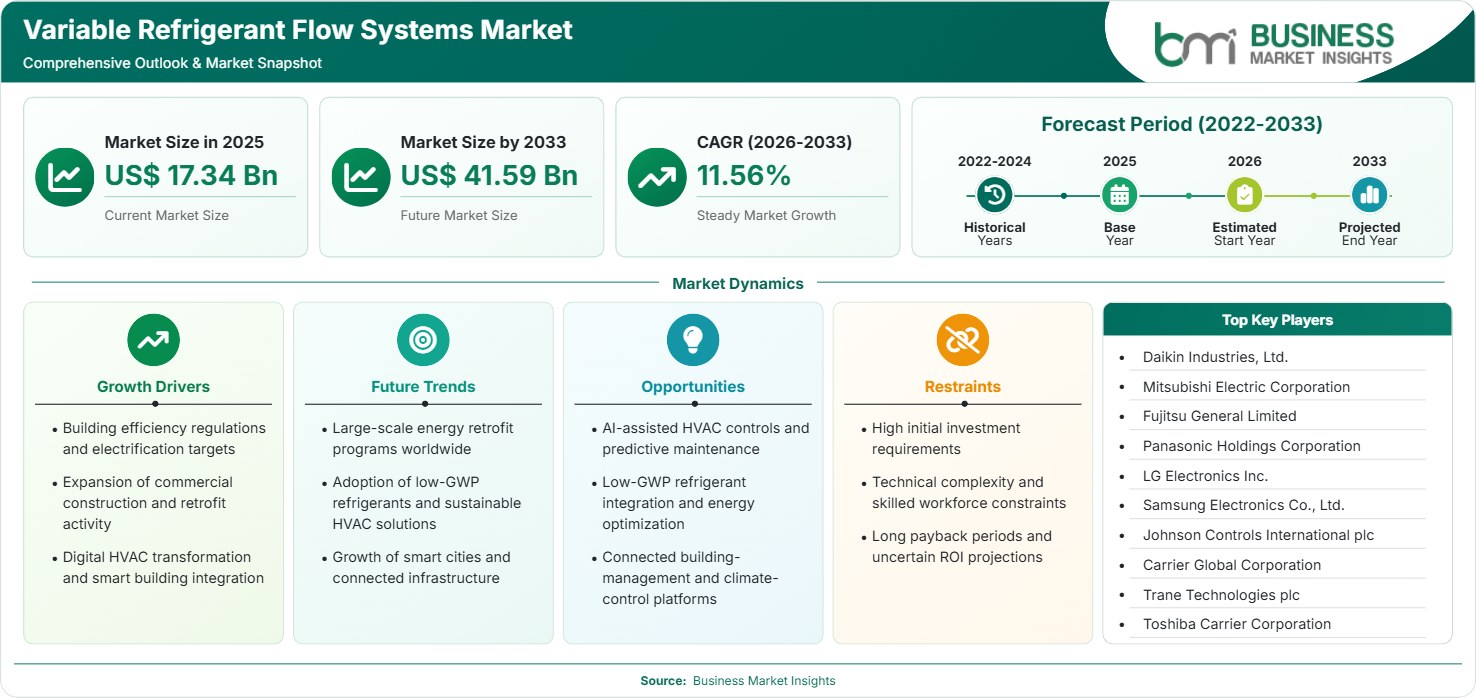
The Variable Refrigerant Flow Systems Market size was valued at US$ 17.34 Billion in 2025 and is projected to reach US$ 41.59 Billion by 2033, growing at a CAGR of 11.56% during 2026–2033, driven by energy-efficient HVAC adoption, green building investments, smart controls integration, retrofit demand, and stricter building performance regulations creating opportunities across residential, commercial, and industrial facilities.

Report Coverage
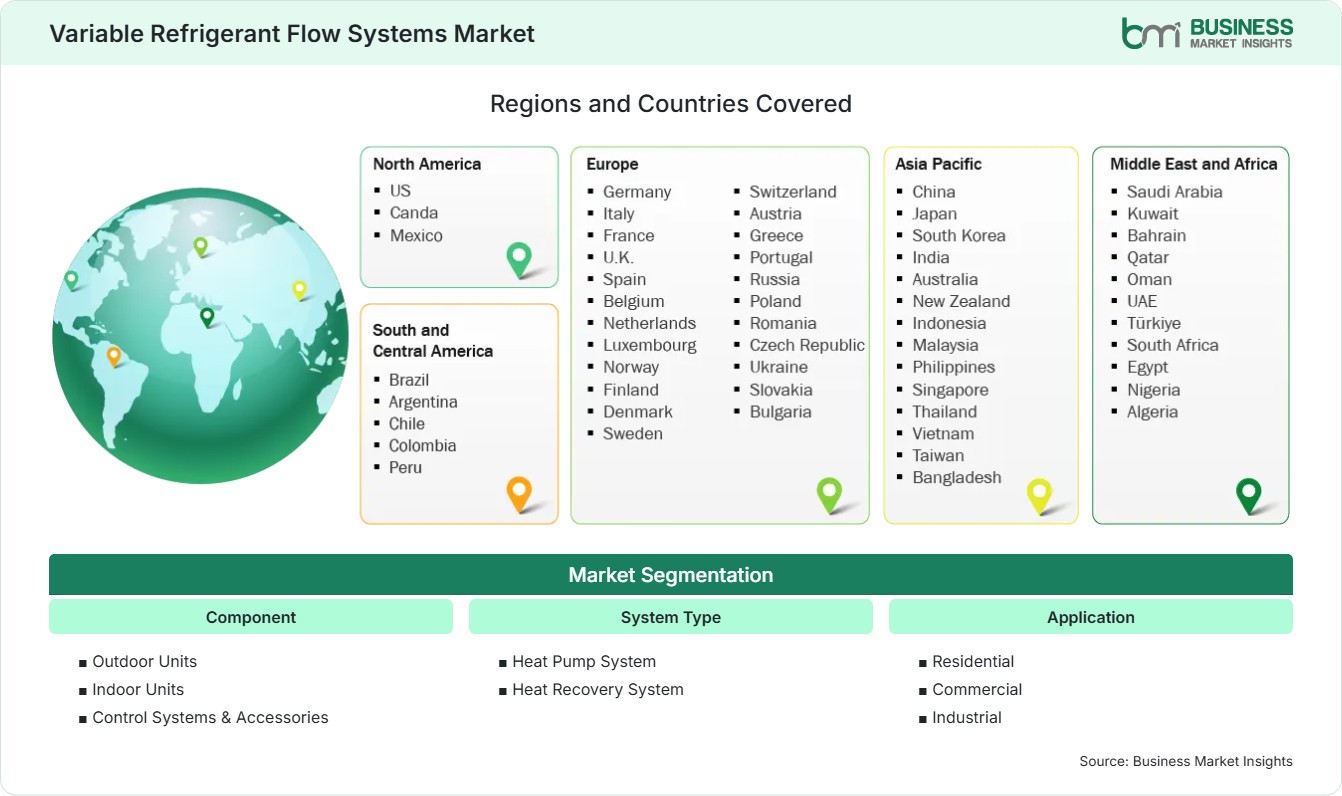
  • Component: Outdoor Units, Indoor Units, Control Systems & Accessories
  • System Type: Heat Pump System, Heat Recovery System
  • Application: Residential, Commercial, Industrial
US$ 17.34 Bn Market size in 2025
US$ 41.59 Bn Market Size by 2033
11.56% CAGR, 2026 - 2033
2026-2033 Forecast Period

AI Overview

Variable Refrigerant Flow Systems Market Summary

  • North America Region: Holds a market share of 22%–25% in 2025, growing at a CAGR of 10.0%–11.0% during 2026–2033. Key drivers include building decarbonization mandates, replacement of aging HVAC infrastructure, and smart-building investments. Opportunities arise from energy retrofits, low-GWP refrigerants, and demand for connected climate-control platforms across commercial assets. The U.S. market benefits from commercial retrofits, electrification initiatives, and institutional construction spending, advancing at 10.2%–11.2% CAGR.
  • Fastest Growing Region: Asia Pacific holds 44%–47% market share in 2025 and expands at 12.5%–13.5% CAGR during 2026–2033. Drivers include urbanization, high-rise construction activity, manufacturing expansion, and stringent efficiency requirements. Opportunities emerge from smart-city projects, residential upgrades, and deployment of advanced inverter-based cooling technologies.
  • Leading Segment: Commercial accounts for 46%–49% share in 2025 and grows at 11.0%–12.0% CAGR through 2033. Demand is supported by office, hospitality, healthcare, and retail projects. Opportunities stem from multi-zone climate management, energy optimization targets, and integrated building automation deployments.
  • High Growth Segment: Heat Recovery System represents 31%–34% share in 2025 and records 12.5%–13.5% CAGR through 2033. Growth is supported by simultaneous heating and cooling requirements, energy savings, occupancy flexibility, and expanding adoption in premium commercial developments and institutional facilities.
  • Key Market Opportunity: Large-scale retrofit programs targeting energy-intensive buildings create attractive demand for advanced climate systems, enabling lifecycle cost reductions, emissions compliance, smarter controls integration, and stronger facility performance outcomes.
  • Major Market Players: Daikin Industries, Ltd.; Mitsubishi Electric Corporation; Fujitsu General Limited; Panasonic Holdings Corporation; LG Electronics Inc.; Samsung Electronics Co., Ltd.; Johnson Controls International plc; Carrier Global Corporation; Trane Technologies plc; Toshiba Carrier Corporation.
Strategic Insights

Variable Refrigerant Flow Systems Market: Strategic Insights

Variable Refrigerant Flow Systems Market Strategic Framework
FREE PDF
Request your free sample
Request free sample
Stakeholder View

Key Takeaways

  • Supply chains are increasingly integrating compressors, electronics, controls, refrigerants, and software platforms, making vertically integrated manufacturers more resilient to cost volatility.
  • Heat recovery solutions and retrofit projects offer substantial upside as building owners prioritize energy savings and carbon reduction goals.
  • Product innovation is moving toward AI-assisted controls, predictive maintenance, occupancy sensing, and cloud-based asset monitoring capabilities.
  • India, Southeast Asia, and Gulf Cooperation Council countries present compelling investment potential because of accelerating infrastructure expansion and energy-efficiency initiatives.
  • Strategic acquisitions focus on controls technologies, building automation portfolios, and aftermarket service networks that enhance recurring revenue streams.
  • Demand from healthcare, hospitality, education, and mixed-use real estate projects is increasing adoption of multi-zone climate management systems.
Geographic Outlook

Variable Refrigerant Flow Systems Market Regional Highlights

North America Variable Refrigerant Flow Systems Market

North America accounts for 22%–25% Variable Refrigerant Flow Systems Market share in 2025 and is projected to expand at 10.0%–11.0% CAGR through 2033. Adoption is supported by building modernization programs, electrification strategies, and increasing demand for energy-efficient HVAC technologies. Commercial retrofits remain a major revenue contributor, particularly in offices, educational institutions, and healthcare facilities. Advanced controls integration and regulatory focus on emissions reduction further strengthen market penetration across major metropolitan areas.

  • Commercial building retrofits continue accelerating adoption of multi-zone climate systems that reduce operating costs and support sustainability targets.
  • Growing adoption of smart-building platforms enhances system monitoring, predictive maintenance, and energy optimization capabilities.
  • Institutional projects in healthcare and education sectors contribute stable procurement demand and long-term service opportunities.
  • Regulatory emphasis on decarbonization supports replacement of conventional HVAC systems with efficient alternatives.

US Variable Refrigerant Flow Systems Market

The United States represents 78%–82% of North American revenue and advances at 10.2%–11.2% CAGR. Rising renovation investments, commercial building upgrades, and energy-performance requirements support sustained equipment deployment. Market demand benefits from expanding awareness of lifecycle cost savings and HVAC electrification strategies. Increased specification within mixed-use developments and premium residential projects reinforces growth prospects across diverse climate zones.

  • Federal and state efficiency incentives encourage adoption of advanced HVAC technologies in public and private facilities.
  • Smart controls integration improves operational visibility and supports demand-response initiatives.
  • Data-driven facility management approaches increase preference for connected climate-control infrastructure.
  • Developers increasingly select flexible systems suitable for phased expansion and variable occupancy patterns.

Europe Variable Refrigerant Flow Systems Market

Europe accounts for 24%–27% share in 2025 and records 10.8%–11.8% CAGR through 2033. The region benefits from stringent efficiency regulations, renovation mandates, and decarbonization objectives. Germany remains the leading market, while Eastern European countries exhibit faster adoption rates. Demand is concentrated within commercial buildings, hospitality facilities, and institutional developments requiring precise temperature management and improved energy performance.

  • Germany leads regional demand, supported by energy-efficiency investments and commercial infrastructure modernization.
  • Poland emerges among faster-growing markets with expanding commercial construction and industrial investments.
  • Low-emission building requirements promote adoption of advanced HVAC architectures across urban centers.
  • Building owners increasingly prioritize operating-cost reductions through intelligent climate management.
  • Retrofit activity remains a major growth engine across mature real-estate portfolios.

Asia Pacific Variable Refrigerant Flow Systems Market

Asia Pacific holds 44%–47% share in 2025 and achieves 12.5%–13.5% CAGR, making it the fastest-growing region. China, Japan, South Korea, and India represent key markets supported by urbanization and infrastructure development. Strong residential construction, commercial real-estate investment, and manufacturing expansion encourage deployment of efficient cooling technologies. The region also benefits from extensive local manufacturing ecosystems and rapid smart-building adoption.

  • China remains the largest regional market supported by extensive construction and HVAC manufacturing capabilities.
  • India ranks among the fastest-growing countries due to commercial expansion and rising cooling requirements.
  • Smart-city programs generate demand for connected building-management technologies and energy-efficient climate systems.
  • Residential high-rise construction supports increasing installation volumes across major urban centers.
  • Industrial facilities adopt advanced systems to enhance occupant comfort and operational efficiency.

Rest of World Variable Refrigerant Flow Systems Market

Rest of World contributes 8%–10% share in 2025 and expands at 11.5%–12.5% CAGR. South and Central America benefit from commercial construction and hospitality investments, while Middle East and Africa markets are driven by infrastructure projects and cooling-intensive climates. Saudi Arabia and the United Arab Emirates lead regional demand, whereas Brazil demonstrates accelerating adoption supported by modernization initiatives and urban development.

  • Gulf economies invest heavily in large-scale commercial and mixed-use developments requiring advanced HVAC systems.
  • Brazil benefits from growing awareness of energy-efficient cooling technologies within commercial properties.
  • Tourism and hospitality projects strengthen equipment demand across several regional markets.
  • Infrastructure diversification strategies support long-term project pipelines.
  • High cooling loads make lifecycle energy savings a critical purchasing consideration.
Global Market Geography
FREE PDF
Request your free sample
Request free sample
Segment Analysis

Variable Refrigerant Flow Systems Market Segmentation

Component

Component segment is led by outdoor units, while integrated controls record strong momentum. The segment accounts for approximately 100% of equipment deployment architecture, with outdoor units contributing the largest revenue share. Growth remains aligned with overall market expansion at 11.0%–12.0% CAGR. Variable Refrigerant Flow Systems Market scope continues expanding as digital controls improve operational intelligence and support energy optimization objectives.

  • Outdoor Units: Core system component housing compressors and heat-exchange functions. Demand benefits from higher-capacity installations, energy-efficiency upgrades, and commercial construction projects requiring scalable climate-control infrastructure.
  • Indoor Units: Adoption grows through flexible zoning requirements across offices, hospitality properties, healthcare facilities, and residential complexes seeking customized thermal comfort management.
  • Control Systems & Accessories: Increasingly important as building owners prioritize remote monitoring, predictive maintenance, occupancy-based control, and integration with automation platforms.

System Type

Heat pump systems maintain the leading revenue position with 56%–59% share in 2025, while heat recovery systems achieve the strongest growth trajectory at 12.5%–13.5% CAGR. Variable Refrigerant Flow Systems Market trends increasingly favor advanced energy-management capabilities and simultaneous heating-cooling functionality across complex commercial environments.

  • Heat Pump System: Widely adopted due to cost efficiency, straightforward installation, and suitability across residential and commercial applications requiring dependable climate management.
  • Heat Recovery System: Gains traction in multi-zone buildings where simultaneous heating and cooling deliver superior energy utilization and operational flexibility.

Application

Commercial remains dominant with 46%–49% share in 2025 and 11.0%–12.0% CAGR, supported by offices, healthcare, hospitality, and retail infrastructure. Residential applications demonstrate accelerating adoption, while industrial environments increasingly deploy advanced systems for occupant comfort and energy management. The Variable Refrigerant Flow Systems Market size benefits from broadening application diversity.

  • Residential: Growing consumer preference for efficient climate control, compact system designs, and lower operating expenses strengthens installation activity.
  • Commercial: Demand is driven by flexible zoning, energy savings, and compatibility with intelligent building-management platforms.
  • Industrial: Facilities adopt advanced HVAC technologies to improve workforce comfort, support administrative areas, and achieve efficiency objectives.
Market Forces

Variable Refrigerant Flow Systems Market Dynamics

Key Market Drivers

Building Efficiency Regulations and Electrification Targets

Governments across North America, Europe, and Asia are strengthening energy-performance standards for buildings, encouraging the adoption of efficient HVAC technologies. The International Energy Agency highlights buildings as a major energy-consuming sector, prompting regulatory emphasis on improved cooling efficiency. Variable Refrigerant Flow Systems Market trends are driven by their ability to provide zone-based temperature control and reduced electricity use compared to many traditional options. There is an increase in the trend of integrating new developments with green building certifications and the objective of reducing carbon emissions. The demand is especially high in commercial renovations.

Expansion of Commercial Construction and Retrofit Activity

Global investment in offices, healthcare facilities, educational campuses, hospitality projects, and mixed-use developments continues creating demand for flexible climate-control infrastructure. Variable Refrigerant Flow Systems Market growth can be attributed to retrofit projects aimed at HVAC systems that are old and inefficient in terms of their efficiency. There has been an increased trend where facility owners assess life-cycle costs of the equipment and not only the cost of acquisition as far as the solutions that can reduce maintenance needs and increase efficiency are concerned.

Digital HVAC Transformation and Smart Building Integration

The convergence of IoT sensors, cloud analytics, AI-based controls, and predictive maintenance platforms is reshaping HVAC procurement decisions. The need for systems that can monitor in real time, automatically diagnose issues and manage climate control in accordance with the number of occupants in the building is growing among building managers. Integrated control increases visibility and improves asset efficiency while minimizing disruptions. Equipment vendors are increasingly developing ecosystems around their equipment portfolio, thus creating repeat business opportunities and retaining customers. The connected building environment trend will continue to be an important driver.

Key Market Opportunities

Large-Scale Energy Retrofit Programs Worldwide

A substantial portion of the global building stock was constructed before modern energy-performance standards became common practice. These facilities represent a significant replacement opportunity as governments and property owners pursue emissions reductions and operational savings. Variable Refrigerant Flow Systems Market Forecasts indicate retrofit will continue to be one of the important investment trends since modern equipment allows lowering energy consumption without causing any disturbances during installation. Commercial offices, education institutions, hotels, and hospitals are especially promising sectors. Companies able to provide financial partnership, energy audits, and other services may enhance their competitive advantage.

Adoption of Low-GWP Refrigerants and Sustainable HVAC Solutions

Regulatory pressure surrounding refrigerant emissions is accelerating interest in environmentally preferable alternatives. By adopting low global warming potential refrigerants, manufacturers can set their products apart from competitors and meet the changing demands of sustainability. Property managers are taking environmental performance into account when making purchasing decisions, especially for high-profile projects aiming for top certifications. HVAC product lines featuring efficient compressors, smart controls, and low global warming potential refrigerants are seen as the future.

Growth of Smart Cities and Connected Infrastructure

Smart-city development strategies increasingly incorporate digital building-management systems, energy monitoring platforms, and intelligent infrastructure. Climate control systems that can interoperate with larger urban technology ecosystems are well positioned to meet demand. The construction of new business areas, transportation centers, hospitals, and universities would need a system that ensures efficiency and convenience for people. Suppliers providing products with features such as interoperability, security, and data analysis can definitely benefit from the growing infrastructure spending pipeline in APAC, ME, and select European countries.

Market Restraints and Challenges

High Initial Investment Requirements

Factor: The high cost of the systems is attributable to the advanced nature of their designs, their complex installation methods, and other aspects such as the need for efficient control systems. This can be costly in the beginning because of factors like procurement, installation, and integration. Such costs may pose a problem especially to consumers who do not have ample funds.

Impact: The high initial capital investment could dissuade the cost-conscious consumers, both in small businesses and home settings, from making any quick purchases, despite promising energy savings in the future. The adoption process would be hampered by the financing considerations, payback period considerations, and limited construction budgets, especially in developing countries. It is therefore up to the sellers to prove their worthiness in terms of saving energy, reducing operational costs, maintenance, and offering better returns on investments to make up for the higher initial capital outlay.

Technical Complexity and Skilled Workforce Constraints

Factor: The design, installation, commissioning, refrigerant management, controls integration, and software configuration of advanced cooling and energy systems require specialized engineering expertise and a well-trained technical workforce. Increasing system sophistication also requires technicians to understand advanced control technologies, energy-management systems, and evolving equipment standards. However, shortages of qualified technicians and engineers in several regions can make it difficult for companies to support growing deployment requirements.

Impact: Shortage of skilled personnel may lead to prolonged project implementation, higher costs of installation and service, and even problems with performance and quality. The constant technological progress necessitates training, certification, and education. In areas lacking in technological infrastructure, fears concerning maintenance and technical support may hold customers back from using modern systems. Development of training, certification, technical support, and channel partner programs is thus crucial for high-quality installation and further market deployment.

Company Analysis

Competitive Landscape

Variable Refrigerant Flow Systems Market analysis indicates competition is shaped by technology leadership, distribution reach, software capabilities, service networks, and efficiency-focused product innovation.

Company Name

Overview

Products and Services relevant to this market

Daikin Industries, Ltd.

Global HVAC leader with extensive VRV/VRF expertise, broad manufacturing footprint, and strong innovation capabilities.

VRV systems, compressors, controls, building-management integration, service and maintenance solutions.

Mitsubishi Electric Corporation

Major climate-control provider focused on energy efficiency and advanced commercial HVAC technologies.

CITY MULTI VRF systems, controls, heat recovery technologies, monitoring solutions.

Fujitsu General Limited

Specialist HVAC manufacturer serving residential and commercial infrastructure worldwide.

VRF systems, indoor units, outdoor units, control platforms, aftermarket services.

Panasonic Holdings Corporation

Diversified electronics and HVAC supplier emphasizing connected and efficient cooling technologies.

VRF equipment, smart controls, energy-management technologies, commercial HVAC solutions.

LG Electronics Inc.

Global electronics company with significant commercial air-conditioning portfolio.

Multi V systems, intelligent controls, cloud monitoring, building integration services.

Samsung Electronics Co., Ltd.

Expanding presence in advanced HVAC through digital and connected solutions.

DVM S systems, controls, remote monitoring, energy optimization platforms.

Johnson Controls International plc

Building technologies specialist integrating HVAC and automation capabilities.

VRF systems, building automation, controls, lifecycle services, analytics tools.

Carrier Global Corporation

Established climate solutions provider with global channel network.

VRF solutions, indoor and outdoor units, digital service offerings, controls.

Trane Technologies plc

Focuses on sustainable climate technologies and high-performance building systems.

Commercial HVAC, controls integration, energy services, efficiency solutions.

Toshiba Carrier Corporation

Joint venture recognized for strong engineering capabilities in advanced HVAC applications.

VRF systems, compressors, controls, commercial climate-management solutions.

Trust & Transparency

Research Methodology

The market analysis combines proprietary research with secondary data from government agencies, company disclosures, regulatory filings, industry databases and expert interviews. Market estimates are validated through data triangulation, cross-market benchmarking and analyst review.

View Full Research Methodology

Questions Answered

Frequently Asked Questions

What insights does a Variable Refrigerant Flow Systems Market Report provide?

It delivers assessment of competitive dynamics, technology evolution, segment opportunities, regional demand patterns, investment trends, and future industry positioning.

How are digital technologies influencing purchasing decisions?

IoT connectivity, predictive maintenance, cloud monitoring, and AI-driven controls help operators improve performance visibility and reduce maintenance disruptions.

What makes heat recovery systems attractive?

Heat recovery designs enable simultaneous heating and cooling in different zones, improving energy utilization and operational flexibility in complex facilities.

Which application area generates the highest revenue contribution?

Commercial buildings generate the highest revenue contribution because they require flexible zoning, large-scale climate control, and integrated building-management capabilities.

What factors are creating long-term demand for advanced VRF systems?

Demand is supported by energy-efficiency regulations, commercial retrofits, smart-building adoption, urbanization, and rising emphasis on lifecycle operating-cost optimization.

Access the Full Variable Refrigerant Flow Systems Market Report

Get segment-level forecasts, regional estimates, competitive benchmarking, company profiles and downloadable Excel datasets.

Access the full Variable Refrigerant Flow Systems Market Report
350 pages PDF & Excel | 2026-08-28