
Vanadium Market Outlook: Size, Share, Trends, Growth Analysis, Competitive Landscape & Forecast, 2026-2033

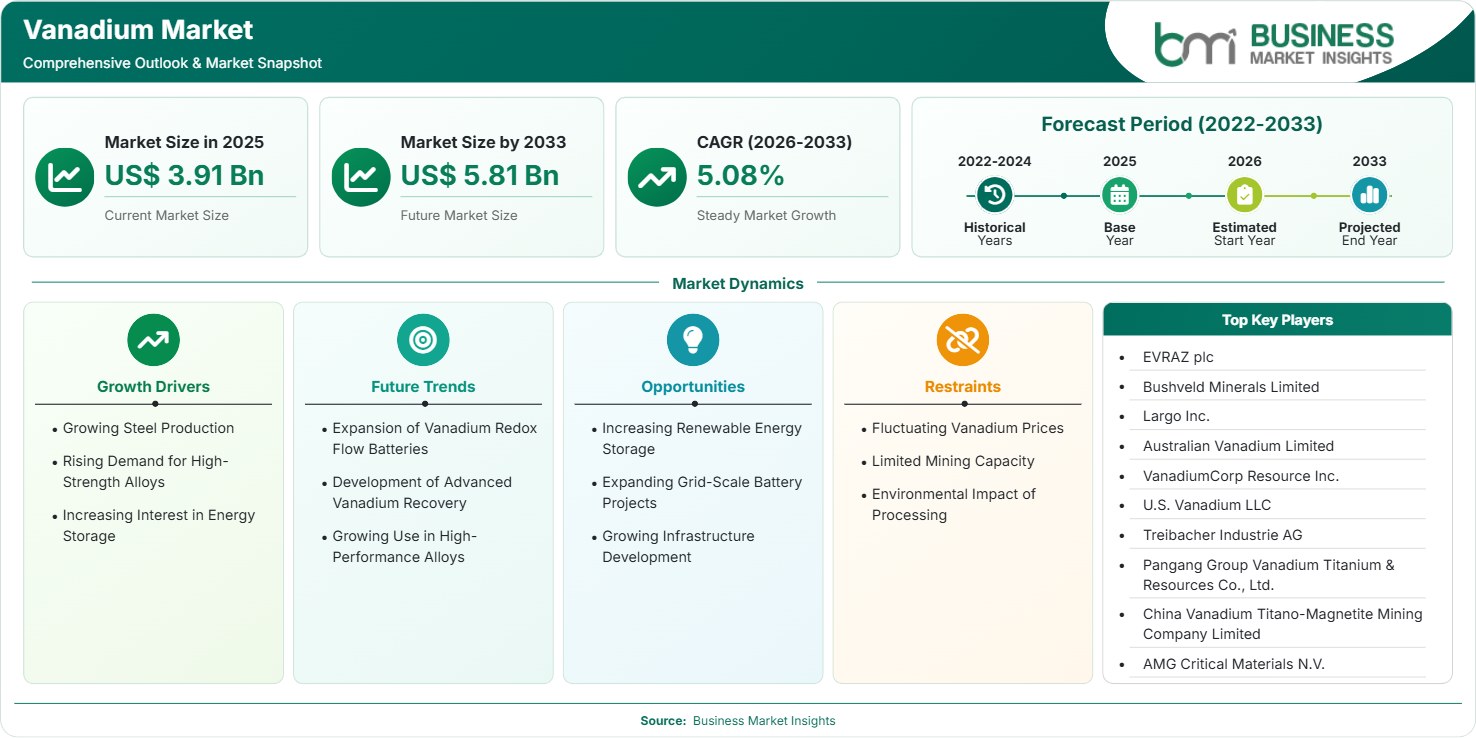
The Vanadium Market size was valued at US$ 3.91 billion in 2025 and is projected to reach US$ 5.81 billion by 2033, growing at a CAGR of 5.08% during 2026–2033. Rising steel production, demand for high-strength alloys, expanding energy storage applications, infrastructure development, and supply-chain diversification are supporting market expansion.

Report Coverage
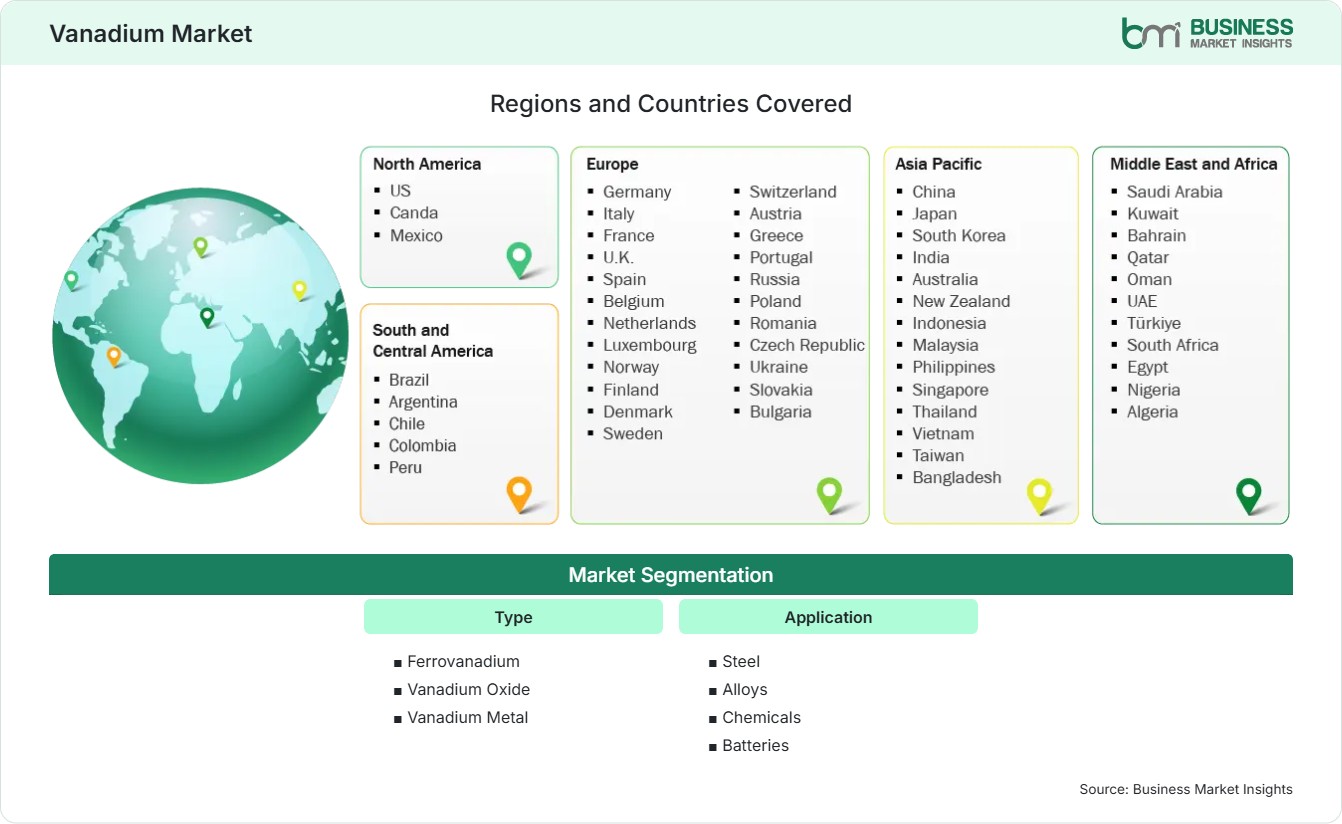
  • Type: Ferrovanadium, Vanadium Oxide, Vanadium Metal
  • Application: Steel, Alloys, Chemicals, Batteries
US$ 3.91 Bn Market size in 2025
US$ 5.81 Bn Market Size by 2033
5.08% CAGR, 2026 - 2033
2026-2033 Forecast Period

AI Overview

Vanadium Market Summary

  • North America Region: North America accounts for 12%–14% market share in 2025 and is projected to expand at a CAGR of 4.7%–5.4% during 2026–2033. Steel demand, specialty alloy applications, recycling opportunities, domestic processing, and energy-storage development support regional expansion. The U.S. represents the leading contributor with a CAGR of 4.8%–5.5%, supported by steel applications, specialty materials, supply-chain localization, and emerging storage requirements.
  • Fastest Growing Region: Asia Pacific holds 59%–62% market share in 2025 and is expected to register a CAGR of 5.4%–6.1% during 2026–2033. Expanding steel production, infrastructure development, manufacturing activity, alloy consumption, industrial investment, and emerging battery-storage applications are creating strong regional opportunities.
  • Leading Segment: Ferrovanadium accounts for 54%–58% market share in 2025 and is expected to grow at a CAGR of 4.7%–5.2%, driven by steel microalloying, reinforcing applications, structural steel demand, automotive components, machinery, and high-strength material requirements.
  • High Growth Segment: Batteries represent 8%–12% market share in 2025 and are projected to achieve a CAGR of 10.0%–12.5%, supported by long-duration storage requirements, renewable integration, grid flexibility, electrolyte demand, repeated cycling, and increasing interest in stationary energy-storage systems.
  • Key Market Opportunity: Integration of mining, processing, recycling, electrolyte production, and downstream applications can create additional value opportunities while improving supply reliability and strengthening relationships with steel, chemical, alloy, and battery customers.
  • Major Market Players: EVRAZ plc, Bushveld Minerals Limited, Largo Inc., Australian Vanadium Limited, VanadiumCorp Resource Inc., U.S. Vanadium LLC, Treibacher Industrie AG, Pangang Group Vanadium Titanium & Resources Co., Ltd., China Vanadium Titano-Magnetite Mining Company Limited, and AMG Critical Materials N.V.
Strategic Insights

Vanadium Market: Strategic Insights

Vanadium Market Strategic Framework
FREE PDF
Request your free sample
Request free sample
Stakeholder View

Key Takeaways

  • The industry ecosystem includes miners, processors, alloy manufacturers, chemical producers, recyclers, battery-material suppliers, storage developers, and industrial customers operating across interconnected stages of the value chain.
  • Ferrovanadium remains the largest opportunity because steel represents the established consumption base, while battery applications provide the strongest incremental growth pathway as long-duration storage adoption develops.
  • Product innovation is increasingly focused on higher-purity materials, efficient processing, electrolyte-ready vanadium products, recycling-derived feedstocks, and application-specific solutions that can improve downstream performance.
  • Asia Pacific provides the strongest regional opportunity because of its large steel and manufacturing ecosystem, while North America offers attractive opportunities in supply diversification, processing, recycling, and storage applications.
  • Investment strategies increasingly favor integrated businesses capable of connecting resources with processing, specialty products, recycling, and downstream customer relationships rather than depending entirely on primary material sales.
  • Competitive positioning will increasingly depend on reliable feedstock, consistent product specifications, cost-efficient processing, downstream partnerships, recycling capabilities, and the ability to serve both established and emerging applications.
Geographic Outlook

Vanadium Market Regional Highlights

North America Vanadium Market

North America represents 12%–14% Vanadium Market share in 2025 and is expected to grow at a CAGR of 4.7%–5.4% during 2026–2033. The region benefits from established steel consumption, specialty alloy applications, processing capabilities, recycling potential, and emerging energy-storage requirements. The United States remains the dominant market because of its industrial base and downstream demand. Canada contributes through resource development, processing opportunities, and potential supply diversification for regional customers.

  • Steel applications remain the principal regional demand base, particularly across structural products, automotive components, machinery, infrastructure, and industrial equipment requiring stronger and more durable materials.
  • Recycling provides an additional supply pathway by recovering suitable vanadium-bearing materials from industrial residues and supporting greater utilization of existing resources.
  • Canadian resource development creates opportunities for upstream diversification where projects can establish suitable processing capabilities and secure long-term downstream customer relationships.
  • Energy-storage development provides an emerging demand pathway for electrolyte materials, particularly where long-duration operation and repeated cycling are commercially important.

US Vanadium Market

The United States contributes 72%–78% of North American revenue and is projected to register a CAGR of 4.8%–5.5% during 2026–2033. Strong industrial activity, steel consumption, specialty alloy demand, recycling opportunities, and emerging storage applications continue supporting market development. Domestic processing and downstream conversion can strengthen supply-chain resilience while enabling suppliers to establish closer relationships with steelmakers, specialty-material manufacturers, chemical producers, and energy-storage developers.

  • Steel remains the principal consumption pathway, supported by applications requiring enhanced strength, durability, and controlled material performance across multiple industrial sectors.
  • Recycling can supplement primary supply by recovering vanadium from suitable industrial residues, creating opportunities for specialized recovery and processing businesses.
  • Battery applications provide an emerging opportunity for electrolyte suppliers, storage developers, system integrators, and vanadium producers capable of coordinating material availability with project requirements.

Europe Vanadium Market

Europe accounts for 15%–17% Vanadium Market share in 2025 and is projected to grow at a CAGR of 4.2%–5.0% during 2026–2033. Germany, France, Italy, Spain, and the United Kingdom provide important demand centers across steel, alloys, chemicals, and emerging storage applications. Germany is expected to grow at 4.4%–5.2% CAGR, while Spain can achieve 5.0%–5.8% CAGR. Advanced manufacturing, infrastructure requirements, recycling, material efficiency, and supply diversification support regional opportunities.

  • European steel producers can increase consumption of vanadium-containing materials as manufacturers seek stronger grades for construction, transportation, machinery, and industrial equipment.
  • Germany provides a strong downstream opportunity because of its manufacturing ecosystem and demand for consistent specialty materials used in technically demanding industrial applications.
  • Spain offers a high-growth opportunity through infrastructure development, renewable deployment, grid flexibility requirements, and potential adoption of long-duration energy-storage systems.
  • France, Italy, and the United Kingdom provide additional opportunities across specialty materials, chemicals, industrial manufacturing, and emerging energy-storage applications.

Asia Pacific Vanadium Market

Asia Pacific holds 59%–62% Vanadium Market share in 2025 and is expected to achieve the fastest 5.4%–6.1% CAGR during 2026–2033. China represents the dominant industrial ecosystem, while India offers strong incremental growth potential. India is expected to achieve 6.0%–6.8% CAGR, supported by steel production, infrastructure, industrialization, and manufacturing. Japan, South Korea, and Southeast Asia contribute through advanced manufacturing, specialty steel, chemicals, construction, and emerging energy-storage applications.

  • China remains strategically important because integrated industrial capabilities support vanadium processing, steel alloying, specialty materials, and downstream manufacturing applications.
  • India provides strong incremental opportunity as infrastructure development, steel production, industrialization, and transportation requirements increase demand for stronger and more durable materials.
  • Japan and South Korea contribute through advanced manufacturing and specialty steel applications where controlled specifications, consistent purity, and technical performance influence material selection.
  • Southeast Asia represents an emerging opportunity as industrialization, construction, manufacturing expansion, renewable deployment, and energy-storage requirements increase.

Rest of World Vanadium Market

South and Central America together account for 8%–10% share in 2025, with a projected 5.0%–5.7% CAGR during 2026–2033. Brazil represents the leading regional opportunity because of its resource potential and downstream development prospects. Infrastructure, steel consumption, industrialization, and resource investment can support additional demand.

The Middle East and Africa account for 6%–8% share in 2025, growing at a 4.8%–5.6% CAGR. South Africa offers resource and processing opportunities, while Gulf economies provide potential demand through industrial diversification, infrastructure development, renewable deployment, and energy-storage projects.

  • Brazil provides an important supply and investment opportunity because integrated resource development can strengthen control over processing, product quality, and downstream relationships.
  • South Africa remains relevant because its resource base and processing potential can support primary production and development of higher-value vanadium products.
  • Gulf economies offer emerging opportunities as industrial diversification, infrastructure investment, renewable energy, and grid modernization create potential applications for specialty materials and storage.
  • Other Latin American markets can expand downstream demand through construction, transportation, infrastructure, industrial equipment, and steel-intensive development projects.
Global Market Geography
FREE PDF
Request your free sample
Request free sample
Segment Analysis

Vanadium Market Segmentation

Type

The Type segment is led by ferrovanadium, which accounted for 54%–58% share in 2025 and is projected to expand at a CAGR of 4.7%–5.2% during 2026–2033. Ferrovanadium remains closely tied to steelmaking, while vanadium oxide and metal serve chemical, alloy, specialty, and emerging energy-storage requirements. Product selection depends on purity, processing economics, customer specifications, and downstream application requirements.

  • Ferrovanadium: Ferrovanadium remains the principal alloying product because it efficiently introduces vanadium into steel, supporting reinforcing products, structural grades, automotive components, machinery, and high-strength industrial applications.
  • Vanadium Oxide: Vanadium oxide serves as an important intermediate for chemical applications, specialty materials, processing requirements, and battery-related uses, with demand influenced by purity and downstream conversion capabilities.
  • Vanadium Metal: Vanadium metal addresses specialized applications requiring metallic or high-purity material, including advanced alloys and technically demanding industrial uses where performance requirements support higher-value products.

Application

The Application segment is led by steel, which accounted for 70%–74% share in 2025 and is projected to expand at a CAGR of 4.4%–4.9% during 2026–2033. Steel provides the largest established demand base, while alloys and chemicals support specialized consumption. Batteries represent the fastest-growing application as energy-storage requirements create a separate downstream opportunity and encourage greater diversification among producers and processors.

  • Steel: Steel remains the largest application because vanadium improves selected material properties and supports construction, infrastructure, automotive, transportation, machinery, and industrial equipment applications.
  • Alloys: Alloys use vanadium to improve strength, hardness, temperature performance, and durability, supporting specialized products where controlled mechanical properties are important.
  • Chemicals: Chemicals include specialty vanadium compounds and industrial formulations, with demand influenced by purity requirements, processing capabilities, and downstream manufacturing applications.
  • Batteries: Batteries represent the strongest emerging application because vanadium-based flow systems can support long-duration stationary storage, repeated cycling, scalable configurations, and renewable-power integration.
Market Forces

Vanadium Market Dynamics

Key Market Drivers

Growing Steel Production

Steel remains the foundational demand driver because vanadium is widely used as an alloying element where strength, toughness, durability, and controlled mechanical performance are required. Construction, transport, infrastructural development, machinery, and manufacturing create cyclical demands for ferrovanadium. The emergence of stronger steel grades promotes alloy optimization owing to the need for high performance and material efficiency. This provides an impetus for Vanadium Market growth in existing uses of steel. Demand becomes even more stable in cases where steel producers have the need for dependable and specified alloy materials. There is also room for creating long-term business ties among producers and their buyers on account of the correlation between steel production and consumption of vanadium.

Rising Demand for High-Strength Alloys

High-strength alloys are gaining importance as manufacturers seek improved mechanical performance, lower material requirements, longer service life, and greater reliability. Vanadium contributes to these objectives through careful alloying and microstructure enhancement, which creates an increasing demand for vanadium in the automotive, aerospace, construction, machine tools, and industrial equipment industries. Clients need specific standards and dependable performance, thus prompting suppliers to enhance their technical capabilities and efficiency in the manufacturing processes. Vanadium Market trends have therefore begun shifting towards customized products and high value-added products. Suppliers understand the downstream needs will be better able to cater for client demands.

Increasing Interest in Energy Storage

Energy storage is creating a distinct demand pathway because vanadium-based flow systems can support applications requiring long-duration operation, repeated cycling, and scalable energy capacity. Unlike the typical steel consumption, the need for batteries calls for collaboration among material providers, electrolyte makers, storage developers, system integrators, and project owners. The energy storage projects may also motivate the companies to produce better-quality materials and conversion technologies downstream. Increased focus on renewable power and grid flexibility creates an enabling environment for such innovations. The potential will remain contingent upon project economics, customer needs, technology choice, and electrolyte supply.

Key Market Opportunities

Increasing Renewable Energy Storage

Renewable-energy expansion is creating demand for storage systems capable of shifting electricity availability across different periods. Vanadium-based flow technology systems can serve selected long-duration needs where cycling ability, scaleability, and flexibility are factors. The Vanadium Market Forecast from electrolyte production to systems integration, project development, maintenance, and recycling. Manufacturers can add further value by taking their operations further down the chain instead of selling just the refined materials. Long-term electrolyte deals may also provide more stable demand than commoditized sales. Those companies that have integrated supply chains can enhance material reliability along with customer security.

Expanding Grid-Scale Battery Projects

Grid-scale battery projects create opportunities to diversify vanadium consumption by increasing demand for electrolyte materials and associated processing capabilities. Large fixed installations require large quantities of vanadium-containing electrolyte, thus giving rise to possibilities for longer-term sourcing contracts and further collaborations. Economics vary with duration of storage, conditions in the electricity market, financing, technology, and customer needs. Vendors may distinguish themselves with the quality of the product, technical assistance, recycling, and reliability of delivery. Regional processing may help increase efficiency of logistics by minimizing dependency on distant conversion plants. Integrated firms able to deliver vanadium-containing products and help produce electrolyte would have an advantage and be able to take a larger share of the value chain.

Growing Infrastructure Development

Infrastructure development provides a durable opportunity because buildings, bridges, transportation systems, industrial facilities, transmission networks, and urban projects require steel with appropriate strength and durability. Steel containing vanadium can enable applications that take advantage of mechanical strength and allow for efficient utilization of materials and longevity of use. Countries with emerging economies offer a favorable environment since industrialization and urbanization may lead to increased usage of steel in many applications. The suppliers build this potential through aligning vanadium products with the demands of steel producers and developing partnerships with them.

Market Restraints and Challenges

Fluctuating Vanadium Prices

Factor: Vanadium prices can fluctuate because supply availability, steel demand, inventory behavior, production economics, and emerging battery requirements can change purchasing patterns. Impact: Pricing volatility can impact the profitability of manufacturers, increase capital needs, make procurement difficult, and impact the economics of downstream uses. Uncertain pricing may cause purchasers to hold off on purchasing or cut back on stock levels, while those manufacturers with high operational costs may face additional stress in tough times. Market uncertainty can thus be an important factor when producers and downstream users are thinking about capacity, investment, and stock decisions.

Limited Mining Capacity

Factor: Developing new vanadium mining and processing capacity requires resource development, technical assessment, financing, infrastructure, processing expertise, permitting, and downstream customer qualification. Impact: Extended time to develop can limit diversification of supplies and make businesses rely more on existing suppliers. It is essential to show consistency in the quality of feedstocks, efficiency of conversion, favorable economics and product specifications before a project reaches commercialization. Recycling could be used as a tool to mitigate such constraints, but in the case of secondary supply, an appropriate system of collecting materials, technology and incentives have to be in place.

Company Analysis

Competitive Landscape

The competitive environment includes mining companies, processors, alloy manufacturers, specialty-material suppliers, chemical producers, recyclers, and emerging energy-storage participants. Vanadium Market analysis indicates that competitive advantage increasingly depends on feedstock security, processing efficiency, product quality, downstream integration, geographic diversification, recycling capabilities, and customer relationships.

Company Name

Overview

Products and Services relevant to this market

EVRAZ plc

Integrated steel and mining company with vanadium exposure linked to metallurgical and alloying requirements.

Ferrovanadium, vanadium-bearing materials, steel alloying inputs, and related metallurgical products.

Bushveld Minerals Limited

Vanadium-focused company with an integrated resource and processing orientation.

Vanadium products, vanadium oxides, ferrovanadium-related materials, and energy-storage inputs.

Largo Inc.

Integrated vanadium producer focused on resource development and downstream application opportunities.

Vanadium products, vanadium oxides, ferrovanadium-related materials, and battery-related inputs.

Australian Vanadium Limited

Australian company focused on resources, processing, electrolyte production, and storage applications.

Vanadium products, electrolyte materials, processing capabilities, and vanadium-based storage solutions.

VanadiumCorp Resource Inc.

Canadian company focused on vanadium resources and processing technology.

Vanadium-bearing materials, processing technology, high-purity products, and electrolyte-related applications.

U.S. Vanadium LLC

Specialty vanadium supplier serving industrial and emerging energy-storage requirements.

Vanadium pentoxide, vanadium chemicals, electrolyte materials, and specialty vanadium products.

Treibacher Industrie AG

Specialty-materials company with capabilities across chemical and metallurgical applications.

Vanadium chemicals, specialty oxides, alloying materials, and industrial products.

Pangang Group Vanadium Titanium & Resources Co., Ltd.

Integrated producer operating across vanadium and titanium-related resource and processing activities.

Vanadium oxides, ferrovanadium, vanadium chemicals, titanium products, and related materials.

China Vanadium Titano-Magnetite Mining Company Limited

Resource company focused on vanadium-titanium-magnetite materials and associated processing.

Vanadium-bearing concentrates, vanadium products, titanium-related materials, and mining activities.

AMG Critical Materials N.V.

Critical-materials company with vanadium processing and recycling capabilities.

Ferrovanadium, recycled vanadium materials, vanadium processing, and energy-storage-related products.

Trust & Transparency

Research Methodology

The market analysis combines proprietary research with secondary data from government agencies, company disclosures, regulatory filings, industry databases and expert interviews. Market estimates are validated through data triangulation, cross-market benchmarking and analyst review.

View Full Research Methodology

Questions Answered

Frequently Asked Questions

What does the Vanadium Market Report cover?

The report covers market size, regional dynamics, segmentation, product types, applications, drivers, opportunities, restraints, competitive positioning, industry trends, and future growth prospects across the defined market.

Which region provides the strongest growth opportunity?

Asia Pacific provides the strongest growth opportunity because of its large steel and manufacturing base, infrastructure requirements, industrialization, specialty-material demand, and emerging energy-storage applications.

How can producers strengthen their position in the supply chain?

Producers can improve competitiveness through integrated mining and processing, downstream conversion, recycling, specialty-product development, electrolyte manufacturing, diversified customer relationships, and long-term supply arrangements.

Why are batteries becoming an important application?

Vanadium-based flow systems can support long-duration stationary storage and repeated cycling. Their potential use in renewable integration and grid-flexibility applications creates a new downstream demand pathway beyond traditional steel and alloy consumption.

What are the major factors supporting vanadium demand?

Steel production, high-strength alloy requirements, infrastructure development, specialty chemical applications, and emerging energy-storage requirements are the principal factors supporting demand. Steel remains the largest established application, while batteries provide the strongest emerging growth pathway.

Access the Full Vanadium Market Report

Get segment-level forecasts, regional estimates, competitive benchmarking, company profiles and downloadable Excel datasets.

Access the full Vanadium Market Report
350 pages PDF & Excel | 2026-08-19
Similar Research

Related Market Reports