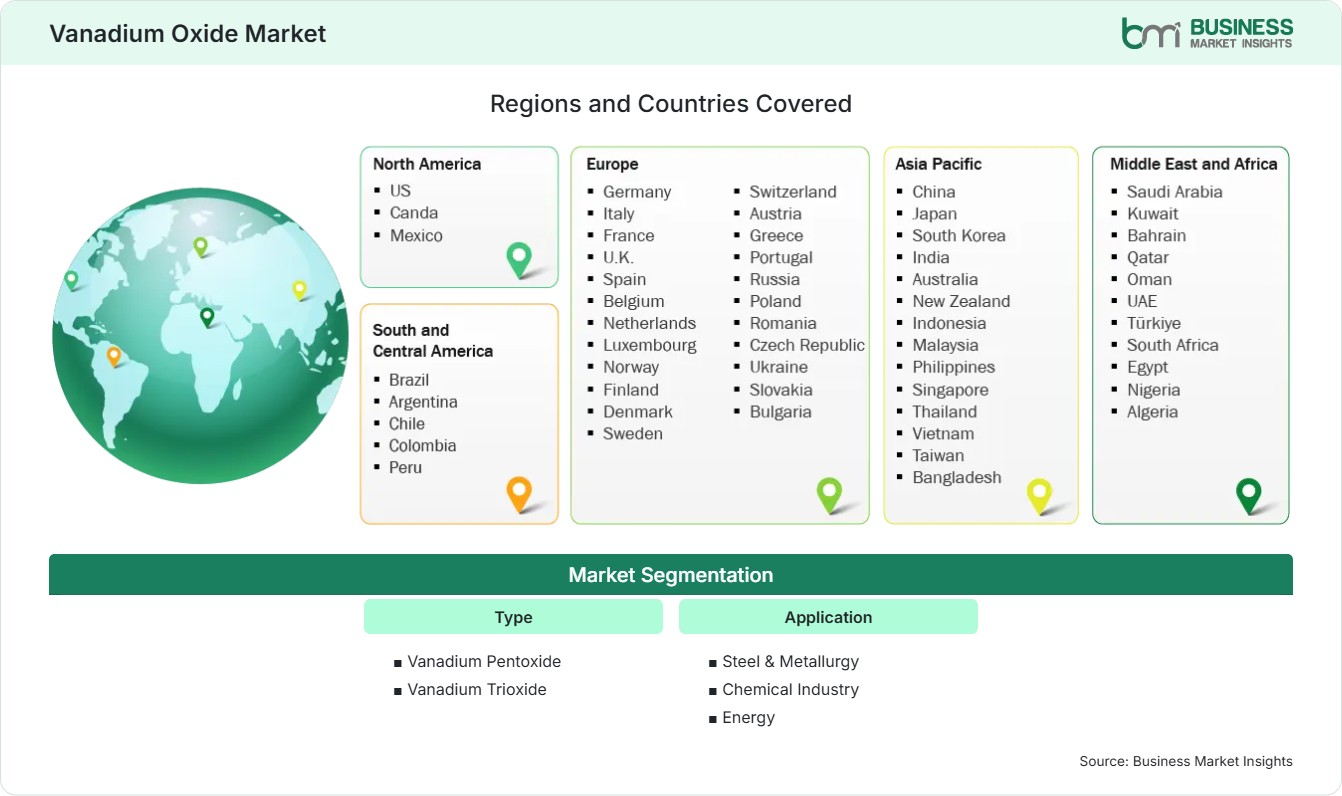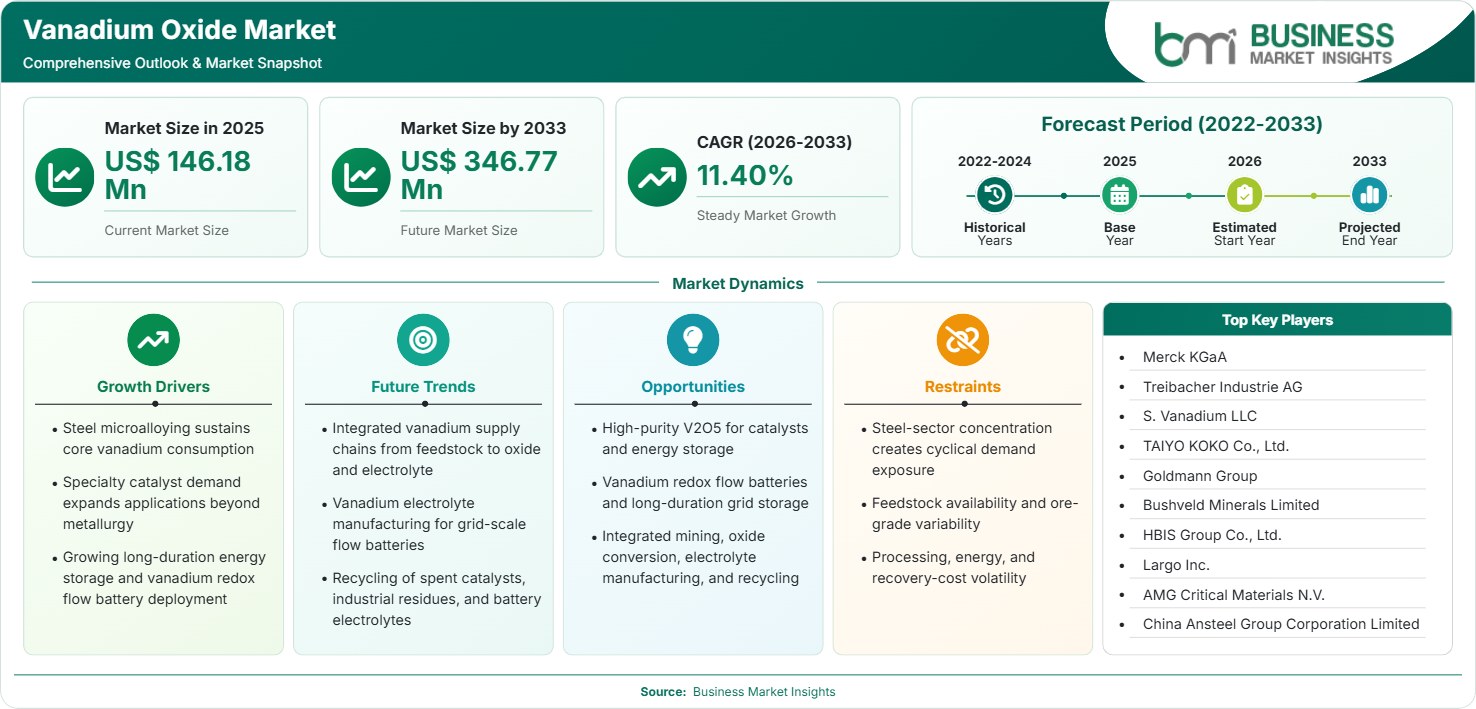
Vanadium Oxide Market Regional Highlights
North America Vanadium Oxide Market
North America represents a 9%–12% share in 2025 and is projected to record a 10.2%–11.5% CAGR during 2026–2033. Demand centers on specialty steels, catalysts, aerospace materials, and energy storage. The region’s strategic focus on critical-mineral security supports localized processing, recycling, and alternative supply arrangements. US demand remains the principal regional contributor, while Canada strengthens the supply side through vanadium resources and project development. Trade policies may increase short-term price volatility but can encourage domestic sourcing and processing capacity.
- US steel demand supports ferrovanadium and V2O5 consumption across infrastructure, automotive, aerospace, and high-strength alloy applications.
- Canadian vanadium resources provide an opportunity to develop Western-aligned supply chains and reduce dependence on concentrated Asian processing.
- Grid-storage developers are evaluating flow batteries where long duration, cycling capability, and safety can offset higher upfront electrolyte costs.
- Domestic recycling can recover vanadium from industrial residues and spent catalysts, improving resource efficiency and creating secondary feedstock streams.
US Vanadium Oxide Market
The US accounts for 70%–75% of the North American Vanadium Oxide Market demand in 2025 and is expected to expand at a 10.5%–11.7% CAGR during 2026–2033. Specialty steel, energy-storage projects, catalyst applications, and strategic sourcing initiatives underpin demand. The market also faces exposure to international pricing and import conditions. Largo’s 2025 disclosures show how tariff conditions can affect high-purity vanadium sales, inventory positioning, and customer economics, reinforcing the value of diversified downstream channels.
- Domestic critical-mineral strategies can encourage investment in processing, recycling, and alternative supply routes, strengthening resilience for steel and energy-storage customers.
- Flow-battery deployment provides incremental demand potential, particularly for utility-scale projects requiring longer discharge durations than conventional short-duration storage systems.
- Aerospace and high-performance alloy applications support higher-value vanadium compounds where impurity control and reliable specifications are critical procurement considerations.
Europe Vanadium Oxide Market
Europe holds an estimated 8%–11% Vanadium Oxide Market share in 2025, with a 9.8%–11.0% CAGR during 2026–2033. Germany leads regional specialty chemical and industrial demand, while the UK and Nordic markets offer opportunities in energy storage and critical-material diversification. France and Italy support downstream alloy and industrial applications. Europe’s high environmental standards encourage catalyst efficiency, recycling, and resource recovery. Treibacher Industrie AG supplies vanadates used in high-temperature SCR and oxidation applications, demonstrating the importance of specialized compounds beyond steel.
- Germany leads industrial applications through specialty chemicals, catalysts, advanced materials, and engineered vanadium compounds used in demanding operating environments.
- The UK presents high-growth potential for energy storage, with policy support for grid flexibility and long-duration storage technologies.
- Nordic countries can support low-carbon processing and recycling initiatives where renewable electricity and circular-material strategies improve project economics.
- France and Italy retain demand across specialty steels, industrial catalysts, and chemical processing, supporting diversified regional consumption beyond energy storage.
Asia Pacific Vanadium Oxide Market
Asia Pacific accounts for 72%–76% of global Vanadium Oxide Market demand in 2025 and is projected to grow at a 11.5%–12.7% CAGR during 2026–2033. China remains the leading regional market because of its steel ecosystem and extensive vanadium processing base. Japan and South Korea contribute through advanced materials and specialty manufacturing. India is a high-growth market supported by infrastructure and steel expansion. China’s energy-storage sector is also becoming an increasingly relevant incremental demand source.
- China’s steel industry remains the principal demand anchor, while vanadium-intensive energy-storage projects can broaden consumption beyond metallurgical applications.
- India offers strong growth potential as infrastructure construction, high-strength steel adoption, and domestic energy-storage requirements increase material demand.
- Japan maintains high-value applications in specialty materials, catalysts, and advanced manufacturing, favoring consistent high-purity oxide specifications.
- South Korea provides opportunities through advanced steel, chemicals, energy-storage technology, and battery-related industrial ecosystems.
Rest of World Vanadium Oxide Market
South and Central America contribute to a 5%–8% Vanadium Oxide Market share in 2025, while the combined Rest of World region is projected to achieve a 10.0%–11.2% CAGR during 2026–2033. Brazil is strategically important because of primary vanadium production and downstream opportunities. Mexico provides steel-linked demand. In the Middle East and Africa, Saudi Arabia and the UAE offer emerging energy-storage opportunities, while South Africa remains strategically important for vanadium resources and processing.
Brazil’s mining base provides supply diversification and creates opportunities for integrated oxide, ferrovanadium, and energy-storage value chains.
South Africa remains a strategically relevant source of vanadium-bearing resources, while Gulf economies offer potential for long-duration storage linked to renewable power expansion.
- Brazil’s primary production capability supports geographically diversified supply, while downstream processing could capture greater value from locally available vanadium resources.
- Mexico’s steel and industrial base provides demand for ferrovanadium-related applications and specialty alloy production.
- Saudi Arabia and the UAE offer potential for flow-battery deployment where renewable integration requires longer-duration grid balancing.
- South Africa’s resource position supports global supply diversification, although project economics remain dependent on processing costs and commodity conditions.