Urinary Incontinence Devices Market Regional Highlights
North America Urinary Incontinence Devices Market
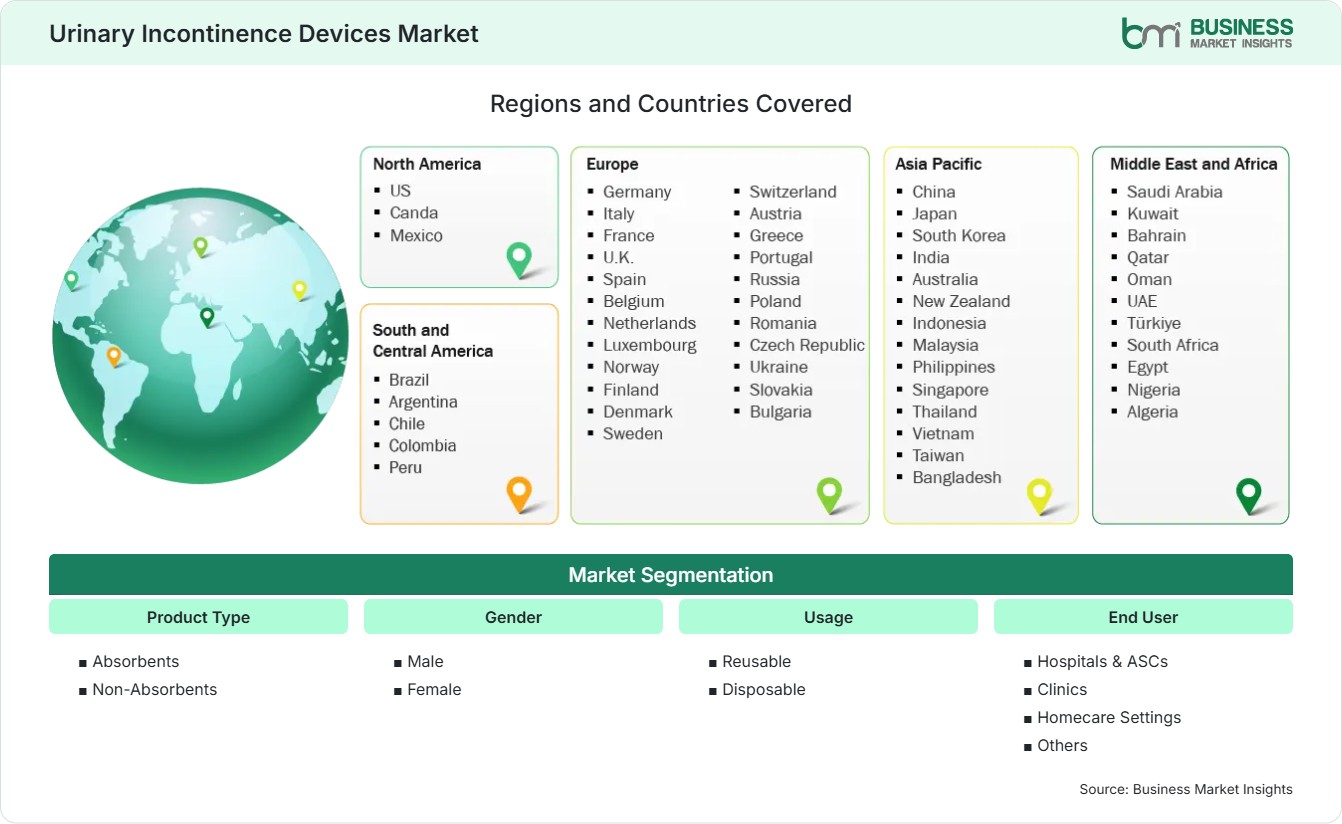
North America accounted for an estimated 36%–39% market share in 2025 and is anticipated to register a 9.2%–9.7% CAGR during 2026–2033. The Urinary Incontinence Devices Market report share remains highest in this region owing to advanced healthcare infrastructure, favorable reimbursement policies, increasing geriatric population, and widespread adoption of minimally invasive continence management technologies. Strong clinical awareness, continuous product innovation, and expanding home healthcare services continue supporting regional demand across hospitals, ambulatory surgical centers, and community care settings.
- The United States remains the dominant contributor through extensive healthcare spending, broad product availability, strong physician awareness, and rapid adoption of advanced neuromodulation systems, premium catheters, and disposable continence care products.
- Canada continues strengthening market demand through expanding elderly care programs, improving reimbursement frameworks, growing awareness campaigns, and increased utilization of homecare services for long-term urinary incontinence management.
- Leading manufacturers continue investing in research, digital patient monitoring technologies, and product innovation to improve comfort, infection prevention, and long-term treatment outcomes across healthcare settings.
- Rising outpatient procedures and minimally invasive surgical interventions are accelerating demand for slings, stimulation devices, and specialized urinary management products while reducing hospital stays and improving patient recovery.
US Urinary Incontinence Devices Market
The United States represented approximately 30%–33% of the global market in 2025 and is projected to expand at a 9.3%–9.8% CAGR through 2026–2033. High disease awareness, advanced reimbursement systems, strong clinical infrastructure, and continuous technological innovation reinforce the country's leadership. Increasing adoption of homecare solutions, favorable regulatory pathways for medical devices, and growing demand for minimally invasive continence therapies continue supporting sustained market expansion.
- Strong investments in clinical research and product development accelerate commercialization of innovative neuromodulation devices, advanced catheter technologies, and patient-friendly continence management products.
- Home healthcare providers continue increasing adoption of disposable absorbents and portable urinary drainage systems, supporting improved patient independence and reducing long-term healthcare costs.
- Expanding geriatric demographics and increasing prevalence of chronic diseases associated with urinary dysfunction continue generating stable demand across hospitals, outpatient facilities, and community healthcare providers.
- Digital healthcare integration and remote patient monitoring technologies improve treatment adherence while enabling clinicians to optimize long-term continence management strategies.
Europe Urinary Incontinence Devices Market
Europe accounted for approximately 28%–31% market share in 2025 and is expected to register a 9.0%–9.5% CAGR during 2026–2033. Strong public healthcare systems, increasing elderly populations, favorable reimbursement mechanisms, and growing emphasis on patient quality of life continue driving market expansion. Germany remains the leading regional market, while Spain and Poland are among the faster-growing countries due to healthcare modernization and increasing medical device accessibility.
- Germany maintains regional leadership through advanced hospital infrastructure, high adoption of minimally invasive procedures, and strong medical device manufacturing capabilities.
- The United Kingdom continues expanding home-based continence management programs supported by aging demographics, healthcare digitization, and increasing patient education initiatives.
- Spain and Poland are witnessing comparatively faster expansion, supported by improving healthcare investment, increasing diagnosis rates, and wider access to continence management products.
- Sustainability initiatives encourage manufacturers to develop environmentally responsible disposable products while maintaining high standards for patient comfort and infection prevention.
- Growing collaboration between healthcare providers and medical device manufacturers supports earlier diagnosis and comprehensive long-term urinary care programs.
Asia Pacific Urinary Incontinence Devices Market
Asia Pacific held an estimated 22%–25% market share in 2025 and is projected to record the fastest regional growth at a 10.8%–11.5% CAGR between 2026 and 2033. Rapid urbanization, expanding healthcare expenditure, improving hospital infrastructure, and increasing public awareness are strengthening market demand. China remains the largest regional market, while India demonstrates the fastest growth due to healthcare expansion and increasing accessibility to continence care solutions.
- China leads regional demand through large patient populations.
- India records the strongest growth supported by healthcare reforms, rising medical insurance coverage.
- Japan continues generating consistent demand because of one of the world's oldest populations.
- Southeast Asian countries are improving access to medical devices through healthcare investments.
- International manufacturers continue strengthening regional distribution networks while expanding localized manufacturing and strategic partnerships to improve market penetration.
Rest of World Urinary Incontinence Devices Market
The Rest of World region accounted for approximately 9%–12% market share in 2025 and is expected to expand at a 9.6%–10.2% CAGR during 2026–2033. South & Central America continue benefiting from improving healthcare accessibility and increasing awareness of continence management. Meanwhile, the Middle East & Africa experience gradual expansion.
- Brazil leads South & Central America through expanding hospital infrastructure, increasing healthcare expenditure, and wider availability of advanced continence care products.
- Mexico continues strengthening demand through improving reimbursement mechanisms, increasing outpatient procedures, and growing awareness regarding urinary health management.
- Saudi Arabia represents the leading Middle Eastern market, supported by healthcare modernization initiatives and increased investments in specialized medical services.
- South Africa demonstrates gradual growth through expanding private healthcare facilities, increasing diagnosis rates, and improving accessibility to urinary management products.
- International manufacturers continue exploring underserved markets through strategic distribution agreements, physician education programs, and localized product portfolios tailored to regional healthcare requirements.