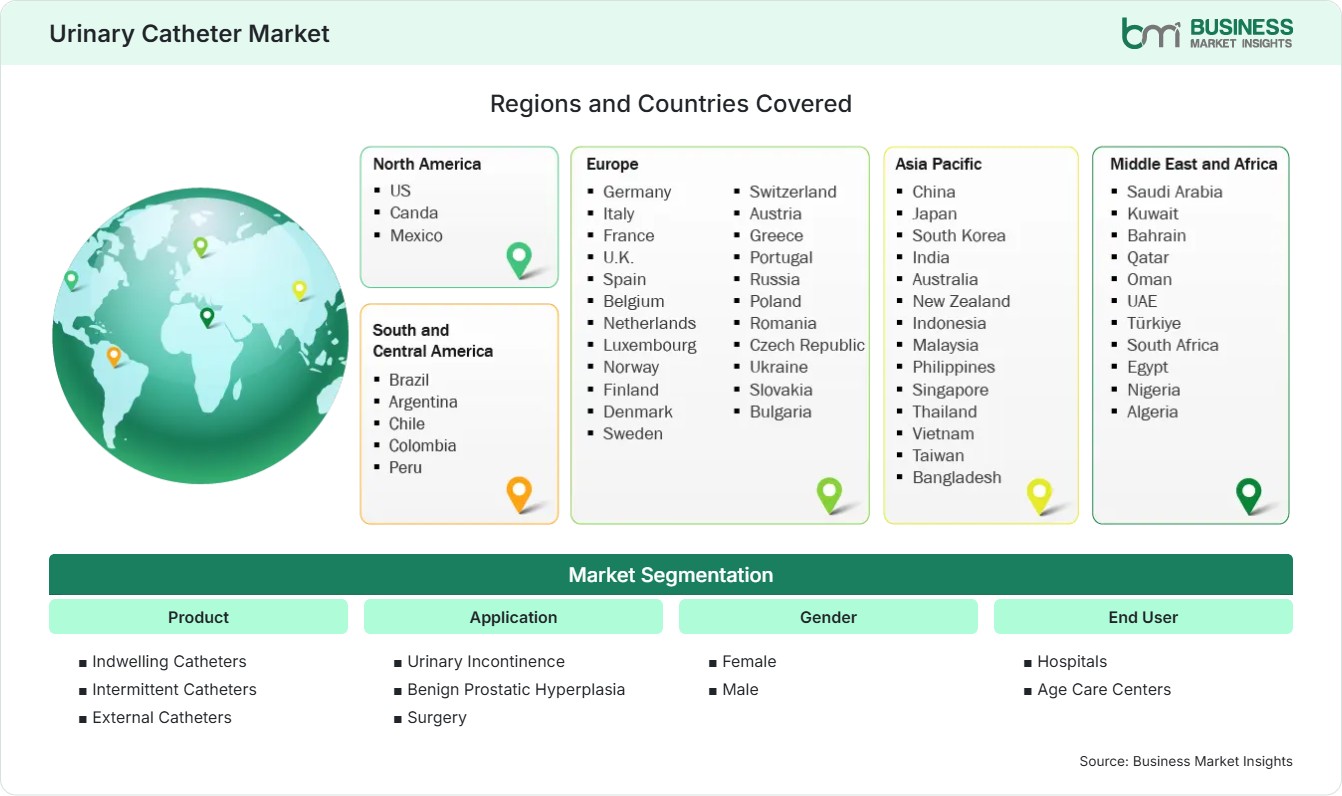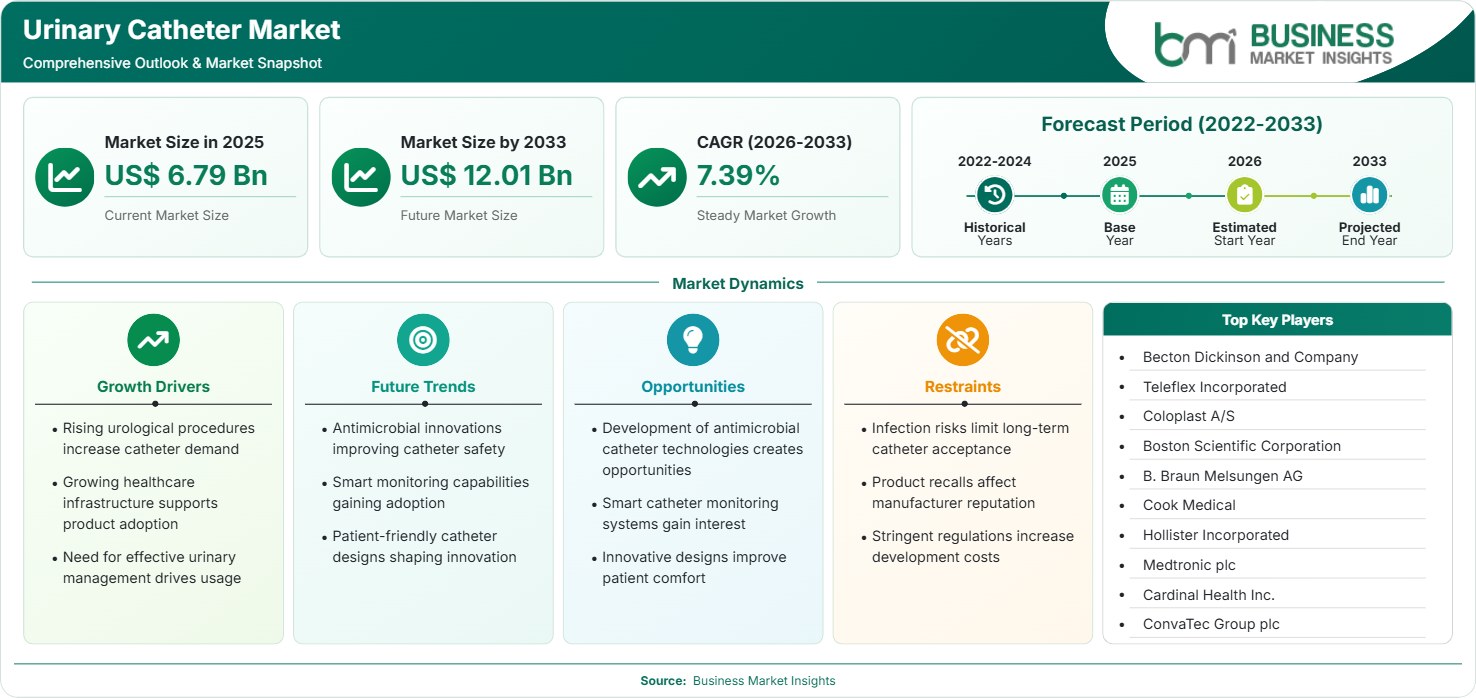
Urinary Catheter Market Regional Highlights
North America Urinary Catheter Market
North America accounts for 32%–35% Urinary Catheter Market share in 2025 and is projected to register a CAGR of 6.8%–7.4% during 2026–2033. Established hospital networks, high urological procedure volumes, aging demographics, and broad availability of specialized urinary care products support regional demand. The United States remains the primary contributor, while Canada provides additional opportunities through institutional care and expanding home-based urinary management. Product quality, infection prevention, clinical familiarity, and established distribution relationships remain important purchasing considerations across healthcare providers.
- Established hospital procurement channels support recurring catheter demand across surgery, critical care, urology, and long-term urinary management applications.
- Manufacturers increasingly emphasize hydrophilic coatings, ergonomic designs, and product features intended to improve insertion comfort and support consistent clinical performance.
- Aging populations and chronic urological conditions sustain demand across hospitals, rehabilitation facilities, outpatient providers, and home-care settings.
- Premium catheter technologies continue finding opportunities where providers prioritize patient comfort, handling efficiency, infection-control practices, and reliable device performance.
US Urinary Catheter Market
The United States contributes 80%–84% of North American revenue and is projected to grow at a CAGR of 6.9%–7.5% during 2026–2033. The country's mature healthcare infrastructure, established urology services, large hospital network, and substantial utilization of catheter-based urinary management support demand. Increasing emphasis on reducing catheter-associated complications encourages providers to evaluate product design, usage protocols, staff training, and alternatives to prolonged catheterization across institutional and home-care environments.
- Hospitals remain major purchasers because urinary catheters are routinely used across surgery, intensive care, urology, emergency care, and postoperative management.
- Home-based urinary care creates opportunities for intermittent catheter products emphasizing discreet packaging, easier handling, patient independence, and predictable supply availability.
- Healthcare providers increasingly evaluate catheter selection alongside infection-control protocols, staff training, appropriate-use policies, and patient-specific clinical requirements.
Europe Urinary Catheter Market
Europe represents 26%–29% urinary catheter market share in 2025 and is expected to register a CAGR of 6.5%–7.2% during 2026–2033. Germany, France, the United Kingdom, Italy, and Spain represent important demand centers, while the United Kingdom and Germany offer comparatively strong opportunities for advanced catheter adoption. Aging demographics, established hospital systems, urological care capacity, and emphasis on device quality continue supporting regional demand. Product safety, infection prevention, clinical evidence, and procurement efficiency remain important competitive factors.
- Germany remains a major European demand center because established hospitals and specialist urology services support broad utilization of catheter-based urinary management products.
- The United Kingdom offers opportunities for intermittent and patient-oriented products as healthcare systems emphasize appropriate urinary management and community-based care.
- France and Italy provide sustained demand through hospital procedures, aging populations, rehabilitation services, and increasing requirements for reliable urinary drainage products.
- Advanced coatings and ergonomic catheter designs continue gaining attention where healthcare providers prioritize comfort, handling consistency, and infection-control considerations.
Asia Pacific Urinary Catheter Market
Asia Pacific holds 25%–28% urinary catheter market share in 2025 and is projected to record the fastest 8.4%–9.1% CAGR during 2026–2033. China and Japan represent leading demand centers, while India and selected Southeast Asian countries provide higher-growth opportunities. Expanding hospital infrastructure, rising surgical volumes, improving access to specialist care, aging populations, and increasing awareness of urinary management are broadening the addressable patient base across the region.
- China represents a major regional market as hospital capacity, specialist care, surgical activity, and domestic medical-device capabilities continue expanding across urban and regional healthcare systems.
- India offers strong growth potential through expanding hospitals, increasing urological procedures, improving healthcare access, and greater awareness of catheter-based urinary management.
- Japan benefits from advanced healthcare infrastructure and an aging population requiring sustained urinary management across hospitals, rehabilitation facilities, and long-term care settings.
- Southeast Asian markets provide emerging opportunities as healthcare investment expands and hospitals increasingly adopt standardized medical-device procurement practices.
Rest of World Urinary Catheter Market
Rest of World accounts for 10%–13% urinary catheter market share in 2025 and is projected to expand at a CAGR of 7.1%–7.9% during 2026–2033. South and Central America are supported by expanding healthcare access, surgical services, and hospital modernization. Brazil represents the leading market, while Mexico provides an attractive growth opportunity. In the Middle East and Africa, Saudi Arabia and the United Arab Emirates offer stronger prospects as healthcare infrastructure and specialist services develop.
Brazil remains an important regional demand center as hospitals expand access to urological and surgical care. Mexico provides additional opportunities through healthcare infrastructure development and increasing availability of specialized medical devices. Across the Middle East, Saudi Arabia and the United Arab Emirates are strengthening specialist healthcare capacity, while selected African markets offer longer-term potential as hospital infrastructure improves.
- Brazil continues supporting regional demand through established hospital networks, expanding specialist services, and increasing availability of urinary management products.
- Mexico offers growth opportunities as healthcare facilities modernize procurement systems and expand access to surgical and urological treatment.
- Saudi Arabia and the United Arab Emirates provide premium product opportunities through specialized hospitals, advanced healthcare facilities, and increasing medical-device adoption.
- Healthcare infrastructure development across selected African countries can gradually broaden access to catheterization products through hospitals and specialist care centers.