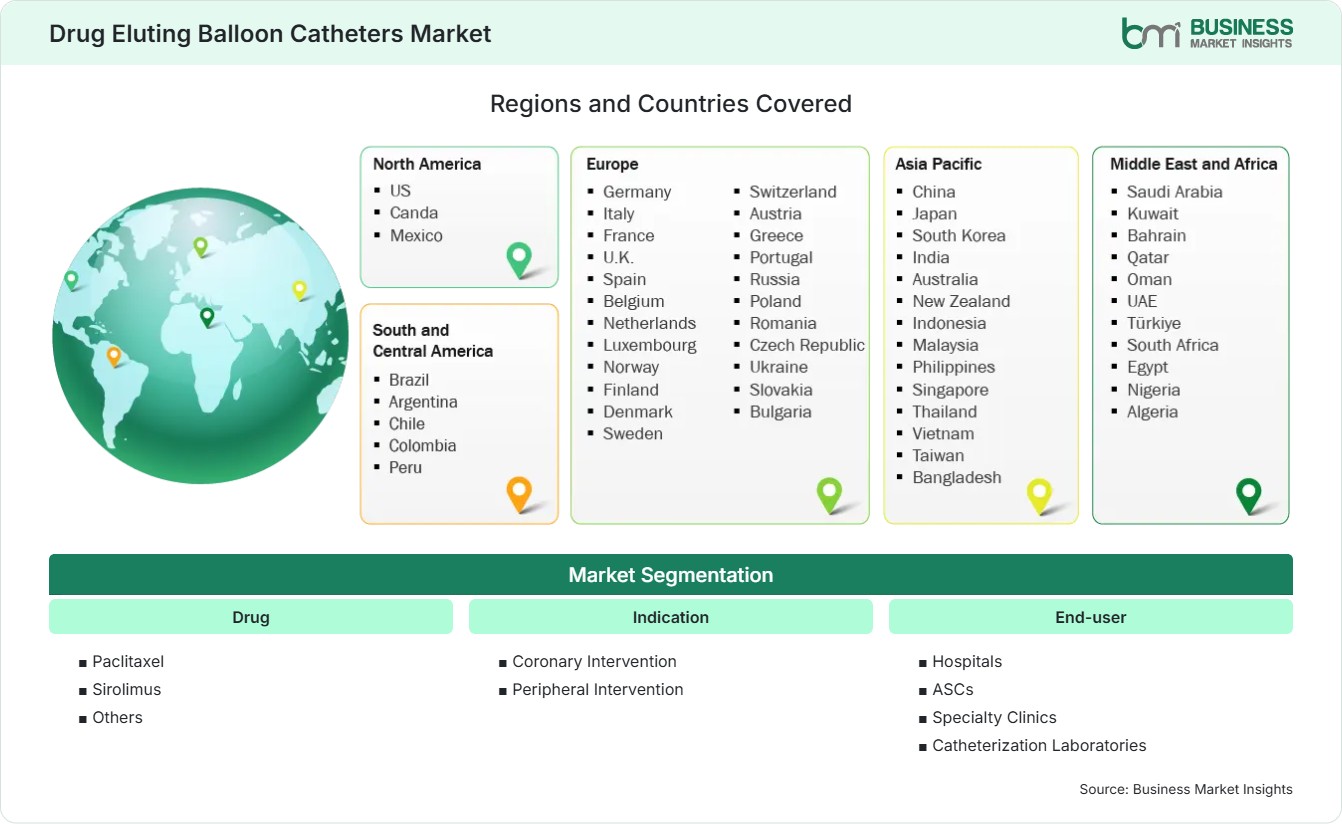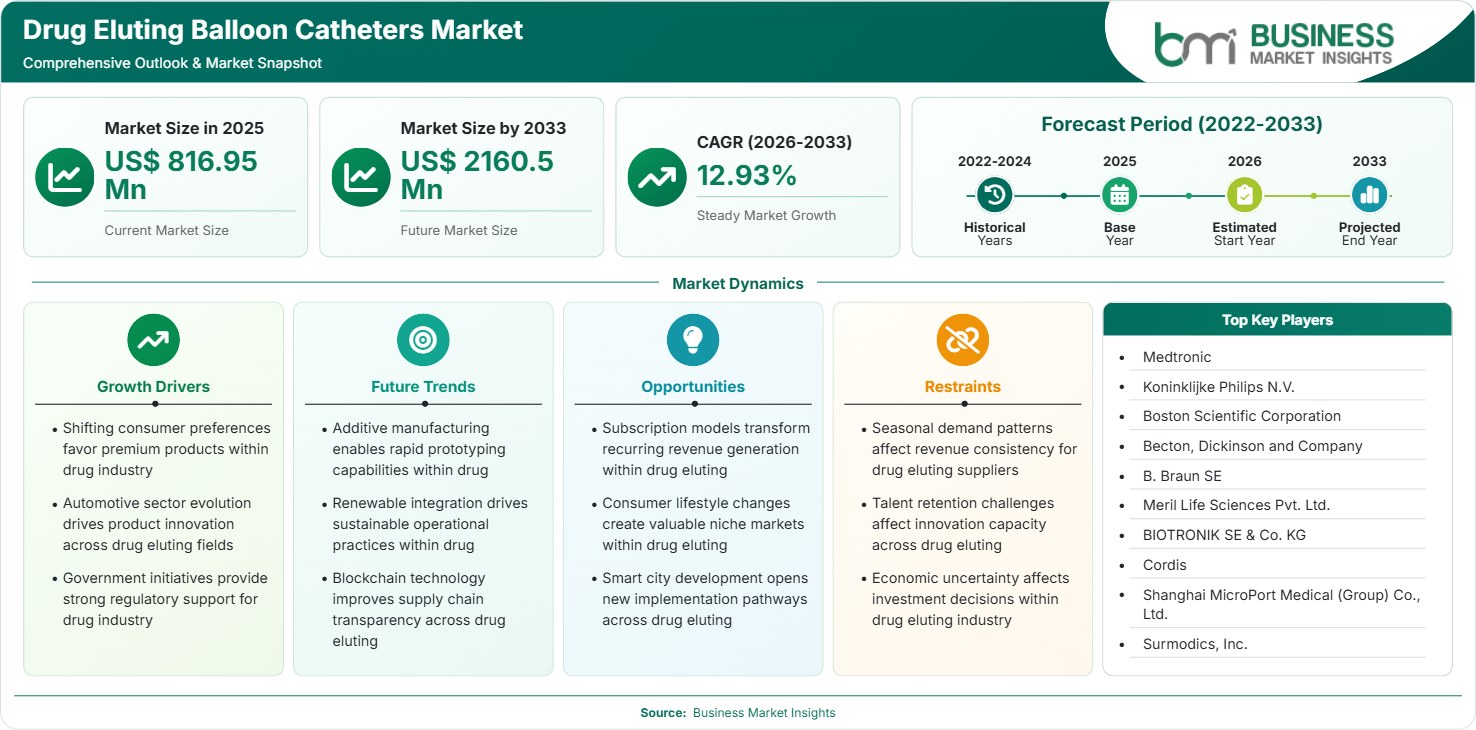
Drug Eluting Balloon Catheters Market Regional Highlights
North America Drug Eluting Balloon Catheters Market
North America accounts for 35%–38% share in 2025 and is projected to expand at a CAGR of 11.5%–12.5% during 2026–2033. Drug Eluting Balloon Catheters Market share benefits from sophisticated PCI infrastructure, high physician specialization, FDA-backed evidence, and improving reimbursement.
- The US market is seeing an increase in the use of coronary DCBs through clinical experience of treating ISR without introducing another metal layer into patients’ bodies.
- The Canadian market offers an opportunity that is relatively smaller but technologically more advanced due to the presence of specialized cardiovascular centers, cath labs, and a need for reducing repeat procedures.
- Differentiation in products depends on deliverability, coating, coverage, and evidence. Companies with better clinical datasets can help strengthen their position in the hospitals’ procurement process.
- The validation of products is one of the important commercial drivers for this market. The actions of the FDA regarding coronary DCBs and new evidence about paclitaxel-coated peripheral devices have minimized uncertainties about clinical uptake.
US Drug Eluting Balloon Catheters Market
The US represents 78%–82% of North American demand in 2025 and is expected to grow at a CAGR of 11.3%–12.3% through 2033. Drug Eluting Balloon Catheters Market share is supported by high PCI specialization and increasingly defined coronary indications.
- Coronary ISR becomes the immediate business foundation due to the fact that treatment with DCB does not entail additional stent layering. Boston Scientific estimates ISR at around 10% of all PCI cases, thus defining a clear clinical base for coronary DCB use.
- CMS payment changes from January 2026 help with economic justification of coronary DCB treatment in an outpatient setting, perhaps encouraging hospitals to define workflows and inventory.
- The peripheral area stays important due to the presence of paclitaxel-based technology platforms. IN.PACT portfolio of Medtronic includes femoropopliteal DCBs targeting long lesions and different accesses.
Europe Drug Eluting Balloon Catheters Market
Europe holds 27%–30% drug eluting balloon catheters market share in 2025 and is projected to register a CAGR of 12.0%–13.0% through 2033. Germany, the United Kingdom, France, Italy, and Spain form the principal demand base, while Germany is estimated to maintain the strongest commercial position.
- There will be high adoption potential in Germany due to well-equipped catheterization laboratories, good manufacturing facilities for medical devices, and high awareness among physicians regarding peripheral and coronary DCB techniques.
- Opportunities for growth exist in the UK and France through specialized cardiovascular units, as well as growing demand for evidence-based options that can help reduce the implant burden on selected patients.
- Italy and Spain represent growing opportunities since peripheral disease management is getting more organized, and interventional centers are evaluating technologies based on durability and repeat interventions.
- Continued influence of European manufacturers in the region because the European drug eluting balloon catheters market is known to have been used as an important launchpad for paclitaxel and sirolimus balloon technologies.
Asia Pacific Drug Eluting Balloon Catheters Market
Asia Pacific holds 25%–28% share in 2025 and is forecast to achieve the fastest CAGR of 14.5%–15.5% through 2033. China, Japan, South Korea, and India represent leading markets, with China and Japan providing substantial procedural depth. India and China are high-growth manufacturing and commercialization hubs because domestic companies increasingly develop drug-coated platforms, while hospital networks expand access to interventional cardiovascular care.
- China combines a large cardiovascular patient base with expanding domestic device manufacturing. Local regulatory approvals can accelerate adoption by allowing differentiated products to enter hospital procurement channels with regionally relevant clinical positioning.
- Japan is a mature interventional drug eluting balloon catheters market where real-world evidence can support indication expansion. Boston Scientific reported an April 2026 launch of a 40 mm AGENT balloon after expanded approval for selected de novo coronary lesions.
- India offers strong manufacturing and cost-optimization potential, with domestic developers contributing sirolimus-based platforms and international companies expanding distribution across major cardiovascular centers.
- South Korea presents an advanced technology market with established PCI capabilities and increasing interest in innovative catheter-based therapies supported by specialist physicians and sophisticated hospital infrastructure.
Rest of World Drug Eluting Balloon Catheters Market
Rest of World represents 10%–13% share in 2025 and is expected to expand at a CAGR of 10.0%–11.0% through 2033. South and Central America contribute demand through Brazil, Mexico, Argentina, and Colombia, where cardiovascular disease creates a substantial intervention need. The Middle East and Africa are led by Saudi Arabia, the UAE, South Africa, and selected Gulf markets, where tertiary hospitals are expanding advanced cardiovascular capabilities.
- Brazil offers the greatest potential in South America, owing to its healthcare size, cardiac centers of excellence, and rising need for technology that will help in minimizing repeated procedures and future treatment options.
- Mexico and Colombia offer emerging market potential due to the usage of value-added interventional devices in private hospitals and centers of excellence, despite some limitations with regard to reimbursements and fragmented purchasing.
- Saudi Arabia and UAE offer top Drug Eluting Balloon Catheters Market potential in the Middle East region, driven by tertiary care investments, medical tourism, excellent catheterization facility, and healthcare reform initiatives backed by the government.
- South Africa represents the top sub-Saharan Africa potential adopter of the technology, owing to tertiary care cardiac centers, while affordability and accessibility remain critical barriers to adoption.