
UAV Propulsion System Market Outlook: Size, Share, Trends, Growth Analysis, Competitive Landscape & Forecast, 2026-2033

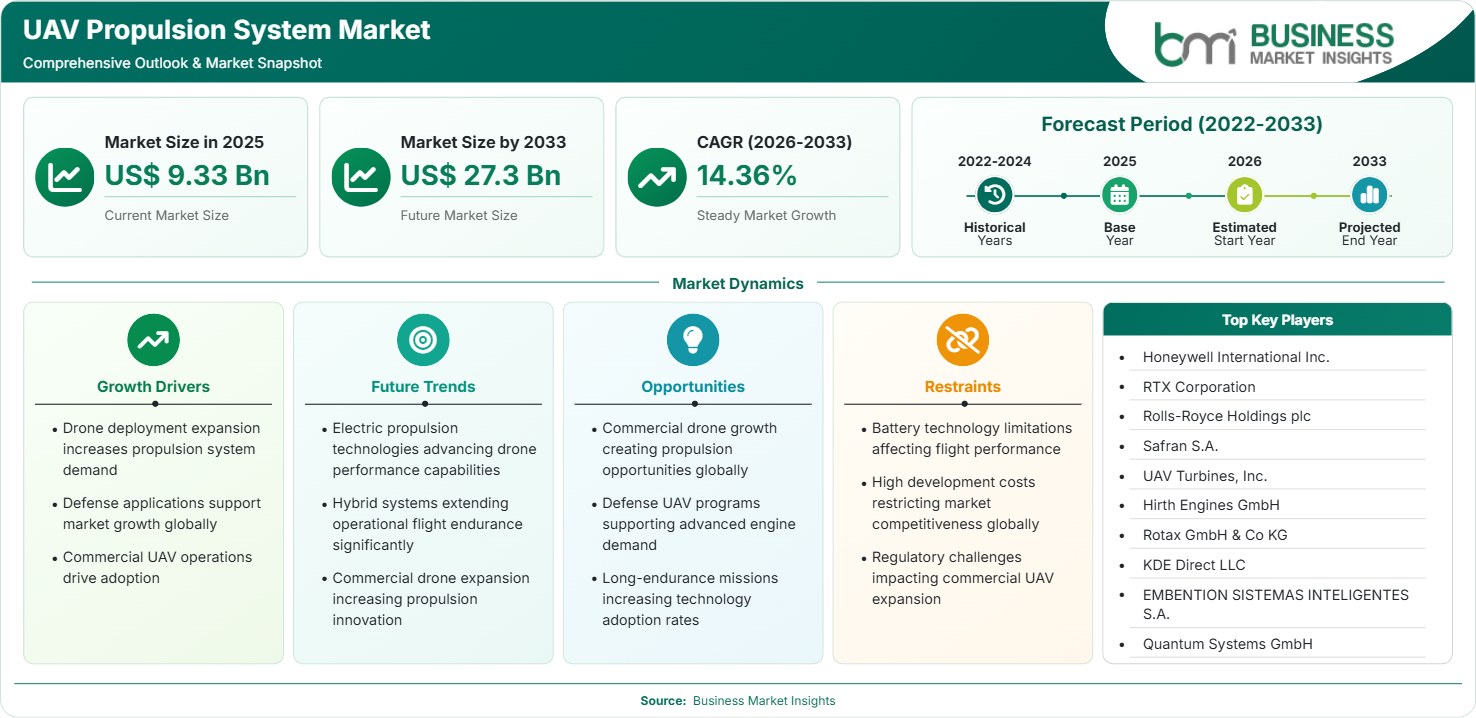
The UAV Propulsion System Market size was valued at US$ 9.33 Billion in 2025 and is projected to reach US$ 27.3 Billion by 2033, growing at a CAGR of 14.36% during 2026–2033. Rising defense procurement, expanding commercial drone deployments, longer-endurance mission requirements, autonomous operations, and rapid advances in electric, hybrid-electric, and fuel-efficient propulsion technologies continue creating substantial opportunities across military and civil UAV programs.

Report Coverage
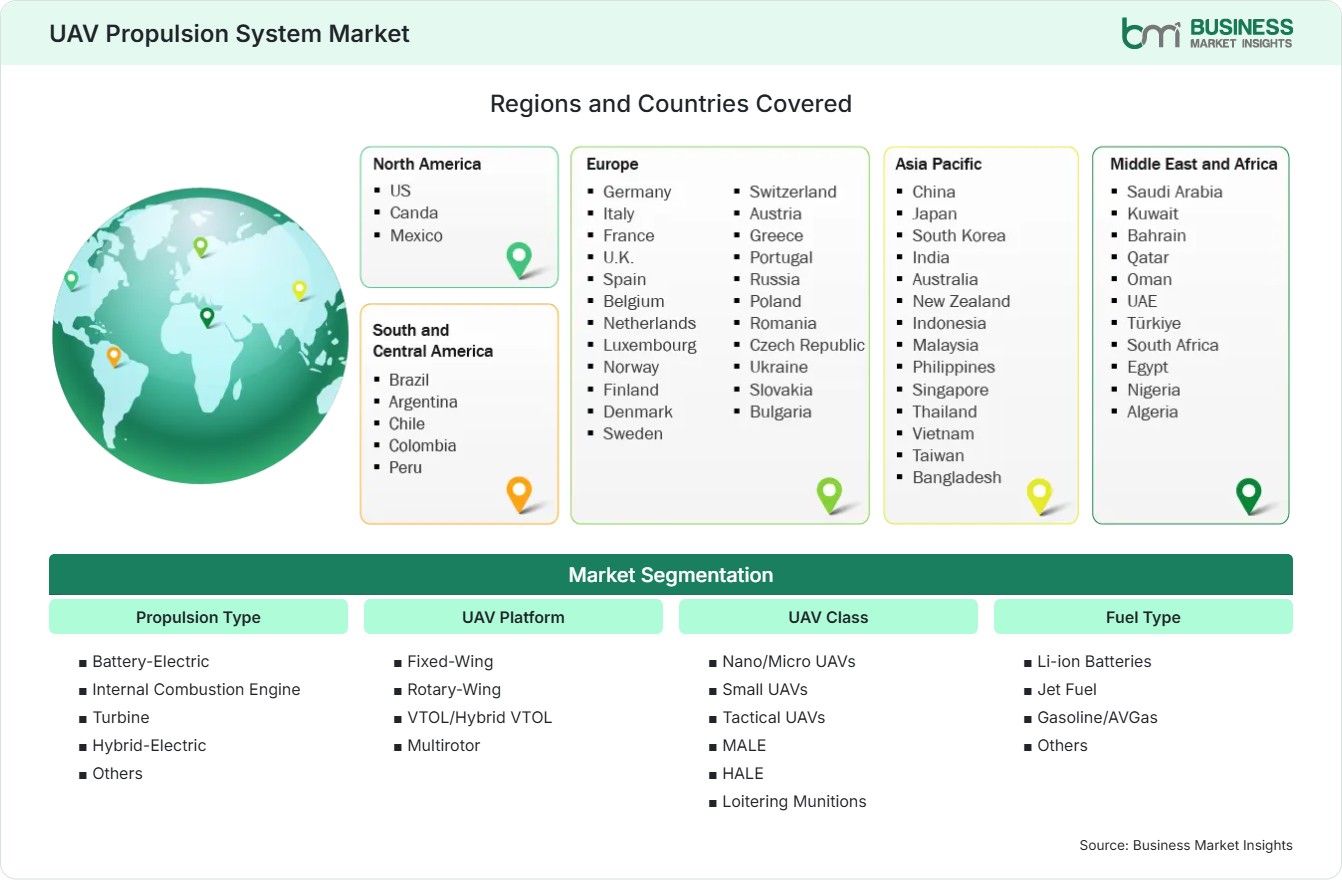
  • Propulsion Type: Battery-Electric, Internal Combustion Engine, Turbine, Hybrid-Electric, Others
  • UAV Platform: Fixed-Wing, Rotary-Wing, VTOL/Hybrid VTOL, Multirotor
  • UAV Class: Nano/Micro UAVs, Small UAVs, Tactical UAVs, MALE, HALE, Loitering Munitions
  • Fuel Type: Li-ion Batteries, Jet Fuel, Gasoline/AVGas, Others
  • Component: Engines/Motors, Propulsors, Energy Storage & Fuel System, Power Electronics & Control, Others
US$ 9.33 Bn Market size in 2025
US$ 27.3 Bn Market Size by 2033
14.36% CAGR, 2026 - 2033
2026-2033 Forecast Period

AI Overview

UAV Propulsion System Market Summary

  • North America Region: North America holds a market share of 34%–37% in 2025, growing at a CAGR of 13.0%–14.2% during 2026–2033, supported by defense modernization, ISR drone expansion, autonomous logistics programs, propulsion innovation funding, and growing commercial inspection activities across energy, infrastructure, emergency response, and border security applications worldwide. US market benefits from defense spending, advanced supplier ecosystems, and a CAGR of 13.2%–14.4% through 2033.
  • Fastest Growing Region: Asia Pacific accounts for a 25%–28% share in 2025 and advances with a CAGR of 15.5%–16.8% during 2026–2033, driven by indigenous drone manufacturing, military modernization programs, commercial delivery trials, government incentives, expanding aerospace supply chains, and increasing investment in advanced propulsion research.
  • Leading Segment: Battery-electric propulsion represents a 36%–39% UAV Propulsion System Market share in 2025 and records a CAGR of 15.2%–16.4% during 2026–2033, supported by lower operating costs, regulatory acceptance, silent operations, urban deployment suitability, improved battery density, and increasing commercial adoption across inspection applications.
  • High Growth Segment: Hybrid-electric propulsion contributes a 14%–17% share in 2025 and expands at a CAGR of 17.0%–18.5% during 2026–2033, supported by endurance advantages, reduced fuel consumption, military mission flexibility, beyond-visual-line-of-sight operations, and increasing demand for long-range autonomous platforms globally.
  • Key Market Opportunity: Integration of high-efficiency propulsion architectures with AI-enabled energy management systems enables longer endurance, lower operating costs, enhanced payload capabilities, and broader deployment across defense, industrial, logistics, and surveillance missions.
  • Major Market Players: Honeywell International Inc., RTX Corporation, Rolls-Royce Holdings plc, Safran S.A., UAV Turbines, Inc., Hirth Engines GmbH, Rotax GmbH & Co KG, KDE Direct LLC, EMBENTION SISTEMAS INTELIGENTES S.A., and Quantum Systems GmbH.
Strategic Insights

UAV Propulsion System Market: Strategic Insights

UAV Propulsion System Market Strategic Framework
FREE PDF
Request your free sample
Request free sample
Stakeholder View

Key Takeaways

  • The industry value chain is evolving toward vertically integrated propulsion ecosystems combining motors, controllers, batteries, software, thermal systems, and predictive maintenance capabilities.
  • Hybrid-electric and VTOL-compatible propulsion solutions offer the strongest commercial upside as operators prioritize endurance, operational flexibility, and reduced mission costs.
  • Innovation activity is increasingly concentrated around energy management software, lightweight materials, hydrogen-ready architectures, advanced batteries, and digital propulsion controls.
  • Asia Pacific presents a compelling investment opportunity as defense procurement programs and domestic drone manufacturing capabilities expand simultaneously across major economies.
  • Strategic partnerships, defense contracts, and venture funding are accelerating commercialization of advanced propulsion technologies while supporting broader UAV platform scalability.
  • Suppliers capable of delivering modular propulsion systems compatible across multiple drone categories are expected to capture stronger long-term customer retention and recurring revenues.
Geographic Outlook

UAV Propulsion System Market Regional Highlights

North America UAV Propulsion System Market

North America maintains its leadership position with a 34%–37% UAV Propulsion System Market share in 2025 and is projected to expand at a 13.0%–14.2% CAGR through 2033. Strong defense expenditures, advanced aerospace manufacturing infrastructure, and broad adoption of unmanned platforms continue to support regional expansion. The region benefits from extensive investments in ISR programs, border monitoring, autonomous logistics initiatives, and commercial drone applications. Propulsion innovation remains concentrated among established aerospace companies and specialized technology developers serving military and civilian operators.

  • Defense modernization programs continue creating sustained demand for high-endurance propulsion systems across surveillance, reconnaissance, and tactical mission profiles.
  • Growing deployment of drones in utility inspection, oil and gas operations, and emergency response supports commercial propulsion technology advancement.
  • Increasing focus on hybrid-electric architectures reflects operator demand for improved range, payload capacity, and operational flexibility.
  • Public procurement programs encourage domestic manufacturing capabilities and collaboration between defense agencies and private aerospace developers.

US UAV Propulsion System Market

The United States accounts for 72%–76% of regional revenue and is anticipated to achieve a 13.2%–14.4% CAGR through 2033. Federal defense budgets, aerospace innovation leadership, and expanding commercial drone operations underpin demand. Significant investments in autonomous systems, military logistics applications, and AI-enabled flight technologies continue driving propulsion development. Major aerospace manufacturers, defense contractors, and emerging drone companies collectively strengthen technology commercialization and supply-chain resilience while enhancing export competitiveness.

  • Defense agencies increasingly prioritize long-endurance UAV programs requiring advanced propulsion efficiency and reliability performance.
  • Expanding BVLOS approvals support greater deployment of industrial inspection and cargo-management drone platforms.
  • Research institutions and aerospace companies continue advancing battery density, electric propulsion performance, and autonomous energy-management technologies.
  • Venture funding remains active for companies developing scalable propulsion systems tailored for next-generation unmanned aircraft.

Europe UAV Propulsion System Market

Europe accounts for 24%-27% of the UAV Propulsion Systems Market in 2025 and is expected to witness a 13.5%-14.8% CAGR through 2033. The region's growth will be facilitated by defense upgrades, sustainable environmental practices, and local drone development initiatives. Applications such as border surveillance, infrastructure inspection, precision agriculture, and safety purposes will boost demand. Aerospace companies still favor emission-free propulsion technology. Germany is considered the largest regional market, whereas Poland leads in terms of growth.

  • Germany leads regional demand through strong aerospace manufacturing capabilities, defense procurement programs, and growing adoption of advanced unmanned systems across industrial and government applications.
  • France continues investing in tactical drone programs and propulsion innovation, supporting domestic technology development and aerospace supply-chain expansion.
  • Poland is expected to record a CAGR of approximately 15.5%–16.5%, benefiting from rising defense expenditure and rapid unmanned systems deployment.
  • European sustainability objectives encourage development of electric and hybrid propulsion solutions suitable for commercial inspection and environmental monitoring applications.
  • Cross-border research programs and aerospace partnerships support technology commercialization and strengthen regional competitiveness in advanced drone propulsion systems.

Asia Pacific UAV Propulsion System Market

The Asia Pacific segment commands a market share of 25% - 28% in 2025 and is estimated to register a CAGR of 15.5% - 16.8% through 2033, rendering it the fastest-growing regional segment. Domestic drone production growth, modernization programs in the military sector, and increasing use in commercial applications create an enabling environment for propulsion system providers. The Chinese market remains the largest in the region, while the Indian market is growing at the fastest pace due to procurement and other factors.

  • China maintains regional leadership through extensive manufacturing capabilities, high drone production volumes, and continuous propulsion technology investments.
  • India is anticipated to achieve a CAGR of 17.0%–18.5%, supported by domestic manufacturing initiatives and expanding defense procurement programs.
  • Precision agriculture, mining, and infrastructure inspection applications continue generating strong propulsion demand across developing economies.
  • Regional governments increasingly support UAV ecosystems through incentives, research funding, and favorable drone deployment regulations.
  • Local manufacturers are investing in electric motors, batteries, and hybrid systems to improve competitiveness and reduce import dependence.

Rest of World UAV Propulsion System Market

The Rest of World region accounts for 11%–14% of the UAV Propulsion System Market in 2025 and is expected to expand at a 14.0%–15.2% CAGR through 2033. South and Central America benefit from increasing agricultural drone deployment and environmental monitoring requirements. Brazil remains the leading regional contributor.

The Middle East and Africa market is aided by upgrades in military capabilities, border security, and infrastructure inspection. The two countries showing robust growth potential in the Middle East region are Saudi Arabia and the United Arab Emirates, while South Africa is growing its industrial drone industry.

  • Brazil benefits from expanding precision agriculture activities and large-scale monitoring requirements across commercial farming operations.
  • Saudi Arabia continues increasing investment in autonomous technologies supporting security, infrastructure, and smart-city development initiatives.
  • United Arab Emirates promotes drone ecosystem development through innovation programs and regulatory support for commercial operations.
  • Mining, energy, and environmental monitoring applications support growing demand across several African economies.
  • Regional governments increasingly emphasize domestic aerospace capabilities and strategic technology partnerships.
Global Market Geography
FREE PDF
Request your free sample
Request free sample
Segment Analysis

UAV Propulsion System Market Segmentation

Propulsion Type

Propulsion Type is another key section, with the share of battery-electric systems at 36%–39% in 2025 and hybrid-electric systems recording the highest growth rate, at 17.0%–18.5% CAGR through 2033. The scope of the UAV Propulsion System Market is expanding as users seek endurance, emissions reductions, efficiency, and versatility.

  • Battery-electric: Dominates commercial applications through low operating costs, minimal maintenance requirements, quiet operation, and increasing suitability for inspection, mapping, surveillance, and agricultural missions.
  • Internal Combustion Engine: Maintains significance in medium-range missions requiring proven reliability, longer flight duration, and operational flexibility across challenging environmental conditions.
  • Turbine: Preferred for high-performance military platforms and specialized missions demanding elevated power output, speed capabilities, and endurance characteristics.
  • Hybrid-electric: Gains momentum from combining electric efficiency with extended endurance, supporting increasingly complex long-range commercial and defense missions.

UAV Platform

Platform choice is critical in determining the demand for propulsion systems and energy use profiles. Fixed-wing platforms make up around 31%-34% of the market in 2025, whereas VTOL/Hybrid VTOL platforms hold the best growth prospects with a CAGR of 16.5%-17.8% through 2033 due to operational flexibility.

  • Fixed-wing: Suitable for long-distance surveillance, environmental monitoring, and mapping operations requiring efficient aerodynamic performance and extended endurance.
  • Rotary-wing: Popular for inspection, security, and public safety missions requiring hovering capability and maneuverability in confined environments.
  • VTOL/Hybrid VTOL: Increasingly adopted for defense, logistics, and industrial operations requiring vertical takeoff combined with efficient forward flight.
  • Multirotor: Widely used across commercial sectors due to cost-effectiveness, simplified deployment, and ease of operation for short-duration missions.

UAV Class

Different UAV types require different propulsion systems based on their endurance, payload, and mission complexity. Currently, small UAVs make up 28%-31% of the UAV Propulsion System Market in 2025, whereas Tactical UAVs are the most rapidly growing segment, with a CAGR of 15.8%-17.0% through 2033.

  • Nano/Micro UAVs: Utilize compact propulsion systems optimized for portability, low power consumption, and close-range intelligence or inspection tasks.
  • Small UAVs: Support widespread commercial applications including agriculture, surveying, infrastructure inspection, and environmental monitoring operations.
  • Tactical UAVs: Experience growing defense demand due to surveillance, reconnaissance, and battlefield intelligence requirements across modern military operations.
  • MALE: Require advanced propulsion systems supporting extended endurance and long-range mission performance for strategic surveillance applications.
  • HALE: Depend on highly efficient propulsion technologies capable of supporting persistent operations at elevated altitudes.
  • Loitering Munitions: Increasingly adopted by defense forces for precision engagement missions requiring compact and efficient propulsion capabilities.

Fuel Type

The fuel choice remains closely linked to mission duration, operational costs, and environmental considerations. The most popular type is lithium-ion batteries, accounting for 35-38% in 2025, while other advanced energy sources also show growing endurance.

  • Li-ion batteries: Benefit from maturing battery technologies, declining costs, and strong compatibility with commercial electric propulsion systems.
  • Jet fuel: Serves turbine-powered UAVs requiring high endurance and power output in military and specialized operational environments.
  • Gasoline/AVGas: Remains relevant for internal combustion platforms requiring established fuel availability and dependable field operations.

Component

Component-level demand is highly influenced by the need for durability, increased load-carrying capacity, self-navigation capability, and energy efficiency. The engines/motors will have the largest share of revenue, accounting for 29%-32% of the UAV Propulsion System Market share in 2025, whereas power electronics & control will show a CAGR of 16.5%-17.9% by 2033 as intelligent energy management becomes a competitive differentiator.

  • Engines/Motors: Serve as the core propulsion element, with manufacturers prioritizing lightweight designs, reliability improvements, and higher power-to-weight ratios for diverse UAV missions.
  • Propulsors: Experience sustained demand through advances in aerodynamics, noise reduction, efficiency optimization, and mission-specific thrust requirements across military and commercial applications.
  • Energy Storage & Fuel System: Increasingly important as operators seek greater endurance, faster charging, improved safety, and lower lifecycle operating costs.
  • Power Electronics & Control: Enable efficient power distribution, autonomous energy management, propulsion optimization, and enhanced flight performance across advanced UAV platforms.
Market Forces

UAV Propulsion System Market Dynamics

Key Market Drivers

Rising Defense Procurement of Unmanned Systems

Defense agencies worldwide are accelerating investments in unmanned aerial capabilities to improve reconnaissance, surveillance, intelligence gathering, and tactical operations. Contemporary military strategies increasingly depend on UAVs, and thus the need for efficient propulsion systems continues to grow. Propulsion systems that can offer greater endurance, reduced heat signature, increased reliability, and operational flexibility are in high demand today. The propulsion ecosystem for UAVs is benefiting from the increasing need for tactical UAVs, loitering munitions, and long-endurance surveillance systems. Given the current global political situation and its effects on military budgets, there is an increasing need for autonomous systems capable of operating in contested environments.

Advancements in Electric Powertrain Technologies

Rapid improvements in battery chemistry, electric motors, controllers, and energy management software are expanding the operational capabilities of unmanned aircraft and driving the UAV Propulsion System Market trends. The weight of the systems is being reduced while the efficiency and power density are being improved. This is helping achieve missions for longer periods and carry larger payloads. It is contributing positively to the commercial usage of UAVs in infrastructure inspection, agricultural activities, mapping, and environmental surveillance. The further development of battery-electric propulsion is also contributing to reduced maintenance efforts and costs. As energy storage technologies have matured, the cost-effectiveness of energy storage is increasing across a range of UAV types, creating an environment conducive to accelerated adoption.

Expansion of Commercial Drone Operations

UAV use is expanding across logistics, energy, agriculture, mining, construction, and security. There has been increased recognition by organizations of the benefits of using drones compared to traditional methods. This necessitates propulsion technology that ensures efficient, affordable, and compliant performance. Increased use of unmanned vehicles in operations out of line of sight has also helped to fuel the demand for endurance propulsion designs. As companies incorporate UAVs into their processes, suppliers have been developing endurance-focused propulsion systems, maintenance-reduction strategies, fleet scalability, and higher utilization rates for commercial operating environments.

Key Market Opportunities

Hybrid-Electric Propulsion for Long-Endurance Missions

One of the most promising areas for investment growth is hybrid-electric systems, as they offer greater durability, efficiency, and versatility. The entities that deal with defense and civilian applications are demanding more advanced propulsion systems capable of longer duty cycles without increasing platform weight. The hybrid system addresses some crucial problems faced by all-electric systems. The hybrid system also saves fuel compared to conventional systems. More investments will be directed towards the development of power management systems, lighter generators, and control systems. According to long-term UAV Propulsion System Market Forecasts, hybrid solutions are expected to become more widely spread due to their advantages.

Autonomous Logistics and Cargo Drone Networks

Autonomous logistics networks represent numerous business opportunities for propulsion providers. The development of e-commerce businesses, healthcare transportation demands, and logistical needs in remote areas are driving interest in using cargo drones. Such uses demand reliable propulsion systems to deliver maximum payloads. Businesses that can provide scalable propulsion systems for cargo transporters may capitalize on the growing commercial use of drone delivery networks. There is high demand, especially in regions with the need to optimize transportation, shorten delivery times, and serve underdeveloped areas where conventional infrastructure remains limited.

Integration of AI-Based Energy Management Systems

Intelligence is now also being incorporated into propulsion management systems architecture to ensure efficient power use, optimal flight performance, optimal routing, and predictive maintenance. This allows operators to improve their endurance by reducing operational and maintenance costs. An intelligent propulsion management system offers significant advantages, especially for fleets operating across varied missions and environments. Manufacturers that offer propulsion systems and intelligent software can improve their market positions by adopting service-based business models. With more advancements in UAV autonomy, there will be greater need for intelligent propulsion management systems.

Market Restraints and Challenges

Battery Energy Density Limitations and Restricted Endurance

One of the main problems that many electric UAVs face is the low energy density of the batteries currently available. Even though battery technology is constantly developing, the endurance problem might affect the operational flexibility for long-range and heavy-payload missions. It makes a lot of sense to pay attention to this issue when talking about commercial use, where endurance plays an important role. It may be necessary to use bigger batteries, which will affect the payload capacity. These limitations influence platform economics and affect adoption decisions in endurance-sensitive applications. Although ongoing research is addressing energy-storage performance, battery-related constraints continue shaping propulsion selection strategies across multiple UAV categories.

Regulatory Complexity and Commercial Deployment Delays

The lack of regulatory consistency across jurisdictions persists in the market. The use of unmanned aerial vehicles (UAVs) is subject to numerous regulations governing airspace integration, certification, licensing, safety, and other issues. The consequences include longer timeframes for commercial use, higher compliance costs, and uncertainty about large-scale deployment plans. In addition, the introduction of new technologies by the propulsion providers faces certain difficulties associated with certification processes. While governments aim to harmonize the regulatory framework, the regulatory challenges are anticipated to gradually diminish.

Company Analysis

Competitive Landscape

The competitive environment remains characterized by aerospace expertise, specialized propulsion engineering, and ongoing product innovation. Current UAV Propulsion System Market analysis indicates that manufacturers are prioritizing efficiency, endurance, lightweight materials, intelligent controls, and platform compatibility to strengthen competitive positioning.

Company Name

Overview

Products and Services relevant to this market

Honeywell International Inc.

Global aerospace and industrial technology company supplying aviation systems, controls, navigation solutions, and propulsion-related technologies.

UAV avionics, power management technologies, aerospace systems integration, flight controls, and advanced unmanned aircraft solutions.

RTX Corporation

Major aerospace and defense contractor supporting military and advanced aerospace programs worldwide.

Propulsion technologies, aerospace systems, defense electronics, mission systems, and UAV-related subsystems.

Rolls-Royce Holdings plc

Developer of advanced propulsion technologies for aerospace, defense, and emerging autonomous platforms.

Turbine engines, power generation systems, hybrid-electric research programs, and propulsion engineering services.

Safran S.A.

Aerospace technology company active across propulsion, navigation, and defense-related systems.

Engine technologies, UAV propulsion solutions, aerospace control systems, and related engineering services.

UAV Turbines, Inc.

Specialist developer of turbine-based propulsion systems designed specifically for unmanned aircraft.

Turbine engines, integrated propulsion packages, fuel systems, and UAV performance optimization technologies.

Hirth Engines GmbH

Manufacturer focused on lightweight aviation and UAV engine technologies.

Two-stroke engines, propulsion systems, powertrain solutions, and engine integration services.

Rotax GmbH & Co KG

Established aviation engine manufacturer serving multiple aircraft categories globally.

Internal combustion engines, UAV propulsion packages, aviation power systems, and support services.

KDE Direct LLC

Specialized supplier of electric propulsion technologies for drone platforms.

Brushless motors, propulsion kits, electronic speed controllers, and UAV powertrain components.

EMBENTION SISTEMAS INTELIGENTES S.A.

Technology provider focused on autonomous aviation systems and control architectures.

Autopilots, flight controllers, power electronics, and UAV system integration solutions.

Quantum Systems GmbH

Developer of advanced unmanned aerial systems for defense and commercial customers.

UAV platforms, propulsion integration, VTOL systems, mission software, and aerial intelligence solutions.

Trust & Transparency

Research Methodology

The market analysis combines proprietary research with secondary data from government agencies, company disclosures, regulatory filings, industry databases and expert interviews. Market estimates are validated through data triangulation, cross-market benchmarking and analyst review.

View Full Research Methodology

Questions Answered

Frequently Asked Questions

What insights does the UAV Propulsion System Market Report provide to stakeholders?

The Market Report provides a detailed evaluation of growth drivers, technology trends, regional opportunities, competitive developments, segment performance, and future investment priorities shaping industry evolution.

What industries are creating the greatest commercial demand?

Energy, agriculture, infrastructure inspection, mining, mapping, logistics, public safety, and environmental monitoring sectors are among the strongest contributors to commercial UAV adoption.

How important are batteries to future industry development?

Battery improvements directly affect flight duration, payload capability, operating economics, and commercialization potential. Enhanced energy density can significantly expand electric UAV deployment opportunities.

Which propulsion technology is expected to experience the strongest adoption momentum?

Hybrid-electric propulsion is gaining momentum because it combines improved endurance with operational flexibility, making it suitable for logistics, surveillance, and long-range commercial missions.

What factors are influencing propulsion system selection in unmanned aircraft?

Mission endurance, payload capacity, maintenance requirements, operating cost targets, regulatory compliance, and environmental conditions remain the primary factors influencing propulsion system selection across commercial and defense applications.

Access the Full UAV Propulsion System Market Report

Get segment-level forecasts, regional estimates, competitive benchmarking, company profiles and downloadable Excel datasets.

Access the full UAV Propulsion System Market Report
350 pages PDF & Excel | 2026-11-10
Similar Research

Related Market Reports