
Transplant Diagnostics Market Outlook: Size, Share, Trends, Growth Analysis, Competitive Landscape & Forecast, 2026-2033

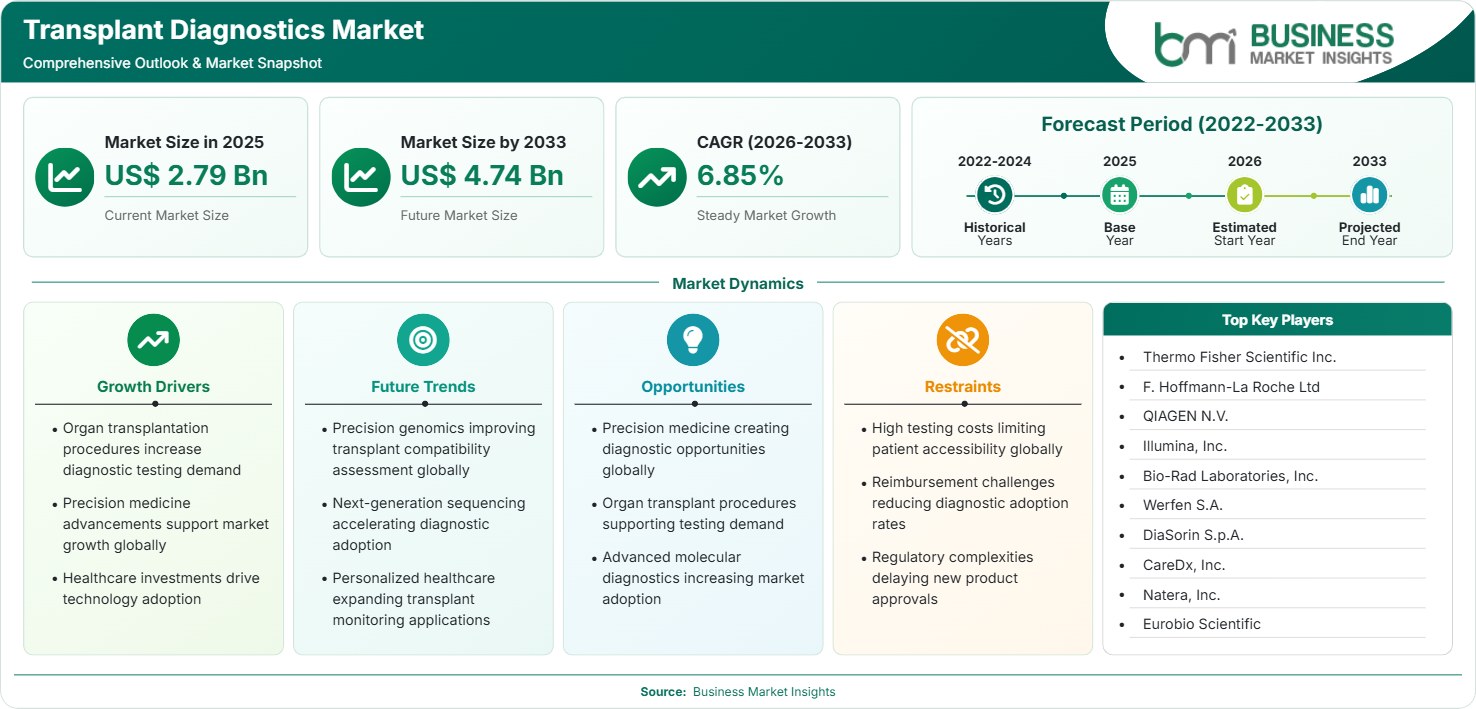
The Transplant Diagnostics Market size was valued at US$ 2.79 Billion in 2025 and is projected to reach US$ 4.74 Billion by 2033, growing at a CAGR of 6.85% during 2026–2033, driven by transplant volumes, molecular testing, precision matching, rejection surveillance, and expanding diagnostic capacity.

Report Coverage
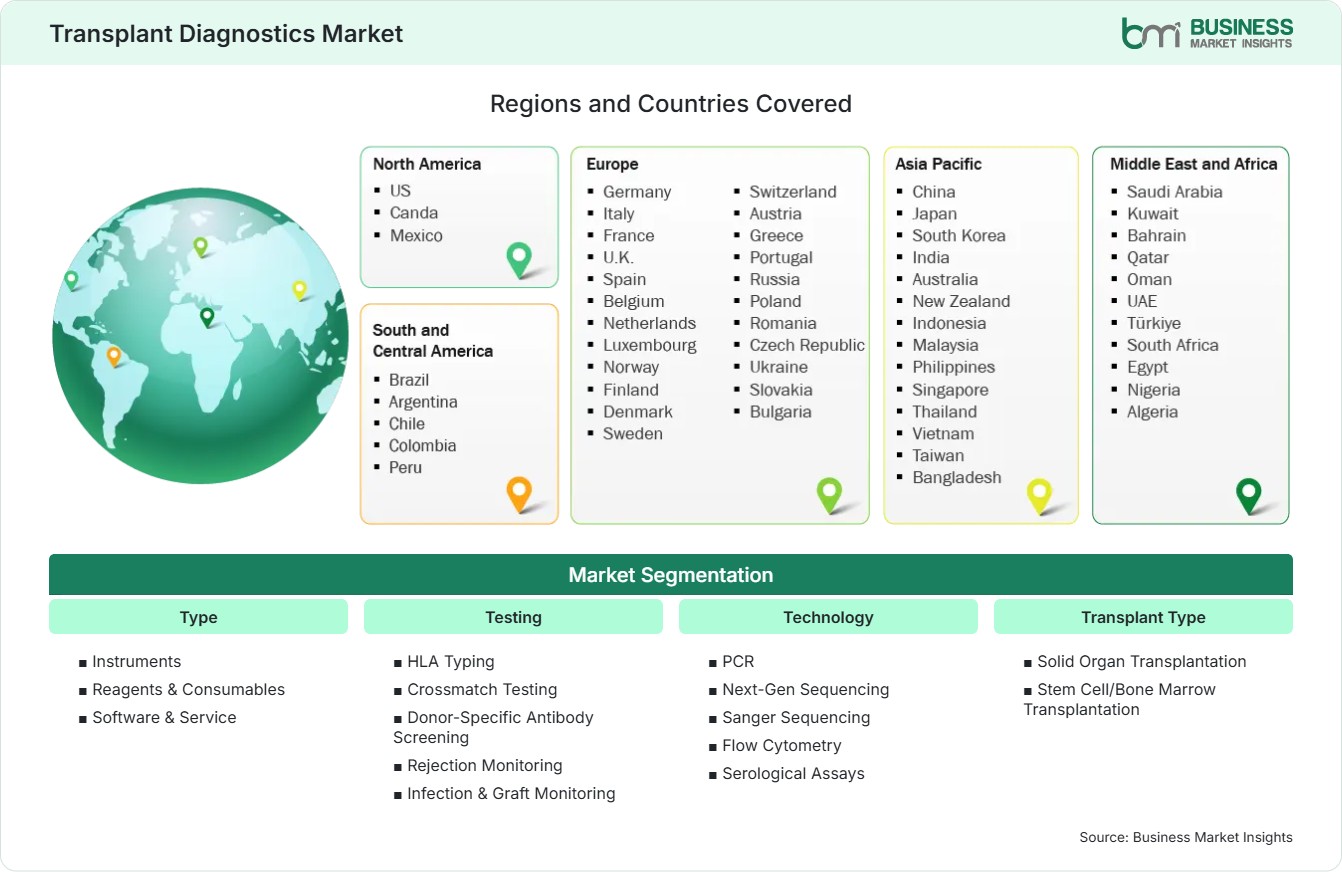
  • Type: Instruments, Reagents & Consumables, Software & Service
  • Testing: HLA Typing, Crossmatch Testing, Donor-Specific Antibody Screening, Rejection Monitoring, Infection & Graft Monitoring
  • Technology: PCR, Next-Gen Sequencing, Sanger Sequencing, Flow Cytometry, Serological Assays
  • Transplant Type: Solid Organ Transplantation , Stem Cell/Bone Marrow Transplantation
  • End User: Hospitals & Transplant Centers, Research & Academic Institutions
US$ 2.79 Bn Market size in 2025
US$ 4.74 Bn Market Size by 2033
6.85% CAGR, 2026 - 2033
2026-2033 Forecast Period

AI Overview

Transplant Diagnostics Market Summary

  • North America Region: North America holds a 34%–37% share in 2025, growing at a 6.2%–6.7% CAGR during 2026–2033, influenced by mature transplant infrastructure, reimbursement, molecular testing adoption, high laboratory automation, and precision surveillance opportunities. US laboratories increasingly integrate molecular typing, donor-specific antibody testing, and non-invasive rejection monitoring into transplant workflows, supporting approximately 6.1%–6.6% CAGR through 2033.
  • Fastest Growing Region: Asia Pacific holds a 25%–28% Transplant Diagnostics Market share in 2025, with a 7.4%–8.1% CAGR during 2026–2033, supported by rising transplantation capacity, expanding tertiary hospitals, improving diagnostic infrastructure, growing genomic testing adoption, and increasing investment in healthcare laboratories.
  • Leading Segment: Reagents & Consumables account for a 44%–47% share in 2025 and expand at a 6.2%–6.6% CAGR during 2026–2033, supported by recurring testing volumes, HLA antibody screening, crossmatching, molecular assays, workflow standardization, and continuous demand from transplant laboratories.
  • High Growth Segment: Next-Gen Sequencing holds a 15%–18% share in 2025 and advances at a 9.0%–9.8% CAGR during 2026–2033, driven by higher-resolution HLA typing, complex allele detection, automation, decreasing sequencing costs, improved software, and broader clinical adoption.
  • Key Market Opportunity: Integrated platforms combining high-resolution HLA typing, donor-specific antibody assessment, rejection surveillance, sequencing, and clinical decision support can increase laboratory efficiency while expanding testing beyond major transplant centers.
  • Major Market Players: Thermo Fisher Scientific Inc.; F. Hoffmann-La Roche Ltd; QIAGEN N.V.; Illumina, Inc.; Bio-Rad Laboratories, Inc.; Werfen S.A.; DiaSorin S.p.A.; CareDx, Inc.; Natera, Inc.; Eurobio Scientific.
Strategic Insights

Transplant Diagnostics Market: Strategic Insights

Transplant Diagnostics Market Strategic Framework
FREE PDF
Request your free sample
Request free sample
Stakeholder View

Key Takeaways

  • The value chain is heading in the direction of integrated workflows that link together donor-recipient characterization, molecular testing, antibody analysis, data interpretation, and post-transplant monitoring, thus increasing the need for interoperable reagents, instruments, software, and services.
  • Because transplant centers nowadays require more detailed immunological information both before and after transplantation, rather than depending solely on conventional compatibility tests, there are promising areas for expansion in the field of high-resolution HLA typing and rejection monitoring.
  • The process of sequencing is moving towards faster procedures, higher resolution, and greater automation, with the use of donor-derived cell-free DNA, digital analysis, artificial intelligence, and multi-omics methods extending the capabilities of monitoring after transplantation.
  • Asia Pacific offers a route for expansion since transplantation programs, tertiary hospitals, genomic laboratories, and healthcare infrastructure are developing in China, India, Japan, South Korea, and throughout Southeast Asia, thereby promoting wider adoption of diagnostic services.
  • There is an increasing trend towards portfolio consolidation as diagnostic companies look to obtain complementary capabilities in the areas of HLA typing, sequencing, transplant monitoring, software, and laboratory services. The transaction between CareDx and Eurobio Scientific regarding laboratory products is an example of this strategic convergence.
  • Vendors with broad menus, validated clinical evidence, automated workflows, and regulatory-ready products can address the operational requirements of transplant centers seeking shorter turnaround times and more standardized laboratory processes.
Geographic Outlook

Transplant Diagnostics Market Regional Highlights

North America Transplant Diagnostics Market

North America represents a 34%–37% Transplant Diagnostics Market share in 2025 and is projected to expand at a 6.2%–6.7% CAGR through 2033. The region benefits from extensive transplant-center networks, sophisticated histocompatibility laboratories, established reimbursement mechanisms, and strong adoption of molecular testing.

  • Well-established transplant networks provide for standardized HLA typing, cross-matching, antibody testing, and post-transplant monitoring in high-volume centers.
  • Molecular assays are now becoming complementary to conventional serological methods, and this allows for a more detailed characterization as well as more actionable information regarding immune risk.
  • Digital laboratory systems enhance interpretation, reporting, quality control, and the coordination between histocompatibility laboratories and transplant clinicians.
  • The extent of investment in non-invasive rejection surveillance is such that testing is now being extended beyond the initial assessment of compatibility before transplantation to include long-term management of the patient.

US Transplant Diagnostics Market

The United States represents approximately 27%–30% of the global Transplant Diagnostics Market demand and about 79%–82% of North America's 2025 market, with a 6.1%–6.6% CAGR through 2033. More than 49,000 transplants were performed in 2025, according to US government transplant statistics, reinforcing recurring demand for compatibility and monitoring diagnostics.

  • Because of the high number of transplants, there is a constant need for HLA typing, crossmatch testing, donor-specific antibody screening, and monitoring for rejection.
  • Large networks that transplant academics speed up the clinical validation of sequencing, cell-free DNA, digital analytics, and other emerging immune-monitoring technologies.
  • As vendors look to develop diagnostic products that are scalable and standardized, regulatory pathways are becoming an ever-greater influence on their commercialization strategies.

Europe Transplant Diagnostics Market

Europe holds a 25%–28% Transplant Diagnostics Market share in 2025 and is expected to register a 6.1%–6.6% CAGR through 2033. Germany, the United Kingdom, France, Italy, and Spain form important demand centers, while Germany and France provide strong opportunities for advanced molecular testing.

  • Germany and France gain the advantage of having well-established transplant hospitals, possessing expertise in immunogenetics, and seeing increasing use of molecular HLA workflows.
  • The United Kingdom is still providing support for demand by means of its centralized transplantation expertise and its existing clinical laboratory infrastructure.
  • Italy and Spain offer great potential due to their well-established solid-organ transplantation programs and specialist diagnostic laboratories.
  • The need for standardized donor characterization, HLA matching, and long-term laboratory monitoring is growing as cellular therapy becomes more widespread.

Asia Pacific Transplant Diagnostics Market

Asia Pacific holds a 25%–28% Transplant Diagnostics Market share in 2025 and is projected to achieve a 7.4%–8.1% CAGR through 2033, making it the fastest-growing regional market. China, Japan, India, South Korea, and Australia represent major demand centers, while India, China, and Southeast Asian countries provide high-growth opportunities.

  • Because of its large number of patients and the growing capacity for transplants, China has a need for molecular typing and antibody testing procedures that can be scaled up.
  • India has great potential for growth since transplant hospitals, specialist laboratories, and advanced diagnostic facilities are being developed in the major metropolitan healthcare centers.
  • Japan and South Korea have technologically advanced facilities in the areas of sequencing, immunogenetics, automation, and precise transplant monitoring.
  • New opportunities are appearing in Southeast Asia as investment in the healthcare sector and specialist transplant programs are being developed in Thailand, Singapore, Malaysia, and Indonesia.

Rest of World Transplant Diagnostics Market

South and Central America account for an estimated 7%–9% Transplant Diagnostics Market share in 2025, with Brazil, Mexico, Argentina, and Colombia representing important markets. Diagnostic expansion is linked to transplant-center development, specialist laboratory availability, and increasing healthcare investment.

  • The best opportunities in Latin America are offered by Brazil and Mexico through their existing tertiary hospitals and their increasing ability in the field of specialist laboratories.
  • Saudi Arabia and the United Arab Emirates are putting their money into advanced healthcare infrastructure and specialized transplant services.
  • South Africa is an important diagnostic hub in Africa due to the presence of a well-established system for academic healthcare and laboratories.
  • As regional laboratories build up their ability to carry out sequencing and acquire specialist knowledge in immunogenetics, the resolution of molecular testing can be increased step by step.
Global Market Geography
FREE PDF
Request your free sample
Request free sample
Segment Analysis

Transplant Diagnostics Market Segmentation

Type

Reagents & Consumables lead the Type segment with a 44%–47% Transplant Diagnostics Market share in 2025 and a 6.2%–6.6% CAGR through 2034, supported by recurring HLA, antibody, crossmatch, and monitoring workflows. Instruments provide laboratory automation, while software and services improve interpretation, workflow management, and operational efficiency across specialized transplant facilities.

  • Instruments: Automated analyzers support HLA typing, antibody screening, flow cytometry, molecular testing, and standardized laboratory workflows, helping transplant centers increase throughput while reducing manual processing requirements.
  • Reagents & Consumables: Recurring testing requirements make reagents central to laboratory economics, covering molecular assays, antibody detection, crossmatching, sequencing preparation, and infection-related transplant testing.
  • Software & Service: Interpretation platforms, workflow management, analytics, laboratory services, and technical support improve data handling as molecular testing generates increasingly complex transplant information.

Testing

HLA Typing remains central to transplant compatibility assessment, while rejection monitoring is gaining importance as laboratories shift toward longitudinal precision management. Donor-specific antibody screening and crossmatch testing remain essential for immune-risk evaluation.

  • HLA Typing: High-resolution donor and recipient characterization supports compatibility assessment, particularly for complex cases and unrelated stem cell transplantation requiring detailed allele-level information.
  • Crossmatch Testing: Complementary donor-recipient testing helps identify immunological incompatibility before transplantation, supporting allocation decisions and reducing avoidable procedural risks.
  • Donor-Specific Antibody Screening: DSA assessment identifies antibodies directed toward donor antigens and supports immune-risk stratification before and after transplantation.
  • Rejection Monitoring: Molecular and cellular surveillance approaches are expanding post-transplant testing by identifying biological signals associated with graft injury before conventional clinical deterioration.
  • Infection & Graft Monitoring: Pathogen surveillance and graft-function assessment provide complementary information for managing immunosuppressed recipients and distinguishing infectious complications from immune-mediated graft injury.

Technology

PCR remains important because of established workflows and rapid turnaround, while Next-Gen Sequencing represents the fastest-growing technology at a 9.0%–9.8% CAGR through 2034. The Transplant Diagnostics Market trends increasingly favor higher resolution, automation, multiplexing, and integrated bioinformatics.

  • PCR: Rapid amplification supports targeted HLA typing and molecular detection workflows where laboratories prioritize turnaround time, established validation, and operational simplicity.
  • Next-Gen Sequencing: High-resolution sequencing enables detailed allele characterization and supports complex donor-recipient matching, making it increasingly attractive for precision transplantation.
  • Sanger Sequencing: Established sequencing workflows remain useful for targeted confirmation, resolving selected variants, and supporting laboratories transitioning from conventional typing methods.
  • Flow Cytometry: Multiparameter cellular analysis supports crossmatching, immune characterization, and monitoring workflows requiring rapid assessment of cell-associated signals.
  • Serological Assays: Established antibody-based methods remain important because of broad laboratory familiarity, established protocols, and their role within complementary immunological testing pathways.

Transplant Type

Solid organ transplantation represents the principal application base, supported by kidney, liver, and lung procedures requiring compatibility assessment and post-transplant surveillance. Stem cell and bone marrow transplantation generate specialized demand for high-resolution HLA typing, donor selection, immune monitoring, and molecular characterization, supporting continued expansion of precision diagnostics.

  • Solid Organ Transplantation: Kidney, liver, and lung transplantation generate recurring diagnostic demand across compatibility, antibody, infection, and rejection-monitoring workflows, supporting broad laboratory utilization.
  • Kidney: High procedural volumes and long-term graft surveillance create sustained demand for HLA typing, antibody assessment, molecular monitoring, and infection testing.
  • Liver: Complex immune management and graft surveillance requirements support complementary molecular, serological, and infection-monitoring diagnostics throughout patient management.
  • Lung: Lung recipients require intensive longitudinal surveillance, increasing demand for rejection monitoring, infection testing, and advanced molecular approaches.
  • Stem Cell/Bone Marrow Transplantation: Detailed donor-recipient HLA matching and immune monitoring create strong demand for high-resolution molecular diagnostics and specialized laboratory interpretation.

End User

Hospitals & Transplant Centers represent the dominant end-user category because transplantation requires coordinated diagnostic services before and after procedures. The Transplant Diagnostics Market scope is therefore expanding across both routine clinical testing and translational applications.

  • Hospitals & Transplant Centers: High testing frequency, integrated clinical teams, and direct responsibility for transplantation make these facilities the primary users of diagnostic platforms and assays.
  • Research & Academic Institutions: Academic laboratories support biomarker discovery, assay validation, sequencing development, immune profiling, and clinical research that accelerates commercial diagnostic adoption.
Market Forces

Transplant Diagnostics Market Dynamics

Key Market Drivers

Rising Transplant Volumes and Diagnostic Intensity

Worldwide organ transplantation is a structure that creates demand for diagnostic products. According to the WHO, there were more than 150,000 solid organ transplants per year based on the most recent global observatory statistics, which translates to a growth rate of 52% compared to 2010. In the United States, there were more than 49,000 organ transplants in 2025. This supports Transplant Diagnostics Market growth because recurring diagnostic events increase reagent consumption and demand for automated interpretation.

Expansion of Molecular and High-Resolution HLA Testing

Workflows based on molecules are taking over some lower-resolution techniques that have been selected due to the need for better allele discrimination at transplant centers. NGS can offer wider sequencing coverage, while PCR still offers value in focused and faster workflows. Higher resolution testing applies especially to cases of unrelated donor stem cell transplants. These developments strengthen Transplant Diagnostics Market trends toward consolidated workflows rather than disconnected laboratory systems.

Growth of Non-Invasive Rejection Surveillance

The need for data in post-transplant monitoring is increasing as medical professionals look for earlier signs of graft injury. Methods such as testing for donor-derived cell-free DNA, examining gene expression, carrying out antibody testing, and using digital analysis can supplement the traditional method of assessing tissue by biopsy. At the 2025 World Transplant Congress, CareDx gave more than 40 presentations as part of its company program and introduced the AI-driven AlloSure Plus platform, which combines molecular data with other clinical information. These techniques have the potential to move the diagnostic value from single compatibility tests to continuous monitoring.

Key Market Opportunities

Integrated Sample-to-Report Diagnostic Platforms

Labs need more systems that minimize the number of handoffs from sample preparation, testing, sequencing, analysis, and reporting. Integration of systems can result in improved speed, standardization of processes, and streamlining of quality management. Companies offering systems that comprise instruments, reagents, software, and services are likely to get a bigger piece of the lab's spending. The Transplant Diagnostics Market Forecasts, therefore, increasingly depend on vendors translating technical complexity into simpler clinical workflows, rather than competing only on assay specifications.

Expansion of Molecular Testing in Emerging Transplant Centers

In some of the Asia Pacific regions and in certain Middle Eastern markets, there is the possibility of setting up advanced diagnostic facilities together with new transplant initiatives. By making investments in tertiary hospitals, specialist laboratories, sequencing infrastructure, and clinical information systems, a route can be created for molecular assays to enter markets in which the range of tests is still less developed. Suppliers may help promote acceptance by offering modular instruments, providing centralized reference testing, offering training, and distributing reagents. Collaborations with academic hospitals can produce validation data and local clinical evidence.

AI, Multi-Omics, and Digital Immune-Risk Assessment

By combining information on HLA types, antibody status, molecular signals, clinical history, and longitudinal laboratory measurements, advanced analytics can generate new diagnostic value. With the aid of AI, it is possible to prioritize patients for further testing and to detect patterns linked to graft injury or immune activation. Multi-omics platforms might one day link genomic, transcriptomic, proteomic, and cell-based information within both transplant research and clinical practices.

Market Restraints and Challenges

Regulatory and Clinical Validation Complexity

Factor: Diagnostics for transplant patients usually need to be extensively validated, have clinical proof, laboratory controls, and regulations, since their output could affect the choice of donors, treatments, and rejection.

Impact: The extended process will make the commercialization of new diagnostics more expensive. The introduction of new molecular or artificial intelligence-assisted diagnostics may be delayed. Diagnostic companies may find it difficult to get multicenter proof, reimbursement, and laboratory acceptance.

Specialist Workforce and Laboratory Infrastructure Gaps

Factor: High-end sequencing, immunogenetics, flow cytometry, and bioinformatics need skilled professionals, validated protocols, and reliable lab facilities.

Impact: Healthcare facilities with a lack of skilled staff members can delay the implementation of advanced platforms or rely on external reference labs for complex tests. This delays time to market and reduces market reach outside of transplant centers.

Company Analysis

Competitive Landscape

The Transplant Diagnostics Market analysis indicates a competitive environment combining diversified diagnostics companies, genomics specialists, transplant-focused laboratories, and immunogenetics providers. Competitive differentiation increasingly depends on menu breadth, assay resolution, workflow integration, clinical evidence, software capabilities, and geographic reach.

Company Name

Overview

Products and Services relevant to this market

Thermo Fisher Scientific Inc.

Diversified life sciences company with extensive molecular diagnostics, genomics, laboratory instrumentation, and research capabilities serving transplant laboratories.

Molecular biology reagents, PCR technologies, sequencing platforms, laboratory instruments, genomic workflows, and related analytical solutions.

F. Hoffmann-La Roche Ltd

Global healthcare company expanding genomic and molecular capabilities across laboratory diagnostics and sequencing technologies.

Molecular diagnostics, sequencing technologies, laboratory automation, informatics, and research solutions applicable to transplant genomics.

QIAGEN N.V.

Molecular diagnostics and sample-preparation specialist supporting nucleic-acid workflows across clinical and research laboratories.

Sample preparation, PCR, molecular testing, bioinformatics, nucleic-acid technologies, and laboratory workflow solutions.

Illumina, Inc.

Genomics company with broad sequencing technology adoption across research and clinical laboratories requiring high-throughput molecular analysis.

NGS platforms, sequencing consumables, library preparation, informatics, and genomic analysis workflows.

Bio-Rad Laboratories, Inc.

A diagnostics and life sciences company with established immunology, molecular testing, and laboratory technology capabilities.

Immunoassays, molecular diagnostics, quality-control products, laboratory instruments, and related testing technologies.

Werfen S.A.

Specialized diagnostics company with a substantial transplantation and immunohematology portfolio following its Immucor business expansion.

HLA typing, antibody identification, donor-specific antibody testing, NGS workflows, flow cytometry, and transplant software.

DiaSorin S.p.A.

In-vitro diagnostics company with strong immunodiagnostic and molecular testing capabilities across international healthcare markets.

Immunoassays, molecular diagnostics, infectious-disease testing, laboratory automation, and specialty diagnostic solutions.

CareDx, Inc.

Transplant-focused precision medicine company developing diagnostic, monitoring, digital, and clinical solutions for transplant patients.

Donor-derived cell-free DNA testing, HLA typing, transplant monitoring, digital solutions, and clinical decision-support technologies.

Natera, Inc.

Molecular diagnostics company applying cell-free DNA technology to precision medicine and transplant monitoring.

Molecular testing, cell-free DNA analysis, transplant surveillance, and genomic diagnostic services.

Eurobio Scientific

European diagnostics group expanding transplantation capabilities through molecular diagnostics and specialized laboratory products.

HLA typing, NGS assays, transplant monitoring kits, software, molecular diagnostics, and laboratory solutions.

Trust & Transparency

Research Methodology

The market analysis combines proprietary research with secondary data from government agencies, company disclosures, regulatory filings, industry databases and expert interviews. Market estimates are validated through data triangulation, cross-market benchmarking and analyst review.

View Full Research Methodology

Questions Answered

Frequently Asked Questions

What opportunities exist in emerging markets?

The Transplant Diagnostics Market Report highlights that Opportunities are strongest where transplant capacity, tertiary hospitals, specialist laboratories, and genomic infrastructure are expanding together. Asia Pacific, selected Middle Eastern countries, and Latin American markets can support adoption through laboratory modernization and centralized reference-testing models.

How are companies differentiating their transplant diagnostic portfolios?

Companies are expanding beyond individual assays by combining HLA typing, antibody testing, sequencing, monitoring, software, analytics, laboratory services, and workflow support. Portfolio breadth can reduce the number of separate systems required within specialized transplant laboratories.

Why is rejection monitoring becoming more important?

Transplant centers increasingly seek earlier evidence of graft injury to complement conventional clinical assessment and biopsy. Molecular surveillance, donor-derived cell-free DNA, gene-expression analysis, and antibody testing can provide additional longitudinal information for clinical decision-making.

What role does NGS play in transplantation?

NGS provides high-resolution characterization of HLA genes and can identify complex or uncommon alleles that may be difficult to resolve using lower-resolution approaches. Its growing role is particularly relevant to unrelated donor matching and precision immunogenetics.

What is driving demand for transplant diagnostics?

Rising transplantation volumes, greater use of molecular HLA typing, increasing donor-specific antibody testing, and expansion of post-transplant surveillance are strengthening demand. More than 49,000 US transplants were performed in 2025, while global solid-organ transplantation remains substantially below estimated need.

Access the Full Transplant Diagnostics Market Report

Get segment-level forecasts, regional estimates, competitive benchmarking, company profiles and downloadable Excel datasets.

Access the full Transplant Diagnostics Market Report
350 pages PDF & Excel | 2026-10-22
Similar Research

Related Market Reports