Hair Transplant Market Regional Highlights
North America Hair Transplant Market
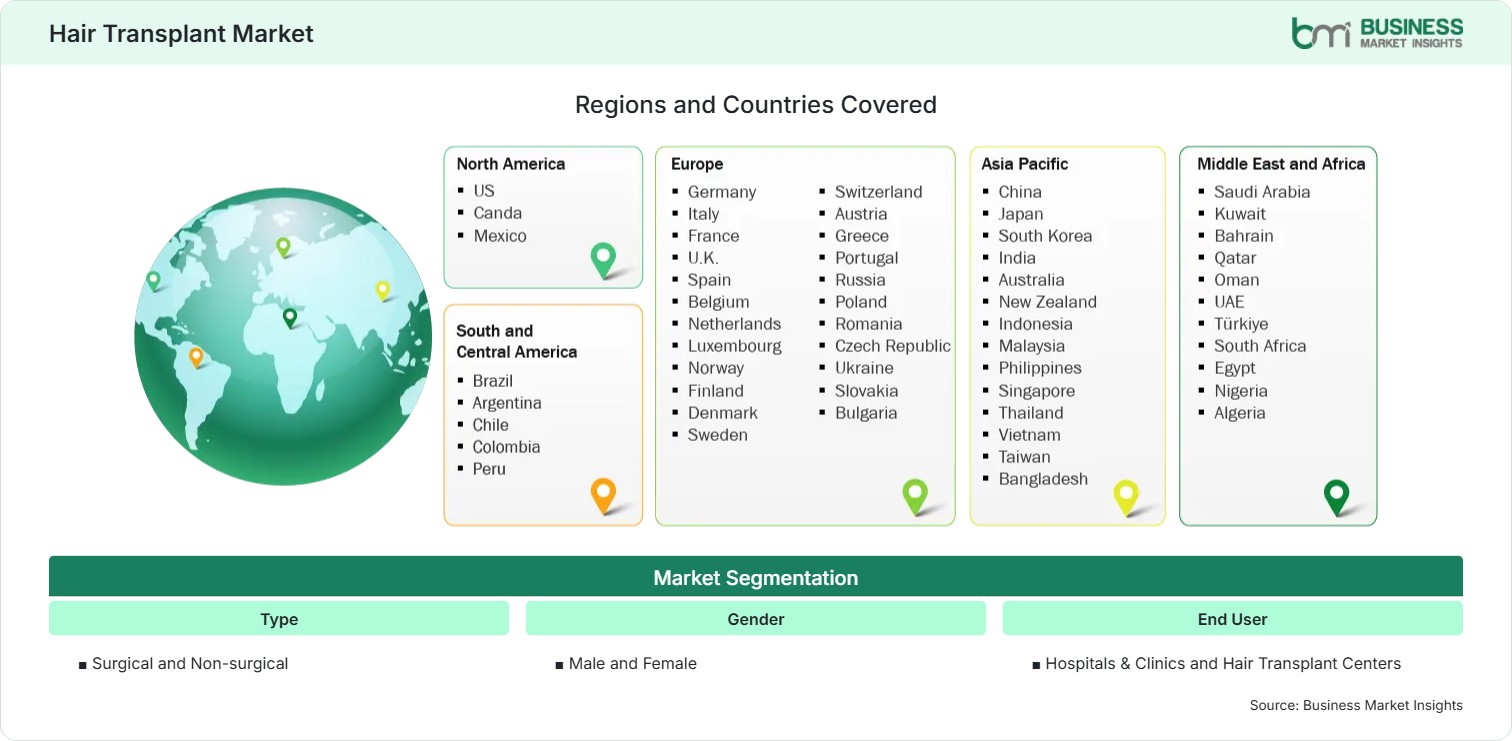
North America accounted for a 34%–37% share in 2025 and is projected to expand at a CAGR of 22%–24% during 2026–2033. There is presence of advanced cosmetic healthcare facilities, excellent surgical skills and good patients’ attitude towards spending money for premium procedures. The Hair Transplant Market Share is highly skewed to US because of specialty clinics, technology adaptation and high demand for aesthetic procedures.
- The United States leads regional adoption with extensive networks of specialized restoration centers, advanced follicular extraction expertise, and strong consumer preference for minimally invasive aesthetic treatments.
- Canada contributes through increasing acceptance of cosmetic procedures, expanding private healthcare services, and growing demand for personalized restoration solutions among professionals and younger demographics.
- Digital consultations, virtual assessments, and AI-assisted treatment planning are improving patient accessibility while enabling clinics to optimize consultation efficiency and procedural customization.
- Premium clinic chains are investing in advanced equipment, surgeon training, and patient experience improvements to differentiate services within a competitive aesthetic healthcare environment.
US Hair Transplant Market
The US represented a 30%–33% share in 2025, growing at a CAGR of 22%–23% between 2026–2033. The country remains the largest individual contributor due to high healthcare spending, widespread awareness of aesthetic procedures, and strong presence of specialized providers. The Hair Transplant Market growth in the US is supported by technological innovation, increasing male grooming trends, and expanding female patient participation.
- Leading clinics are adopting robotic systems, digital scalp analysis tools, and advanced graft extraction techniques to improve treatment accuracy and patient outcomes.
- Increasing demand among millennials and younger professionals is encouraging providers to develop customized procedures focused on early intervention and natural appearance.
- Insurance limitations for cosmetic procedures encourage private financing models, membership programs, and premium service packages offered by specialized restoration centers.
Europe Hair Transplant Market
Europe held a 25%–28% share in 2025 and is expected to register a CAGR of 21%–23% through 2026–2033. The region benefits from mature aesthetic healthcare infrastructure, skilled specialists, and strong medical tourism activity. Countries such as the UK, Germany, Spain, and Turkey contribute significantly, with Turkey demonstrating a higher growth rate of 25%–27% due to international patient inflows.
- The United Kingdom maintains strong demand through established clinics, advanced practitioner expertise, and increasing consumer preference for clinically supervised restoration procedures.
- Turkey has become a major medical tourism hub due to competitive treatment pricing, specialized surgeons, and extensive international patient services.
- Germany and Spain are expanding through premium healthcare facilities, technological adoption, and growing acceptance of aesthetic treatments among diverse age groups.
- European providers are emphasizing regulatory compliance, patient safety protocols, and standardized clinical practices to strengthen consumer confidence.
- Rising awareness of non-invasive preparation methods and combination therapies is influencing treatment preferences across major European markets.
Asia Pacific Hair Transplant Market
Asia Pacific accounted for a 27%–30% share in 2025 and is projected to grow at a CAGR of 26%–28% during 2026–2033. The region represents the fastest-expanding hair transplant market due to rising disposable income, medical tourism, urbanization, and increasing beauty consciousness. India, China, South Korea, and Thailand are key markets, with South Korea growing at approximately 28%–30% due to advanced cosmetic healthcare capabilities.
- India is expanding rapidly through affordable treatment options, skilled specialists, and increasing domestic and international patient demand for restoration procedures.
- China is witnessing increased adoption due to growing aesthetic awareness, expanding private clinics, and rising investment in cosmetic healthcare infrastructure.
- South Korea benefits from advanced cosmetic technologies, strong beauty culture, and innovation-driven clinics offering sophisticated restoration techniques.
- Thailand attracts medical tourists through competitive pricing, international healthcare standards, and integrated cosmetic treatment packages.
- Regional providers are increasingly adopting digital platforms, online consultations, and targeted marketing strategies to reach younger consumer groups.
Rest of World Hair Transplant Market
Rest of World accounted for a 7%–10% share in 2025 and is anticipated to grow at a CAGR of 20%–22% from 2026–2033. South and Central America are supported by increasing cosmetic procedure awareness, while the Middle East and Africa benefit from expanding private healthcare investment. Countries including Brazil, Mexico, UAE, and Saudi Arabia are emerging as attractive markets.
Latin American countries are strengthening aesthetic healthcare infrastructure, while Middle Eastern nations are investing in premium medical facilities and specialized cosmetic centers.
- Brazil and Mexico are experiencing increased demand due to established cosmetic surgery ecosystems and growing consumer spending on appearance-related treatments.
- UAE and Saudi Arabia are developing advanced healthcare facilities that attract domestic and international patients seeking premium restoration services.
- South Africa contributes through expanding private clinics, skilled specialists, and increasing awareness of aesthetic treatment options.
- Government healthcare modernization programs in emerging economies are indirectly supporting private-sector cosmetic healthcare expansion.
- Digital awareness campaigns and social media influence are accelerating consumer interest in hair restoration procedures across developing regions.