Market Summary
Executive Summary and Global Market Analysis
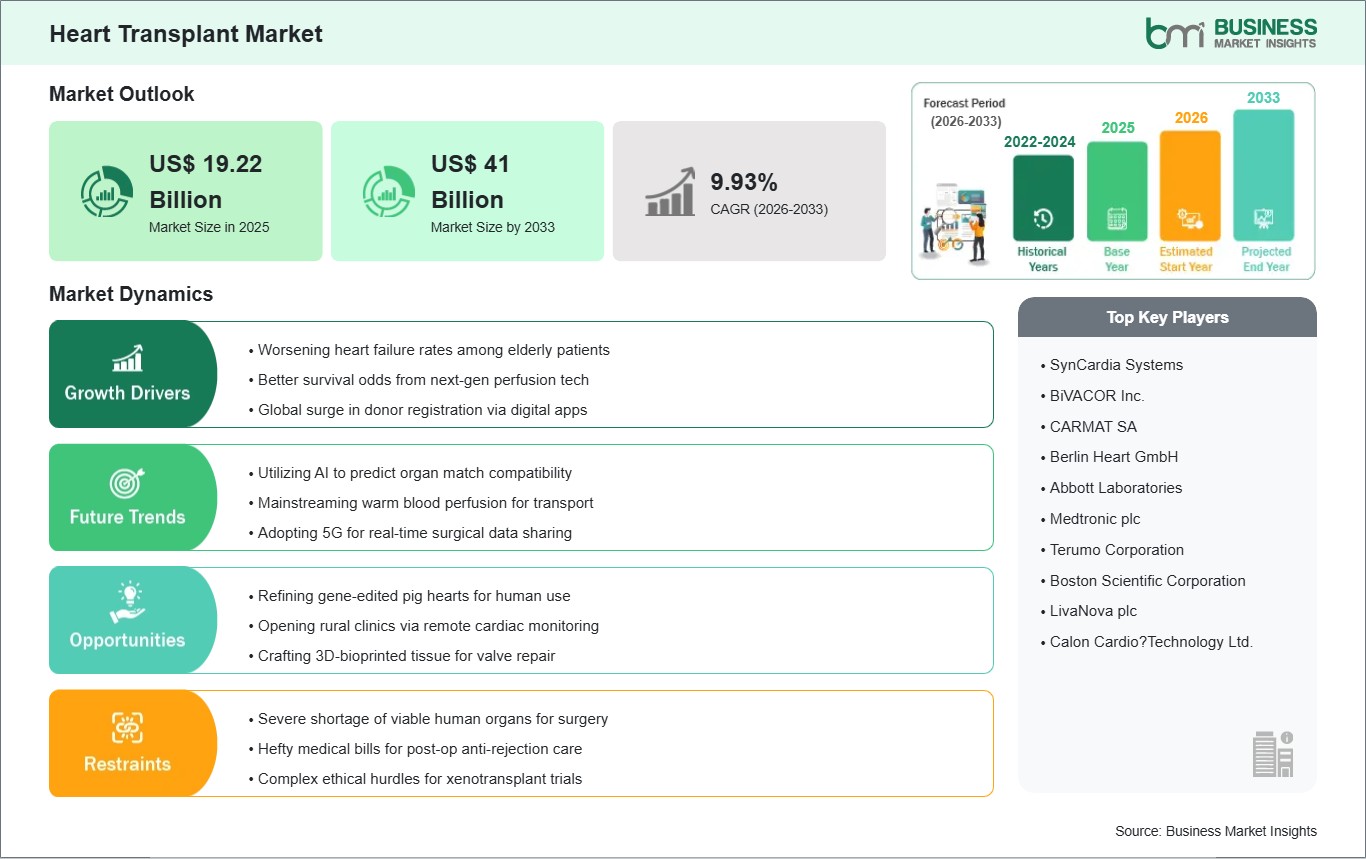
Heart transplants involve surgically replacing a failing heart with a healthy donor heart, typically for end-stage heart failure unresponsive to other treatments like medications or devices. The procedure requires precise matching of donor-recipient factors such as blood type, size, and tissue compatibility, supported by advanced organ preservation technologies and post-operative immunosuppression. As a life-saving therapy, heart transplantation has evolved with improvements in surgical techniques, organ procurement networks, and rejection management.
The Heart Transplant Market is experiencing steady growth, driven by the rising global incidence of advanced heart failure due to aging populations, ischemic heart disease, and cardiomyopathies. Expansion is further supported by advancements in organ preservation solutions extending donor heart viability, expanded donor pools including donation after circulatory death (DCD), and innovations in immunosuppression to reduce rejection risks and improve long-term survival rates, which now exceed 85% at one-year post-transplant in leading centers.
Segment Analysis
Heart Transplant Market Segmentation
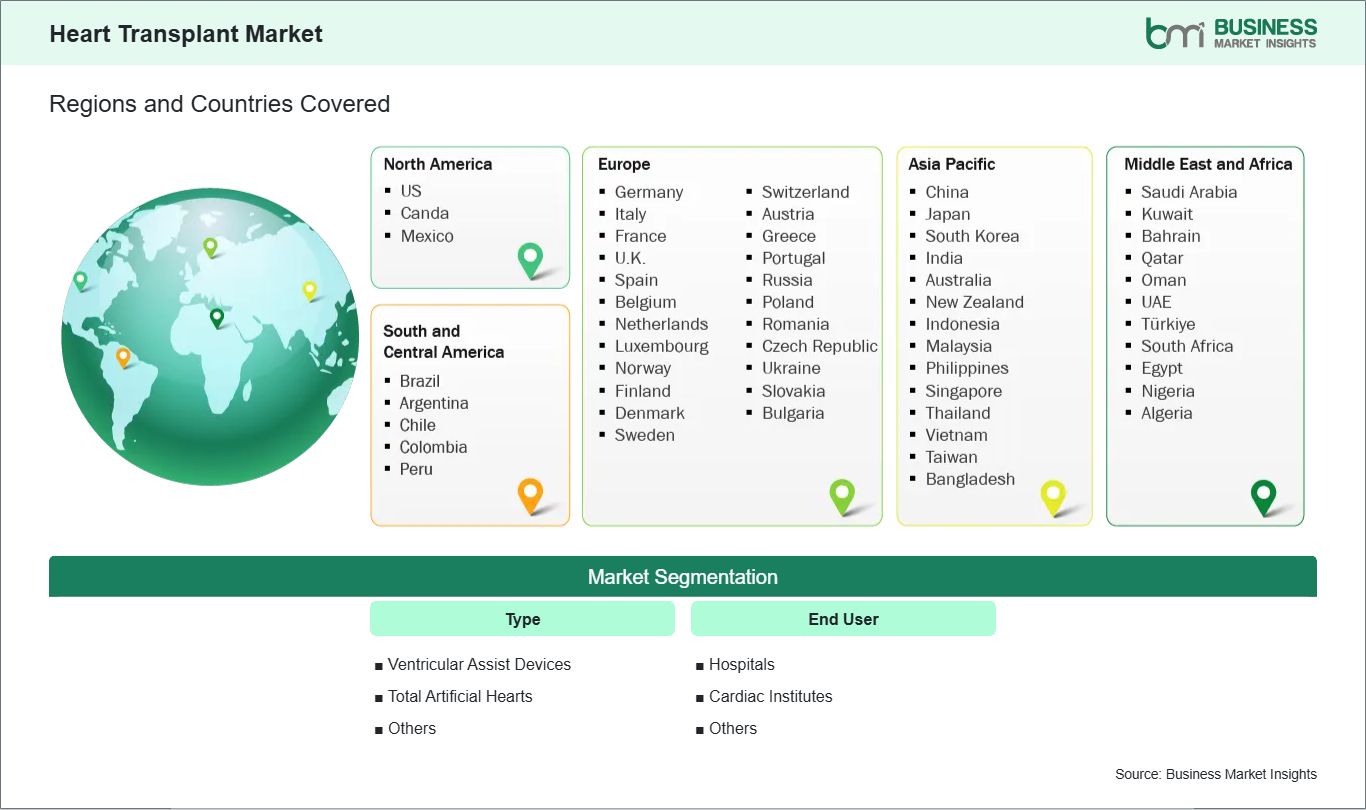
Key segments that contributed to the derivation of the Heart Transplant Market analysis are type and end user.
- By Type, the market is segmented into Ventricular Assist Devices, Total Artificial Hearts, and Others.
- By End User, the market is segmented into Hospitals, Cardiac Institutes, and Others.
Market Forces
Heart Transplant Market Drivers and Opportunities
Increasing Prevalence of End-Stage Heart Failure
The key regulator fuelling the growth of the Heart Transplant Market is the increasing number of cases of end-stage heart failure worldwide, surpassing 64 million, and expected to increase with the growing geriatric population and cardiovascular conditions. Illnesses such as coronary artery diseases, hypertensive disorders, and viral cardiomyopathy frequently lead to irreversible heart failures, and the sole cure at this stage is a transplant, ensuring a 12-14-year survival rate. Advanced technologies in the form of echocardiographies and/or cardiac MRI are used for prior screening of potential recipients, and awareness programs and registering centers facilitate waiting list management. This leads to increasing demand for organ acquisitions, instrumentation, and immunosuppressives, increasing by 5–10% in developed countries, thus contributing directly to market revenue generation.
Advancements in Organ Preservation and Xenotransplantation
A significant market opportunity is presented by the advancements and innovations that have occurred within organ preservation and the development of xenotransplantation, which would solve the recurrent shortage of available organs and prevent the annual death of over 20% of the waiting list recipients. Machine perfusion technology, such as hypothermic oxygen perfusion, has extended the available time for using the heart from 4–6 hours to 12+ hours by restoring the organ’s energy and protecting the cells from ischemic-reperfusion injury, increasing the number of available organs by 20–30%. Organized, on the other hand, are the use of pig heart organs that have been gene-edited using the CRISPR technique and have shown the ability to survive for up to two months post-human trials, and the potential for an unlimited supply of organs.
Size and Share Analysis
Heart Transplant Market Size and Share Analysis
The Heart Transplant Market demonstrates consistent growth, with size and share analysis revealing strong positioning of key players in organ preservation and pharmaceuticals. The report examines subsegments within type and end user for their market contributions.
For instance, the Total Artificial Hearts subsegment dominates the market by type due to lifelong patient use post-transplant, generating recurring revenue unlike one-time donor heart procurement. Hospitals remain the top end-user segment, fueled by specialized infrastructure and high procedure complexity.
Report Coverage
Heart Transplant Market Report Coverage and Deliverables
The "Heart Transplant Market Size and Forecast (2022 - 2033)" report provides a detailed analysis of the market covering below areas:
- Heart Transplant Market size and forecast at global, regional, and country levels for all the key market segments covered under the scope
- Heart Transplant Market trends, as well as market dynamics such as drivers, restraints, and key opportunities
- Heart Transplant Market analysis covering key market trends, global and regional framework, major players, regulations, and recent market developments
- Industry landscape and competition analysis covering market concentration, heat map analysis, prominent players, and recent developments for the Heart Transplant Market
- Detailed company profiles, including SWOT analysis
Geographic Insights
Heart Transplant Market Geographic Insights
The geographical scope of the Heart Transplant Market report is divided into five regions: North America, Asia Pacific, Europe, Middle East & Africa, and South & Central America.
North America dominates the Heart Transplant Market with the largest revenue share, attributed to advanced transplant networks like UNOS, high procedure volumes, substantial R&D funding, and favorable reimbursement policies.
Asia Pacific is projected as the fastest-growing region, propelled by expanding healthcare access in China and India, rising cardiovascular disease prevalence, government investments in transplant infrastructure, and growing organ donation programs.
Industry Activity
Recent Developments
The Heart Transplant Market is evaluated by gathering qualitative and quantitative data post-primary and secondary research, which includes important corporate publications, association data, and databases. A few of the key developments in the Heart Transplant Market are:
- In June 2025, CARMAT announced the first implants of its Aeson® artificial heart in a commercial set-up, outside the European Union.
- In March 2025, Boston Scientific Corporation announced to have entered into a definitive agreement to acquire SoniVie Ltd., a privately held medical device company that developed the TIVUS™ Intravascular Ultrasound System. An investigational technology, the TIVUS system is designed to denervate nerves surrounding blood vessels to treat a variety of hypertensive disorders, including renal artery denervation for hypertension.
- In January 2025, SynCardia Systems, LLC (“SynCardia”, or the “Company”) announced that the China National Intellectual Property Administration notified the Company of the administration’s decision to grant SynCardia its first patent covering the Company’s next-generation total artificial heart. This patent describes novel technology aimed at eliminating external drive mechanisms by fully integrating the pumping mechanism within the implanted artificial heart ventricle.
Trust & Transparency
Research Methodology
The market analysis combines proprietary research with secondary data from government agencies, company disclosures, regulatory filings, industry databases and expert interviews. Market estimates are validated through data triangulation, cross-market benchmarking and analyst
review.
View Full Research Methodology
Key Sources Referred:
World Bank - Global Trade IndicatorsWorld Trade Organization (WTO)International Monetary Fund (IMF)International Trade Administration (ITA)Company WebsitesCompany Annual ReportsCompany Investor Presentations