Market Summary
Executive Summary and Global Market Analysis
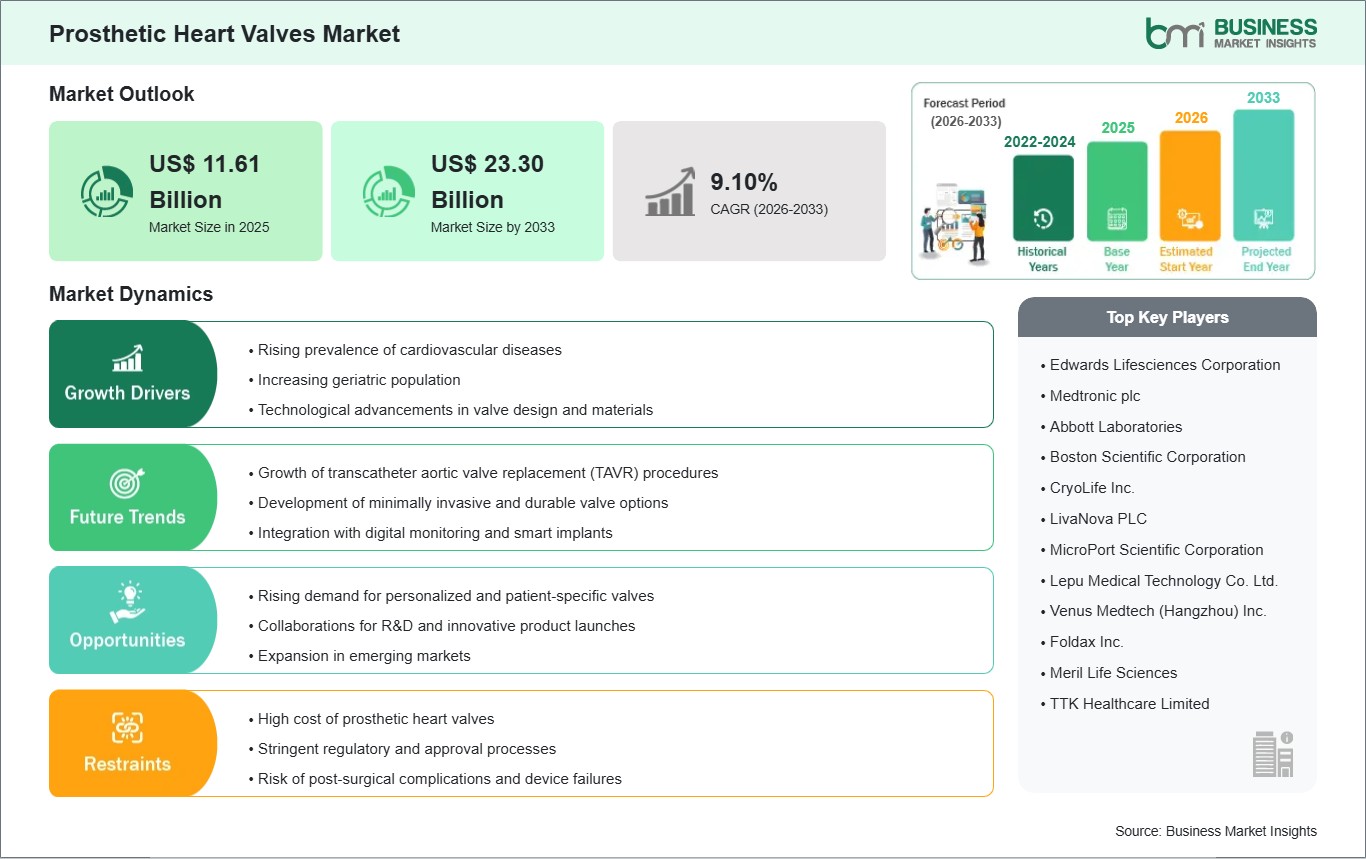
A prosthetic heart valve is an implantable medical device engineered to replicate the function of a native heart valve that has become stenotic or insufficient. These devices provide significant clinical and strategic value by restoring cardiac hemodynamics and reducing the risk of heart failure in millions of patients worldwide. Market growth is primarily driven by the global increase in population aging, the rapid adoption of Transcatheter Aortic Valve Replacement (TAVR) for low-to-intermediate risk patients, and the rising prevalence of rheumatic and degenerative heart diseases. Additionally, the transition to next-generation polymeric valves, which combine the durability of mechanical valves with the advantage of not requiring lifelong anticoagulation, is expanding the eligible patient population.
Several challenges may impede market growth. High procedural costs and device prices for transcatheter systems continue to restrict adoption in cost-sensitive emerging markets. Limited long-term durability data for bioprosthetic valves in younger patient cohorts remains a clinical concern, frequently resulting in potential re-interventions such as Valve-in-Valve procedures. Furthermore, the industry is constrained by a shortage of specialized interventional cardiologists and insufficient catheterization laboratory capacity outside major Tier-1 metropolitan hospitals.
Despite these challenges, the market presents substantial opportunities, including the expansion of transcatheter technologies for mitral and tricuspid valve positions and the increasing use of artificial intelligence-driven diagnostic screening for early detection of asymptomatic stenosis. The development of 3D-printed patient-specific valves and broader reimbursement coverage in middle-income countries are also anticipated to drive long-term market growth.
Segment Analysis
Prosthetic Heart Valves Market Segmentation
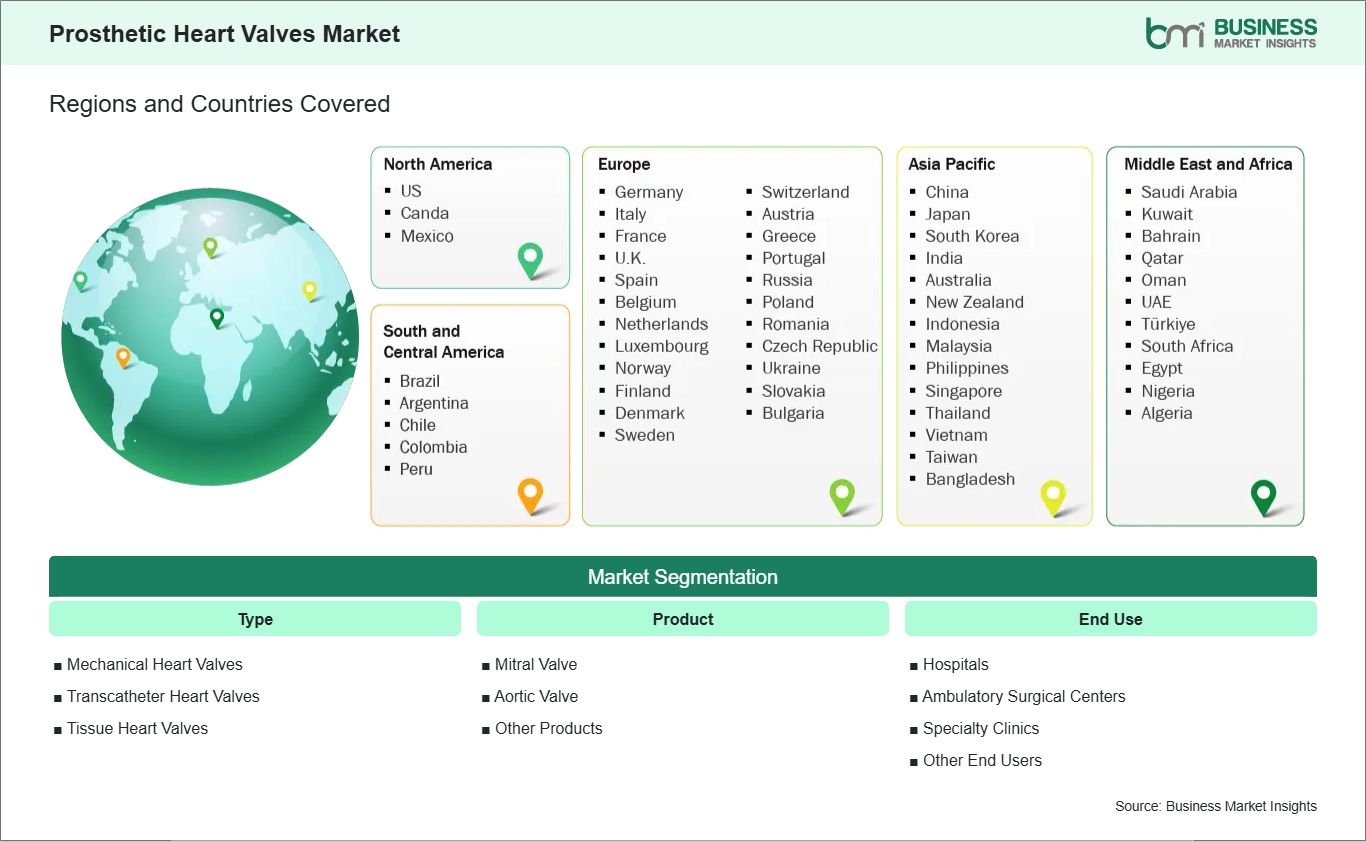
Key segments that contributed to the derivation of the Prosthetic Heart Valves market analysis are type, product, and end use.
- By Type, the market is segmented into Mechanical Heart Valves, Transcatheter Heart Valves, and Tissue Heart Valves.
- By Product, the market is categorized into Mitral Valve, Aortic Valve, and Others
- By End Use, the market is divided into Hospitals, Ambulatory Surgical Centers, Specialty Clinics, and Others
Market Forces
Prosthetic Heart Valves Market Drivers and Opportunities
Demographic Aging and the Mainstreaming of Transcatheter Therapies
The primary driver of the Prosthetic Heart Valves Market is the increasing global prevalence of valvular heart diseases, including aortic stenosis and mitral regurgitation, which are predominantly associated with an aging population. The expanding geriatric demographic serves as a key catalyst, as degenerative valve conditions become more prevalent with age, necessitating reliable replacement solutions to restore cardiac function. This trend is further supported by the widespread adoption of Transcatheter Aortic Valve Replacement (TAVR). Initially reserved for high-risk patients, these minimally invasive procedures are now being extended to low-risk and younger populations, resulting in a significant rise in valve implantations. Technological advancements in anti-calcification treatments and materials science also play a critical role by increasing the durability of bioprosthetic valves and reducing the long-term need for intensive anticoagulation therapy. Additionally, favorable reimbursement policies and early diagnosis initiatives are improving access to these high-cost interventions, prompting earlier treatment in the disease progression. Collectively, these factors, demographic changes, the expansion of transcatheter procedures, and enhanced material durability, are driving sustained and technologically advanced growth in the global heart valves market.
Size and Share Analysis
Prosthetic Heart Valves Market Size and Share Analysis
The Prosthetic Heart Valves market demonstrates steady growth, with size and share analysis revealing evolving trends and competitive positioning among key players. The report examines subsegments categorized within type, product, and end use, offering insights into their contribution to overall market performance.
Based on type, Mechanical Heart Valves, Transcatheter Heart Valves, and Tissue Heart Valves constitute the primary market subsegments, each representing a distinct technological approach to valve replacement. Mechanical Heart Valves are considered the industry standard for durability, particularly for younger patient populations, due to their capacity to function without structural failure throughout a patient`s lifetime, contingent upon consistent anticoagulation therapy. Recent market trends indicate significant growth in the Transcatheter Heart Valves (THV) and Tissue Heart Valves subsegments. Transcatheter Heart Valves are increasingly utilized for high- and intermediate-risk patients, as they facilitate the Valve-in-Valve procedure, which allows for the replacement of a failing tissue valve with a transcatheter unit, thereby eliminating the need for repeat open-heart surgery. Concurrently, Tissue Heart Valves (bioprosthetic) are being enhanced with advanced bovine or porcine tissue to improve hemodynamic performance and reduce thrombogenicity, making them attractive to active patients seeking to avoid long-term anticoagulation therapy.
Report Coverage
Prosthetic Heart Valves Market Report Coverage and Deliverables
The "Prosthetic Heart Valves Market Size and Forecast (2022–2033)" report provides a detailed analysis of the market covering below areas:
- Prosthetic Heart Valves market size and forecast at global, regional, and country levels for all market segments covered under the scope
- Prosthetic Heart Valves market trends, as well as drivers, restraints, and opportunities
- Prosthetic Heart Valves market analysis covering key trends, global and regional framework, major players, regulations, and recent developments
- Industry landscape and competition analysis covering market concentration, heat map analysis, prominent players, and recent developments for the Prosthetic Heart Valves market
- Detailed company profiles, including SWOT analysis
Geographic Insights
Prosthetic Heart Valves Market Geographic Insights
The geographical scope of the Prosthetic Heart Valves market report is divided into five regions: North America, Asia Pacific, Europe, Middle East & Africa, and South & Central America.
North America maintains its dominance in the global market, supported by a highly developed cardiovascular healthcare network and the rapid adoption of Transcatheter Aortic Valve Replacement (TAVR) among low-risk patient groups. Europe retains a strong position, distinguished by comprehensive reimbursement policies for bioprosthetic valves and robust clinical research into sutureless valve technologies. The Asia Pacific region is the fastest-growing market, driven by an aging population and substantial government investments in cardiac care infrastructure, particularly in China and India.
The Asia-Pacific Prosthetic Heart Valves Market is segmented into China, Japan, South Korea, India, Australia, and the rest of Asia Pacific. China serves as a primary growth driver, shifting toward large-scale domestic production of transcatheter valves to enhance affordability and decrease dependence on imports. In India, demand is increasing due to a higher prevalence of rheumatic heart disease and the growth of specialized private cardiac centers. Japan's market remains technologically advanced, emphasizing MRI-conditional and long-durability valves to address the needs of an aging population.
Industry Activity
Recent Developments
The Prosthetic Heart Valves market is evaluated by gathering qualitative and quantitative data post primary and secondary research, which includes important corporate publications, association data, and databases. A few of the key developments in the Prosthetic Heart Valves market are:
- In January 2024, Medtronic launched the Avalus Ultra™ surgical aortic tissue valve in the U.S., building on 10 years of clinical experience with the Avalus™ valve. The device features a low-profile design, PEEK base frame, radiopaque coil for valve-in-valve procedures, and optimized hemodynamics, supporting ease of implantation and lifetime patient management. This launch strengthens Medtronic`s portfolio in the prosthetic heart valve market and advances surgical options for patients with aortic stenosis.
- In May 2024, Edwards Lifesciences received FDA approval for the SAPIEN 3, SAPIEN 3 Ultra, and SAPIEN 3 Ultra RESILIA Transcatheter Heart Valve System for use in replacing failing previously implanted surgical biological mitral valves in intermediate- and high-risk patients. This expansion strengthens minimally invasive treatment options in the prosthetic heart valve market.
Trust & Transparency
Research Methodology
The market analysis combines proprietary research with secondary data from government agencies, company disclosures, regulatory filings, industry databases and expert interviews. Market estimates are validated through data triangulation, cross-market benchmarking and analyst
review.
View Full Research Methodology
Key Sources Referred:
World Bank – Global Trade IndicatorsWorld Trade Organization (WTO)(International Monetary Fund )IMFInternational Trade Administration (ITA)Company websiteCompany annual reportsCompany investor presentations