Market Summary
Executive Summary and Global Market Analysis
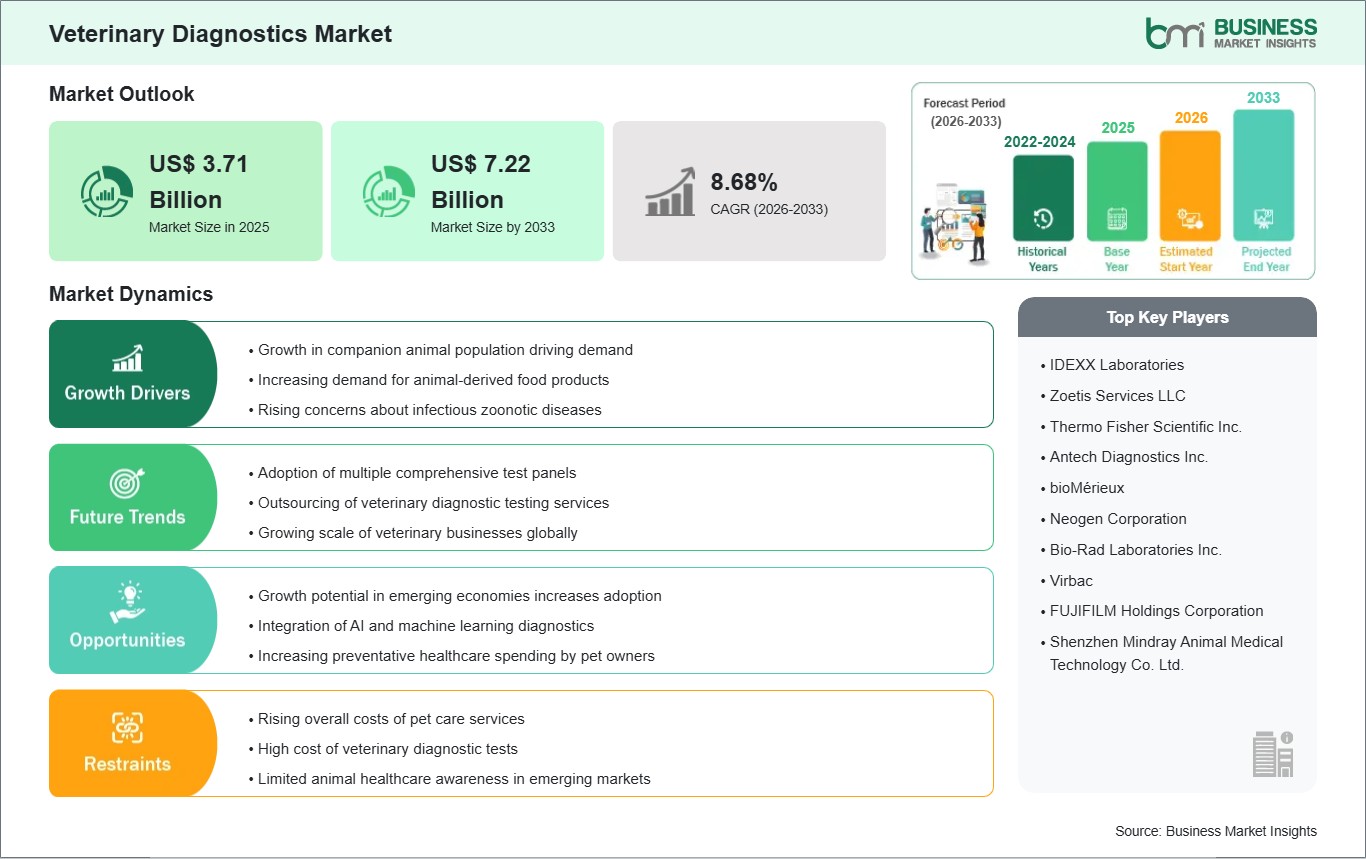
Veterinary diagnostics are specialized clinical tools, assays, and imaging technologies used by veterinary professionals to identify the presence of disease, monitor health status, and manage the biological well-being of animals. These tools deliver critical strategic value by facilitating early disease intervention, improving the success rates of complex treatments, and ensuring the safety of the global food supply chain through rigorous livestock monitoring. Market expansion is primarily attributed to the global trend of pet humanization, where owners increasingly view animals as family members deserving of advanced medical care, and the rising demand for rapid, point-of-care (POC) testing in clinical settings. Furthermore, the shift toward integrated digital health platforms, which combine diagnostic hardware with cloud-based data management, is substantially enhancing the diagnostic accuracy and operational efficiency of modern veterinary practices.
However, several factors can restrain market growth. High procedural and equipment costs remain a significant barrier, particularly for specialized molecular tests or advanced imaging, which can limit accessibility for lower-income pet owners and small-scale livestock farmers. Shortages of trained veterinary technicians and laboratory professionals in rural or emerging regions can lead to underutilization of advanced diagnostic hardware. Additionally, the industry faces constraints due to stringent and varied regulatory pathways across different geographies, which can delay the commercial rollout of innovative diagnostic assays and AI-integrated software solutions.
Despite these hurdles, the market holds immense opportunities in the development of AI-powered diagnostic analyzers that can automate image and data interpretation. The rise of specialized pet insurance, which lowers the financial barrier for high-end diagnostic workups, and the expansion of zoonotic disease surveillance programs are expected to support long-term development within the sector.
Segment Analysis
Veterinary Diagnostics Market Segmentation
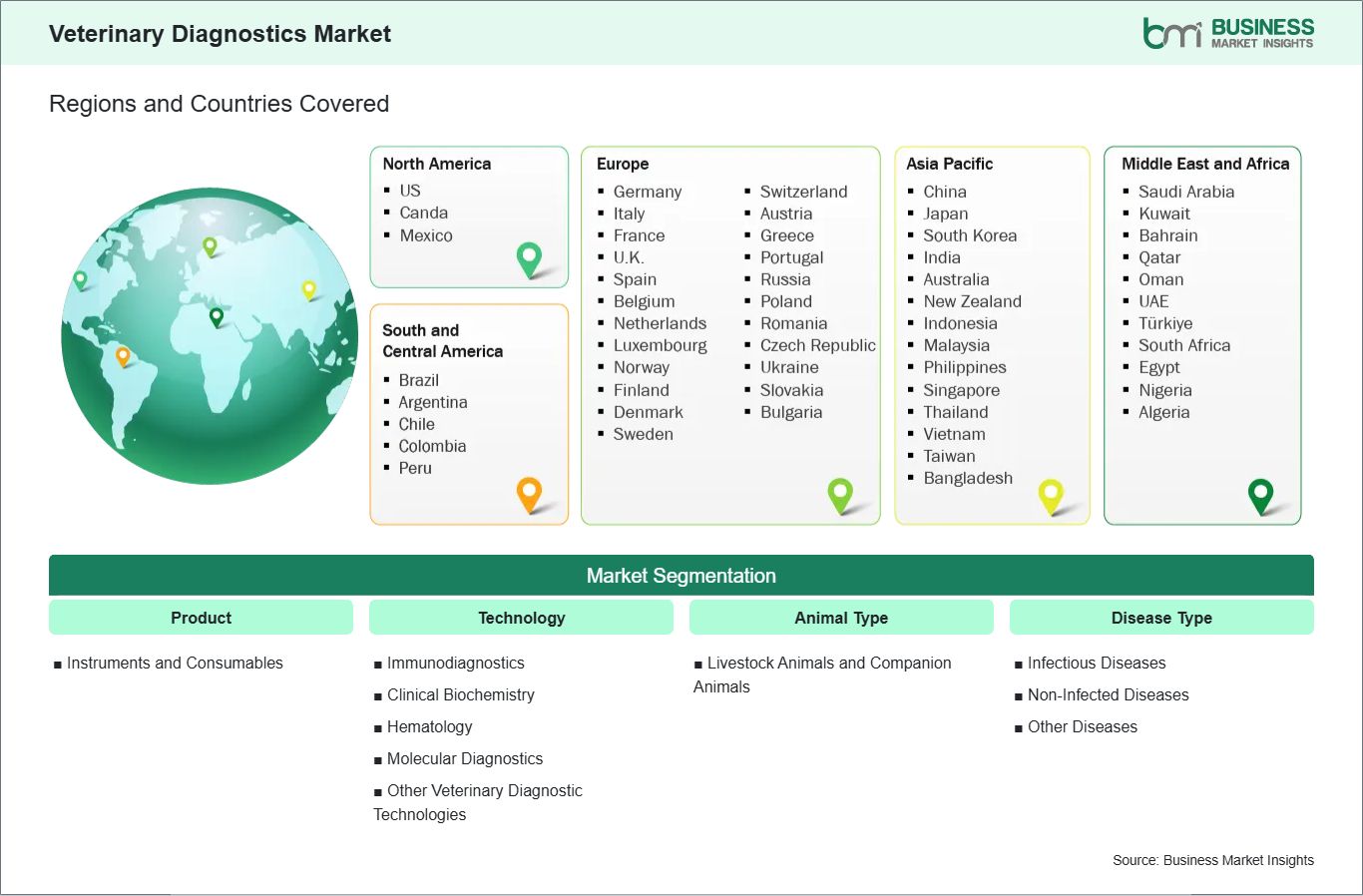
Key segments that contributed to the derivation of the Veterinary Diagnostics market analysis are product, technology, animal type, and disease type.
- By Product, the market is segmented into Instruments and Consumables.
- By Technology, the market is categorized into Immunodiagnostics, Clinical Biochemistry, Hematology, Molecular Diagnostics, and Other Veterinary Diagnostic Technologies.
- By Animal Type, the market is divided into Livestock Animals and Companion Animals.
- By Disease Type, the market is segmented into Infectious Diseases, Non-Infected Diseases, and Other Diseases.
Market Forces
Veterinary Diagnostics Market Drivers and Opportunities
Animal Humanization and the Proliferation of Zoonotic Surveillance
The primary driver for the Veterinary Diagnostics Market is the systemic global rise in pet ownership and the intensifying humanization of companion animals. The Growing Expenditure on Preventive Healthcare for Pets acts as a foundational catalyst, as owners increasingly treat animals as family members, opting for regular wellness screenings and advanced diagnostic workups previously reserved for human medicine. This momentum is further propelled by the Rising Prevalence of Zoonotic and Foodborne Diseases; as pathogens like avian influenza and rabies pose continuous threats to public health, governments are mandating rigorous diagnostic surveillance in livestock to ensure food safety and prevent cross-species transmission. In the technological sphere, the Rapid Advancements in Molecular Diagnostics and PCR Miniaturization serve as critical drivers, making high-sensitivity testing accessible in rural and field settings.
Furthermore, the Expansion of Pet Insurance Coverage is lowering the financial barriers to high-cost diagnostics like MRI and specialized blood panels, encouraging more frequent and thorough testing. Together, these factors, the emotional bond with pets, public health mandates, and diagnostic accessibility, ensure a high-velocity growth path for the global veterinary diagnostics market.
AI-Driven Cytology and Wearable Biometric Integration
A significant high-value opportunity lies in the convergence of Veterinary Diagnostics with Artificial Intelligence (AI) and Machine Learning. Next-generation diagnostic platforms are now utilizing AI for automated image analysis of blood smears and fecal samples, providing lab-grade cytology results in minutes without the need for an on-site pathologist. There is also a major growth frontier in the development of Wearable Biometric Sensors and Continuous Monitoring Tools; by integrating diagnostic sensors into smart collars or ear tags, veterinarians can track real-time physiological data, such as heart rate variability and temperature, to detect subclinical illnesses before visible symptoms appear. Furthermore, the expansion of Genomic Testing for Breed-Specific Conditions presents a lucrative opportunity, as breeders and owners seek personalized health plans based on an individual animal`s genetic predisposition to metabolic or orthopedic disorders. Beyond the clinic, the rise of Tele-Diagnostic Platforms and Cloud-Based Data Management offers a unique frontier, where diagnostic results are instantly uploaded to a global network for specialist review and epidemiological tracking. Manufacturers who focus on Multi-Analyte Single-Drop Blood Systems and those pioneering CRISPR-Based Rapid Pathogen Detection are positioned to lead the most innovative and high-margin segments of the global veterinary diagnostics market.
Size and Share Analysis
Veterinary Diagnostics Market Size and Share Analysis
The Veterinary Diagnostics market demonstrates steady growth, with size and share analysis revealing evolving trends and competitive positioning among key players. The report examines subsegments categorized within product, technology, animal type, and disease type, offering insights into their contribution to overall market performance.
Based on product, the Consumables and Instruments subsegment holds the primary market presence, representing the recurring revenue and foundational infrastructure of the industry. Consumables, including specialized reagents and test kits, are indispensable for the market, as the high frequency of routine wellness checks and infectious disease screening ensures a continuous demand for these essential supplies. A notable trend is the surge in the Instruments subsegment, particularly AI-Powered Analyzers and Automated Imaging Systems, which are registering higher interest. These advanced platforms are becoming essential for Modern Veterinary Hospitals, as they offer high-throughput capabilities and reduce human error, allowing clinics to scale their diagnostic offerings without a proportional increase in technical staff.
Report Coverage
Veterinary Diagnostics Market Report Coverage and Deliverables
The "Veterinary Diagnostics Market Size and Forecast (2022–2033)" report provides a detailed analysis of the market covering below areas:
- Veterinary Diagnostics market size and forecast at global, regional, and country levels for all market segments covered under the scope
- Veterinary Diagnostics market trends, as well as drivers, restraints, and opportunities
- Veterinary Diagnostics market analysis covering key trends, global and regional framework, major players, regulations, and recent developments
- Industry landscape and competition analysis covering market concentration, heat map analysis, prominent players, and recent developments for the Veterinary Diagnostics market
- Detailed company profiles, including SWOT analysis
Geographic Insights
Veterinary Diagnostics Market Geographic Insights
The geographical scope of the Veterinary Diagnostics market report is divided into five regions: North America, Asia Pacific, Europe, Middle East & Africa, and South & Central America.
North America maintains a prominent market position, supported by extensive pet ownership and a highly developed veterinary infrastructure that prioritizes advanced molecular and immunodiagnostic testing.
Europe represents a mature and technologically sophisticated market where demand is sustained by stringent animal health regulations and a strong emphasis on preventive care for both companion and livestock animals.
Asia Pacific is identified as the most rapidly advancing region, propelled by accelerating urbanization, rising disposable incomes, and significant public and private investments in animal health surveillance to mitigate zoonotic disease risks.
The Asia-Pacific Veterinary Diagnostics Market is segmented into China, Japan, South Korea, India, Australia, and the Rest of Asia Pacific. China serves as a central hub for market expansion, driven by a growing middle class with a strong preference for pet humanization and increased government focus on food safety within the livestock sector. India is experiencing notable growth in demand as the dairy industry modernizes and domestic awareness of specialized veterinary services increases. Japan and South Korea continue to prioritize high-specification diagnostic equipment, focusing on the integration of artificial intelligence and point-of-care (POC) systems to address the needs of an aging pet population and optimize clinical workflows.
Industry Activity
Recent Developments
The Veterinary Diagnostics market is evaluated by gathering qualitative and quantitative data post primary and secondary research, which includes important corporate publications, association data, and databases. A few of the key developments in the Veterinary Diagnostics market are:
- In Dec 2025, KVP International acquired SafePath-IVD and IVD Research, strengthening its veterinary diagnostics capabilities. The acquisition enhances R&D, expands rapid and point-of-care diagnostic solutions, and supports innovation and global distribution, positively impacting the veterinary diagnostics market.
- In December 2024, Zoetis announced the Vetscan OptiCell™, a cartridge-based, AI-enabled point-of-care hematology analyzer for veterinary clinics. The device delivers rapid, accurate blood counts, and streamlines workflows.
Trust & Transparency
Research Methodology
The market analysis combines proprietary research with secondary data from government agencies, company disclosures, regulatory filings, industry databases and expert interviews. Market estimates are validated through data triangulation, cross-market benchmarking and analyst
review.
View Full Research Methodology
Key Sources Referred:
World Bank – Global Trade Indicators World Trade Organization (WTO) (International Monetary Fund )IMF International Trade Administration (ITA) Company website Company annual reports Company investor presentations