Tissue Diagnostics Market Outlook (2022-2033)

Historic Data: 2022 - 2024   |   Base Year: 2025   |   Forecast Period: 2026-2033
Report Content: Market Scope, Market Segmentation, Market Dynamics, and Competitive Analysis

Report Coverage:
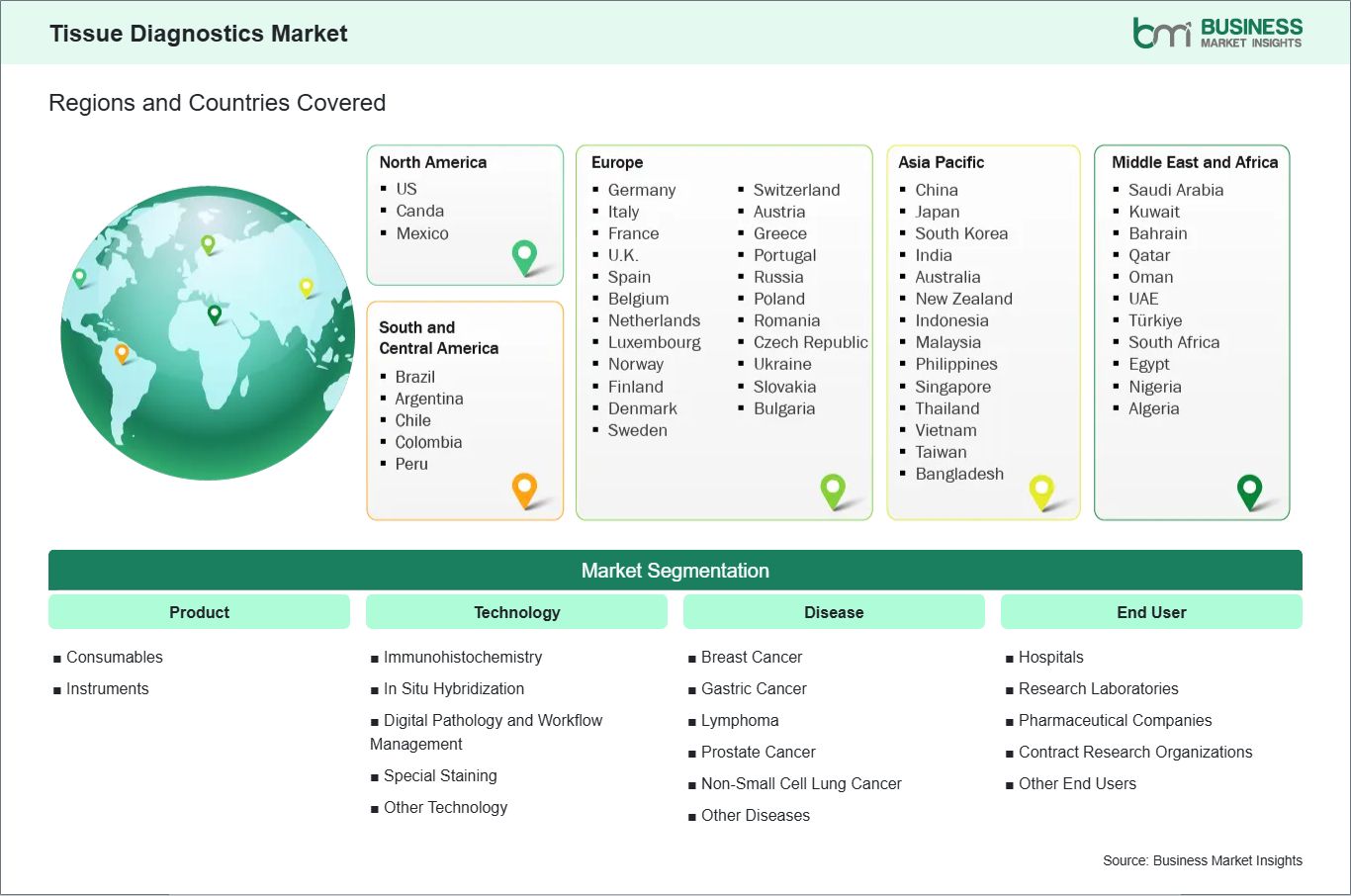
  • Product (Consumables, Instruments)
  • Technology (Immunohistochemistry, In Situ Hybridization, Digital Pathology and Workflow Management, Special Staining, Other Technology)
  • Disease (Breast Cancer, Gastric Cancer, Lymphoma, Prostate Cancer, Non-Small Cell Lung Cancer, Other Diseases)
  • End User (Hospitals, Research Laboratories, Pharmaceutical Companies, Contract Research Organizations, Other End Users)

No. of Pages: 400
Report Code: BMIPUB00032635
Category: Life Sciences
Tissue Diagnostics Market
Buy Now

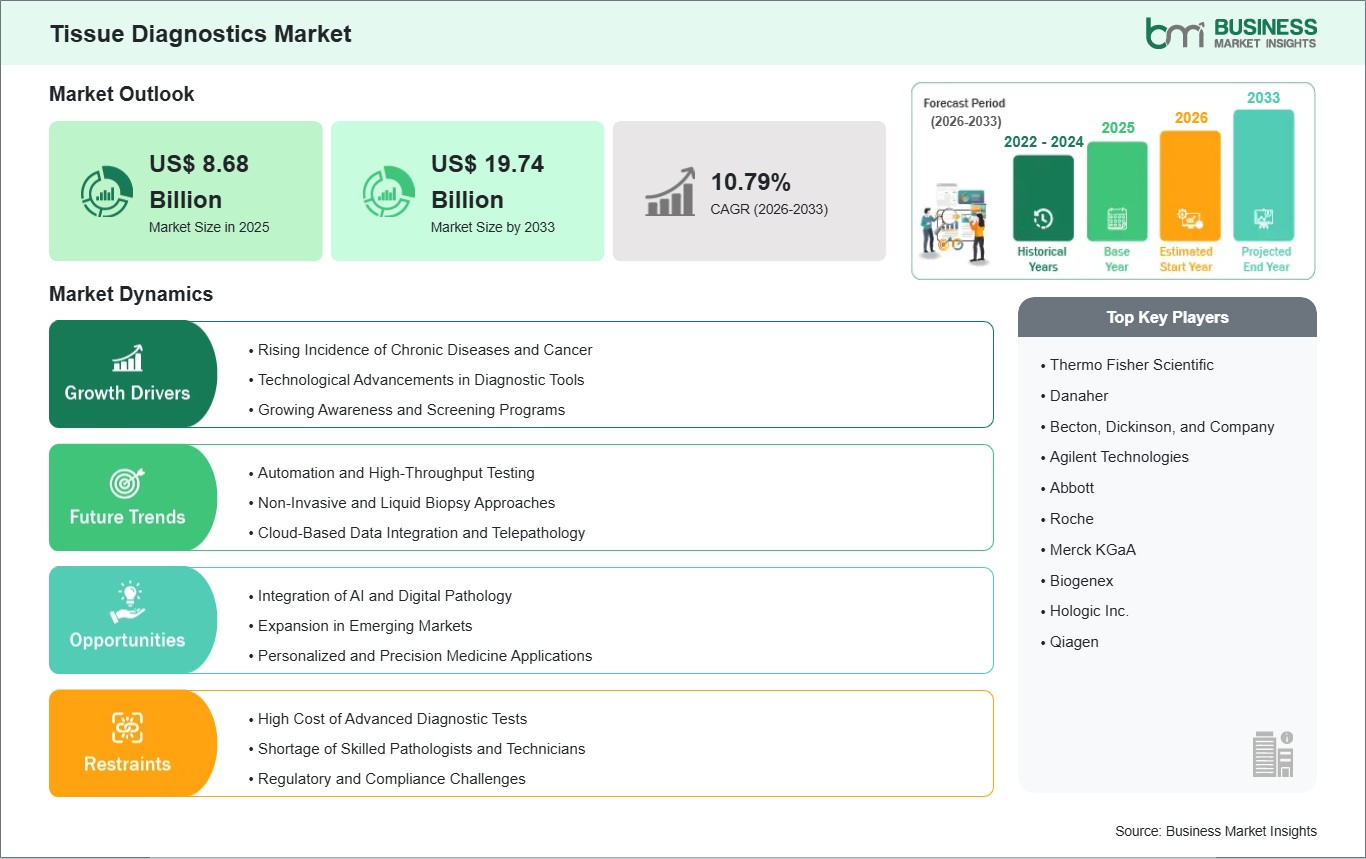
The tissue diagnostics market size is expected to reach US$ 19.74 billion by 2033 from US$ 8.68 billion in 2025. The market is estimated to record a CAGR of 10.79% from 2026 to 2033.

Executive Summary and Global Market Analysis:

The tissue diagnostics market represents a crucial part of medical diagnostics and embodies the analysis of tissue samples aimed at disease detection, characterization, and monitoring & primarily through the care of patients with malignant tumors and those with chronic illnesses. Tissue diagnostics encompass methods such as immunohistochemistry (IHC), in situ hybridization (ISH), histopathology, and the digital pathology workflow, all of which serve as tools for pathologists in their evaluation of cellular and molecular changes in biopsied tissue. The use of these technologies has become a necessary part of accurate disease diagnosis, staging, prognosis, and treatment planning, forming the core component of current precision oncology and personalized medicine, which always depends on tumors' molecular fingerprints. The growing worldwide incidence of cancer and chronic diseases is a significant factor in the increase of the tissue diagnostics market since clinicians are increasingly taking recourse to detailed tissue analysis to make informed therapeutic decisions and targeted treatments. For example, biomarker assessments, such as HER2 or PD-L1 expression, are now considered the primary factor in selecting the entire target therapy, thereby reinforcing the role of tissue-based diagnostics in the treatment pathway.

The introduction of new technologies is yet another major factor. Digital pathology, as well as the use of artificial intelligence (AI), is the most common reason for changing the order of the diagnostic workflow by improving image analysis accuracy, making the process faster, and allowing collaboration among specialists regardless of their location. Using whole-slide imaging in conjunction with AI algorithms enables the repetitive analysis of the same high standard with a large output, thereby addressing the shortage of pathologists while ensuring more consistent diagnoses. Additionally, the laboratory is more efficient due to the automation of every step & from sample preparation to slide scanning & the human error factor is minimized.

Even with good momentum, the market is still hindered by multiple limitations, including the high prices of sophisticated diagnostic tools and consumables, the strict regulations that slow down the introduction of new products, and the limited availability of these products in underdeveloped areas due to a lack of awareness and poorly developed infrastructure. Emerging markets are the source of opportunities, as the enlarging healthcare budget and the development of diagnostic facilities are making access to modern tissue diagnostics easier. The progress of personalized medicine, along with its connection to molecular profiling, also increases the range of clinical applications and their adoption.

In general, the tissue diagnostics market is undergoing change due to the development of new digital and molecular technologies, which are making diagnostics more precise, speeding up workflow, and enabling more effective disease control in all clinical settings.

Tissue Diagnostics Market - Strategic Insights:

global-market-strategic-framework
Get more information on this report

Tissue Diagnostics Market Segmentation Analysis:

Key segments that contributed to the derivation of the tissue diagnostics market analysis are product, technology, disease, and end user.

  • By product, the tissue diagnostics market is bifurcated into consumables, instruments. The consumables segment dominated the market in 2025.
  • By technology, the market is segmented into immunohistochemistry, in situ hybridization, digital pathology and workflow management, special staining, other technology. The immunohistochemistry segment held the largest share of the market in 2025.
  • By disease, the market is segmented into breast cancer, gastric cancer, lymphoma, prostate cancer, non-small cell lung cancer, other diseases. The breast cancer segment held the largest share of the market in 2025.
  • By end user, the market is segmented into hospitals, research laboratories, pharmaceutical companies, contract research organizations, other end users. The hospitals segment held the largest share of the market in 2025.

Tissue Diagnostics Market Drivers and Opportunities:

Rising Incidence of Chronic Diseases and Cancer

The growing number of chronic diseases and cancer is driving demand for tissue diagnostics, as more accurate and timely analysis of tissue samples becomes essential. Worldwide, chronic illnesses like cancer, heart disease, and diabetes cause most deaths, with cancer alone adding millions of new cases each year and making up a large part of the global disease burden. Tissue diagnostics, including histopathology, immunohistochemistry (IHC), and molecular tests, play a crucial role in confirming diagnoses, determining disease stage, and identifying biomarkers that guide personalized treatment. For instance, the World Health Organization’s cancer agency recently reported about 20 million new cancer cases worldwide, and this number is expected to rise in the coming decades due to changes in population, environment, and lifestyle that increase chronic disease risk.

As cancer rates rise in many groups, including younger people and those not usually at risk, healthcare systems are focusing more on early detection and accurate analysis of tissue changes. This shift has led hospitals and laboratories to utilize more diagnostic technologies, as doctors require advanced tissue analysis to personalize treatments, such as targeted cancer therapies that rely on detailed tissue profiles. The increasing number of older adults worldwide also adds to this trend, as they are more likely to have chronic conditions that need regular monitoring and diagnosis.

In summary, as chronic diseases like cancer become more common, tissue diagnostics are becoming a vital part of modern healthcare. They enhance diagnostic accuracy, support personalized medicine, and aid doctors in making more informed treatment decisions, ultimately leading to improved patient outcomes.

Integration of AI and Digital Pathology

The combination of AI and digital pathology presents a significant opportunity for the tissue diagnostics market, as it revolutionizes the entire process of analysis, interpretation, and sharing of tissue samples across clinical workflows. Digital pathology platforms, which transform traditional glass slides into high-resolution whole-slide images, are increasingly combined with AI-driven analysis tools that automatically detect cellular patterns, quantify biomarkers, and highlight areas for review, thereby significantly improving the precision and consistency of diagnostics through the combination of AI and human interpretation. Over the last few years, more than 60% of major hospitals have adopted AI-assisted digital pathology systems, reporting a reduction in diagnostic errors that can be measured and an increase in the speed of turnaround times for complex cases, particularly in cancer.

The incorporation of AI enables more efficient work for pathologists, who can now automate tasks such as tissue segmentation, anomaly detection, and IHC scoring, thereby saving time and effort. This allows specialists to focus on complex diagnoses and clinical decisions. AI has been utilized in a real-world case to significantly reduce the time required to review cases, while simultaneously increasing the number of diagnoses made and overall productivity.

The gains that come with efficiency are not the only thing that results from this technological alliance; it also brings about standardization in the laboratories which is one of the main advantages in the fight against the inconsistency caused by manual tissue analysis — and it also makes possible remote collaboration and telepathology, thus giving access to expert interpretation even in areas where pathology resources are scarce.

Tissue Diagnostics Market Size and Share Analysis:

By product, the tissue diagnostics market is bifurcated into consumables, instruments. The consumables segment dominated the market in 2025. The consumables segment is defined by essential reagents, antibodies, slides, stains, probes, and fixatives used in the processing and analysis of tissues. These products drive accurate diagnostics and underpin histopathology, immunohistochemistry, and molecular assays. High repeat usage, strict adherence to standardized workflows, and relentless research demand position consumables as the most stable and high-volume segment in the tissue diagnostics market.          

By technology, the market is segmented into immunohistochemistry, in situ hybridization, digital pathology and workflow management, special staining, other technology. The immunohistochemistry segment held the largest share of the market in 2025. Immunohistochemistry (IHC) is a staining method that uses antibodies to find specific proteins in cells from tissue samples. If the target protein is present in tumor cells, the antibody attaches and causes a visible color change under a microscope. IHC helps doctors select the most effective drug treatments and is commonly used in research, cancer diagnosis, and the development of new therapies.

By disease, the market is segmented into breast cancer, gastric cancer, lymphoma, prostate cancer, non-small cell lung cancer, other diseases. The breast cancer segment held the largest share of the market in 2025. The increase in breast cancer cases, linked to lifestyle changes and an aging population, is fueling this trend. New products and advances in genomic testing kits, which provide more information about a tumor’s genetics, are also boosting growth in this area.

By end user, the market is segmented into hospitals, research laboratories, pharmaceutical companies, contract research organizations, other end users. The hospitals segment held the largest share of the market in 2025. The use of tissue diagnostic systems and services in hospitals and clinics has increased over time. Many doctors now prefer tissue diagnostic tests instead of traditional methods. Since conventional tests take longer, the quicker results from tissue diagnostics are encouraging this change.

Tissue Diagnostics Market Report Highlights:

Report Attribute Details
Market size in 2025 US$ 8.68 Billion
Market Size by 2033 US$ 19.74 Billion
Global CAGR (2026 - 2033)10.79%
Historical Data 2022 - 2024
Forecast period 2026-2033
Segments Covered By Product
  • Consumables
  • Instruments
By Technology
  • Immunohistochemistry
  • In Situ Hybridization
  • Digital Pathology and Workflow Management
  • Special Staining
  • Other Technology
By Disease
  • Breast Cancer
  • Gastric Cancer
  • Lymphoma
  • Prostate Cancer
  • Non-Small Cell Lung Cancer
  • Other Diseases
By End User
  • Hospitals
  • Research Laboratories
  • Pharmaceutical Companies
  • Contract Research Organizations
  • Other End Users
Regions and Countries Covered North America
  • US
  • Canada
  • Mexico
Europe
  • Belgium
  • Austria
  • Finland
  • Denmark
  • Greece
  • Poland
  • Romania
  • Russia
  • Ukraine
  • Czech Republic
  • Slovakia
  • Bulgaria
  • Italy
  • Luxembourg
  • Germany
  • Switzerland
  • France
  • Netherlands
  • Norway
  • Portugal
  • Spain
  • Sweden
  • United Kingdom
Asia-Pacific
  • Australia
  • China
  • India
  • Japan
  • South Korea
  • Indonesia
  • Malaysia
  • Philippines
  • Singapore
  • Thailand
  • Vietnam
  • Bangladesh
  • New Zealand
  • Taiwan
South and Central America
  • Brazil
  • Argentina
  • Peru
  • Chile
  • Colombia
Middle East and Africa
  • Bahrain
  • Kuwait
  • Oman
  • Qatar
  • Saudi Arabia
  • United Arab Emirates
  • Turkiye
  • South Africa
  • Egypt
  • Algeria
  • Nigeria
Market leaders and key company profiles
  • Thermo Fisher Scientific
  • Danaher
  • Becton, Dickinson, and Company
  • Agilent Technologies
  • Abbott
  • Roche
  • Merck KGaA
  • Biogenex
  • Hologic Inc.
Get more information on this report

Tissue Diagnostics Market Report Coverage and Deliverables:

The "Tissue Diagnostics Market Size and Forecast (2022–2033)" report provides a detailed analysis of the market covering below areas:

  • tissue diagnostics market size and forecast at global, regional, and country levels for all the key market segments covered under the scope
  • tissue diagnostics market trends, as well as market dynamics such as drivers, restraints, and key opportunities
  • tissue diagnostics market analysis covering key market trends, global and regional framework, major players, regulations, and recent market developments
  • Industry landscape and competition analysis covering market concentration, heat map analysis, prominent players, and recent developments for the tissue diagnostics market
  • Detailed company profiles, including SWOT analysis

Tissue Diagnostics Market Geographic Insights:

The geographical scope of the tissue diagnostics market report is divided into five regions: North America, Asia Pacific, Europe, Middle East & Africa, and South & Central America. The tissue diagnostics market in Asia Pacific is expected to grow significantly during the forecast period.

The Asia-Pacific tissue diagnostics market is segmented into China, Japan, South Korea, India, Australia, and the rest of Asia. The tissue diagnostics market in the Asia Pacific region is experiencing rapid growth, primarily due to the increasing incidence of cancer in countries such as China, India, Japan, and South Korea. As more people are diagnosed with cancer, there is a greater need for advanced diagnostic technologies that help with early detection and effective treatment. In 2022, the WHO South-East Asia reported about 2.2 million new cancer cases and 1.4 million cancer-related deaths, which made up over 10% of all deaths in the region. Lung cancer caused 10.6% of these deaths, breast cancer 9.4%, and cervical cancer 8%. This increase in cancer cases shows why better diagnostic tools are needed to accurately find and stage tumors.

In China, the tissue diagnostics market is also experiencing rapid expansion. Cancer is becoming a major public health issue there, with the National Institutes of Health (NIH) estimating 4,824,700 new cancer cases in 2022. Of these, 2,533,900 were in men and 2,290,800 in women, with an Age-Standardized Incidence Rate (ASIR) of 208.58 per 100,000 people. This rise in cancer cases is expected to drive demand for more advanced and accurate diagnostic tools, further fueling the growth of the tissue diagnostics market in China.

global-market-geography
Get more information on this report

Tissue Diagnostics Market Research Report Guidance:

  • The report includes qualitative and quantitative data in the tissue diagnostics market across product, application, end user, and geography.
  • The report starts with the key takeaways (chapter 2), highlighting the key trends and outlook of the tissue diagnostics market.
  • Chapter 3 includes the research methodology of the study.
  • Chapter 4 further includes ecosystem analysis.
  • Chapter 5 highlights the major industry dynamics in the tissue diagnostics market, including factors that are driving the market, prevailing deterrents, potential opportunities, as well as future trends. Impact analysis of these drivers and restraints is also covered in this section.
  • Chapter 6 discusses the tissue diagnostics market scenario, in terms of historical market revenues, and forecast till the year 2031.
  • Chapters 7 to 10 cover tissue diagnostics market segments by product, application, end user, and geography across North America, Europe, Asia Pacific, Middle East and Africa, and South and Central America. They cover the market value revenue forecast and factors driving the market.
  • Chapter 11 describes the competitive analysis along with the heat map analysis for the key players operating in the market.
  • Chapter 12 describes the industry landscape analysis. It provides detailed descriptions of business activities such as market initiatives, new developments, mergers, and joint ventures globally, along with a competitive landscape.
  • Chapter 13 provides detailed profiles of the major companies operating in the tissue diagnostics market. Companies have been profiled on the basis of their key facts, business descriptions, products and services, financial overview, SWOT analysis, and key developments.
  • Chapter 14, i.e., the appendix is inclusive of a brief overview of the company, list of abbreviations, and disclaimer.

Tissue Diagnostics Market News and Key Development:

The tissue diagnostics market is evaluated by gathering qualitative and quantitative data post primary and secondary research, which includes important corporate publications, association data, and databases. A few of the key developments in the tissue diagnostics market are:

  • In January 2024, QIAGEN expanded its operations in the Middle East by opening new regional headquarters in Dubai, United Arab Emirates. This strategic move aligns with the company's goal of strengthening its presence in emerging markets and enhancing access to its molecular diagnostics and sample preparation technologies. The new headquarters will support key projects across healthcare, research, and industrial sectors, advancing QIAGEN's mission to grow its footprint in the region and foster local partnerships.
  • In February 2024, Merck KGaA inaugurated a new $21.88 million distribution center in Cajamar, São Paulo, Brazil, designed to enhance service for its life science clients. This investment enhances Merck’s operational efficiency and responsiveness, supporting the delivery of advanced tissue diagnostics solutions to the region.
  • In February 2024, Roche partnered with PathAI to develop AI-enabled digital pathology algorithms for the companion diagnostics market. This collaboration aims to increase the demand for personalized medicines by integrating AI-driven algorithms into digital pathology, thereby enhancing both the speed and accuracy of diagnostics.

Key Sources Referred:

  • World Bank – Global Trade Indicators
  • American Medical Association (AMA)
  • National Center for Biotechnology Information (NCBI)
  • National Library of Medicine (NLM)
  • Centers for Disease Control and Prevention (CDC)
  • Company website
  • National Institutes of Health (NIH)
  • International Hospital Federation (IHF)
  • Company annual reports
  • Company investor presentations

The List of Companies - Tissue Diagnostics Market

  • Thermo Fisher Scientific
  • Danaher
  • Becton, Dickinson, and Company
  • Agilent Technologies
  • Abbott
  • Roche
  • Merck KGaA
  • Biogenex
  • Hologic Inc.
  • Qiagen
Frequently Asked Questions
How big is the Tissue Diagnostics Market?

The Tissue Diagnostics Market is valued at US$ 8.68 Billion in 2025, it is projected to reach US$ 19.74 Billion by 2033.

What is the CAGR for Tissue Diagnostics Market by (2026 - 2033)?

As per our report Tissue Diagnostics Market, the market size is valued at US$ 8.68 Billion in 2025, projecting it to reach US$ 19.74 Billion by 2033. This translates to a CAGR of approximately 10.79% during the forecast period.

What segments are covered in this report?

The Tissue Diagnostics Market report typically cover these key segments-

  • Product (Consumables, Instruments)
  • Technology (Immunohistochemistry, In Situ Hybridization, Digital Pathology and Workflow Management, Special Staining, Other Technology)
  • Disease (Breast Cancer, Gastric Cancer, Lymphoma, Prostate Cancer, Non-Small Cell Lung Cancer, Other Diseases)
  • End User (Hospitals, Research Laboratories, Pharmaceutical Companies, Contract Research Organizations, Other End Users)

What is the historic period, base year, and forecast period taken for Tissue Diagnostics Market?

The historic period, base year, and forecast period can vary slightly depending on the specific market research report. However, for the Tissue Diagnostics Market report:

  • Historic Period : 2022 - 2024
  • Base Year : 2025
  • Forecast Period : 2026-2033
  • Who are the major players in Tissue Diagnostics Market?

    The Tissue Diagnostics Market is populated by several key players, each contributing to its growth and innovation. Some of the major players include:

  • Thermo Fisher Scientific
  • Danaher
  • Becton, Dickinson, and Company
  • Agilent Technologies
  • Abbott
  • Roche
  • Merck KGaA
  • Biogenex
  • Hologic Inc.
  • Qiagen
  • Who should buy this report?

    The Tissue Diagnostics Market report is valuable for diverse stakeholders, including:

    • Investors: Provides insights for investment decisions pertaining to market growth, companies, or industry insights. Helps assess market attractiveness and potential returns.
    • Industry Players: Offers competitive intelligence, market sizing, and trend analysis to inform strategic planning, product development, and sales strategies.
    • Suppliers and Manufacturers: Helps understand market demand for components, materials, and services related to concerned industry.
    • Researchers and Consultants: Provides data and analysis for academic research, consulting projects, and market studies.
    • Financial Institutions: Helps assess risks and opportunities associated with financing or investing in the concerned market.

    Essentially, anyone involved in or considering involvement in the Tissue Diagnostics Market value chain can benefit from the information contained in a comprehensive market report.

    Available Report Formats

    pdf-format excel-format pptx-format
    Buy Now

    Customization Form

    Please tell us your area of interest
    (Market Segments/ Regions and Countries/ Companies)