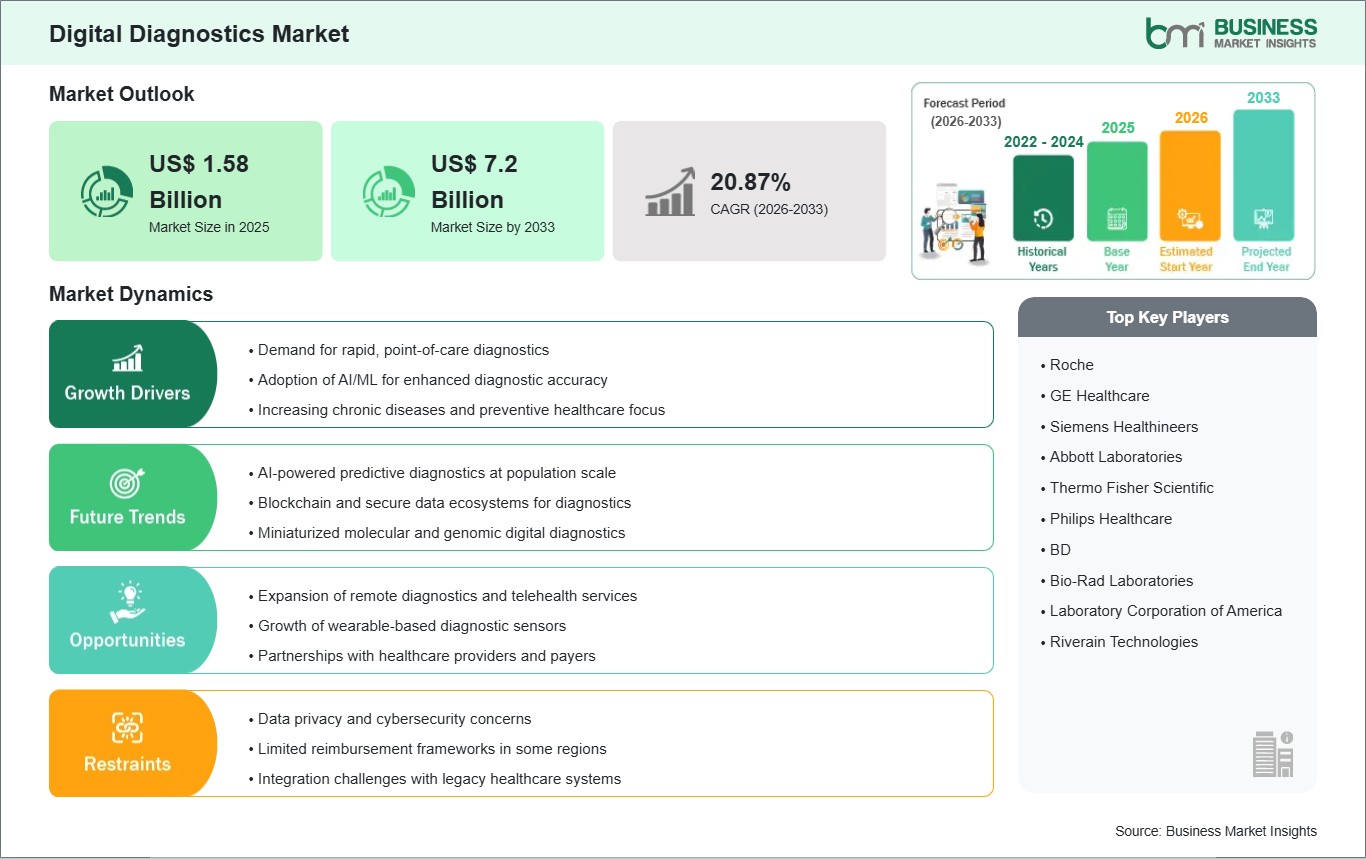
The Digital Diagnostics Market size is expected to reach US$ 7.2 billion by 2033 from US$ 1.58 billion in 2025. The market is estimated to record a CAGR of 20.87% from 2026 to 2033.
Digital diagnostics is the process by which modern digital technologies are utilized to identify, keep track of, and forecast the state of health conditions in much quicker, more precise, and more efficient ways than traditional ones. In most cases, these solutions are screens which, with the help of electronic health records and telemedicine systems, allow health data to be collected, patients to be monitored, and physicians to be supported in their decisions during consultations to the extent that they become more precise in their diagnosis and can thus intervene even before the disease breaks out throughout various applications in cardiology, oncology, and pathology, as well as in chronic disease management.
At present, the global market for digital diagnostics is expanding at a fast pace, and the main reason for this is the rising number of people suffering from chronic diseases, the growing need for early and correct diagnosis, and the acceptance of digital health solutions. Innovations in technology, especially AI-based imaging, point-of-care devices, and health-monitoring wearables, are changing the diagnostic processes and cutting down the reliance on traditional laboratory infrastructure. The market sees factories burning with investments and product introductions, while partnerships among major players in the sector are a further driving force behind the acceptance. North America is at the forefront presently due to strong healthcare IT infrastructure and early technology adoption, while Asia-Pacific has emerged as the fastest-growing region in the world because of healthcare investments, telemedicine use, and awareness of digital tools. Dangers such as data privacy issues and unusable systems still exist, but innovations in cloud workflow and personalized medicine are anticipated to be the major drivers of long-term growth and healthcare delivery transformation worldwide.

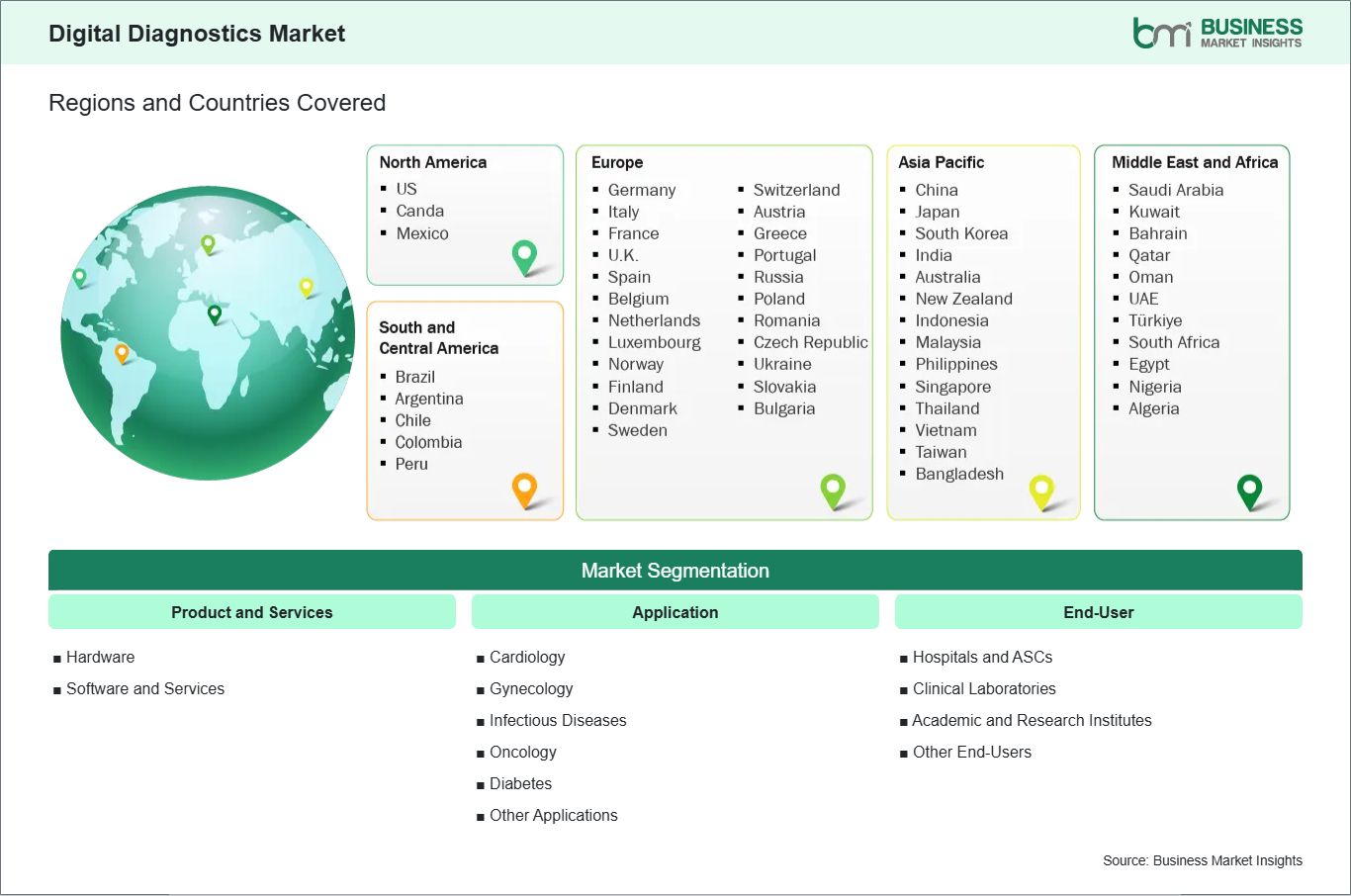
Key segments that contributed to the derivation of the digital diagnostics market analysis are product and services, application, and end-user.
The quick merger of artificial intelligence (AI) and machine learning (ML) came into the diagnostics workflow as a great force that drove the digital diagnostics market, leading to a very substantial improvement in the accuracy, speed, and efficiency of the whole process. Nowadays, AI-enabled diagnostics are being used in all imaging modalities like X-ray, MRI, and ultrasound, among others, and they are able to spot the presence of anomalies much quicker and with more accuracy than traditional techniques. The influence of AI is seen in innovations like GE HealthCare's Sonic DL AI MRI algorithm, which not only speeds up the scan analysis but also improves the resolution and the platforms that decrease human error and aid real-time data interpretation. AI's ability to reduce the interpretation of high-volume data, lower clinician stress, and promote the use of personalized treatment paths is making it the main reason for investments and the worldwide acceptance of such technology, thereby transforming the diagnostic fields of radiology, pathology, cardiology, and oncology.
The digital diagnostics market has a remarkable chance to take off due to the gradual increase in integration of telemedicine and remote patient monitoring systems, which are driven by the digitalization of healthcare. As telehealth services become a regular part of the practice—thanks to the demand for remote care and convenience—tools for digital diagnostics are being used on virtual platforms to provide real-time diagnostic results without the need for in-person visits. This integration promotes wider healthcare access, especially in rural and underserved areas where there is limited traditional diagnostic infrastructure. The most recent progress indicates that wearable health devices with new powerful features (e.g., smartwatches performing biomarker analysis for personalized insights) are illustrating how consumer technology can be coupled with clinical diagnostics and thus facilitate market adoption. Moreover, smartphone-based as well as home diagnostic tools are becoming popular, giving patients the advantage of early detection and allowing clinicians to get remote data for faster intervention. The above scenario of telehealth growing and regulatory frameworks adapting to digital care models points to the convergence of digital diagnostics with telemedicine as a transformative opportunity not only to improve care delivery but also to enhance patient outcomes on a global scale.
By product and services, the digital diagnostics market is bifurcated into hardware, software and services. The software and services segment dominated the market in 2025. The software and services segment lead due to its critical role in interpreting complex diagnostic data, enabling AI-based image analysis, clinical decision support, and integration with healthcare IT systems. Advanced software solutions improve diagnostic accuracy, streamline workflows, and support data analytics across devices, making them indispensable for modern digital diagnostics. This strong value proposition and rising adoption by providers drive its leading position over hardware and services.
By application, the market is segmented into cardiology, gynecology, infectious diseases, oncology, diabetes, other applications. The oncology segment held the largest share of the market in 2025. Within applications, oncology leads as digital diagnostics are heavily applied in cancer detection, where advanced imaging, biomarker analysis, and AI tools enhance early diagnosis and treatment planning. The high global burden of cancer and need for precise, data-driven tools has accelerated adoption in this segment, giving it a larger market share compared to other disease areas.
By end-user, the digital diagnostics market is segmented into hospitals and ASCS, clinical laboratories, academic and research institutes, other end-users. The hospitals and ASCS segment dominated the market in 2025. Hospitals and ambulatory surgical centers (ASCs) dominate because they require comprehensive diagnostic capabilities across specialties, high patient volumes, and substantial healthcare IT infrastructure. Their multi-specialty care environment and investment capacity enable broad deployment of digital diagnostics hardware and software, making them the primary end users.
| Report Attribute | Details |
|---|---|
| Market size in 2025 | US$ 1.58 Billion |
| Market Size by 2033 | US$ 7.2 Billion |
| Global CAGR (2026 - 2033) | 20.87% |
| Historical Data | 2022 - 2024 |
| Forecast period | 2026-2033 |
| Segments Covered | By Product and Services
|
|
Regions and Countries Covered
| |
| North America | US, Canada, Mexico |
| Europe | Belgium, Austria, Finland, Denmark, Greece, Poland, Romania, Russia, Ukraine, Czech Republic, Slovakia, Bulgaria, Italy, Luxembourg, Germany, Switzerland, France, Netherlands, Norway, Portugal, Spain, Sweden, United Kingdom |
| Asia-Pacific | Australia, China, India, Japan, South Korea, Indonesia, Malaysia, Philippines, Singapore, Thailand, Vietnam, Bangladesh, New Zealand, Taiwan |
| South and Central America | Brazil, Argentina, Peru, Chile, Colombia |
| Middle East and Africa | Bahrain, Kuwait, Oman, Qatar, Saudi Arabia, United Arab Emirates, Turkiye, South Africa, Egypt, Algeria, Nigeria |
| Market leaders and key company profiles |
|
The " Digital Diagnostics Market Size and Forecast (2022–2033)" report provides a detailed analysis of the market covering below areas:
The geographical scope of the digital diagnostics market report is divided into five regions: North America, Asia Pacific, Europe, Middle East & Africa, and South & Central America. The digital diagnostics market in Asia Pacific is expected to grow significantly during the forecast period.
The Asia-Pacific digital diagnostics market is segmented into China, Japan, South Korea, India, Australia, New Zealand, Indonesia, Malaysia, the Philippines, Singapore, Thailand, Vietnam, Taiwan, Bangladesh, and the Rest of Asia. The Asia-Pacific digital diagnostics market is experiencing robust growth due to several factors that are coming together to change the way healthcare is delivered and technology adoption. The main reason for this change is the increased use of telemedicine and remote patient monitoring, which makes it possible for clinicians to use digital diagnostic tools, such as wearable sensors and mobile health apps, to monitor and diagnose patients outside the hospital, especially in rural areas where access to healthcare is limited. The pandemic of COVID-19 has played a major role in this trend, as it created a new and enduring market for remote consultations and digital care solutions.
The other major reason for this growth is the increase in the number of people suffering from chronic and age-related diseases in countries like China, India, Japan, and South Korea. This situation has made the demand for efficient diagnostic processes that would provide timely detection and management even greater. Governments in the Asia-Pacific region are also investing massively in healthcare digitalization, such as by making the necessary infrastructure, cloud systems, and electronic health systems available to support the integration of AI, machine learning, and other advanced diagnostic technologies. In addition to that, there is a growing consumer awareness of preventive healthcare, rising disposable incomes, and better quality in digital imaging and AI analytics, which are the factors that are collectively encouraging adoption by hospitals, clinics, and patients, leading to sustained growth in the region.

The digital diagnostics market is evaluated by gathering qualitative and quantitative data post primary and secondary research, which includes important corporate publications, association data, and databases. A few of the key developments in the digital diagnostics market are:
The Digital Diagnostics Market is valued at US$ 1.58 Billion in 2025, it is projected to reach US$ 7.2 Billion by 2033.
As per our report Digital Diagnostics Market, the market size is valued at US$ 1.58 Billion in 2025, projecting it to reach US$ 7.2 Billion by 2033. This translates to a CAGR of approximately 20.87% during the forecast period.
The Digital Diagnostics Market report typically cover these key segments-
The historic period, base year, and forecast period can vary slightly depending on the specific market research report. However, for the Digital Diagnostics Market report:
The Digital Diagnostics Market is populated by several key players, each contributing to its growth and innovation. Some of the major players include:
The Digital Diagnostics Market report is valuable for diverse stakeholders, including:
Essentially, anyone involved in or considering involvement in the Digital Diagnostics Market value chain can benefit from the information contained in a comprehensive market report.
Please tell us your area of interest
(Market Segments/ Regions and Countries/ Companies)