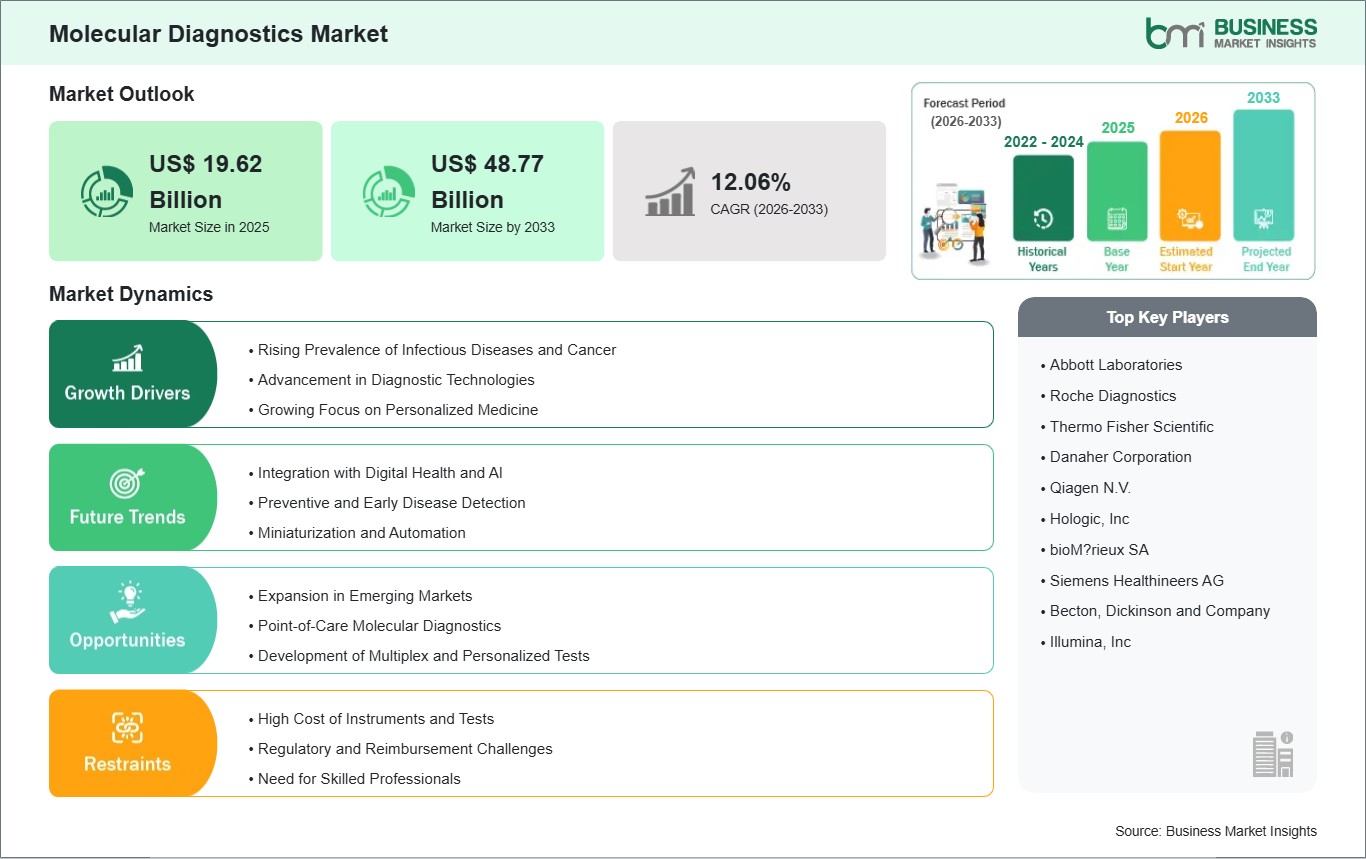
Market Summary
Executive Summary and Global Market Analysis
The global molecular diagnostics market experiences a major shift as healthcare systems across the globe put more focus on early and accurate disease detection in order to improve patient outcomes and cope with the increasing disease burdens. The market is flooded with demands for rapid and accurate diagnostic solutions for infectious diseases, oncology, genetic disorders, and chronic conditions, which is driven by clinical necessity and the growth of personalized medicine. The mentioned technologies such as PCR, next, generation sequencing (NGS), and isothermal amplification are at the center of this change as they allow very sensitive and specific detection of pathogens and genetic markers.
The rising occurrence of infectious diseases such as tuberculosis, HIV, and newly emerging pathogens, in combination with the focus on early detection of cancer, is the main reason for the strong uptake of molecular testing platforms. On top of that, regulatory initiatives that support the market, growing healthcare infrastructure in developing countries, and increasing investment in advanced diagnostic research are some of the factors that contribute to the market growth. In terms of regions, North America is still holding a leading position due to strong healthcare infrastructure and the widespread adoption of advanced diagnostics while the Asia Pacific region becomes the fastest, growing one because of increasing healthcare expenditure and growing biotech sectors. Two of the most talked, about points in the future of molecular diagnostics are point, of, care testing and digital health initiatives that will improve accessibility and clinical utility.
Segment Analysis
Molecular Diagnostics Market Segmentation
Key segments that contributed to the derivation of the Molecular Diagnostics market analysis are component, technology, application, and end user.
- By component, the molecular diagnostics market is segmented into instruments, reagents and kits. The reagents and kits segment dominated the market in 2024.
- By technology, the market is segmented polymerase chain reaction, next-generation sequencing (NGS) / DNA sequencing, in situ hybridization, DNA microarrays, others. The polymerase chain reaction segment held the largest share of the market in 2024.
- By application, the market is segmented into infectious diseases, oncology, genetic disorders, companion diagnostics, others. The infectious diseases segment held the largest share of the market in 2024.
- By end user, the market is segmented into hospitals and clinics, diagnostic laboratories, academic and research institutes, others. The hospitals and clinics segment held the largest share of the market in 2024.
Market Forces
Molecular Diagnostics Market Drivers and Opportunities
Rising Demand for Early and Accurate Disease Detection
Due to an increase in the demand for accurate and timely detection of disease, there is a rapid evolution in how healthcare services are provided globally. Molecular diagnostics allow for the accurate identification of specific pathogens and pathological changes (e.g., genetic changes) which aid in diagnosing a specific disease or abnormality early in the disease course. Early diagnosis with molecular techniques has proven critical to improving patient outcomes particularly within the fields of oncology, infectious diseases, inherited genetic disorders and is essential for developing successful treatment protocols for patients diagnosed with these conditions. The rapid increase in chronic and infectious diseases globally, including cancer, tuberculosis, HIV, and emerging virus outbreaks, coupled with the shift toward personalized medicine and the use of targeted therapies, are creating an urgent need for reliable molecular testing platforms. Hospitals, clinics and diagnostic laboratories are developing and implementing innovative techniques such as polymerase chain reactions, next-generation sequencing, and isothermal amplification to address the need for reliable molecular testing solutions to support personalized medicine and targeted therapies. There is an increasing emphasis on preventive care and early intervention from both healthcare providers and policymakers and, as a result, molecular diagnostics represent a critical component for improving the health of a population, decreasing future healthcare costs, and improving decision-making in clinical practice.
Expansion of Point-of-Care Diagnostics and Emerging Markets
The growth in use of point-of-care (POC) diagnostic solutions is fueling the growth of the Molecular Diagnostics Market. The introduction of technology-driven innovations which are smaller, faster, and better to use have led to the creation of POC molecular testing systems that are deployable outside traditional laboratory environments (e.g. clinics, rural clinics, and even in low-resource locations). Timely diagnosis of disease provides an essential tool to clinicians regarding decision-making for immediate clinical intervention regarding infectious disease outbreaks and monitoring patients for cancer therapy. While many of the world’s emerging economies (e.g. Asia-Pacific, Latin America, and Africa) are benefiting from increased healthcare spending, developed medical infrastructure, and increased familiarity with molecular testing, these regions are ripe for increased growth in the molecular diagnostics market. The increased incidence of infectious diseases, as well as ongoing government support in these regions for enhancing diagnostic capabilities, are aiding in-creased adoption of molecular testing in these areas. Furthermore, there is an increasing interest and demand for lower cost and higher accuracy POC molecular tests that can expand into untapped markets due to the availability of new technologies. Establishing business relationships with local healthcare providers, investing in mobile/portable diagnostic systems, and developing culturally and regionally specific testing procedures and products are additional areas for growth and potential market entry. Leveraging trends in the above categories will allow companies to broaden their brand awareness, increase access to healthcare services, and support long-term growth within the Market.
Size and Share Analysis
Molecular Diagnostics Market Size and Share Analysis
By component, the molecular diagnostics market is segmented into instruments, reagents and kits. The reagents and kits segment dominated the market in 2024. The demand for reagents and kits is largely a consequence of the increasing number of diagnostic tests and the growing adoption of advanced molecular techniques. As healthcare providers keep on expanding testing for infectious diseases, oncology, and genetic disorders, consumables are perpetually required, thus this segment becomes the main market driver.
By technology, the market is segmented into polymerase chain reaction, next-generation sequencing (NGS) / DNA sequencing, in situ hybridization, DNA microarrays, others. The polymerase chain reaction segment held the largest share of the market in 2024. Rapid, accurate, and reliable diagnostic results are the main factors behind PCR adoption. In addition, its versatility across different applications, low price, and established clinical use make it the most suitable test for both routine and specialized testing.
By application, the market is segmented into infectious diseases, oncology, genetic disorders, companion diagnostics, others. The infectious diseases segment held the largest share of the market in 2024. The prevalence of infectious diseases globally and the need for early detection as well as accurate identification of pathogens are the major factors leading to the growth of this segment.
By end user, the market is segmented hospitals and clinics, diagnostic laboratories, academic and research institutes, others. The hospitals and clinics segment held the largest share of the market in 2024. the rise in patient numbers, the need for fast diagnosis, and the growth of hospitals in both developed and emerging markets are the major factors that lead to the increase of this segment.
Report Coverage
Molecular Diagnostics Market Report Coverage and Deliverables
The "Molecular Diagnostics Market Size and Forecast (2022–2033)" report provides a detailed analysis of the market covering below areas:
- Molecular Diagnostics market size and forecast at global, regional, and country levels for all the key market segments covered under the scope
- Molecular Diagnostics market trends, as well as market dynamics such as drivers, restraints, and key opportunities
- Molecular Diagnostics market analysis covering key market trends, global and regional framework, major players, regulations, and recent market developments
- Industry landscape and competition analysis covering market concentration, heat map analysis, prominent players, and recent developments for the Molecular Diagnostics market
- Detailed company profiles, including SWOT analysis
Geographic Insights
Molecular Diagnostics Market Geographic Insights
The geographical scope of the Molecular Diagnostics market report is divided into five regions: North America, Asia Pacific, Europe, Middle East and Africa, and South and Central America. The Molecular Diagnostics market in Asia Pacific is expected to grow significantly during the forecast period.
The Asia-Pacific Molecular Diagnostics market is segmented into China, Japan, South Korea, India, Australia, New Zealand, Indonesia, Malaysia, the Philippines, Singapore, Thailand, Vietnam, Taiwan, Bangladesh, and the Rest of Asia. Increasing healthcare expenses, expanded infrastructure, and greater knowledge of advanced diagnostic technology has created a growing Asia Pacific market for molecular diagnostics. Countries such as China, India, Japan, South Korea, and Australia have experienced substantial growth in their utilization of molecular diagnostics for infectious disease testing as well as oncology, genetic disorders and personalized medicine. Infectious disease continues to pose large public health threats, with high incidence rates of tuberculosis, hepatitis, and HIV. The growing incidence of cancer and other genetic diseases is creating an urgent need for timely and accurate diagnosis, resulting in continued growth within this sector. Government initiatives to improve healthcare delivery, enhance the ability of health services to monitor disease, and create early detection programs have all contributed to increased utilization of molecular diagnostics. Many private diagnostic laboratories, hospitals and medical centres now have access to state-of-the-art molecular testing platforms and are expanding the availability of these tests to patients, particularly in urban and semi-urban environments. Point-of-care rapid molecular diagnostic devices are gaining additional momentum and increasing accessibility to diagnostic testing for patients living in remote and resource constrained settings. New digital health tools, including telemedicine services and electronic health records, are improving efficiency of testing and overall patient management. While the Asia Pacific region is also facing some challenges related to regulatory variability and the sensitivity of patients to costs; there are many opportunities for continued growth because of the large patient population in the Asia Pacific region with rising income levels and greater acceptance of innovative health solutions.
Industry Activity
Recent Developments
The Molecular Diagnostics market is evaluated by gathering qualitative and quantitative data post primary and secondary research, which includes important corporate publications, association data, and databases. A few of the key developments in the molecular diagnostics market are:
- In November 2025, Synthego, announced a strategic expansion of its product offerings with the launch of a new portfolio of high-performance molecular reagents. Building on its established leadership in CRISPR gene editing, Synthego now delivers essential PCR enzymes, RNA synthesis tools, and advanced isothermal amplification kits designed to meet the stringent requirements of diagnostic laboratories as well as the evolving needs of molecular biology research.
- In August 2025, Seegene Inc., unveiled two new technologies at ADLM 2025 in Chicago (July 29–31) designed to advance laboratory automation and data-driven infectious disease monitoring. The company introduced CURECA, world’s first fully unattended PCR automation system, and STAgora, a real-time data analytics platform intended to support earlier detection and precision care.
- In April 2025, Predicta Biosciences, launched its first Laboratory Developed Test (LDT): GenoPredicta for bone marrow or blood. The test measures a spectrum of genomic alterations and can be used by ordering physicians to molecularly diagnose individuals who have or are at risk for multiple myeloma and inform therapeutic management. The test is conducted in a CLIA-approved laboratory.
Trust & Transparency
Research Methodology
The market analysis combines proprietary research with secondary data from government agencies, company disclosures, regulatory filings, industry databases and expert interviews. Market estimates are validated through data triangulation, cross-market benchmarking and analyst
review.
View Full Research Methodology
Key Sources Referred:
World Bank – Global Trade Indicators
World Trade Organization (WTO)
Centers for Disease Control and Prevention (CDC)
World Health Organization (WHO)
(International Monetary Fund )IMF
International Trade Administration (ITA)
Company website
Company annual reports
Company investor presentations