
Touch Screen Display Market Outlook: Size, Share, Trends, Growth Analysis, Competitive Landscape & Forecast, 2026-2033

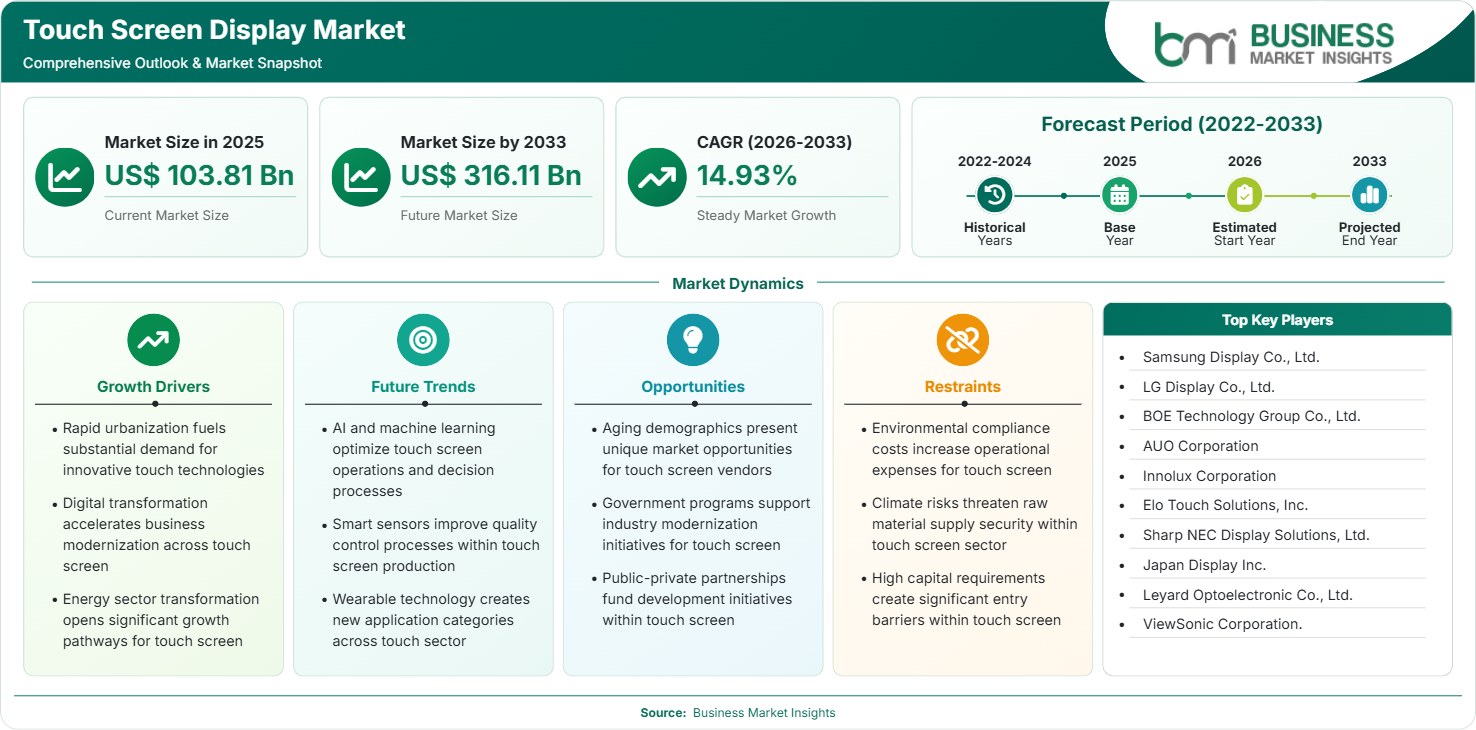
The Touch Screen Display Market size was valued at US$ 103.81 Billion in 2025 and is projected to reach US$ 316.11 Billion by 2033, growing at a CAGR of 14.93% during 2026–2033, driven by smart device adoption, interactive retail technologies, industrial automation, digital signage deployment, AI-enabled interfaces, and expanding opportunities across healthcare, transportation, education, and connected workplaces.

Report Coverage
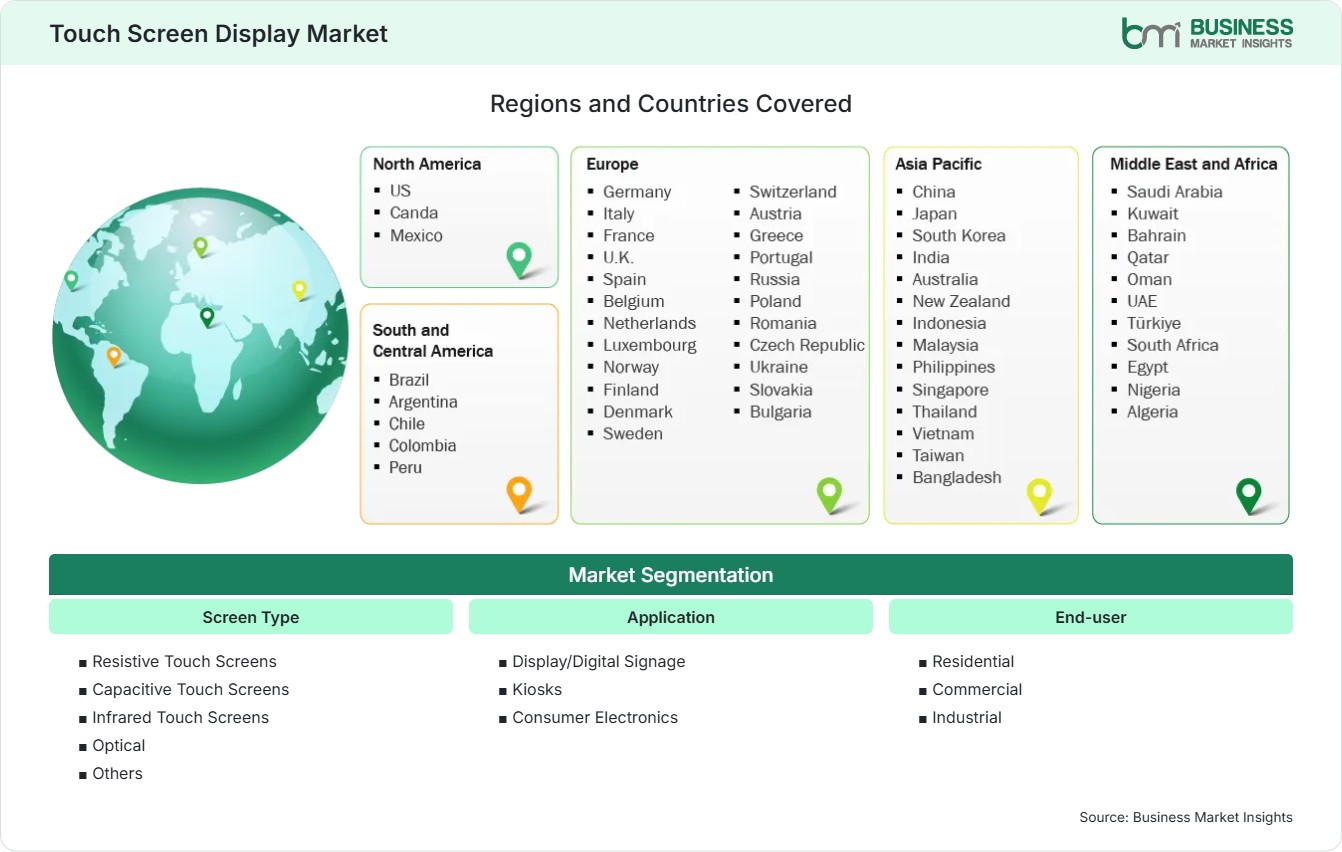
  • Screen Type: Resistive Touch Screens, Capacitive Touch Screens, Infrared Touch Screens, Optical, Others
  • Application: Display/Digital Signage, Kiosks, Consumer Electronics
  • End-user: Residential, Commercial, Industrial
US$ 103.81 Bn Market size in 2025
US$ 316.11 Bn Market Size by 2033
14.93% CAGR, 2026 - 2033
2026-2033 Forecast Period

AI Overview

Touch Screen Display Market Summary

  • North America Region: North America holds a Touch Screen Display Market share of 32%–35% in 2025, growing with a CAGR of 13.2%–14.2% during 2026–2033. Growth is supported by enterprise digitization, self-service infrastructure, automotive cockpit displays, retail modernization, healthcare technology investments, and interactive learning deployments across public and private institutions worldwide. US represents the dominant regional market, supported by advanced consumer electronics demand and a CAGR of 13.5%–14.5%.
  • Fastest Growing Region: Asia Pacific holds a market share of 28%–31% in 2025, growing with a CAGR of 16.8%–17.8% during 2026–2033. Expansion is supported by electronics manufacturing capacity, smartphone penetration, smart city projects, industrial digitalization, automotive innovation, and growing deployment of interactive display technologies throughout developing economies.
  • Leading Segment: Capacitive Touch Screens account for 48%–52% of the Touch Screen Display Market share in 2025 and advance at a CAGR of 15.2%–16.2%. Demand benefits from responsiveness, multi-touch functionality, durability, premium device integration, energy efficiency, and broad adoption in smartphones, tablets, wearables, laptops, automotive interfaces, and kiosks.
  • High Growth Segment: Consumer Electronics accounts for 42%–46% share in 2025 and advances at a CAGR of 15.8%–16.8%. Expansion reflects increasing shipments of smartphones, tablets, wearable devices, smart televisions, hybrid work hardware, premium displays, and AI-enabled connected consumer ecosystems globally.
  • Key Market Opportunity: Large-format interactive screens integrated with AI analytics, cloud platforms, and digital collaboration software are creating new revenue opportunities across retail, education, healthcare, transportation, hospitality, and smart workplace environments globally.
  • Major Market Players: Samsung Display Co., Ltd.; LG Display Co., Ltd.; BOE Technology Group Co., Ltd.; AUO Corporation; Innolux Corporation; Elo Touch Solutions, Inc.; Sharp NEC Display Solutions, Ltd.; Japan Display Inc.; Leyard Optoelectronic Co., Ltd.; ViewSonic Corporation.
Strategic Insights

Touch Screen Display Market: Strategic Insights

Touch Screen Display Market Strategic Framework
FREE PDF
Request your free sample
Request free sample
Stakeholder View

Key Takeaways

  • Supply chains increasingly integrate display panel manufacturers, touch sensor providers, controller chip vendors, software developers, and OEM assemblers, creating a highly interconnected value ecosystem.
  • Consumer electronics, interactive kiosks, and intelligent digital signage present the strongest growth potential due to expanding digital engagement requirements across enterprises and public infrastructure.
  • Innovation is shifting toward ultra-thin OLED touch integration, in-cell touch architectures, haptic feedback technologies, and AI-enabled user interfaces that improve responsiveness and user experiences.
  • Asia Pacific offers the most compelling manufacturing and consumption opportunity, supported by electronics production clusters in China, India, Vietnam, South Korea, and Taiwan.
  • Strategic acquisitions, including touchscreen and interactive solution consolidation activities, highlight increasing interest in scalable customer engagement technologies and self-service ecosystems.
  • Industrial automation environments are emerging as important demand centers as factories deploy touch-enabled HMIs for equipment monitoring, predictive maintenance, and workflow optimization.
Geographic Outlook

Touch Screen Display Market Regional Highlights

North America Touch Screen Display

North America accounted for 32%–35% of global revenue in 2025 and is projected to record a CAGR of 13.2%–14.2% through 2033. The region benefits from strong enterprise technology spending, digital retail transformation, healthcare modernization, and advanced automotive interface integration. The Touch Screen Display Market share remains concentrated among commercial and consumer electronics applications. Strong software ecosystems, mature infrastructure, and high consumer purchasing power support deployment across self-service kiosks, smart displays, interactive education platforms, and connected workplace environments.

  • Retailers continue expanding self-checkout and interactive shopping systems to improve operational efficiency and customer engagement.
  • Healthcare providers deploy touch-enabled diagnostic, registration, and patient management solutions across hospitals and clinics.
  • Automotive manufacturers integrate larger touchscreen interfaces into digital cockpit architectures and connected vehicle platforms.
  • Airports, hotels, and entertainment venues increasingly adopt interactive display systems to improve visitor experiences.

US Touch Screen Display

The United States Touch Screen Display Market represents 78%–82% of North American revenue and is expected to expand at a CAGR of 13.5%–14.5% through the forecast period. Enterprise digital transformation, consumer technology spending, and AI-enabled interface adoption support sustained demand. Federal infrastructure modernization and smart transportation investments also encourage wider deployment. Strong adoption of interactive education solutions, commercial signage, advanced healthcare systems, and self-service technology strengthens long-term industry momentum.

  • Technology companies accelerate development of advanced touch-integrated displays for premium computing and mobility applications.
  • Educational institutions continue investment in interactive classroom technologies and collaborative learning environments.
  • Digital advertising networks increasingly deploy touch-capable screens across transportation and retail locations.
  • Industrial facilities incorporate touchscreen controls within automation and process monitoring infrastructures.

Europe Touch Screen Display

Europe accounted for 24%–27% of total global revenue in 2025 and is estimated to grow at a CAGR of 13.8%–14.8% through 2033. Germany continues to lead the Touch Screen Display Market, driven by demand from the automotive and industrial segments, while economies in Eastern Europe have more opportunities for expansion at a CAGR of around 15%- 16%. Initiatives from digital governments, infrastructure investments driven by sustainable policies, and investments in smart manufacturing are driving deployment.

  • German manufacturers drive adoption within industrial automation and advanced production environments.
  • France and the United Kingdom expand digital retail and transportation information systems.
  • Automotive OEMs integrate larger display interfaces for infotainment and vehicle control functions.
  • Smart factory programs supported by European industrial policies increase touchscreen HMI installations.

Asia Pacific Touch Screen Display

Asia Pacific accounted for 28%–31% of revenue in 2025 and is anticipated to expand at a CAGR of 16.8%–17.8%, making it the fastest-growing region. China remains the largest market and manufacturing hub, while India records some of the strongest growth rates near 18%–19%. Expanding electronics production, rising smartphone penetration, increasing disposable incomes, and smart city investments support regional demand. The Touch Screen Display Market growth trajectory is reinforced by integrated supply chains and large-scale consumer adoption.

  • China maintains leadership in panel production capacity and downstream device manufacturing.
  • India experiences rapid expansion through electronics localization and digital public infrastructure programs.
  • South Korea and Taiwan continue advancing premium display innovation and component development.
  • Regional smart city programs increase deployment across transportation, governance, healthcare, and education facilities.

Rest of World Touch Screen Display

Rest of World Touch Screen Display Market represented 10%–13% of global revenue in 2025 and is projected to grow at a CAGR of 14.5%–15.5% through 2033. South & Central America are benefiting from retail modernization and financial service digitization. The Middle East and Africa are witnessing stronger demand from smart city investments, tourism infrastructure, and public service digitization initiatives. Brazil leads regional demand while Saudi Arabia and the UAE exhibit higher expansion rates due to technology-focused development strategies.

  • Brazil remains the leading Latin American market supported by retail and banking technology investments.
  • Saudi Arabia and the UAE benefit from large-scale smart city and tourism infrastructure programs.
  • Interactive displays gain traction across transportation hubs and public information systems.
  • Industrial diversification initiatives create opportunities for touchscreen-enabled monitoring and control solutions.
Global Market Geography
FREE PDF
Request your free sample
Request free sample
Segment Analysis

Touch Screen Display Market Segmentation

Screen Type

Screen Type formed the technology layer of the market. Capacitive screen technologies have a market share of 48% to 52% and are projected to grow at a 15.2% to 16.2% CAGR in 2025. The Touch Screen Display Market trends indicate a shift towards the most interactive and robust technology that supports multi-touch features.

  • Resistive Touch Screens: Widely used in industrial environments requiring glove operation, reliability, and cost efficiency under demanding operating conditions.
  • Capacitive Touch Screens: Preferred across smartphones, tablets, and commercial devices because of superior sensitivity, multi-touch capability, optical clarity, and user experience.
  • Infrared Touch Screens: Increasingly adopted in large interactive displays and educational installations where durability and touch accuracy are important.
  • Optical: Suitable for large-format applications requiring scalable display dimensions, responsiveness, and reduced maintenance requirements.
  • Surface Acoustic Wave Type Displays: Utilized in selected commercial environments where image clarity and touch performance outweigh harsh-environment constraints.

Application

The application requirement is mainly driven by consumer electronics uptake and digitalization initiatives. Consumer Electronics accounted for 42%  in the Touch Screen Display Marketin25 and is expected to grow at a CAGR of 15.8% to 16.8%. Growth will continue to depend heavily on connected devices, high-end display solutions, and innovative interfaces across personal and commercial technology ecosystems.

  • Display/Digital Signage: Organizations deploy interactive displays to strengthen customer engagement, navigation experiences, and advertising effectiveness.
  • Kiosks: Self-service adoption accelerates across retail, hospitality, banking, airports, and healthcare registration environments.
  • Laptops & Tablets: Hybrid work and digital education requirements continue supporting touchscreen-enabled computing device demand.
  • Smart Television: Interactive features and connected entertainment ecosystems encourage touchscreen integration opportunities in selected premium applications.
  • Smartphones & Smart Wearables: Ongoing innovation in form factors, sensors, and user experiences sustains substantial device volumes globally.

End-user

The commercial industry accounted for the highest end-user segment contribution, holding a share of 45%–49% in the Touch Screen Display Market in 2025 and is forecasted to have a CAGR of 15.0%–16.0%. Commercial entities are increasingly focusing on investing in technology that fosters digital interaction, efficient services, and operations.

  • Residential: Consumer demand centers on smartphones, tablets, entertainment systems, and connected home technologies.
  • Commercial: Broad deployment across retail locations, offices, educational institutions, healthcare facilities, and hospitality venues drives revenue generation.
  • Industrial: Industry 4.0 initiatives accelerate adoption of touch-enabled operator panels, machine controls, and process automation interfaces.
Market Forces

Touch Screen Display Market Dynamics

Key Market Drivers

Expanding Demand for Interactive Consumer Electronics

The adoption of smartphones, tablets, wearables, and IoT products worldwide continues to drive robust demand for touchscreen solutions. Industry shipment dynamics, as reported by leading electronics manufacturers and their display chains, reveal that high-end devices are increasingly inclined towards advanced touch functionality enabled by OLED technology. Consumer demand for responsiveness, multitouch capabilities, durability, and aesthetics is driving technological innovation. Furthermore, touch-enabled computing devices will be positively influenced by trends toward flexible remote working and learning. High rates of replacement in developed regions and new purchases in emerging regions form a large installed base.

Digital Transformation Across Commercial Infrastructure

Retailers, hospitals, airports, banks, and educational establishments are adopting self-service and interactive technology solutions to streamline their operations. The implementation of kiosks, digital signage, and collaboration screens enables faster customer interactions while reducing administrative hassles. There is a trend towards using touchscreens to offer personalized services and relevant data. The rise of cashless transactions, intelligent transport systems, e-learning, and interactive public services is contributing to the installation activity. Along with cloud management and analytics tools, business digitization is an important driver of growth for touchscreen vendors.

Industrial Automation and Smart Manufacturing Adoption

Manufacturing plants are consistently implementing touchscreen HMI applications to automate their manufacturing operations. Programs related to Industry 4.0 involve the recommendation of connected machinery, predictive maintenance systems, and real-time operational dashboards. Touchscreen human-machine interface systems enable easier machine operation, diagnostics, workflow management, and human interaction. In today’s manufacturing processes, the priority is on easy-to-use systems with shorter training times. The growing adoption of robots and connected factories in Asia, North America, and Europe is driving demand.

Key Market Opportunities

AI-Enabled Interactive Display Ecosystems

Intelligent touchscreen solutions integrating artificial intelligence are emerging, opening new possibilities. Modern displays are becoming integrated with touch, computer vision, speech recognition, and prediction capabilities. Intelligent promotion can be delivered to retail stores, patients in hospitals can interact more efficiently, and collaboration is easier in the office environment. Software developers who invest in touchscreen display ecosystems benefit in ways beyond just hardware sales. The Touch Screen Display Market Forecasts indicate an increase in demand for solutions that provide analytics and automation. These developments support recurring service revenue models and differentiation strategies across multiple vertical markets.

Smart Cities and Public Infrastructure Projects

Governments around the globe are providing substantial amounts for smart transport, governance, information, and urban mobility solutions. Interactive displays serve vital purposes in ticketing, wayfinding, civic applications, and information provision. Large-scale projects in the Middle East, Asia Pacific, and select European countries offer long-term procurement potential. With upgrades to city infrastructure, needs expand beyond hardware to include software and maintenance requirements. Partnering with urban technology solution companies offers possibilities for market growth.

Expansion of Advanced Automotive Interfaces

The trend in modern automobiles is towards larger central screens, multi-screen dashboards, and various other control mechanisms. The rise in electric vehicle sales would only speed up the development of such technologies. The auto industry is adopting touchscreen controls for climate management, entertainment systems, navigation, and driver assistance. Premium technologies are slowly becoming accessible to mid-size cars, providing more opportunities for the suppliers. The future holds even more prospects, especially related to autonomous and connected vehicles.

Market Restraints and Challenges

High Production Complexity and Cost Pressures

Factor: Advanced display manufacturing requires specialized materials, precision processing, sophisticated controller integration, and substantial capital investment. Impact: Cost volatility affects profitability and pricing flexibility across the supply chain. Manufacturers face ongoing pressure to balance performance improvements with affordability, particularly in highly competitive consumer electronics segments. Margin compression risks intensify when raw material costs rise or production yields decline. Smaller suppliers may encounter greater challenges in financing technology upgrades and capacity expansion initiatives, potentially limiting competitive positioning within the market.

Durability and Performance Limitations in Harsh Conditions

Factor: Touch-enabled systems deployed in industrial facilities, outdoor environments, and high-traffic public locations must withstand moisture, dust, temperature fluctuations, and physical wear. Impact: Maintenance costs and replacement requirements can increase substantially when performance degrades. End users often require specialized solutions featuring enhanced durability and environmental resistance, resulting in higher procurement costs. Failure to meet reliability expectations may delay implementation decisions and create operational concerns, particularly within mission-critical industrial and infrastructure applications.

Company Analysis

Competitive Landscape

Touch Screen Display Market analysis highlights competition across display manufacturing, touch sensing technology, digital signage, kiosks, and integrated interactive systems.

Company Name

Overview

Products and Services relevant to this market

Samsung Display Co., Ltd.

Leading display innovator with strong OLED and advanced touch-enabled technology capabilities serving global electronics brands.

OLED panels, touch-integrated displays, mobile screens, automotive displays, advanced display technologies.

LG Display Co., Ltd.

Major global panel manufacturer focused on OLED, commercial displays, and premium screen technologies.

OLED displays, touchscreen panels, commercial screens, automotive displays, digital display solutions.

BOE Technology Group Co., Ltd.

Large-scale display producer with extensive manufacturing footprint and diversified application coverage.

Touch panels, LCDs, OLED displays, smart device screens, industrial display solutions.

AUO Corporation

Global display technology provider active across commercial, industrial, and mobility applications.

Interactive displays, LCD solutions, industrial touchscreens, automotive display technologies.

Innolux Corporation

Taiwan-based display manufacturer serving consumer and commercial market segments worldwide.

Touch-enabled panels, digital signage displays, industrial screens, smart terminal solutions.

Elo Touch Solutions, Inc.

Specialist provider of commercial touchscreen systems and interactive customer engagement solutions.

Touch monitors, kiosks, POS systems, interactive signage, enterprise touchscreen platforms.

Sharp NEC Display Solutions, Ltd.

Strong presence in professional displays, collaboration technologies, and digital signage markets.

Interactive displays, commercial touchscreens, signage platforms, visualization solutions.

Japan Display Inc.

Advanced display developer serving mobility, industrial, and electronics applications.

Touch displays, LCD modules, automotive screens, specialized display solutions.

Leyard Optoelectronic Co., Ltd.

Provider of visualization and large-format display technologies for enterprise and public infrastructure.

Interactive displays, LED visualization systems, digital signage technologies.

ViewSonic Corporation

Global visual solutions company serving education, enterprise, and consumer markets.

Interactive flat panels, touch monitors, collaborative display technologies, educational solutions.

Trust & Transparency

Research Methodology

The market analysis combines proprietary research with secondary data from government agencies, company disclosures, regulatory filings, industry databases and expert interviews. Market estimates are validated through data triangulation, cross-market benchmarking and analyst review.

View Full Research Methodology

Questions Answered

Frequently Asked Questions

What role do touchscreens play in Industry 4.0?

Touch-enabled interfaces simplify machine control, production monitoring, diagnostics, and workflow management, making them essential components of connected manufacturing and industrial automation ecosystems.

Which region is likely to expand the fastest through 2033?

Asia Pacific is expected to record the strongest growth due to electronics manufacturing leadership, rising consumer demand, smart city investments, and increasing industrial digitalization initiatives.

How is the Touch Screen Display Market Report useful for investors?

The report helps investors evaluate technology trends, regional expansion prospects, competitive positioning, demand drivers, and emerging applications influencing long-term revenue opportunities.

What technology currently dominates touchscreen deployments?

Capacitive touch technology leads adoption because it offers high responsiveness, multi-touch functionality, durability, and compatibility with premium smartphones, tablets, laptops, kiosks, and automotive displays.

What industries generate the highest demand for touchscreen displays?

Consumer electronics remain the largest demand source, followed by retail, healthcare, education, transportation, hospitality, and industrial automation applications where interactive interfaces improve efficiency and engagement.

Access the Full Touch Screen Display Market Report

Get segment-level forecasts, regional estimates, competitive benchmarking, company profiles and downloadable Excel datasets.

Access the full Touch Screen Display Market Report
350 pages PDF & Excel | 2026-08-28