
Interactive Display Market Outlook: Size, Share, Trends, Growth Analysis, Competitive Landscape & Forecast, 2026-2033

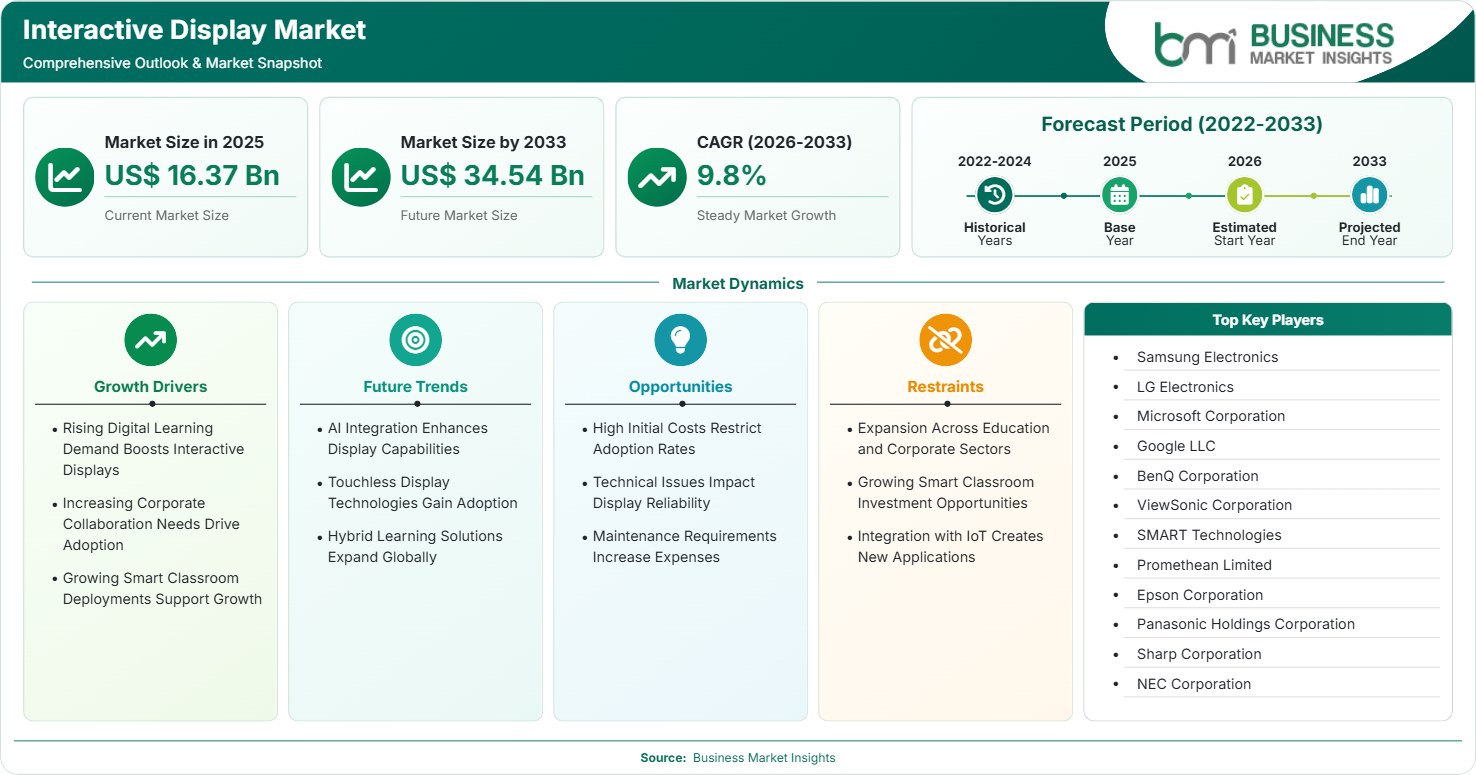
The Interactive Display Market size was valued at US$ 16.37 billion in 2025 and is projected to reach USD 34.54 billion by 2033, growing at a CAGR of 9.8% during 2026–2033, driven by rising adoption of digital collaboration solutions, smart classrooms, interactive retail experiences, enterprise visualization systems, and advanced touch technologies.

Report Coverage
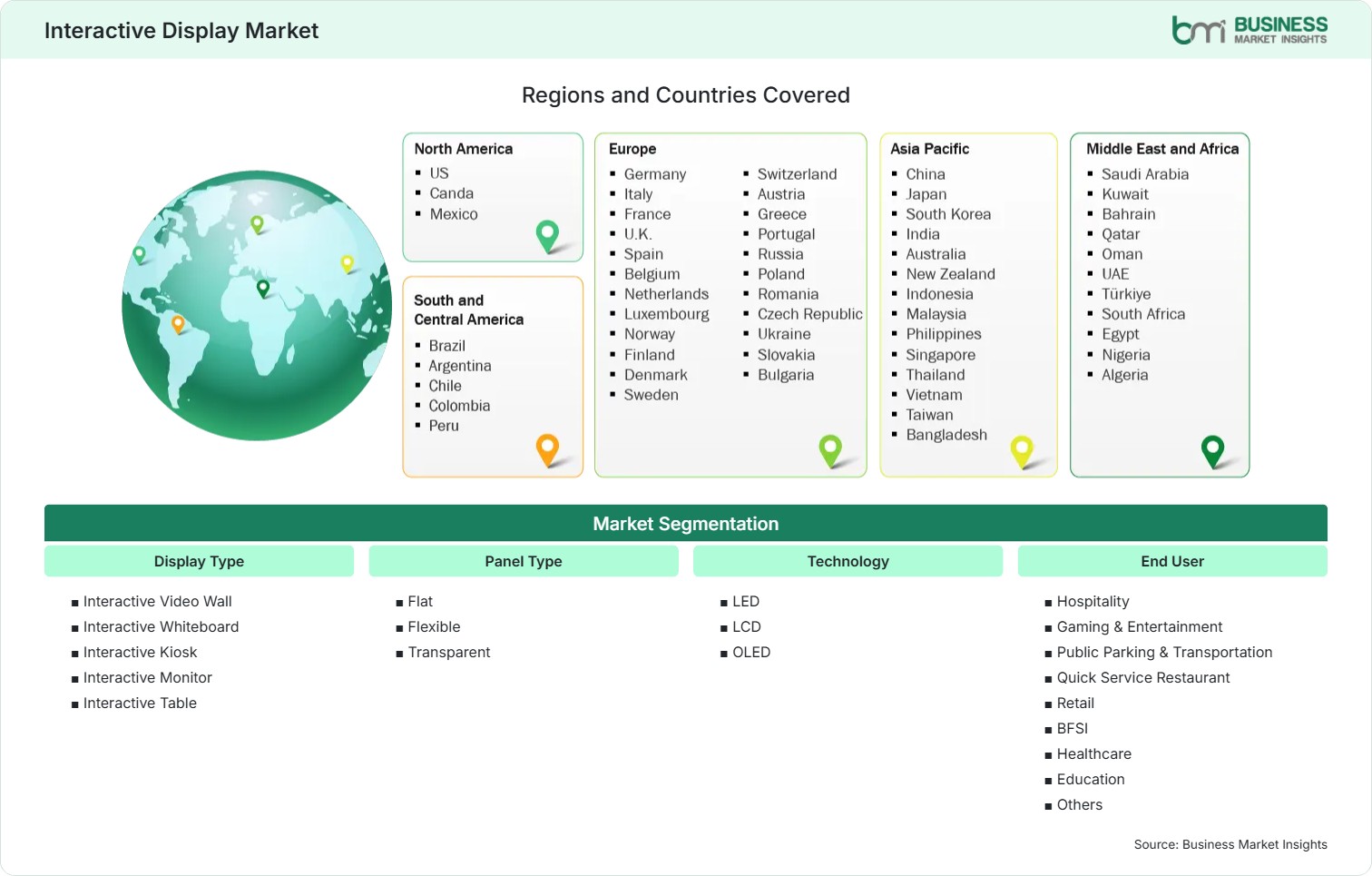
  • Display Type: Interactive Video Wall, Interactive Whiteboard, Interactive Kiosk, Interactive Monitor, Interactive Table
  • Panel Type: Flat, Flexible, Transparent
  • Technology: LED, LCD, OLED
  • End User: Hospitality, Gaming & Entertainment, Public Parking & Transportation, Quick Service Restaurant, Retail, BFSI, Healthcare, Education, Others
US$ 16.37 Bn Market size in 2025
US$ 34.54 Bn Market Size by 2033
9.8% CAGR, 2026 - 2033
2026-2033 Forecast Period

01 AI Overview

Interactive Display Market Summary

  • North America Region: North America holds a market share of 30%–33% in 2025 and is projected to expand at a CAGR of 9.2%–9.9% during 2026–2033, supported by enterprise digitization, educational technology adoption, smart infrastructure investments, and demand for collaborative communication systems. The United States leads regional demand with a CAGR of 9.4%–10.1% driven by technology investments and institutional modernization.
  • Fastest Growing Region: Asia Pacific accounts for 36%–39% of the global market in 2025 and is expected to grow at a CAGR of 10.2%–11.0% during 2026–2033, driven by smart city projects, education digitization, expanding commercial infrastructure, and increasing adoption of interactive technologies across emerging economies.
  • Leading Segment: Interactive Whiteboard holds a market share of 34%–37% in 2025 and is projected to register a CAGR of 9.5%–10.2% during 2026–2033, supported by digital learning initiatives, hybrid classrooms, collaborative teaching methods, and institutional investments in education technology.
  • High Growth Segment: OLED technology represents 12%–15% of technology demand in 2025 and is anticipated to expand at a CAGR of 11.5%–12.5% during 2026–2033, supported by superior display quality, flexible applications, premium commercial installations, and advanced visualization requirements.
  • Key Market Opportunity: Growing investments in smart education, digital workplaces, interactive healthcare systems, automated retail environments, and immersive customer engagement solutions are creating opportunities for manufacturers developing high-performance interactive display platforms.
  • Major Market Players: Samsung Electronics Co., Ltd.; LG Electronics Inc.; Microsoft Corporation; Google LLC; BenQ Corporation; ViewSonic Corporation; SMART Technologies ULC; Promethean Limited; Epson Corporation; Panasonic Holdings Corporation; Sharp Corporation; NEC Corporation; Hikvision; Leyard Optoelectronic Co., Ltd.; Elo Touch Solutions.
02 Strategic Insights

Interactive Display Market: Strategic Insights

Interactive Display Market Strategic Framework
FREE PDF
Request your free sample
Request free sample
03 Stakeholder View

Key Takeaways

  • The ecosystem integrates display manufacturers, semiconductor suppliers, software developers, system integrators, education technology providers, and commercial solution providers supporting connected interactive environments.
  • Education remains a major opportunity area, while retail, healthcare, hospitality, and corporate collaboration applications are creating additional growth avenues through digital transformation initiatives.
  • Innovation is shifting toward AI-enabled displays, cloud-based collaboration platforms, gesture recognition, multi-touch capabilities, and energy-efficient display technologies.
  • Asia Pacific provides strong investment potential due to large-scale education digitization, smart city development, expanding commercial infrastructure, and increasing technology adoption in emerging economies.
  • Companies are strengthening competitive positions through partnerships, software integration, product launches, and expansion into specialized application areas requiring advanced visualization solutions.
  • Growing demand for immersive and connected user experiences is encouraging manufacturers to develop flexible, transparent, and interactive display technologies for future applications.
04 Geographic Outlook

Interactive Display Market Regional Highlights

North America Interactive Display Market

North America accounts for 30%–33% Interactive Display Market share in 2025 while expanding at a CAGR of 9.2%–9.9% through 2026–2033. Regional growth is supported by enterprise collaboration demand, education technology investments, healthcare digitization, and adoption of advanced communication systems. Strong technology infrastructure and high institutional spending continue supporting interactive display deployment across commercial and public environments.

  • The United States remains the largest contributor due to strong demand from education institutions, enterprises, healthcare organizations, and smart workplace initiatives.
  • Businesses are increasingly deploying interactive displays for hybrid meetings, digital collaboration, presentations, and employee engagement applications.
  • Educational institutions continue investing in smart classrooms and interactive learning technologies to improve teaching effectiveness and student participation.
  • Retailers are adopting interactive displays to enhance customer engagement through digital signage, product visualization, and self-service experiences.
  • Healthcare providers are integrating interactive systems for patient communication, training, and operational efficiency improvements.

US Interactive Display Market

The United States represents the largest national market in North America, accounting for 26%–28% of global revenue in 2025 while growing at a CAGR of 9.4%–10.1% through 2026–2033. Enterprise technology investments, educational modernization, and increasing adoption of collaborative workplace solutions continue driving demand.

  • Corporate organizations are expanding interactive display installations to support hybrid work environments and digital collaboration requirements.
  • Schools and universities are upgrading classrooms with interactive boards and connected learning technologies to improve educational outcomes.
  • Retail companies are adopting interactive kiosks and digital displays to deliver personalized customer experiences.
  • Technology providers are integrating cloud platforms and artificial intelligence features into interactive display solutions.

Europe Interactive Display Market

Europe contributes 22%–25% of global revenue in 2025 while registering a CAGR of 8.7%–9.5% during 2026–2033. Regional expansion is supported by smart education initiatives, workplace digitalization, sustainability-focused technology adoption, and commercial infrastructure modernization. Germany and the United Kingdom remain leading markets, while France demonstrates increasing adoption through digital transformation programs.

  • Germany leads regional demand through strong industrial technology adoption, enterprise digitization, and educational infrastructure investments.
  • France demonstrates faster growth with a CAGR of 9.8%–10.5% supported by smart classroom development and public sector technology upgrades.
  • The United Kingdom continues adopting interactive systems across corporate, education, and hospitality environments.
  • European organizations increasingly prioritize energy-efficient display technologies and sustainable digital infrastructure solutions.
  • Government-supported digital transformation programs continue strengthening interactive display adoption across multiple sectors.

Asia Pacific Interactive Display Market

Asia Pacific represents 36%–39% of global revenue in 2025 and records the fastest CAGR of 10.2%–11.0% during 2026–2033. Regional growth is driven by education technology expansion, smart city initiatives, commercial development, and increasing digital adoption. China remains the largest market, while India demonstrates significant growth potential.

  • China dominates regional demand through large-scale education modernization, manufacturing capabilities, and smart infrastructure investments.
  • India is projected to grow at a CAGR of 11.5%–12.3% due to digital education programs, corporate technology adoption, and expanding commercial infrastructure.
  • Japan and South Korea continue advancing premium interactive display solutions through innovation in display technologies.
  • Southeast Asian countries are adopting interactive systems across retail, hospitality, and educational applications.
  • Regional manufacturers are expanding production capabilities to support growing domestic and international demand.

Rest of World Interactive Display Market

The Rest of World region accounts for 5%–8% of global revenue in 2025 while expanding at a CAGR of 9.0%–9.8% through 2026–2033. Latin America benefits from educational digitization and commercial technology adoption, while the Middle East & Africa experience growing demand from smart infrastructure, hospitality, and public sector modernization projects.

  • Brazil remains the leading Latin American Interactive Display market, while Mexico records faster growth with a CAGR of 10.0%–10.8% due to commercial technology investments.
  • Middle Eastern countries are deploying interactive displays in smart cities, hospitality facilities, and government infrastructure projects.
  • African markets present opportunities through expanding digital education initiatives and improving technology accessibility.
  • International manufacturers are strengthening regional partnerships to improve distribution and service capabilities.
  • Increasing demand for digital communication solutions continues supporting market expansion across emerging economies.
Global Market Geography
FREE PDF
Request your free sample
Request free sample
05 Segment Analysis

Interactive Display Market Segmentation

Display Type

Display type segmentation represents diverse application requirements across education, enterprise, retail, healthcare, and public infrastructure environments. The segment accounted for 100% of market demand in 2025 and is projected to expand at a CAGR of 9.8% during 2026–2033. Increasing preference for immersive communication, collaborative learning, and digital engagement solutions continues shaping Interactive Display Market trends across commercial and institutional applications.

  • Interactive Video Wall: Interactive video walls are gaining adoption in control rooms, retail environments, and public spaces due to large-scale visualization capabilities, multi-user interaction, and enhanced customer engagement applications.
  • Interactive Whiteboard: Interactive whiteboards represent the leading display category due to extensive use in education and corporate environments, enabling digital collaboration, interactive teaching, and real-time content sharing.
  • Interactive Kiosk: Interactive kiosks are expanding across retail, transportation, hospitality, and public service locations by enabling self-service operations, information access, and improved customer experience management.
  • Interactive Monitor: Interactive monitors support professional applications including meetings, design workflows, healthcare visualization, and industrial operations requiring precise touch interaction and compact display solutions.
  • Interactive Table: Interactive tables are utilized in gaming, education, museums, and collaborative environments where multi-user interaction and engaging digital experiences are required.

Panel Type

Panel type selection influences display performance, flexibility, durability, and application suitability across multiple industries. The segment accounted for 100% of demand in 2025 and is expected to grow at a CAGR of 9.8% through 2026–2033. Advancements in display engineering, improved visual quality, and demand for customized installations continue expanding market adoption.

  • Flat: Flat panels remain the dominant configuration due to affordability, easy installation, high reliability, and extensive deployment across classrooms, offices, retail stores, and public environments.
  • Flexible: Flexible panels are emerging for specialized applications requiring curved, adaptable, and innovative display formats in premium commercial, entertainment, and architectural installations.
  • Transparent: Transparent panels are gaining attention in retail showcases, smart environments, and advanced visualization applications where digital content integration with physical surroundings is required.

Technology

Technology segmentation defines product performance through brightness, resolution, energy efficiency, durability, and interactive capabilities. The segment represented 100% of the Interactive Display market demand in 2025 and is projected to register a CAGR of 9.8% from 2026–2033. Continuous improvements in display technologies, touch responsiveness, and energy-efficient solutions are strengthening adoption across end-user industries.

  • LED: LED technology continues expanding due to high brightness, durability, large-format capabilities, and suitability for commercial displays, outdoor applications, and immersive visualization environments.
  • LCD: LCD remains widely adopted because of cost efficiency, availability, reliability, and extensive use across education, enterprise, healthcare, and retail interactive display applications.
  • OLED: OLED technology is gaining momentum through superior contrast, thinner designs, flexible capabilities, and premium visual experiences for advanced commercial and entertainment applications.

End User

End-user segmentation reflects growing adoption across multiple industries seeking enhanced interaction, communication, and operational efficiency. The segment accounted for 100% of market demand in 2025 and is forecast to expand at a CAGR of 9.8% during 2026–2033. Increasing digital transformation initiatives continue widening the Interactive Display Market scope across education, retail, healthcare, and commercial sectors.

  • Hospitality: Hospitality organizations are adopting interactive displays for guest engagement, digital information services, navigation solutions, and personalized customer experiences across hotels and entertainment facilities.
  • Gaming & Entertainment: Gaming and entertainment sectors utilize interactive displays to create immersive experiences, interactive attractions, digital installations, and enhanced audience engagement platforms.
  • Public Parking & Transportation: Transportation facilities deploy interactive displays for passenger information, navigation, ticketing support, and real-time communication across public infrastructure systems.
  • Quick Service Restaurant: Quick service restaurants are integrating interactive kiosks and digital ordering displays to improve operational efficiency, reduce waiting times, and enhance customer convenience.
  • Retail: Retail businesses use interactive displays for product visualization, self-service solutions, digital promotions, and personalized shopping experiences that improve customer interaction.
  • BFSI: Banking and financial institutions adopt interactive displays for customer education, digital services, self-service applications, and enhanced branch experiences.
  • Healthcare: Healthcare providers utilize interactive systems for patient communication, medical training, operational management, and improved information accessibility.
  • Education: Education remains a leading application area due to smart classroom initiatives, digital teaching methods, collaborative learning, and institutional technology investments.
06 Market Forces

Interactive Display Market Dynamics

Key Market Drivers

Rising Digital Learning Demand Boosts Interactive Displays

Adoption of digital learning is being fueled by the incorporation of classroom technologies by the learning institutions. The government's efforts towards the modernization of education and investment in learning infrastructure have enabled learning institutions to adopt digital technology to replace conventional teaching methods. According to UNESCO, digital transformation in education continues gaining importance as institutions seek technology solutions that improve accessibility and learning outcomes. This shift is strengthening market growth while influencing Interactive Display Market trends toward cloud-connected, AI-enabled, and multifunctional educational display systems.

Increasing Corporate Collaboration Needs Drive Adoption

Corporate organizations are increasingly adopting interactive displays to support hybrid workplaces, remote collaboration, and digital communication requirements. The growth of flexible working practices has led to a greater need for sophisticated technologies that enable real-time meetings where people can collaborate, present their ideas, and interact with each other. Corporations are now turning to smart meeting rooms, which are built on touch displays, cloud technology, and collaboration technologies. Such technologies not only enhance productivity but also facilitate communication and teamwork. The growing trend of enterprise digitization continues to motivate companies to modernize legacy meeting systems.

Growing Smart Classroom Deployments Support Growth

Smart classroom deployments are increasing globally as educational institutions seek advanced teaching technologies that improve engagement and learning efficiency. Interactive displays enable educators to deliver multimedia lessons, annotate content, conduct assessments, and provide collaborative learning experiences. Governments and private education providers are investing in digital classroom infrastructure to improve technology accessibility and educational quality. Growing adoption across developing economies, combined with increasing availability of affordable display solutions, is supporting broader implementation. Interactive Display Market trends indicate that this shift is encouraging manufacturers to develop cost-effective, durable, and software-integrated interactive display platforms designed specifically for modern educational environments.

Key Market Opportunities

Expansion Across Education and Corporate Sectors

Education and corporate sectors provide significant opportunities as organizations continue investing in digital collaboration and interactive learning infrastructure. Schools, universities, enterprises, and training institutions are increasingly replacing traditional communication methods with connected display solutions. Growing demand for hybrid learning, virtual meetings, and collaborative workflows creates opportunities for manufacturers offering integrated hardware and software platforms. Companies that develop scalable solutions with cloud connectivity, artificial intelligence features, and simplified deployment can capture additional demand across global markets. Interactive Display Market forecasts indicate that expansion in these sectors is expected to support long-term adoption as organizations prioritize technology-driven engagement and productivity improvements.

Growing Smart Classroom Investment Opportunities

Smart investments in classroom environments are creating significant opportunities for interactive display companies as government bodies and institutions focus on developing digital education infrastructure. Rising technology budget allocations, collaborations between public and private education sectors, and a growing need for personalized learning environments are driving the adoption of interactive displays. Emerging economies present attractive market segments due to expanding educational networks and greater access to technology. Companies with an emphasis on cost-effective products, software integration, and durability will be well-placed to compete in emerging education technology markets.

Integration with IoT Creates New Applications

Integration with Internet of Things platforms creates new opportunities by enabling interactive displays to connect with sensors, smart devices, analytics platforms, and automated systems. IoT-enabled displays can support intelligent environments across retail, healthcare, transportation, and commercial buildings by providing real-time information and personalized experiences. Smart infrastructure development is increasing demand for connected visualization solutions capable of improving operational efficiency and user interaction. Companies investing in interoperable technologies, data analytics capabilities, and secure connectivity features can benefit from expanding smart ecosystem deployments across multiple industries.

Market Restraints and Challenges

High Initial Costs Restrict Adoption Rates

Factor: Interactive display systems require significant upfront investment due to advanced hardware components, installation requirements, software integration, and maintenance infrastructure.

Impact: High acquisition costs can limit adoption among small businesses, educational institutions with restricted budgets, and organizations in price-sensitive emerging markets. Although long-term operational benefits are attractive, initial expenditure remains a barrier for wider implementation. Manufacturers must focus on cost optimization, scalable solutions, and financing models to improve accessibility and encourage broader Interactive Display market penetration across diverse end-user segments.

Technical Issues Impact Display Reliability

Factor: Interactive displays depend on complex hardware, software, touch technologies, connectivity systems, and integrated platforms that may experience technical challenges.

Impact: Reliability issues, software compatibility problems, calibration issues, and maintenance considerations may affect user experience and efficiency. Regular interruptions may lead organizations to avoid using interactive systems, especially in fields such as education, medicine, and government. Firms should strive to enhance the durability of their products, software reliability, technical assistance, and integration capabilities.

07 Company Analysis

Competitive Landscape

The competitive landscape includes global electronics manufacturers, display technology providers, software ecosystem companies, and specialized interactive solution developers competing through advanced visualization technologies, AI integration, cloud connectivity, and industry-specific solutions. The Interactive Display Market analysis highlights that companies are focusing on product innovation, strategic partnerships, enterprise solutions, education technology expansion, and development of energy-efficient interactive platforms.

Company Name

Overview

Products and Services Relevant to this Market

Samsung Electronics Co., Ltd.

Global electronics company providing advanced display technologies and digital solutions.

Interactive displays, smart boards, professional displays, LED walls, digital signage solutions.

LG Electronics Inc.

Technology company offering commercial display and smart visualization solutions.

Interactive displays, OLED displays, digital signage, collaboration displays, display solutions.

Microsoft Corporation

Software and technology company supporting digital collaboration ecosystems.

Interactive collaboration platforms, touchscreen devices, meeting solutions, productivity software.

Google LLC

Technology company developing cloud-based collaboration and education solutions.

Digital classroom platforms, cloud collaboration tools, interactive learning technologies.

BenQ Corporation

Display technology company specializing in professional and educational solutions.

Interactive flat panels, classroom displays, corporate collaboration systems, projectors.

ViewSonic Corporation

Visual technology provider focused on interactive and display solutions.

Interactive displays, touch monitors, digital whiteboards, education technology solutions.

SMART Technologies ULC

Education technology company specializing in interactive learning systems.

Interactive whiteboards, classroom displays, collaboration software, digital learning solutions.

Promethean Limited

Education technology provider focused on interactive classroom solutions.

Interactive panels, teaching software, classroom collaboration tools, educational displays.

Epson Corporation

Technology company offering visual communication and education solutions.

Interactive displays, projectors, classroom technologies, visualization solutions.

Panasonic Holdings Corporation

Electronics manufacturer providing professional display and communication technologies.

Interactive displays, professional monitors, digital signage, business solutions.

Sharp Corporation

Display technology company serving commercial and educational markets.

Interactive displays, touch panels, collaboration systems, professional monitors.

NEC Corporation

Technology provider offering enterprise and public display solutions.

Interactive displays, digital signage systems, visualization platforms, commercial displays.

Hikvision

Security and visualization technology company offering display solutions.

Interactive panels, commercial displays, smart visualization products, integrated solutions.

Leyard Optoelectronic Co., Ltd.

Display technology manufacturer specializing in advanced LED solutions.

Interactive LED displays, fine-pitch LED products, visualization systems, digital display solutions.

Elo Touch Solutions

Touch technology provider specializing in interactive display applications.

Touchscreens, interactive monitors, kiosks, self-service display solutions.

08 Industry Activity

Recent Developments

July 2026

Sharp Imaging and Information Company of America expanded the interoperability of its professional interactive and large-format display portfolio by launching a new Q-SYS Verified Plugin, enabling seamless integration, centralized display control, status monitoring, and simplified AV management across corporate and education collaboration environments.

May 2025

Elo Touch Solutions expanded its interactive solutions portfolio by launching the I-Series 5 for Android, I-Series 5 Slate, and Backpack 5, featuring AI-ready processing, Android 14, enhanced connectivity, and improved touchscreen performance for self-service, retail, hospitality, healthcare, and enterprise interactive display applications.

February 2025

LG Electronics Inc. expanded its commercial display portfolio by showcasing advanced digital signage and collaborative display solutions at ISE 2025, including innovations designed for corporate, education, retail, transportation, and hospitality environments, strengthening its interactive and professional display offerings.

February, 2026: Samsung Electronics Co., Ltd. expanded its professional display portfolio by introducing the new WAFX-P Interactive Display as part of its connected classroom ecosystem, integrating AI-powered collaboration tools, Google EDLA certification, enhanced content management, and seamless connectivity to improve teaching and learning experiences across education environments.

10 Trust & Transparency

Research Methodology

The market analysis combines proprietary research with secondary data from government agencies, company disclosures, regulatory filings, industry databases and expert interviews. Market estimates are validated through data triangulation, cross-market benchmarking and analyst review.

View Full Research Methodology

11 Questions Answered

Frequently Asked Questions

Which industries are adopting interactive displays?

Education, corporate offices, healthcare, retail, hospitality, transportation, banking, and entertainment sectors are adopting interactive displays to improve communication, customer engagement, operational efficiency, and digital experiences.

How is AI influencing interactive display solutions?

AI integration is improving interactive displays through intelligent content management, automated recommendations, enhanced collaboration features, voice interaction, analytics capabilities, and personalized user experiences.

Why is Asia Pacific the fastest-growing region?

Asia Pacific is expanding rapidly due to smart classroom investments, digital transformation initiatives, growing commercial infrastructure, manufacturing capabilities, and increasing adoption of interactive technologies across emerging economies.

Which segment dominates the Market?

Interactive whiteboards represent a leading segment due to widespread adoption in educational institutions, corporate training environments, and collaborative workplaces requiring digital content sharing and interactive communication.

What factors are driving the Interactive Display Market?

The market is driven by digital education adoption, hybrid workplace expansion, enterprise collaboration requirements, smart infrastructure investments, interactive retail experiences, and increasing demand for connected visualization technologies. Interactive Display Market Report provides detailed analysis of these growth drivers, emerging opportunities, competitive developments, and future industry outlook.

Access the Full Interactive Display Market Report

Get segment-level forecasts, regional estimates, competitive benchmarking, company profiles and downloadable Excel datasets.

Access the full Interactive Display Market Report
350 pages PDF & Excel | 2026-07-27