
Head Mounted Display Market Outlook: Size, Share, Trends, Growth Analysis, Competitive Landscape & Forecast, 2026-2033

Historic Data: 2022-2024   |   Base Year: 2025   |   Forecast Period: 2026-2033
Report Content: Market Scope, Market Segmentation, Market Dynamics, and Competitive Analysis

Report Coverage:
  • Type (Integrated HMD, Slide-On HMD, Discrete HMD)
  • Technology (AR, VR, MR)
  • End-Use (Consumer, Commercial, Enterprise & Industry, Healthcare, Aerospace & Defense, Education)

No. of Pages: 400
Report Code: BMIPUB00035443
Category: Electronics and Semiconductor
Head Mounted Display Market

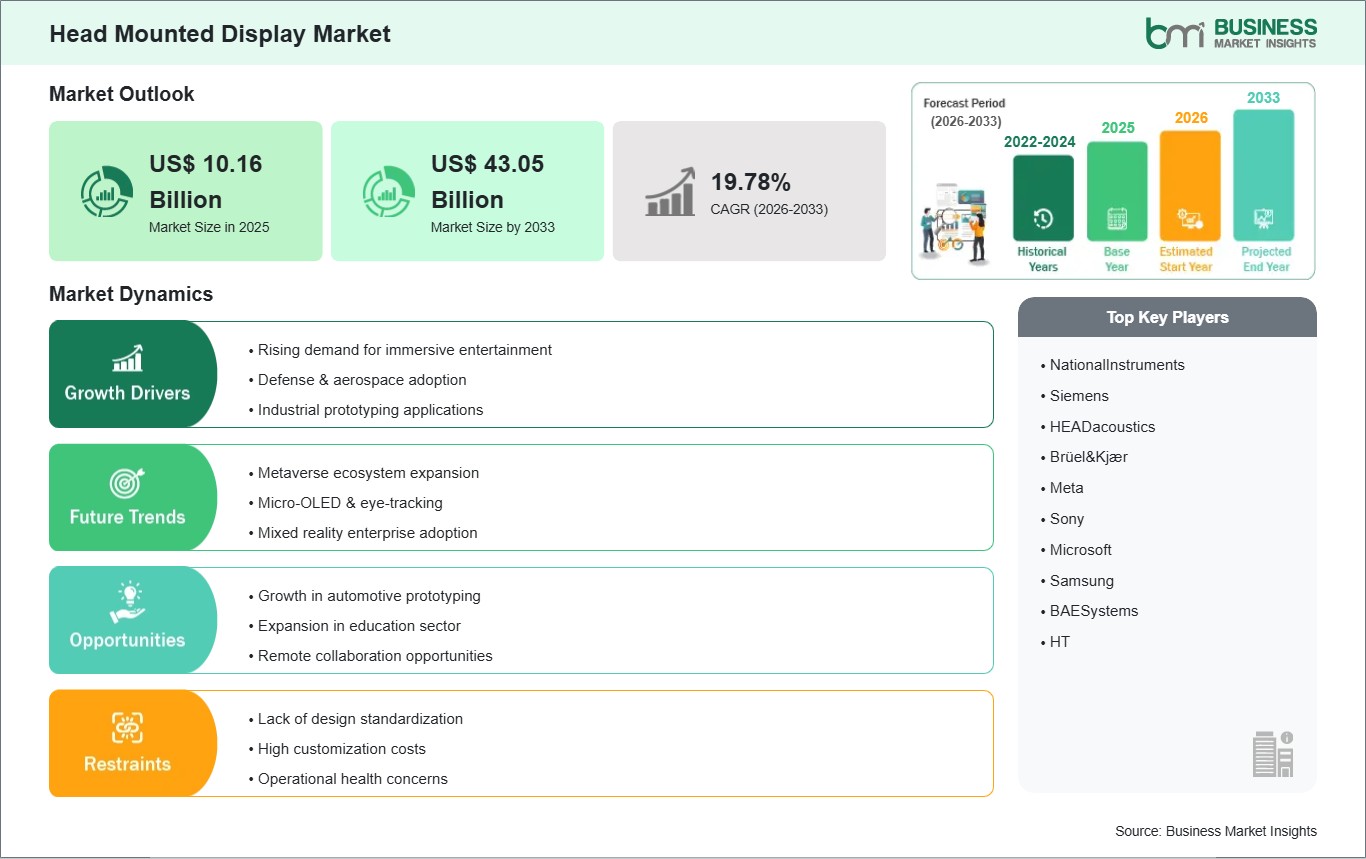
The Head Mounted Display Market size is expected to reach US$ 43.05 Billion by 2033 from US$ 10.16 Billion in 2025.The market is estimated to record a CAGR of 19.78% from 2026 to 2033.

Executive Summary and Global Market Analysis:

Head Mounted Displays refer to wearable visual systems engineered to project digital information directly into the user's field of vision, typically through a visor, helmet, or smart glasses. By utilizing technologies such as Augmented Reality (AR), Virtual Reality (VR), and Mixed Reality (MR), these devices generate immersive, hands-free data visualization and interactive 3D environments. This technology is fundamental to the operational architecture of spatial computing, advanced training simulations, and remote expert collaboration across multiple sectors. Market expansion is being propelled by the rapid integration of AR and VR applications into gaming and entertainment, the rising institutional requirement for high-fidelity simulation in defense and healthcare, and the increasing demand for immersive collaboration tools within enterprise and industry verticals.

However, several factors may restrain market progression. The high capital intensity associated with advanced optical components, such as high-resolution micro-displays and precision waveguide lenses, remains a primary hurdle for price-sensitive consumer segments. The industry also faces persistent technical challenges regarding user ergonomics and motion sickness, as prolonged use of HMDs can cause discomfort, eye strain, and nausea. Additionally, concerns regarding privacy and data security are significant, as HMDs equipped with multiple cameras and sensors constantly map the user's private environment. These hurdles, compounded by the limited availability of high-quality, standardized content and applications across different software ecosystems, increase the total cost of ownership and the perceived risk for large-scale deployments.

Despite these hurdles, the market outlook remains highly favorable as the sector transitions toward AI-enhanced spatial intelligence. Opportunities are emerging through the adoption of generative AI and edge computing; the market is witnessing the launch of HMDs capable of sub-millisecond perception processing, allowing users to achieve human-like interaction in dynamic virtual environments. The expansion of the digital twin market is gaining significant traction, with HMDs serving as the primary visualization tool for real-time structural health monitoring and collaborative prototyping in engineering. Furthermore, the growth of AR-assisted surgical navigation and VR-based cognitive therapy aligns with global goals for enhanced precision medicine and mental health treatment. Collectively, these innovations position the Head Mounted Display industry for sustained long-term development as a cornerstone of the modern, automated, and hyper-realistic global digital landscape.

Head Mounted Display Market - Strategic Insights:

global-market-strategic-framework
Get more information on this report

Head Mounted Display Market Segmentation Analysis:

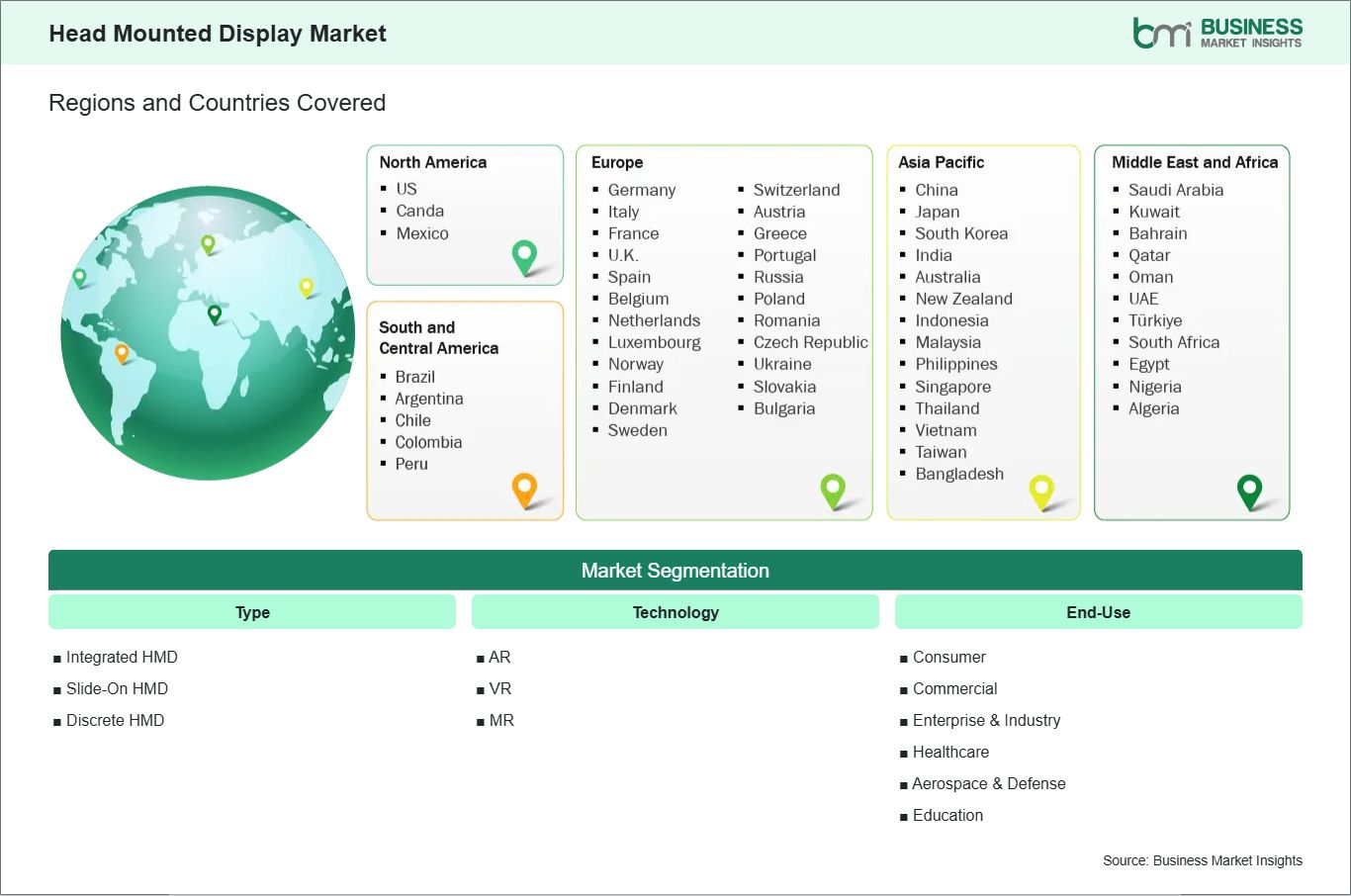
The Head Mounted Display market is segmented based on type, technology, and end-use, reflecting the growing demand for advanced visualization and immersive solutions across multiple applications.

By Type

  • Integrated HMD: Contains all necessary processing, battery, and sensory components within the unit, eliminating the need for external cables or PCs; offers high portability and ease of use, making it the preferred choice for enterprise training and mainstream consumer gaming
  • Slide-On HMD: Uses a smartphone as the primary display and processor; serves as an entry point for mobile VR and is pivoting toward industrial clip-ons for modular AR applications in construction and maintenance
  • Discrete HMD: Relies on a physical connection to an external workstation or console to handle heavy computational loads; remains the gold standard for engineering, design, and high-end flight simulators where ultra-high resolution and low latency are paramount

By Technology

  • Augmented Reality (AR): Projects contextual digital data and overlays onto the user's real-world view; widely adopted for enterprise applications, maintenance support, and tactical situational awareness
  • Virtual Reality (VR): Creates fully immersive digital environments that replace the user's physical surroundings; predominantly used for gaming, training simulations, and virtual tours
  • Mixed Reality (MR): Blends virtual and physical interaction layers, allowing digital objects to interact with the real environment; adopted in advanced simulation, mission rehearsal, and collaborative prototyping

By End-Use

  • Consumer: Focuses on immersive media including AAA VR gaming, virtual concerts, and 360-degree cinema; represents the largest volume driver for the HMD market
  • Commercial: Encompasses applications in retail, hospitality, and live events, enabling customer behavior analysis, virtual showrooms, and interactive brand experiences
  • Enterprise & Industry: Concentrates on remote assistance, digital workflow instruction, and collaborative design; enables frontline workers with hands-free access to manuals and expert live feeds
  • Healthcare: Utilized for image-guided surgery where surgeons view 3D MRI or CT overlays directly on patients, as well as VR-based cognitive therapy and medical student training in virtual anatomy
  • Aerospace & Defense: Mission-critical for tactical situational awareness, providing pilots and ground troops with real-time navigation, targeting, and friend-or-foe identification; helmet-mounted displays are integral to next-generation combat aircraft
  • Education: Enables virtual field trips and interactive laboratory simulations that would otherwise be dangerous or cost-prohibitive; focus is on collaborative learning across geographically dispersed classrooms
Head Mounted Display Market Drivers and Opportunities:

Rising Demand for Immersive Experiences, Training, and Operational Efficiency

The head mounted display market is being driven by the growing need for immersive experiences, advanced training solutions, and operational efficiency across industries such as consumer electronics, defense, healthcare, and manufacturing. Unlike traditional flat-screen displays, HMDs provide spatial awareness and hands-free interaction, enabling advanced applications like virtual collaboration, surgical navigation, and tactical targeting. Rising adoption of AR/VR devices in gaming and entertainment is amplifying demand, as consumers increasingly seek enhanced interactivity and immersive content.

In aerospace and defense, HMDs are being integrated into pilot helmets and soldier systems to support navigation, threat detection, and real-time data overlays. Healthcare applications such as surgical planning, medical training, and patient rehabilitation are reinforcing growth. Additionally, industrial automation and remote assistance are leveraging HMDs for quality inspection, process optimization, and expert guidance. The expansion of smart factories and digital transformation initiatives is further propelling adoption. Collectively, immersive visualization, simulation accuracy, and operational efficiency requirements are fueling sustained growth in the global head mounted display market.

Rising Integration of AI, 5G, and Emerging Cross-Industry Applications

Opportunities in the head mounted display market are expanding through the integration of artificial intelligence, 5G connectivity, and cross-industry applications. AI-enabled HMDs are opening lucrative opportunities by delivering adaptive imaging, real-time language translation, and predictive maintenance alerts. The growing emphasis on spatial computing platforms is fueling demand for interoperable HMD solutions that support seamless collaboration across different devices and software ecosystems. Emerging applications in retail are driving innovation, as AR HMDs enable virtual try-ons, inventory tracking, and personalized shopping experiences.

In construction and architecture, HMDs are increasingly used for building information modeling (BIM), site surveys, and remote inspection. Additionally, sustainability trends are encouraging deployment of lightweight, energy-efficient HMDs that align with global environmental goals. The expansion of 5G infrastructure is creating new pathways for adoption, where cloud-rendered HMDs deliver console-quality graphics without tethered connections, enhancing mobility and reducing hardware costs. Vendors who focus on cost-effective, AI-driven, and 5G-ready solutions are well-positioned to capture growth. The convergence of AI, immersive technologies, and high-speed connectivity underscores a transformative trajectory for the global head mounted display market.

Head Mounted Display Market Size and Share Analysis:

The Head Mounted Display Market is projected to grow from US$ 10.16 Billion in 2025 to US$ 43.05 Billion by 2033 , registering a CAGR of 19.78% from 2026 to 2033.

By type, integrated HMDs account for a significant and rapidly growing share as they offer standalone functionality with onboard processing, battery, and sensors, eliminating the need for external computers. Discrete HMDs continue to hold a substantial share in high-end professional applications, particularly in engineering, design, and simulation where maximum graphical fidelity is required. Slide-on HMDs represent a smaller but evolving segment, pivoting toward industrial clip-on solutions for modular AR applications in rugged environments.

By technology, VR currently dominates consumer adoption, driven by gaming, entertainment, and virtual training applications. AR is witnessing the fastest growth, fueled by enterprise demand for hands-free data visualization, remote assistance, and maintenance support across industrial sectors. MR is expanding steadily with strong adoption in advanced simulation, mission rehearsal, and collaborative design where digital and physical objects must interact seamlessly.

By end-use, consumer applications represent the largest volume driver, propelled by the immersive media boom and the entry of premium lifestyle devices. Aerospace and defense represent a high-value segment with mission-critical applications in fighter aircraft, helicopter platforms, and dismounted soldier systems. Healthcare is emerging as a high-growth segment with applications in image-guided surgery, cognitive therapy, and medical training. Enterprise and industry are expected to show strong growth as companies adopt HMDs for remote assistance, digital workflow instruction, and collaborative design. Education continues to expand as institutions adopt virtual field trips and interactive laboratory simulations.

Head Mounted Display Market Report Highlights:

Report Attribute Details
Market size in 2025 US$ 10.16 Billion
Market Size by 2033 US$ 43.05 Billion
Global CAGR (2026 - 2033)19.78%
Historical Data 2022-2024
Forecast period 2026-2033
Segments Covered By Type
  • Integrated HMD
  • Slide-On HMD
  • Discrete HMD
By Technology
  • AR
  • VR
  • MR
By End-Use
  • Consumer
  • Commercial
  • Enterprise & Industry
  • Healthcare
  • Aerospace & Defense
  • Education
Regions and Countries Covered
North America US, Canada, Mexico
Europe Germany, Italy, France, U.K., Spain, Belgium, Netherlands, Luxembourg, Norway, Finland, Denmark, Sweden, Switzerland, Austria, Greece, Portugal, Russia, Poland, Romania, Czech Republic, Ukraine, Slovakia, Bulgaria
Asia-Pacific China, Japan, South Korea, India, Australia, New Zealand, Indonesia, Malaysia, Philippines, Singapore, Thailand, Vietnam, Taiwan, Bangladesh
South and Central America Brazil, Argentina, Chile, Colombia, Peru
Middle East and Africa Saudi Arabia, United Arab Emirates, Kuwait, Bahrain, Qatar, Oman, Turkiye, South Africa, Egypt, Nigeria, Algeria
Market leaders and key company profiles
  • NationalInstruments
  • Siemens
  • HEADacoustics
  • Brüel&Kjær
  • Meta
  • Sony
  • Microsoft
  • Samsung
  • BAESystems
  • HT
Get more information on this report

Head Mounted Display Market Report Coverage and Deliverables:

The "Head Mounted Display Market Size and Forecast (2022–2033)" report provides a detailed analysis of the market covering below areas:

  • Head Mounted Display market size and forecast at global, regional, and country levels for all market segments covered under the scope
  • Head Mounted Display market trends, as well as drivers, restraints, and opportunities
  • Head Mounted Display market analysis covering key trends, global and regional framework, major players, regulations, and recent developments
  • Industry landscape and competition analysis covering market concentration, heat map analysis, prominent players, and recent developments for the Head Mounted Display market
  • Detailed company profiles, including SWOT analysis

Head Mounted Display Market Geographic Insights:

The Head Mounted Display Market shows diverse regional adoption patterns influenced by advancements in display technologies, increasing demand for immersive experiences, and rising adoption of AR/VR across various industries.s

North America, being a technologically advanced region, has a strong presence of leading HMD manufacturers and a robust software development ecosystem. The region comprises the United States and Canada, where investments are being made in spatial computing platforms, AR/VR content creation, and enterprise collaboration tools. The region focuses on enhancing display resolution and improving user experiences through advanced eye-tracking and gesture recognition technologies. It has well-established defense and technology sectors, allowing for widespread adoption of HMDs across military training, healthcare, industrial maintenance, and consumer entertainment applications.

Asia Pacific is growing significantly, driven by rapid expansion of the consumer electronics industry, increasing government support for AR/VR development, and rising adoption of smart technologies in manufacturing. The region comprises countries such as China, Japan, and South Korea, where manufacturers are actively integrating HMD technologies into gaming devices, industrial training systems, and medical equipment. The region focuses on improving manufacturing efficiency and supporting innovation in digital imaging and automation technologies. The expansion of 5G infrastructure, smart city initiatives, and increasing investments in research and development activities is also contributing to the growth of the Head Mounted Display Market, along with advanced semiconductor manufacturing for micro-displays and optical components.

Both regions are contributing significantly to the growth of the Head Mounted Display Market, focusing on technological advancements, increasing adoption of immersive solutions, and rising demand for advanced visualization systems across various end-use industries.

global-market-geography
Get more information on this report

Head Mounted Display Market Research Report Guidance:

The report includes qualitative and quantitative data for the Head Mounted Display market across type, technology, end-use, and geography.

  • The report starts with the key takeaways (chapter 2), highlighting the key trends and outlook of the Head Mounted Display market.
  • Chapter 3 focuses on the research methodology of the study.
  • Chapter 4 includes ecosystem analysis.
  • Chapter 5 highlights the major industry dynamics in the Head Mounted Display market, including factors that are driving the market, prevailing deterrents, potential opportunities, as well as future trends. Impact analysis of these drivers and restraints is also covered in this section.
  • Chapter 6 discusses the Head Mounted Display market scenario, in terms of historical market revenues, and forecast till the year 2033.
  • Chapters 7 to 10 cover Head Mounted Display market segments by type, technology, end-use, and geography across North America, Europe, Asia Pacific, Middle East and Africa, and South and Central America. They cover the market revenue, forecast, and factors driving the market.
  • Chapter 11 describes the competitive analysis along with the heat map analysis for the key players operating in the market.
  • Chapter 12 describes the industry landscape analysis. It provides detailed descriptions of business activities such as market initiatives, new developments, mergers, and joint ventures globally, along with a competitive landscape.
  • Chapter 13 provides detailed profiles of the major companies operating in the Head Mounted Display market. Companies have been profiled on the basis of their key facts, business descriptions, products and services, financial overview, SWOT analysis, and key developments.
  • Chapter 14, i.e., the appendix, is inclusive of a brief overview of the company, list of abbreviations, and disclaimer.

Head Mounted Display Market News and Key Development:

The Head Mounted Display market is evaluated by gathering qualitative and quantitative data post primary and secondary research, which includes important corporate publications, association data, and databases. A few of the key developments in the Head Mounted Display market are:

  • In February 2026, Kopin Corporation (NASDAQ: KOPN) a leading provider of application-specific optical systems and high-performance microdisplays for defense, training, enterprise, industrial, consumer and medical products, today announced it has secured a new $3.6 million purchase order for an advanced avionic helmet mounted display (“HMD”) system to be integrated into a rotary wing military aircraft platform for a European defense customer.
  • In July 2024, Vision Products, a leader in innovative head mounted display solutions, has successfully delivered its first high-resolution, wide field of view Army Aircrew Augmented Reality Optics and Display System Head-Mounted Display (HMD) to the United States Army, marking a significant milestone in increasing rotorcraft pilots’ situational awareness.

Key Sources Referred:

  • World Bank – Global Trade Indicators
  • World Trade Organization (WTO)
  • International Monetary Fund (IMF)
  • International Trade Administration (ITA)
  • Company Websites
  • Company Annual Reports
  • Company Investor Presentations
The List of Companies - Head Mounted Display Market
  • NationalInstruments
  • Siemens
  • HEADacoustics
  • Brüel&Kjær
  • Meta
  • Sony
  • Microsoft
  • Samsung
  • BAESystems
  • HT
Frequently Asked Questions
How big is the Head Mounted Display Market?

The Head Mounted Display Market is valued at US$ 10.16 Billion in 2025, it is projected to reach US$ 43.05 Billion by 2033.

What is the CAGR for Head Mounted Display Market by (2026 - 2033)?

As per our report Head Mounted Display Market, the market size is valued at US$ 10.16 Billion in 2025, projecting it to reach US$ 43.05 Billion by 2033. This translates to a CAGR of approximately 19.78% during the forecast period.

What segments are covered in this report?

The Head Mounted Display Market report typically cover these key segments-

  • Type (Integrated HMD, Slide-On HMD, Discrete HMD)
  • Technology (AR, VR, MR)
  • End-Use (Consumer, Commercial, Enterprise & Industry, Healthcare, Aerospace & Defense, Education)

What is the historic period, base year, and forecast period taken for Head Mounted Display Market?

The historic period, base year, and forecast period can vary slightly depending on the specific market research report. However, for the Head Mounted Display Market report:

  • Historic Period : 2022-2024
  • Base Year : 2025
  • Forecast Period : 2026-2033
  • Who are the major players in Head Mounted Display Market?

    The Head Mounted Display Market is populated by several key players, each contributing to its growth and innovation. Some of the major players include:

  • NationalInstruments
  • Siemens
  • HEADacoustics
  • Brüel&Kjær
  • Meta
  • Sony
  • Microsoft
  • Samsung
  • BAESystems
  • HT
  • Who should buy this report?

    The Head Mounted Display Market report is valuable for diverse stakeholders, including:

    • Investors: Provides insights for investment decisions pertaining to market growth, companies, or industry insights. Helps assess market attractiveness and potential returns.
    • Industry Players: Offers competitive intelligence, market sizing, and trend analysis to inform strategic planning, product development, and sales strategies.
    • Suppliers and Manufacturers: Helps understand market demand for components, materials, and services related to concerned industry.
    • Researchers and Consultants: Provides data and analysis for academic research, consulting projects, and market studies.
    • Financial Institutions: Helps assess risks and opportunities associated with financing or investing in the concerned market.

    Essentially, anyone involved in or considering involvement in the Head Mounted Display Market value chain can benefit from the information contained in a comprehensive market report.

    Available Report Formats

    pdf-format excel-format pptx-format
    Buy Now
    Sales Assistance
    +1 646 791 7070 (US & UK)
    Customization Form

    Please tell us your area of interest
    (Market Segments/ Regions and Countries/ Companies)