Market Summary
Executive Summary and Global Market Analysis
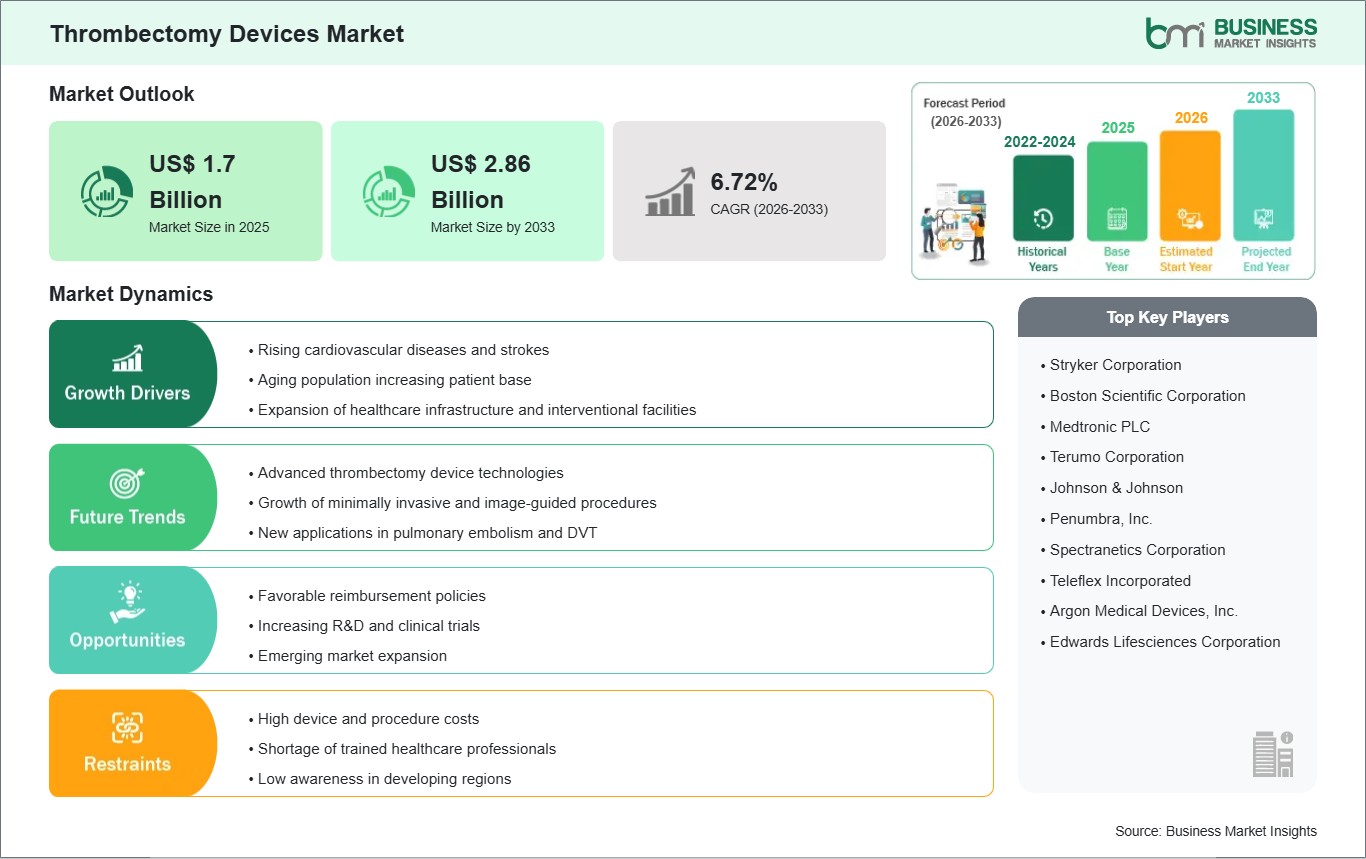
A thrombectomy device is a specialized medical instrument designed for the mechanical removal of a blood clot (thrombus) from a blood vessel. These devices deliver profound strategic value by providing a frontline intervention for life-threatening vascular emergencies in comprehensive stroke centers and specialized surgical hospitals. Market expansion is driven by the rising global incidence of cardiovascular and cerebrovascular diseases, often linked to sedentary lifestyles and an aging population. Furthermore, the shift toward minimally invasive endovascular procedures is improving patient recovery times and reducing the duration of hospital stays compared to open surgical alternatives.
However, several factors can restrain market growth. The lack of specialized neurointerventionalists and trained clinical staff in rural or under-developed regions can limit the availability of these high-complexity procedures. Additionally, the high capital cost of advanced aspiration pumps and the single-use nature of specialized catheters can place a significant financial burden on healthcare facilities. The industry also faces challenges from stringent regulatory approval processes and the need for extensive clinical trial data to prove superior efficacy over existing standard-of-care treatments.
Despite these hurdles, the market finds immense opportunities in the development of artificial intelligence for rapid stroke triage and the expansion of the treatment window, allowing more patients to be eligible for intervention. The rise of ambulatory surgical centers for peripheral interventions and the refinement of hybrid systems, which combine aspiration with mechanical retrieval, are expected to support long-term development within the sector.
Segment Analysis
Thrombectomy Devices Market Segmentation
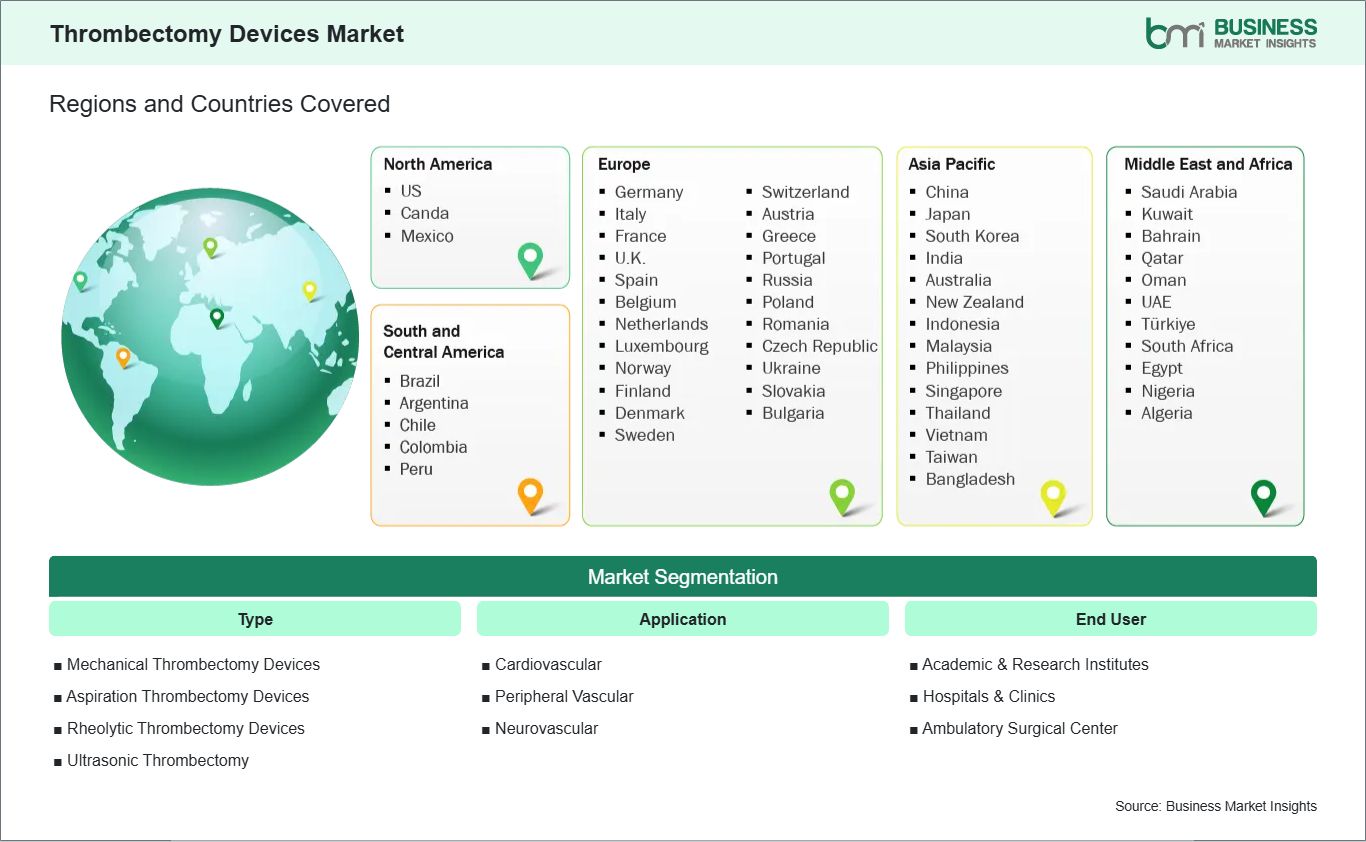
Key segments that contributed to the derivation of the Thrombectomy Devices market analysis are type, application, and end user.
- By Type, the market is segmented into Mechanical Thrombectomy Devices, Aspiration Thrombectomy Devices, Rheolytic Thrombectomy Devices, and Ultrasonic Thrombectomy.
- By Application, the market is divided into Cardiovascular, Peripheral Vascular, and Neurovascular.
- By End User, the market is categorized into Academic & Research Institutes, Hospitals & Clinics, and Ambulatory Surgical Center.
Market Forces
Thrombectomy Devices Market Drivers and Opportunities
Rising Vascular Burden and the Global Expansion of Comprehensive Stroke Centers
The primary driver for the Thrombectomy Devices Market is the escalating global prevalence of cardiovascular and cerebrovascular disorders, such as acute ischemic stroke, deep vein thrombosis (DVT), and pulmonary embolism. The Aging Global Population acts as a foundational catalyst, as elderly individuals face a heightened risk of thrombotic events necessitated by age-related vascular degradation. This momentum is further propelled by the Expanding Clinical Evidence Supporting Mechanical Thrombectomy; high-profile clinical trials have demonstrated superior outcomes for mechanical intervention over medical management alone, leading to broader inclusion in international treatment guidelines. In the technological sphere, the Demand for Minimally Invasive and Non-Surgical Procedures serves as a critical driver, as patients and clinicians prioritize techniques that offer faster recovery times and reduced hospital stays.
Furthermore, the Proliferation of Specialized Neurovascular and Cardiovascular Centers, particularly in emerging markets, is increasing procedural access and driving consistent equipment procurement. Together, these factors, demographic shifts, guideline-backed efficacy, and infrastructure growth, ensure a high-velocity growth path for the global thrombectomy devices market.
AI-Guided Navigation and Next-Generation Smart Aspiration
A significant high-value opportunity lies in the convergence of Thrombectomy Devices with AI-Driven Procedural Guidance. Next-generation platforms are being developed with intelligent aspiration technology that utilizes pressure-sensing algorithms to automatically adjust suction levels based on clot resistance, maximizing retrieval efficiency while protecting the vessel wall. There is also a major growth frontier in the development of Robotic-Assisted Neurovascular Navigation; by utilizing robotic arms to steer catheters through tortuous anatomy, manufacturers can enhance precision and reduce radiation exposure for interventionalists.
Furthermore, the expansion of Thrombectomy Applications in Pulmonary Embolism (PE) and Peripheral Arterial Disease (PAD) presents a lucrative opportunity, as manufacturers adapt successful neurovascular technologies to treat larger-bore peripheral vessels. Beyond hardware, the rise of Integrated Real-Time Imaging and Biometric Feedback offers a unique frontier, where catheters can distinguish between clot material and the vessel wall using electrical impedance or optical sensors. Manufacturers who focus on Small-Vessel Distal Retrieval Tools and those pioneering Hybrid Pharmacomechanical Systems are positioned to lead the most innovative and high-margin segments of the global thrombectomy devices market.
Size and Share Analysis
Thrombectomy Devices Market Size and Share Analysis
The Thrombectomy Devices market demonstrates steady growth, with size and share analysis revealing evolving trends and competitive positioning among key players. The report examines subsegments categorized within type, application, and end user, offering insights into their contribution to overall market performance.
Based on type, the Mechanical, Aspiration, and Rheolytic devices subsegment holds significant market presence, reflecting the diversity of clot-removal physics. Mechanical Thrombectomy Devices, specifically stent retrievers, are indispensable for the Large Vessel Occlusion (LVO) vertical, serving as the gold standard for restoring flow in major cerebral arteries due to their high efficacy in gripping and extracting tough, organized clots. A notable trend is the surge in the Aspiration Thrombectomy and Ultrasonic subsegments, which are registering higher interest. Aspiration Systems are becoming essential for Peripheral and Coronary Interventions, as next-generation large-bore catheters and automated pumps provide the suction force necessary to evacuate softer, fresher clots quickly while minimizing distal embolization.
Report Coverage
Thrombectomy Devices Market Report Coverage and Deliverables
The "Thrombectomy Devices Market Size and Forecast (2022–2033)" report provides a detailed analysis of the market covering below areas:
- Thrombectomy Devices market size and forecast at global, regional, and country levels for all market segments covered under the scope
- Thrombectomy Devices market trends, as well as drivers, restraints, and opportunities
- Thrombectomy Devices market analysis covering key trends, global and regional framework, major players, regulations, and recent developments
- Industry landscape and competition analysis covering market concentration, heat map analysis, prominent players, and recent developments for the Thrombectomy Devices market
- Detailed company profiles, including SWOT analysis
Geographic Insights
Thrombectomy Devices Market Geographic Insights
The geographical scope of the Thrombectomy Devices market report is divided into five regions: North America, Asia Pacific, Europe, Middle East & Africa, and South & Central America.
North America maintains a commanding lead in the global landscape, characterized by a highly integrated network of Comprehensive Stroke Centers and a robust reimbursement framework that incentivizes the adoption of advanced mechanical stent retrievers.
Europe represents a significant and stable market, where growth is sustained by extensive clinical validation of aspiration techniques and national health programs that prioritize rapid interventional response for acute ischemic stroke.
Asia Pacific is identified as the most rapidly expanding region, driven by the increasing availability of neuro-interventional training, significant healthcare infrastructure upgrades in emerging economies, and a substantial patient pool requiring cardiovascular and neurovascular interventions.
The Asia-Pacific Thrombectomy Devices Market is segmented into China, Japan, South Korea, India, Australia, and the Rest of Asia Pacific. China serves as a critical growth engine, as domestic manufacturers scale production and government initiatives focus on expanding stroke care access in second-tier cities. India is witnessing a transformation in its interventional landscape, with a rising number of private specialty hospitals investing in catheterization laboratories to address the growing burden of peripheral and coronary artery diseases. Japan remains at the forefront of technological refinement, with a strong emphasis on miniaturized devices tailored for complex anatomical access in an aging population, while South Korea leads in the early adoption of AI-integrated triage systems that streamline the thrombectomy workflow.
Industry Activity
Recent Developments
The Thrombectomy Devices market is evaluated by gathering qualitative and quantitative data post primary and secondary research, which includes important corporate publications, association data, and databases. A few of the key developments in the Thrombectomy Devices market are:
- In Jan 2026, Boston Scientific announced the acquisition of Penumbra, a leading thrombectomy company, to expand its cardiovascular and neurovascular portfolio. The acquisition enhances access to innovative mechanical thrombectomy devices, strengthens offerings in stroke and vascular care, and positively impacts the thrombectomy devices market.
- In July 2025, Inari Medical (part of Stryker) launched the next-generation InThrill® Thrombectomy System, designed for arteriovenous access and small vessel clot removal. This innovation improves procedural efficiency and supports advancements in the thrombectomy devices market.
Trust & Transparency
Research Methodology
The market analysis combines proprietary research with secondary data from government agencies, company disclosures, regulatory filings, industry databases and expert interviews. Market estimates are validated through data triangulation, cross-market benchmarking and analyst
review.
View Full Research Methodology
Key Sources Referred:
World Bank – Global Trade Indicators World Trade Organization (WTO) (International Monetary Fund )IMF International Trade Administration (ITA) Company website Company annual reports Company investor presentations