
Thermoelectric Module Market Outlook: Size, Share, Trends, Growth Analysis, Competitive Landscape & Forecast, 2026-2033

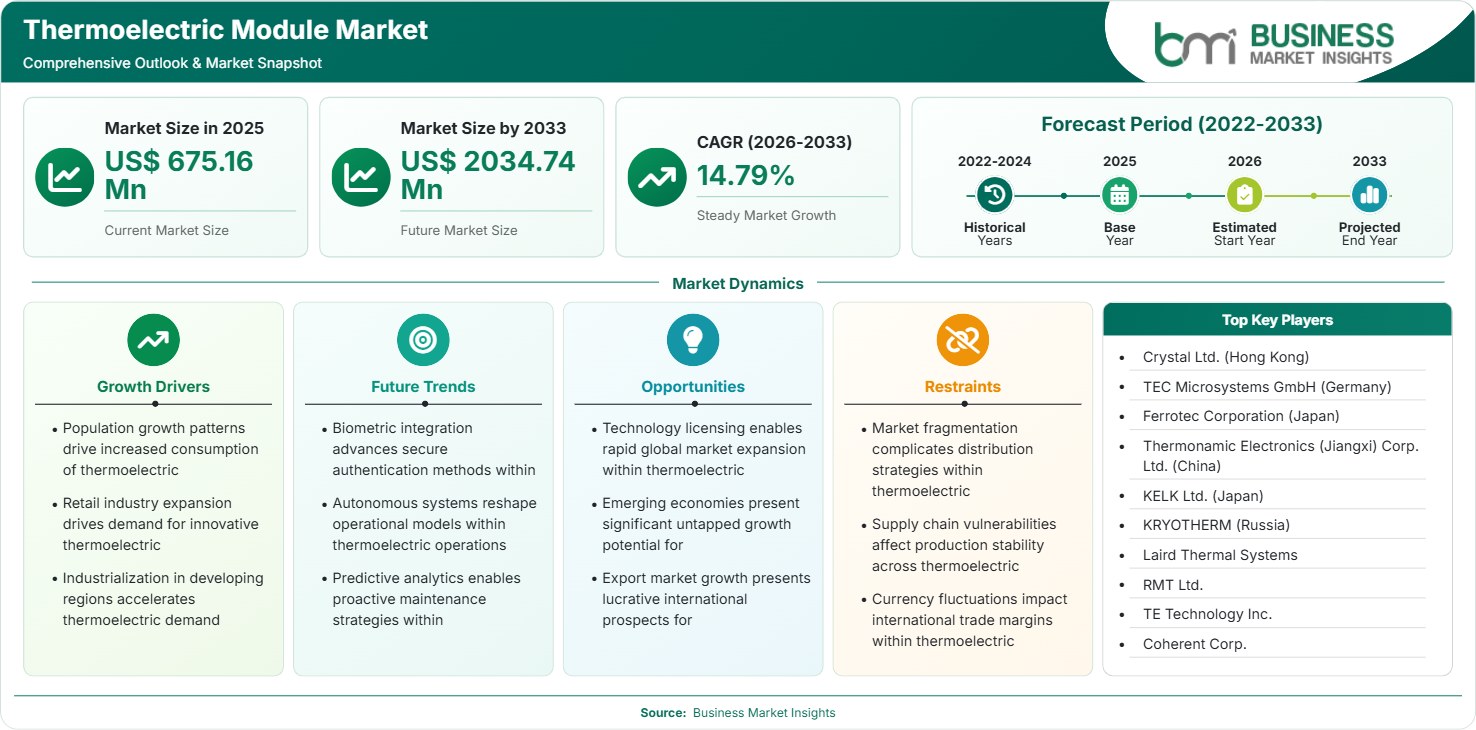
The Thermoelectric Module Market size was valued at US$ 675.16 Million in 2025 and is projected to reach US$ 2034.74 Million by 2033, growing at a CAGR of 14.79% during 2026–2033. Rising demand for compact thermal management solutions, increasing electric vehicle adoption, expansion of medical cooling applications, and advancements in semiconductor technologies are creating substantial growth opportunities across global industries.

Report Coverage
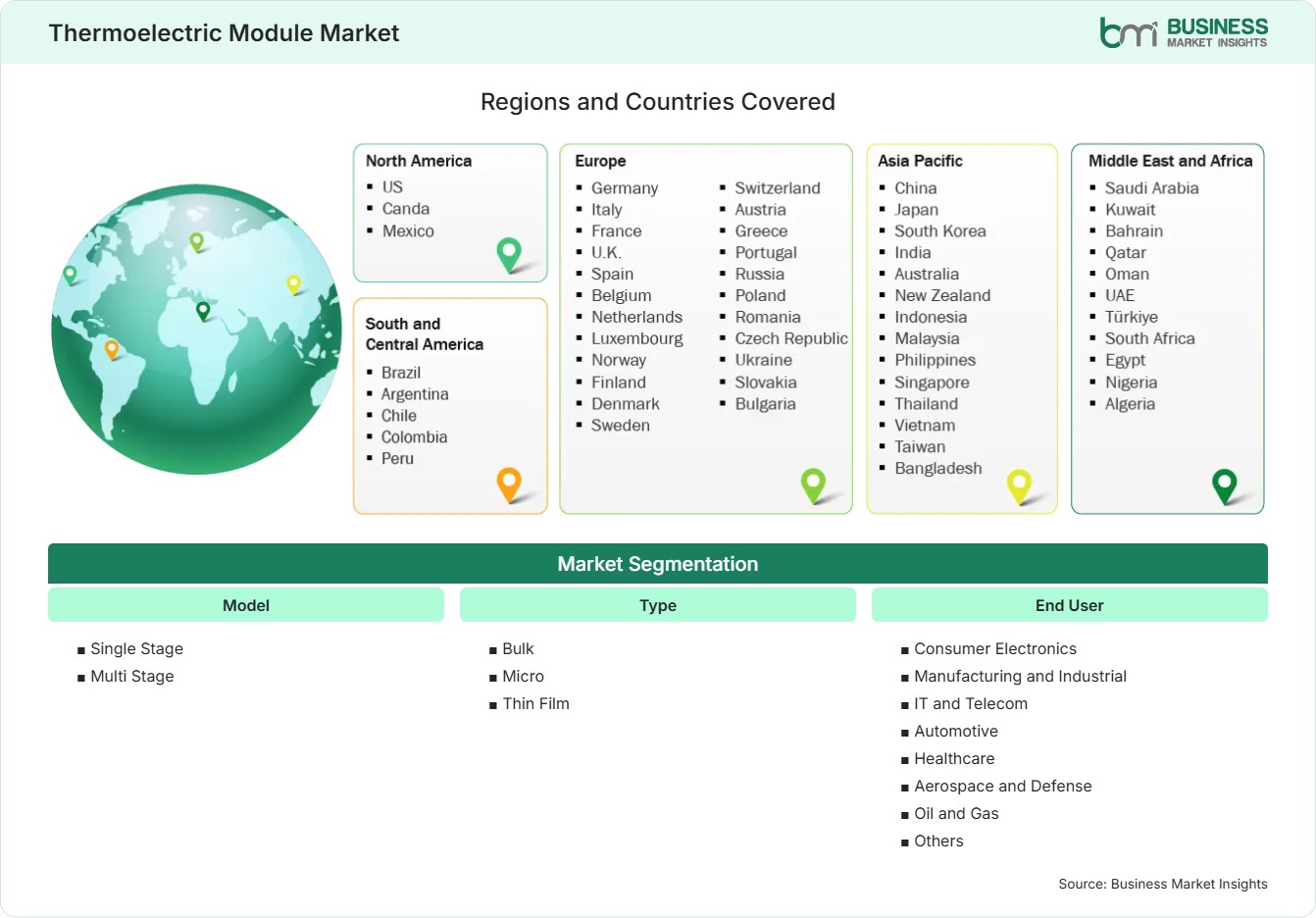
  • Model: Single Stage, Multi Stage
  • Type: Bulk, Micro, Thin Film
  • End User: Consumer Electronics, Manufacturing and Industrial, IT and Telecom, Automotive, Healthcare, Aerospace and Defense, Oil and Gas, Others
US$ 675.16 Mn Market size in 2025
US$ 2034.74 Mn Market Size by 2033
14.79% CAGR, 2026 - 2033
2026-2033 Forecast Period

AI Overview

Thermoelectric Module Market Summary

  • North America Region: North America holds a market share of 34%–37% in 2025, growing with a CAGR of 13.2%–14.5% during 2026–2033. Strong electronics manufacturing, defense investments, data center expansion, medical device innovation, and electric vehicle thermal management adoption continue supporting demand across industrial and commercial applications globally. The U.S. accounts for approximately 76%–80% of regional demand and is projected to grow at a CAGR of 13.5%–14.8% through 2033.
  • Fastest Growing Region: Asia Pacific holds a market share of 29%–32% in 2025, growing with a CAGR of 16.2%–17.8% during 2026–2033. Expanding semiconductor fabrication, electric vehicle manufacturing, telecommunications infrastructure deployment, healthcare equipment production, and government-backed electronics localization initiatives continue accelerating demand across multiple high-value industrial sectors.
  • Leading Segment: Consumer Electronics represents 28%–31% market share in 2025 and is expected to grow at a CAGR of 14.0%–15.2% during 2026–2033. Growing integration of compact cooling systems in wearables, sensors, gaming devices, optical equipment, and premium electronics supports continued commercial adoption worldwide.
  • High Growth Segment: Healthcare accounts for 12%–15% market share in 2025 and is projected to expand at a CAGR of 16.5%–18.0% during 2026–2033. Increased deployment in diagnostic instruments, portable medical refrigeration, laboratory equipment, biologics transportation, and precision temperature-controlled healthcare systems strengthens future demand.
  • Key Market Opportunity: Growing deployment of energy-efficient thermal management technologies in electric vehicles, edge computing infrastructure, aerospace electronics, and advanced healthcare devices is creating new revenue streams for module manufacturers worldwide.
  • Major Market Players: Crystal Ltd. (Hong Kong), TEC Microsystems GmbH (Germany), Ferrotec Corporation (Japan), Thermonamic Electronics (Jiangxi) Corp. Ltd. (China), KELK Ltd. (Japan), KRYOTHERM (Russia), Laird Thermal Systems, RMT Ltd., TE Technology Inc., and Coherent Corp.
Strategic Insights

Thermoelectric Module Market: Strategic Insights

Thermoelectric Module Market Strategic Framework
FREE PDF
Request your free sample
Request free sample
Stakeholder View

Key Takeaways

  • The value chain increasingly integrates semiconductor materials suppliers, module manufacturers, thermal system designers, electronics assemblers, and end-use industries, creating opportunities for vertically integrated supply strategies and enhanced margin capture.
  • Healthcare, telecommunications infrastructure, advanced sensors, and electric vehicle battery thermal management applications present the strongest long-term commercial potential due to increasing temperature-control requirements and reliability standards.
  • Product innovation is shifting toward thin-film structures, micro-scale cooling technologies, advanced semiconductor compounds, and high-performance multi-stage architectures capable of supporting precision thermal control environments.
  • Asia Pacific presents one of the strongest investment opportunities due to concentrated electronics manufacturing ecosystems, expanding semiconductor production, and favorable government support for industrial technology development.
  • Strategic acquisitions and technology partnerships are becoming increasingly common as manufacturers seek proprietary thermal management technologies, specialized materials expertise, and access to rapidly growing application markets.
  • Sustainability objectives are encouraging adoption of solid-state cooling technologies that eliminate refrigerants, reduce maintenance requirements, and improve energy efficiency across industrial and commercial operations.
Geographic Outlook

Thermoelectric Module Market Regional Highlights

North America Thermoelectric Module Market

North America accounted for approximately 34%–37% of global demand in 2025 and is projected to expand at a CAGR of 13.2%–14.5% through 2033. The region benefits from advanced semiconductor manufacturing capabilities, strong healthcare technology adoption, defense modernization initiatives, and increasing deployment of high-performance computing infrastructure. Thermoelectric Module Market share remains particularly strong across precision cooling applications where reliability, compact design, and energy efficiency are critical operational requirements. Continued investment in data centers and electric mobility technologies is expected to sustain regional leadership.

  • Semiconductor manufacturing investments across the United States and Canada continue supporting adoption of precision thermal control systems required for fabrication equipment, inspection technologies, and advanced packaging applications.
  • Growing defense modernization programs are increasing demand for ruggedized cooling technologies used in surveillance systems, communication equipment, infrared sensors, and mission-critical electronics platforms.
  • Expansion of hyperscale data centers is accelerating deployment of thermal management solutions that improve equipment reliability while supporting increasingly dense computing environments.
  • Rising adoption of electric vehicles is creating demand for temperature stabilization technologies supporting battery systems, sensors, charging infrastructure, and onboard electronic components.
  • Medical technology innovation continues driving implementation of solid-state cooling systems in diagnostics, laboratory equipment, portable refrigeration units, and biologics transportation applications.

US Thermoelectric Module Market

The United States represents approximately 76%–80% of North American demand and is expected to register a CAGR of 13.5%–14.8% during the forecast period. Strong federal support for domestic semiconductor manufacturing, growing defense expenditures, and expanding healthcare technology investments continue strengthening market fundamentals. Advanced electronics production and increasing adoption of AI-enabled computing infrastructure are creating additional opportunities for thermal management solution providers. Significant research activity among universities, laboratories, and technology companies also supports product innovation.

  • Federal semiconductor manufacturing initiatives are encouraging deployment of precision cooling technologies across fabrication facilities, research laboratories, and advanced electronics production ecosystems.
  • Strong defense procurement activity supports adoption of thermal management systems in avionics, radar platforms, surveillance equipment, and secure communications infrastructure.
  • Healthcare equipment manufacturers increasingly utilize solid-state cooling solutions in diagnostic imaging systems, laboratory instruments, and portable patient monitoring devices.
  • Data center operators are investing in efficient thermal management technologies to support AI workloads, cloud computing expansion, and next-generation networking infrastructure.

Europe Thermoelectric Module Market

Europe accounted for approximately 24%–27% of global demand in 2025 and is projected to expand at a CAGR of 13.8%–15.1% through 2033. The region benefits from strong industrial automation adoption, advanced automotive engineering capabilities, and stringent sustainability regulations. Germany remains the leading national market, while Eastern European manufacturing hubs are demonstrating faster expansion rates. Growing investment in energy-efficient technologies and electronics production continues supporting demand across multiple industrial sectors requiring reliable temperature-control solutions.

  • Germany leads regional demand owing to its automotive electronics ecosystem and extensive industrial automation infrastructure supporting advanced manufacturing applications.
  • Poland and the Czech Republic are emerging as high-growth production centers due to increasing electronics manufacturing investments and supply-chain diversification initiatives.
  • Sustainability regulations encouraging energy-efficient thermal management technologies continue supporting replacement of traditional cooling systems across industrial facilities.
  • Aerospace and defense modernization programs are expanding deployment of high-performance temperature-control technologies in mission-critical equipment applications.
  • Medical technology innovation remains a significant demand contributor, particularly across laboratory instruments, diagnostics equipment, and specialized refrigeration systems.

Asia Pacific Thermoelectric Module Market

Asia Pacific represented approximately 29%–32% of global Thermoelectric Module Market demand in 2025 and is anticipated to record the fastest CAGR of 16.2%–17.8% through 2033. China, Japan, South Korea, and Taiwan collectively account for a substantial share of electronics and semiconductor production. Growing investments in electric vehicles, telecommunications infrastructure, and advanced manufacturing facilities continue strengthening regional demand. The region benefits from extensive supply-chain integration, cost-efficient production capabilities, and expanding domestic consumption of high-technology products.

  • China remains the largest regional market due to extensive electronics manufacturing capacity, strong electric vehicle production, and increasing semiconductor localization initiatives.
  • India is among the fastest-growing countries, supported by electronics manufacturing incentives, telecommunications expansion, and rising healthcare infrastructure investments.
  • Japan maintains strong demand through advanced industrial automation, precision instrumentation, automotive electronics, and semiconductor equipment applications.
  • South Korea and Taiwan continue benefiting from global semiconductor leadership positions, creating sustained demand for high-performance thermal management technologies.
  • Rapid deployment of 5G infrastructure and next-generation telecommunications networks supports increased adoption across communications equipment applications.

Rest of World Thermoelectric Module Market

Rest of World accounted for approximately 9%–12% of global Thermoelectric Module Market demand in 2025 and is expected to expand at a CAGR of 14.5%–16.0% through 2033. South and Central America are witnessing increasing adoption across industrial automation, healthcare equipment, and telecommunications infrastructure projects.

The Middle East and Africa are benefiting from industrial diversification initiatives, renewable energy investments, and modernization of healthcare systems. Expanding electronics imports, infrastructure development programs, and growing demand for energy-efficient thermal management technologies are supporting long-term market expansion opportunities across emerging economies.

  • Brazil leads regional demand through industrial modernization programs, expanding healthcare infrastructure, and increasing adoption of advanced manufacturing technologies.
  • Mexico benefits from proximity to North American electronics supply chains and increasing investment in automotive and industrial production facilities.
  • Saudi Arabia is emerging as a key growth market supported by industrial diversification strategies and large-scale infrastructure development projects.
  • United Arab Emirates continues investing in healthcare modernization, smart infrastructure, and advanced technology deployment supporting thermal management requirements.
  • South Africa demonstrates increasing adoption across telecommunications, industrial automation, and healthcare applications as digital transformation initiatives expand.
Global Market Geography
FREE PDF
Request your free sample
Request free sample
Segment Analysis

Thermoelectric Module Market Segmentation

Model

The Model segment accounted for approximately 100% of total market revenue, with Single Stage modules contributing the majority of installations in 2025. Demand is supported by growing adoption across consumer electronics, telecommunications equipment, and healthcare devices. Multi-stage systems are gaining traction in applications requiring larger temperature differentials. The segment is projected to expand at a CAGR of 14.4%–15.6% through 2033 as performance requirements become increasingly sophisticated. The Thermoelectric Module Market scope continues broadening across precision cooling environments.

  • Single Stage: Widely adopted due to cost efficiency, compact design, and suitability for moderate temperature control applications across electronics, industrial automation, medical devices, and telecommunications equipment requiring reliable thermal stabilization.
  • Multi Stage: Increasingly deployed where substantial temperature differentials are necessary, including scientific instruments, aerospace electronics, laboratory systems, and specialized healthcare applications demanding highly precise thermal regulation capabilities.

Type

The Type segment reflects continuous innovation in material science and module architecture. Bulk technologies maintained the largest revenue contribution in 2025 with an estimated 58%–62% share, supported by extensive industrial and commercial deployment. Micro and Thin Film technologies are expanding rapidly as device miniaturization trends accelerate. The segment is expected to register a CAGR of 14.8%–16.1% through 2033. Thermoelectric Module Market share continues shifting toward advanced configurations delivering improved efficiency and integration flexibility.

  • Bulk: Dominates commercial deployment owing to mature manufacturing processes, proven reliability, and broad utilization across industrial equipment, automotive electronics, medical technologies, and telecommunications infrastructure applications worldwide.
  • Micro: Benefits from miniaturization trends in sensors, wearable electronics, portable healthcare devices, and compact semiconductor systems where precise thermal management enhances operational performance and component longevity.
  • Thin Film: Gaining momentum through advanced electronics applications requiring lightweight construction, rapid heat transfer characteristics, and seamless integration within next-generation semiconductor and optoelectronic systems.

End User

The End User segment demonstrates diverse adoption patterns across technology-intensive industries. Consumer Electronics maintained the leading position with approximately 28%–31% share in 2025 and is forecast to grow at a CAGR of 14.0%–15.2%. Healthcare represents the fastest-expanding category with a CAGR of 16.5%–18.0%. Thermoelectric Module Market trends indicate increasing penetration across industries prioritizing energy efficiency, compact thermal management, and operational reliability under demanding environmental conditions.

  • Consumer Electronics: Extensive deployment in gaming systems, wearables, sensors, cameras, premium electronics, and portable devices requiring compact and efficient temperature-control technologies for enhanced functionality.
  • Manufacturing and Industrial: Adoption is increasing across automation systems, process monitoring equipment, industrial sensors, and precision production environments requiring stable thermal operating conditions.
  • IT and Telecom: Growth is supported by expanding data centers, optical communication equipment, networking infrastructure, and telecommunications systems demanding consistent temperature management and equipment reliability.
  • Automotive: Rising electrification trends, advanced driver-assistance systems, battery technologies, and vehicle electronics are creating new opportunities for compact thermal management solutions.
  • Healthcare: Strong demand originates from diagnostics equipment, laboratory instruments, medical refrigeration, biologics transport systems, and temperature-sensitive healthcare technologies requiring precise control capabilities.
  • Aerospace and Defense: Utilized in avionics, surveillance systems, radar technologies, infrared sensors, and mission-critical electronics operating under challenging environmental conditions.
  • Oil and Gas: Deployment continues across remote monitoring systems, instrumentation equipment, sensing technologies, and field operations requiring dependable thermal performance in harsh environments.
Market Forces

Thermoelectric Module Market Dynamics

Key Market Drivers

Expansion of Semiconductor and Electronics Manufacturing

The international semiconductor industry continues to grow due to significant investment by both government organizations and private companies in the production process. Hundreds of billions of dollars have been invested in semiconductors within North America, Europe, and Asia according to industry groups. Temperature control is vital in all aspects of the semiconductor fabrication process. Thermoelectric Module Market growth is further being supported by the rise in complexity and reduction in process nodes in semiconductors, which necessitate a constant temperature. Further, manufacturers are incorporating new cooling solutions in sensors, optical systems, and communication equipment. Moreover, the production of consumer electronics, industrial electronics, and telecommunications equipment is rising.

Accelerating Adoption of Electric Vehicles and Advanced Mobility Systems

The number of electric vehicles being manufactured worldwide is increasing constantly due to the adoption of emissions-reduction goals and development of electric product line-ups by automobile companies. Precise temperature control becomes more necessary for battery packs, electronics, sensors, lidars, and charging stations. Thermoelectric coolers offer a compact solution without refrigerant and mechanical compressors. Thermoelectric Module Market trends suggest that there is an increased usage in battery management systems and the electronics of future automobiles. Increased usage of connected cars, autonomous driving technology, and ADAS increases the demand for thermal interface material. The automotive suppliers are developing new thermal management solutions which can withstand high power density.

Rising Demand for Medical and Healthcare Temperature-Control Solutions

Healthcare providers and medical equipment manufacturers increasingly depend on accurate thermal management technologies. Temperature stability is very important for the proper function of diagnostic imaging devices, laboratory analyzers, biological transporters, and portable refrigerators. Based on the information from global health organizations, the need for diagnostics and temperature-sensitive treatment options is growing steadily worldwide. Thermoelectric Module Market growth benefits from these developments because solid-state cooling systems offer low maintenance requirements, quiet operation, and precise control. Expanding pharmaceutical manufacturing activities, vaccine distribution networks, and laboratory modernization initiatives are creating sustained demand for thermoelectric technologies across healthcare ecosystems.

Key Market Opportunities

Growth Potential in Edge Computing and AI Infrastructure

Fast-growing edge computing centers and artificial intelligence technologies offer a great chance for thermal management solutions vendors. Advanced processors produce large amounts of heat that can affect reliability and performance. Thermoelectric solutions become more widely used in localized cooling. With the expansion of AI usage by companies in various industries such as manufacturing, healthcare, telecommunication, and finance, there is an increasing demand for efficient cooling systems. Thermoelectric Module Market Forecasts increasingly highlight intelligent infrastructure as a promising growth avenue. Companies developing high-performance modules optimized for data-intensive computing applications may secure long-term competitive advantages.

Emerging Applications in Renewable Energy and Energy Harvesting

Renewable energy systems and waste-heat recovery technologies are creating new commercial opportunities for module manufacturers. Thermoelectric technologies can convert temperature differentials into usable electrical energy, supporting sustainability initiatives across industrial sectors. A greater concern about reducing carbon emissions and efficiency has encouraged research in the creation of new materials as well as new thermoelectric generators. Thermoelectric generation from industrial facilities, transportation networks, and distant engineering projects has also been viewed as one way of improving efficiency. In light of government policies that seek to reduce carbon emissions and industries that search for new energy generation sources, there is a potential for an increase in the use of thermoelectrics.

Expansion of Precision Thermal Management in Aerospace Systems

Aerospace platforms increasingly incorporate sophisticated electronics requiring dependable temperature control under extreme environmental conditions. Satellite, avionics, infrared imaging and space explorations all need an effective way of thermal management. Thermoelectric cooling has its own strengths including being portable, durable, and the absence of moving parts. Greater investment in research for commercial space ventures, communication satellites, military advancements, and UAVs is expected to bring positive conditions for the uptake of the technology. Firms that produce lightweight and effective thermoelectric coolers that meet the needs of the aerospace sector will thrive.

Market Restraints and Challenges

Material Cost Volatility and Margin and Pricing Pressure

Factor: Fluctuations in raw material availability and pricing create uncertainty throughout the manufacturing value chain.

Impact: Production costs may increase unpredictably, resulting in lower profits and more complicated arrangements for long-term supply of materials. It may be harder for small companies to acquire a reliable source of materials than for their bigger rivals who have better procurement capacity. The situation is additionally difficult since clients do not want to pay higher prices for the goods when costs have gone up.

Performance Limitations and Restricted Adoption Scope

Factor: Limited efficiency under certain operating conditions can constrain adoption where large-scale cooling requirements dominate.

Impact: Prospective consumers might continue using their compression systems or other devices in terms of assessing their total cost performance. Engineers need to have a thorough cost analysis done prior to incorporating the thermoelectric system into a major industrial system. Further developments need to be done in order for thermoelectric devices to become more competitive than traditional thermal management systems.

Company Analysis

Competitive Landscape

The competitive environment is characterized by technological innovation, material science advancements, manufacturing scale expansion, and increasing specialization across semiconductor, healthcare, aerospace, and telecommunications applications. Thermoelectric Module Market analysis indicates that manufacturers are prioritizing high-efficiency module architectures, miniaturized cooling solutions, and strategic capacity investments to address growing demand from electronics and industrial sectors.

Company Name

Overview

Products and Services Relevant to this Market

Crystal Ltd. (Hong Kong)

Specialized provider of thermoelectric cooling solutions serving electronics, industrial equipment, and customized thermal management applications across global markets.

Thermoelectric modules, cooling assemblies, custom thermal solutions, temperature control systems, and integrated electronic cooling components.

TEC Microsystems GmbH (Germany)

European specialist focused on precision thermoelectric technologies for scientific instruments, medical systems, and advanced industrial applications.

Single-stage modules, multi-stage modules, custom TEC assemblies, thermal controllers, and precision cooling solutions.

Ferrotec Corporation (Japan)

Global leader in thermoelectric technologies with extensive manufacturing capabilities supporting semiconductor, optical communication, and industrial sectors.

Thermoelectric modules, thermal management devices, semiconductor components, temperature control systems, and advanced electronic materials.

Thermonamic Electronics (Jiangxi) Corp. Ltd. (China)

Major manufacturer serving consumer electronics, telecommunications, automotive, and industrial customers through large-scale production capabilities.

Thermoelectric coolers, thermoelectric generators, cooling modules, thermal assemblies, and customized temperature-control products.

KELK Ltd. (Japan)

Technology-focused company supplying advanced thermoelectric products for industrial process control and precision equipment markets.

Thermoelectric modules, thermal sensors, temperature monitoring systems, industrial thermal management technologies, and engineering services.

KRYOTHERM (Russia)

Specialized developer of thermoelectric devices supporting scientific, aerospace, defense, and industrial applications requiring precision thermal control.

Thermoelectric coolers, generators, thermal systems, custom-engineered modules, and temperature stabilization technologies.

Laird Thermal Systems

Established thermal management provider serving electronics, medical, telecommunications, and industrial equipment manufacturers globally.

Thermoelectric assemblies, thermal interface materials, temperature controllers, cooling systems, and custom thermal engineering solutions.

RMT Ltd. (U.S.)

Provider of thermoelectric technologies focused on scientific instrumentation, industrial automation, and specialized cooling applications.

Thermoelectric modules, thermal control units, custom cooling systems, and precision temperature-management products.

TE Technology Inc. (U.S.)

U.S.-based manufacturer offering thermoelectric products and engineering support for commercial, industrial, and laboratory applications.

Thermoelectric modules, cooling assemblies, temperature controllers, thermoelectric generators, and thermal design services.

Coherent Corp. (U.S.)

Global photonics and engineered materials company with significant expertise in advanced thermal management technologies.

Thermoelectric coolers, photonic thermal solutions, semiconductor thermal components, cooling systems, and engineered thermal materials.

Industry Activity

Recent Developments

July, 2026

Ferrotec Corporation — Announced expansion of thermo-module production capacity for optical communication transceivers from approximately 4 million to 6 million units per month, with plans to further increase capacity to 9 million units to address growing demand from AI and optical networking applications.

March, 2026

Laird Technologies — Expanded its thermal management portfolio through the introduction of the Laird™ Tflex™ SF16 thermal gap filler designed for AI, automotive, consumer electronics, and data-center applications requiring enhanced thermal conductivity.

March, 2026

Coherent Corp. — Introduced Thermadite™ 800 Liquid Cold Plates targeting next-generation AI accelerator cooling applications, utilizing advanced diamond-based thermal materials to improve heat dissipation performance.

January, 2025

Coherent Corp. — Launched the CT-Series thermoelectric coolers for life sciences, medical, industrial, sensor cooling, and thermal stabilization applications, expanding its thermoelectric thermal management portfolio.

Trust & Transparency

Research Methodology

The market analysis combines proprietary research with secondary data from government agencies, company disclosures, regulatory filings, industry databases and expert interviews. Market estimates are validated through data triangulation, cross-market benchmarking and analyst review.

View Full Research Methodology

Questions Answered

Frequently Asked Questions

What insights are typically included in a Thermoelectric Module Market Report?

A comprehensive Thermoelectric Module Market Report generally includes market sizing, segmentation analysis, competitive benchmarking, technology trends, regional outlooks, supply chain assessments, growth opportunities, regulatory influences, and future demand projections across end-use industries.

What factors influence purchasing decisions in this industry?

Customers typically evaluate cooling performance, energy efficiency, temperature differential capability, reliability, module lifespan, size constraints, integration flexibility, operating environment requirements, and total ownership costs when selecting thermal management solutions.

Which region offers the strongest future growth potential?

Asia Pacific presents the strongest growth outlook due to expanding semiconductor manufacturing, electric vehicle production, telecommunications infrastructure deployment, and government support for advanced electronics manufacturing across China, India, South Korea, Japan, and Taiwan

How do thermoelectric modules differ from conventional cooling technologies?

Unlike compressor-based systems, thermoelectric modules contain no moving parts, require minimal maintenance, operate quietly, and provide precise temperature regulation. These characteristics make them valuable in compact and reliability-critical applications.

What are the primary applications of thermoelectric modules?

Thermoelectric modules are widely used in consumer electronics, medical devices, telecommunications equipment, industrial automation systems, aerospace electronics, defense technologies, and automotive thermal management applications. Their solid-state operation makes them suitable for precise temperature control requirements.__________________________________________________________________________

Access the Full Thermoelectric Module Market Report

Get segment-level forecasts, regional estimates, competitive benchmarking, company profiles and downloadable Excel datasets.

Access the full Thermoelectric Module Market Report
350 pages PDF & Excel | 2026-08-31
Similar Research

Related Market Reports