
Connectivity Module Market Outlook: Size, Share, Trends, Growth Analysis, Competitive Landscape & Forecast, 2026-2033

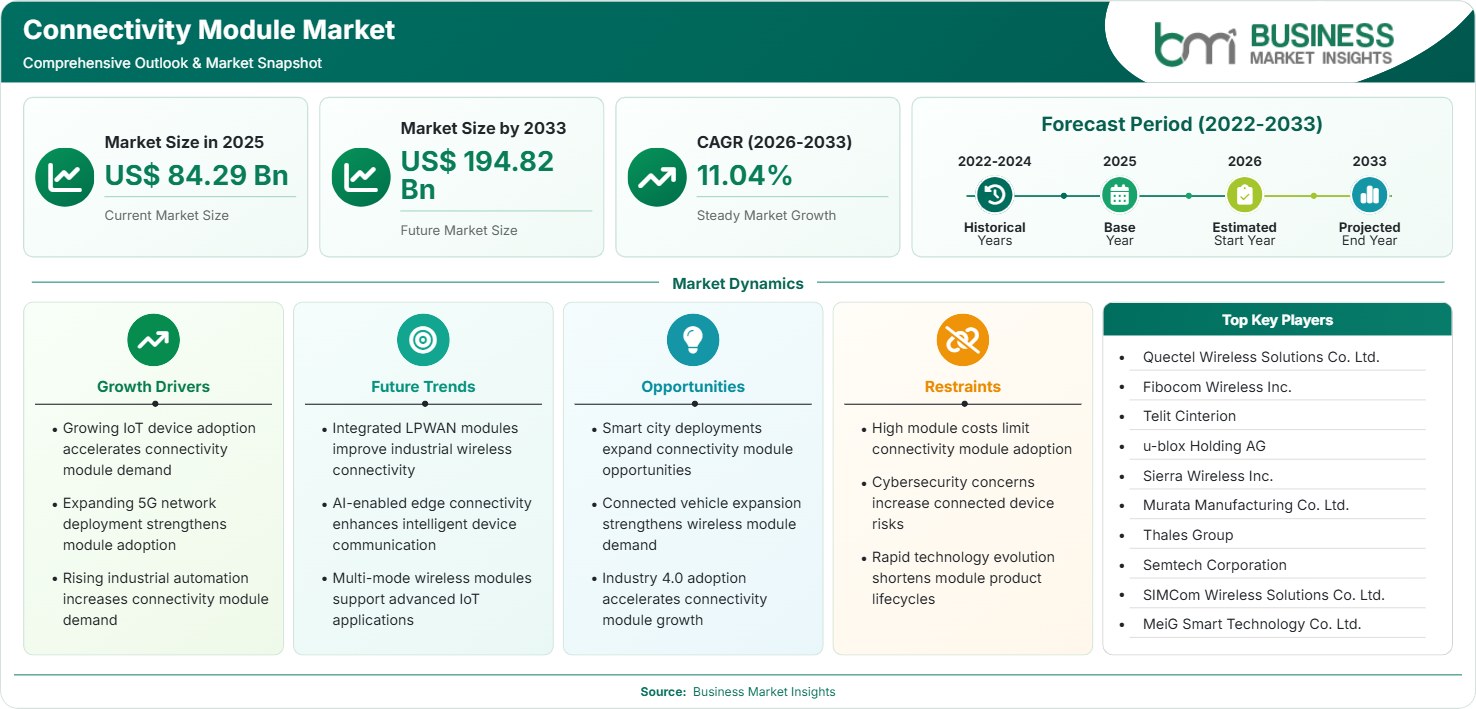
The Connectivity Module Market size was valued at US$ 84.29 billion in 2025 and is projected to reach US$ 194.82 billion by 2033, registering a CAGR of 11.04% during 2026–2033. The market is showing substantial growth owing to the growing use of Internet of Things (IoT) devices, fast installation of 5G technology, and increasing requirement for connected solutions in various applications like automobiles, industry, healthcare, smart cities, and consumers. Connectivity modules facilitate communication among devices, networks, and cloud computing by ensuring connectivity through wireless and wired connection capabilities.

Report Coverage
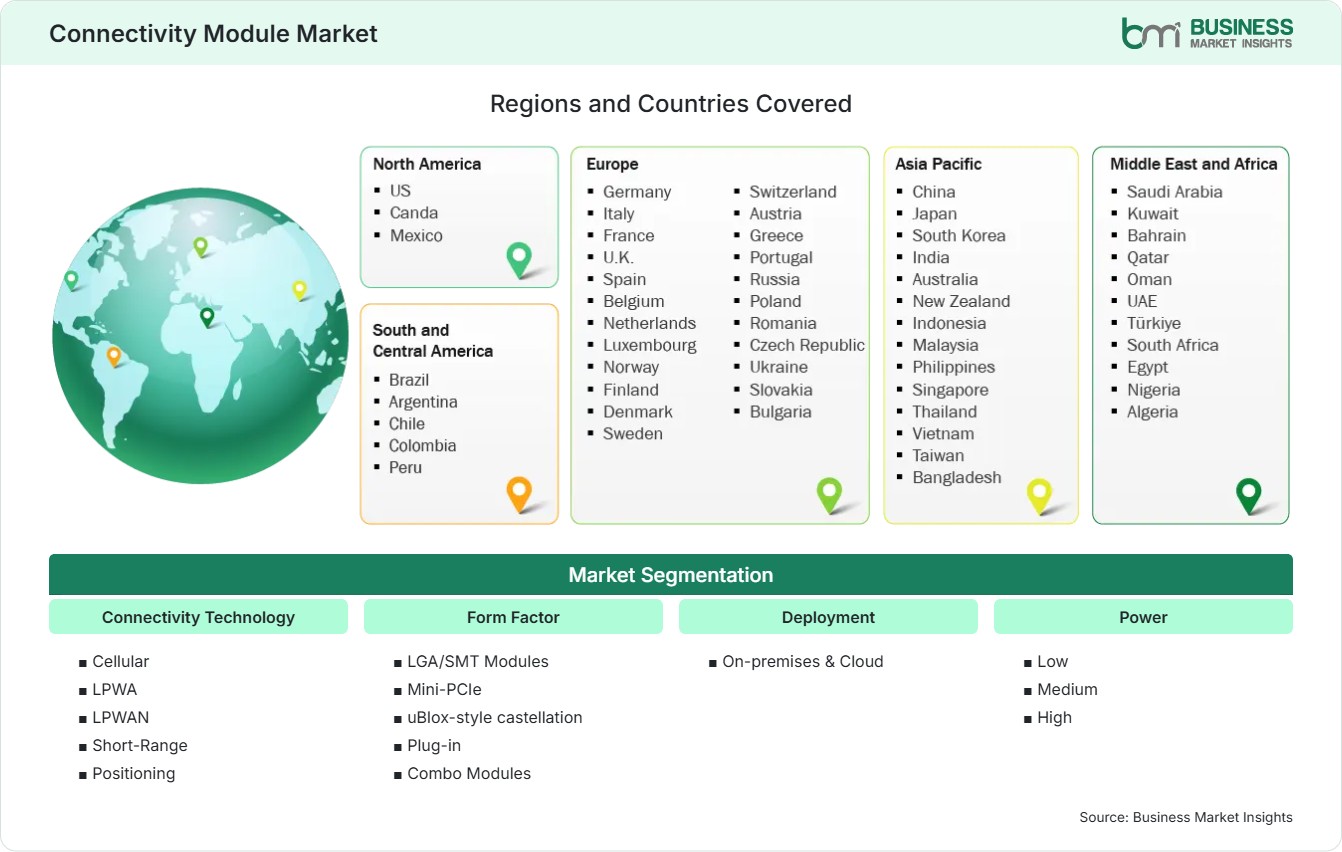
  • Connectivity Technology: Cellular, LPWA, LPWAN, Short-Range, Positioning
  • Form Factor: LGA/SMT Modules, Mini-PCIe, uBlox-style castellation, Plug-in, Combo Modules
  • Deployment: On-premises & Cloud
  • Power: Low, Medium, High
  • Industry Vertical: Automotive & Transportation, Manufacturing, Energy & Utilities, Healthcare, Retail & E-commerce, Residential/Commercial Buildings, Government & Public Sector/Smart Cities, IT-Telecom, Others
US$ 84.29 Bn Market size in 2025
US$ 194.82 Bn Market Size by 2033
11.04% CAGR, 2026 - 2033
2026-2033 Forecast Period

01 AI Overview

Connectivity Module Market Summary

  • North America Region: North America accounted for 26%–29% of global revenue in 2025 and is projected to register a CAGR of 10.5%–11.0% during 2026–2033. Strong adoption of IoT technologies, advanced telecommunications infrastructure, industrial automation, connected vehicle solutions, and smart city initiatives continue supporting regional growth. The United States contributes approximately 84%–87% of regional revenue and is expected to register a CAGR of 10.6%–11.1% owing to increasing investments in 5G infrastructure and connected technologies.
  • Fastest Growing Region: Asia Pacific represented 40%–43% of global revenue in 2025 and is projected to register the highest CAGR of 11.8%–12.3% during the forecast period. Rapid industrial digitalization, expanding IoT deployment, smart manufacturing initiatives, and increasing telecommunications investments continue accelerating regional demand.
  • Leading Segment: Cellular (WWAN) accounted for 35%–38% of market revenue in 2025 and is projected to register a CAGR of 11.2%–11.7% during the assessment period owing to widespread adoption across automotive, industrial IoT, logistics, and enterprise connectivity applications.
  • High Growth Segment: Automotive & Transportation represented 22%–25% of total market revenue in 2025 and is projected to expand at a CAGR of 12.0%–12.5% driven by increasing connected vehicle adoption, advanced driver assistance systems, vehicle telematics, and intelligent transportation infrastructure.
  • Key Market Opportunity: Smart city development, connected vehicle expansion, industrial automation, and Industry 4.0 transformation continue creating significant opportunities for connectivity module manufacturers.
  • Major Market Players: Quectel Wireless Solutions Co. Ltd., Fibocom Wireless Inc., Telit Cinterion, u-blox Holding AG, Sierra Wireless Inc., Murata Manufacturing Co. Ltd., Thales Group, Semtech Corporation, SIMCom Wireless Solutions Co. Ltd., MeiG Smart Technology Co. Ltd.
02 Strategic Insights

Connectivity Module Market: Strategic Insights

connectivity-module-market-market-strategic-framework
FREE PDF
Request your free sample
Request free sample
03 Stakeholder View

Key Takeaways

  • The market continues benefiting from increasing IoT adoption, 5G network expansion, industrial automation, and growing demand for connected ecosystems.
  • The strongest Connectivity Module Market Growth opportunities continue emerging from smart cities, connected vehicles, Industry 4.0 transformation, and cloud-connected applications.
  • Cellular connectivity modules remain the leading technology segment due to extensive deployment across industrial, automotive, logistics, and enterprise applications.
  • Asia Pacific continues maintaining strong growth momentum owing to rapid digitalization, electronics manufacturing expansion, and increasing IoT investments.
  • Manufacturers are focusing on low-power solutions, advanced security features, compact designs, and multi-network compatibility to strengthen product innovation.
  • Companies investing in next-generation connectivity technologies, secure communication platforms, and industry-specific module solutions are expected to improve their competitive positioning.
04 Geographic Outlook

Connectivity Module Market Regional Highlights

North America Connectivity Module Market

North America accounted for 26%–29% of global revenue in 2025 and is projected to register a CAGR of 10.5%–11.0% during 2026–2033. The region continues witnessing strong demand due to advanced telecommunications infrastructure, widespread IoT adoption, industrial automation initiatives, connected vehicle deployment, and increasing investments in smart infrastructure. The Connectivity Module Market Share remains significant as enterprises across automotive, manufacturing, healthcare, and government sectors increasingly integrate connected technologies into their operations.

  • The United States remains the largest regional market owing to strong 5G network deployment, advanced IoT ecosystems, and increasing adoption of connected industrial solutions.
  • Canada continues supporting regional expansion through smart city initiatives, digital infrastructure investments, and increasing adoption of connected devices.
  • Growing investments in edge computing, cloud connectivity, and industrial automation continue strengthening demand for advanced connectivity modules.
  • Manufacturers are focusing on secure communication solutions, low-power modules, and multi-network compatibility to address increasing connectivity requirements.

US Connectivity Module Market

The United States accounted for approximately 84%–87% of North American revenue in 2025 and is projected to register a CAGR of 10.6%–11.1% during the forecast period. Increasing IoT implementation, expanding 5G infrastructure, connected vehicle adoption, and industrial digitalization continue driving market growth. Enterprises across manufacturing, transportation, healthcare, and commercial sectors are increasingly deploying connectivity-enabled systems to improve operational efficiency and data accessibility.

  • Growing investments in smart manufacturing and industrial IoT solutions continue increasing demand for reliable wireless communication modules.
  • Automotive companies are increasingly integrating connectivity modules into connected vehicles, telematics systems, and advanced mobility solutions in connectivity module market.
  • Healthcare providers continue adopting connected medical devices requiring secure and efficient data transmission capabilities.

Europe Connectivity Module Market

Europe represented 23%–26% of global revenue in 2025 and is expected to expand at a CAGR of 10.2%–10.7% during 2026–2033. Strong automotive manufacturing, industrial automation adoption, smart city development, and increasing focus on digital transformation continue supporting regional growth. Germany remains the largest regional market, while the United Kingdom is expected to register the fastest growth with a CAGR of 10.8%–11.3% due to increasing investments in connected infrastructure and digital services.

  • Germany continues leading regional demand through automotive innovation, Industry 4.0 initiatives, and advanced manufacturing capabilities.
  • The United Kingdom supports market expansion through smart infrastructure development, IoT adoption, and telecommunications modernization.
  • France continues contributing to connectivity module demand through automotive, healthcare, and industrial applications in connectivity module market.
  • European manufacturers are increasingly focusing on secure connectivity solutions to support data protection requirements and connected device reliability.
  • Increasing deployment of smart factories and connected logistics systems continues accelerating adoption of advanced connectivity modules.

Asia Pacific Connectivity Module Market

Asia Pacific accounted for 40%–43% of global revenue in 2025 and is projected to register the highest CAGR of 11.8%–12.3% during the forecast period. Rapid industrialization, expanding electronics manufacturing, growing IoT adoption, increasing 5G deployment, and smart city initiatives continue positioning the region as a major growth contributor. China remains the leading regional market, while India is projected to register the fastest growth with a CAGR of 12.3%–12.8% due to increasing digital transformation initiatives and connected infrastructure development.

  • China continues dominating regional demand through large-scale electronics manufacturing, IoT deployment, and advanced telecommunications infrastructure.
  • India continues experiencing strong growth through smart city programs, industrial automation, digital infrastructure expansion, and increasing connected device adoption.
  • Japan maintains stable demand through automotive technology development, robotics, and advanced manufacturing applications in connectivity module market.
  • South Korea continues supporting market expansion through semiconductor innovation, 5G infrastructure, and connected consumer electronics.
  • Southeast Asian countries are witnessing increasing demand through smart manufacturing investments and expanding industrial connectivity applications.

Rest of World Connectivity Module Market

The Rest of World accounted for 5%–7% of global revenue in 2025 and is projected to register a CAGR of 10.5%–11.0% during 2026–2033. Latin America, the Middle East, and Africa are witnessing increasing adoption of connectivity modules due to expanding telecommunications infrastructure, smart city projects, industrial modernization, and digital transformation initiatives.

Growing investments in connected infrastructure, energy management systems, transportation networks, and industrial automation continue creating new opportunities for connectivity module providers.

  • Brazil remains the leading Latin American market through expanding IoT applications, telecommunications development, and industrial digitalization.
  • The United Arab Emirates continues strengthening demand through smart city initiatives, connected infrastructure projects, and technology investments.
  • Saudi Arabia supports market growth through digital transformation programs, smart infrastructure development, and industrial modernization.
  • South Africa continues adopting connectivity solutions across logistics, energy, healthcare, and public infrastructure sectors.
  • Global connectivity module manufacturers are expanding partnerships and distribution networks to capture emerging market opportunities.
global-market-geography
FREE PDF
Request your free sample
Request free sample
05 Segment Analysis

Connectivity Module Market Segmentation

Connectivity Technology

The Connectivity Technology segment accounted for 35%–38% of market revenue in 2025 and is projected to register a CAGR of 11.2%–11.7% during the forecast period. Increasing adoption of IoT ecosystems, connected infrastructure, industrial automation, and real-time data communication continues driving demand for advanced connectivity technologies. The Connectivity Module Market Trends indicate growing preference for flexible, low-power, and multi-network communication solutions capable of supporting diverse applications across automotive, manufacturing, healthcare, and smart city environments.

  • Cellular (WWAN): Cellular connectivity modules represent the leading technology category due to extensive adoption in connected vehicles, industrial IoT, logistics tracking, smart meters, and enterprise applications. Increasing 4G LTE and 5G network availability continues supporting demand for reliable wide-area communication.
  • LPWA (Cellular): Cellular low-power wide-area technologies continue gaining adoption for battery-operated IoT applications requiring long-range communication and low energy consumption. These solutions support smart metering, asset tracking, agriculture monitoring, and environmental sensing applications.
  • LPWAN (Non-cellular): Non-cellular LPWAN technologies continue expanding through applications requiring cost-effective and energy-efficient connectivity solutions across industrial monitoring, smart buildings, and large-scale sensor networks.
  • Short-Range (WLAN/PAN): Short-range connectivity solutions remain important for consumer electronics, smart home devices, industrial equipment, and local communication networks due to their affordability and ease of integration.
  • Positioning: Positioning connectivity modules are increasingly adopted in automotive navigation, fleet management, logistics tracking, and location-based IoT applications requiring accurate positioning capabilities.

Form Factor

The Form Factor segment represented 28%–31% of total market revenue in 2025 and is expected to expand at a CAGR of 10.8%–11.3% throughout the assessment period. Increasing demand for compact electronic designs, embedded connectivity solutions, and efficient device integration continues supporting growth across different module formats. The Connectivity Module Market Scope continues expanding as manufacturers develop smaller, energy-efficient, and application-specific module designs.

  • LGA/SMT Modules: LGA/SMT modules continue witnessing strong adoption due to compact size, efficient integration, and suitability for embedded IoT devices, industrial equipment, and consumer electronics.
  • Mini-PCIe: Mini-PCIe modules remain widely used in industrial computers, routers, gateways, and enterprise networking equipment due to their flexible installation and compatibility advantages.
  • uBlox-style castellation: Castellation-based modules continue supporting compact device designs where space efficiency, reliable connections, and simplified integration are essential.
  • Plug-in: Plug-in modules continue serving applications requiring easy installation, replacement flexibility, and modular connectivity upgrades.
  • Combo Modules: Combo modules are gaining adoption by integrating multiple connectivity technologies into single solutions, reducing device complexity and improving overall system efficiency.

Deployment

The Deployment segment accounted for 18%–21% of market revenue in 2025 and is projected to register a CAGR of 11.0%–11.5% during 2026–2033. Growing demand for scalable connectivity infrastructure, cloud-based platforms, and distributed IoT management systems continues increasing adoption across enterprises and industries.

  • On-premises: On-premises deployment continues supporting organizations requiring greater control over data management, security, and network infrastructure, particularly in industrial and enterprise environments.
  • Cloud: Cloud-based connectivity deployment is witnessing increasing adoption due to scalability, remote device management capabilities, reduced infrastructure requirements, and integration with advanced analytics platforms.

Power

The Power segment represented 15%–18% of market revenue in 2025 and is expected to expand at a CAGR of 10.7%–11.2% during the forecast period. Increasing demand for energy-efficient connected devices and battery-powered IoT systems continues influencing module development strategies.

  • Low Power: Low-power modules are increasingly preferred for remote IoT devices, smart sensors, wearable technologies, and applications requiring extended battery life.
  • Medium Power: Medium-power modules support applications requiring balanced performance and energy efficiency across industrial, commercial, and transportation systems.
  • High Power: High-power modules are used in applications requiring advanced processing capabilities, continuous connectivity, and higher data transmission performance.

Industry Vertical

The Industry Vertical segment accounted for 22%–25% of market revenue in 2025 and is projected to register a CAGR of 12.0%–12.5% during 2026–2033. Increasing digital transformation initiatives and connected technology adoption across industries continue expanding connectivity module applications.

  • Automotive & Transportation: Automotive and transportation remain major application areas due to increasing connected vehicle deployment, vehicle tracking systems, telematics, and intelligent transportation solutions.
  • Manufacturing: Manufacturing industries are increasingly adopting connectivity modules for smart factories, industrial automation, machine monitoring, and predictive maintenance systems.
  • Energy & Utilities: Energy companies utilize connectivity modules for smart grids, remote monitoring, energy management systems, and utility infrastructure optimization.
  • Healthcare: Healthcare applications are expanding through connected medical devices, remote monitoring systems, and digital healthcare platforms requiring secure communication.
  • Retail & E-commerce: Retail and e-commerce sectors are adopting connected solutions for inventory tracking, smart shelves, logistics management, and customer experience enhancement.
  • Residential/Commercial Buildings: Smart building applications are increasing demand for connectivity modules supporting automation, security systems, energy management, and connected devices.
  • Government & Public Sector/Smart Cities: Smart city initiatives are driving adoption through intelligent transportation, public safety systems, environmental monitoring, and connected infrastructure.
  • IT-Telecom: IT and telecom sectors continue supporting demand through network equipment, communication infrastructure, and connected service platforms.
  • Others: Agriculture, logistics, industrial monitoring, and specialized applications continue contributing to overall market expansion.
06 Market Forces

Connectivity Module Market Dynamics

Key Market Drivers

Growing IoT device adoption accelerates connectivity module demand

The rising usage of IoT devices in various applications such as consumers, industries, automobiles, health care, and commerce applications continues to fuel the growth of connectivity modules. The fast growth of interconnected ecosystems necessitates reliable communication means through which the devices can communicate effectively. The increasing usage of smart sensors and remote monitoring devices is expected to boost the demand for connectivity modules.

Expanding 5G network deployment strengthens module adoption

Global expansion of 5G networks is accelerating adoption of high-performance connectivity modules capable of supporting faster data transmission, lower latency, and improved network reliability. Increasing investments in telecommunications infrastructure, smart cities, and connected mobility solutions are encouraging enterprises to integrate advanced wireless communication technologies.

Rising industrial automation increases connectivity module demand

Growing adoption of Industry 4.0 technologies, smart manufacturing systems, and automated industrial processes is increasing demand for connectivity modules that enable real-time monitoring, machine communication, and operational optimization. Manufacturers are increasingly deploying connected equipment to improve productivity, reduce downtime, and enhance decision-making capabilities.

Key Market Opportunities

Smart city deployments expand connectivity module opportunities

Increasing smart city initiatives are creating opportunities for connectivity module providers through applications including intelligent transportation, smart lighting, environmental monitoring, public safety systems, and connected infrastructure. Governments and municipalities are investing in digital infrastructure to improve efficiency and service delivery.

Connected vehicle expansion strengthens wireless module demand

Growing adoption of connected vehicles, advanced driver assistance systems, vehicle telematics, and intelligent transportation networks is increasing demand for reliable wireless connectivity solutions. Automotive manufacturers are integrating connectivity modules to enable real-time communication, navigation services, and enhanced vehicle experiences.

Industry 4.0 adoption accelerates connectivity module growth

Increasing implementation of smart factories, robotics, industrial sensors, and automated production systems is creating significant opportunities for connectivity module manufacturers. Industry 4.0 transformation requires advanced communication infrastructure to enable data-driven operations and connected industrial environments.

Market Restraints and Challenges

High module costs limit connectivity module adoption

Factor: Connective modules need sophisticated hardware, communications chip sets, security, and support for different network technologies that may lead to high manufacturing costs. Modules designed for use with 5G technology and other advanced technologies such as LPWANs require a lot of research and development investment.

Impact: The high cost of modules could reduce the uptake by smaller and medium-sized organizations especially in developing nations. Manufacturers are working on manufacturing cost minimization through design scalability and cost-effective sourcing of components.

Cybersecurity concerns increase connected device risks

Factor: The use of connected devices in various industries, including industry, automotive, healthcare, and intelligent infrastructure, has raised concerns about the security of information and the possibility of intrusion from cyber sources. Connective modules that carry sensitive business and consumer information need sophisticated security solutions for proper communication.

Impact: The issue of security may hinder the implementation of connected devices in companies that have high data security demands. The companies are putting money into encryption and cybersecurity solutions.

07 Company Analysis

Competitive Landscape

The competition in the connectivity module market is based on technology innovations, connectivity, miniaturization of the product, its security and industry-specific solutions. As per the Connectivity Module Market Analysis, the top players in this field are concentrating on developing advanced wireless technologies, power-saving solutions, connectivity platforms and customizing modules due to growing demands in automotive, industrial automation, healthcare, telecom and smart cities segments.

Company Name

Overview

Products and Services relevant to this market

Quectel Wireless Solutions Co. Ltd.

Global provider of IoT connectivity solutions and wireless communication modules.

Cellular modules, 5G modules, LTE modules, LPWA modules, GNSS solutions, IoT antennas, and connected device solutions.

Fibocom Wireless Inc.

Developer of wireless communication modules and IoT solutions for global markets.

Cellular modules, 5G solutions, LTE modules, smart modules, automotive connectivity solutions, and industrial IoT products.

Telit Cinterion

Global provider of IoT modules, platforms, and connectivity solutions.

Cellular modules, IoT connectivity solutions, industrial communication modules, cloud connectivity platforms, and embedded solutions.

u-blox Holding AG

Technology company specializing in positioning and wireless communication solutions.

GNSS modules, cellular connectivity modules, short-range wireless modules, and positioning technologies.

Sierra Wireless Inc.

Provider of IoT connectivity hardware and software solutions.

Cellular modules, IoT gateways, embedded connectivity solutions, and enterprise networking products.

Murata Manufacturing Co. Ltd.

Global electronics manufacturer providing communication components and modules.

Wireless modules, IoT solutions, short-range connectivity products, and electronic components.

Thales Group

Technology company providing secure connectivity and digital solutions.

IoT connectivity solutions, secure communication modules, embedded systems, and cybersecurity solutions.

Semtech Corporation

Semiconductor and connectivity solutions provider specializing in IoT technologies.

LoRa-based modules, wireless connectivity solutions, semiconductor products, and IoT platforms.

SIMCom Wireless Solutions Co. Ltd.

Manufacturer of wireless communication modules for IoT applications.

Cellular modules, GNSS modules, LTE modules, smart modules, and M2M communication solutions.

MeiG Smart Technology Co. Ltd.

Provider of wireless communication modules and IoT solutions.

5G modules, LTE modules, smart connectivity solutions, automotive modules, and IoT communication products.


10 Trust & Transparency

Research Methodology

The market analysis combines proprietary research with secondary data from government agencies, company disclosures, regulatory filings, industry databases and expert interviews. Market estimates are validated through data triangulation, cross-market benchmarking and analyst review.

View Full Research Methodology

11 Questions Answered

Frequently Asked Questions

How do market forecasts support strategic planning?

Connectivity Module Market Forecasts help technology providers, investors, manufacturers, and enterprises evaluate future demand patterns, identify emerging opportunities, optimize product strategies, and support long-term business planning.

What does market report include?

The Connectivity Module Market Report provides comprehensive insights covering market size, competitive landscape, segmentation analysis, regional outlook, technological developments, industry trends, investment opportunities, and future growth prospects.

What factors are driving market expansion?

Growing IoT adoption, expanding 5G networks, industrial automation, smart city development, and increasing demand for connected devices continue supporting market growth.

Which industry vertical is expected to witness significant growth?

Automotive & Transportation is expected to experience strong growth due to increasing connected vehicle adoption, telematics integration, intelligent transportation systems, and demand for real-time vehicle communication.

Which connectivity technology dominates the market?

Cellular (WWAN) represents the leading connectivity technology segment due to extensive deployment across automotive, industrial IoT, logistics, enterprise connectivity, and smart infrastructure applications.

Access the Full Connectivity Module Market Report

Get segment-level forecasts, regional estimates, competitive benchmarking, company profiles and downloadable Excel datasets.

Access the full Connectivity Module Market Report
350 pages PDF & Excel | 2026-08-04