Telepsychiatry Market Regional Highlights
North America Telepsychiatry Market
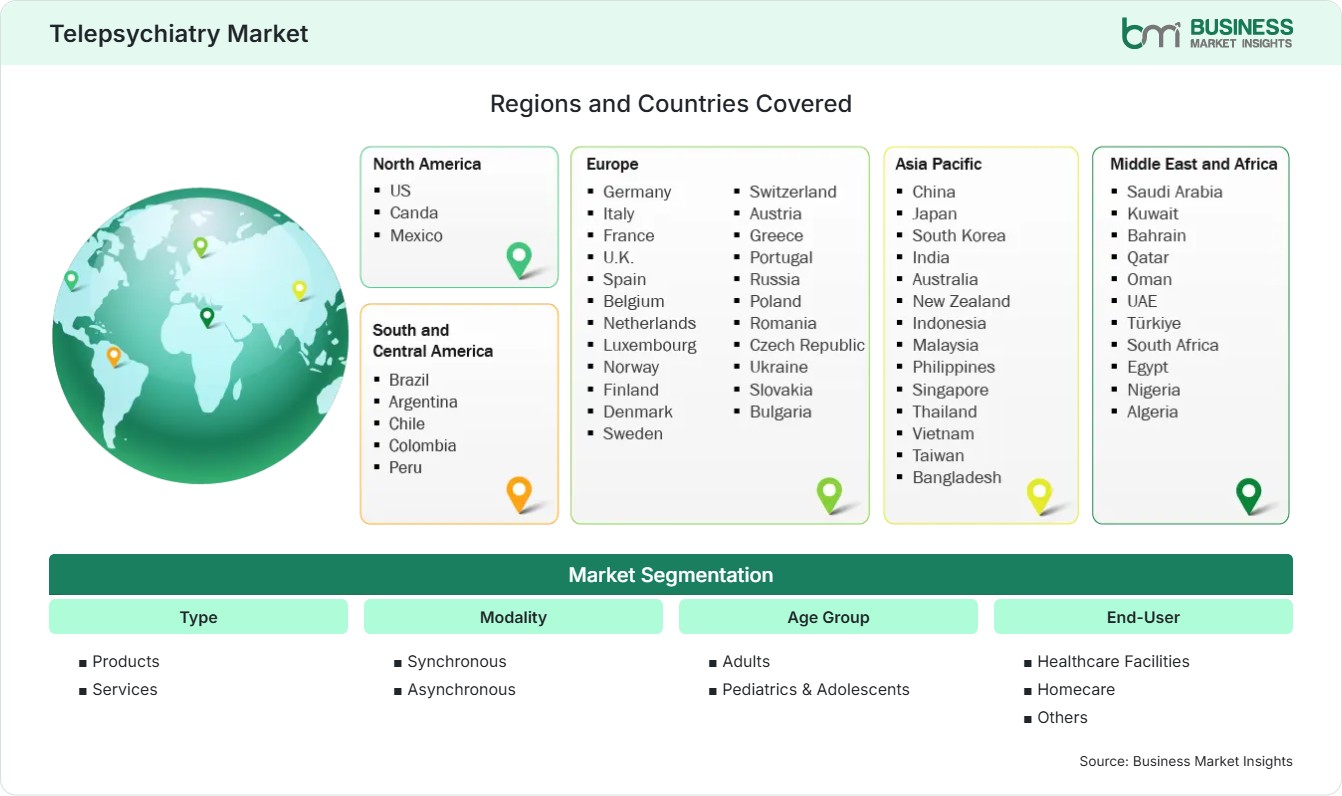
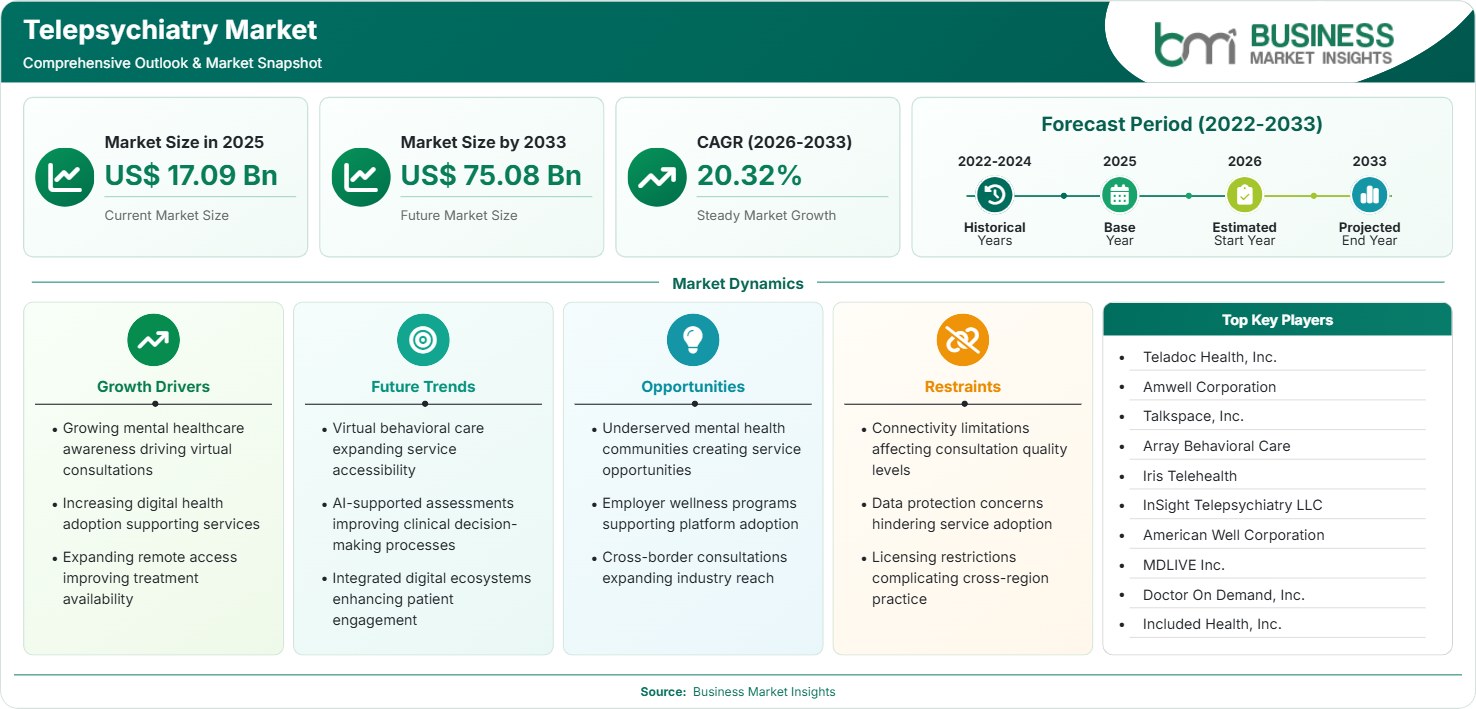
North America accounted for approximately 38%–41% Telepsychiatry Market share in 2025 and continues to represent the largest regional market. Growth is supported by mature telehealth reimbursement frameworks, broad broadband coverage, rising mental health spending, and expanding provider networks. The region is projected to grow at a CAGR of 18.5%–20.5% during 2026–2033.
- The growth of value-based healthcare programs is causing providers to adopt virtual psychiatric care models which help to improve access, lower costs, and aid continuity of care in a number of clinical settings.
- Large healthcare systems are combining their behavioral health services with virtual primary care platforms in order to establish coordinated treatment pathways and improve patient engagement at every stage of the mental health care journey.
- As more employers introduce mental health programs, there is an increasing demand from people of working age for virtual counseling, psychiatric consultations, and preventive behavioral care services.
- Spending money on AI-powered triage tools and digital platforms for mental health assessments is helping to improve operational efficiency and speed up patients' access to qualified psychiatric professionals.
- The Telepsychiatry Market share remains highest in North America due to favorable reimbursement policies, strong digital infrastructure, and extensive adoption among healthcare organizations.
US Telepsychiatry Market
The United States represents approximately 82%–85% of the North American Telepsychiatry Market revenue in 2025 and is expected to record a CAGR of 18.5%–20.5% through 2033. Demand remains driven by a widening behavioral healthcare gap, payer support for telehealth services, and increasing integration of psychiatry within population health frameworks.
- The expansion of reimbursement from Medicare, Medicaid, and private insurers is still helping to promote the use of remote psychiatric consultations among both healthcare providers and patients.
- Healthcare organizations are increasingly using virtual psychiatry in order to cut down on waiting times, especially in rural and poorly served areas which are suffering from a lack of specialists.
- Educational institutions are putting into practice virtual mental health support services in order to improve access for adolescents and young adults who need psychiatric intervention.
- Virtual psychiatric assessment and therapy options are increasingly being included by employer-sponsored behavioural healthcare programmes as part of their overall workforce wellness strategies.
Europe Telepsychiatry Market
Europe held approximately 27%–30% Telepsychiatry Market share in 2025 and is projected to expand at a CAGR of 19.0%–21.0% between 2026 and 2033. Growing awareness regarding mental health, digital healthcare modernization, and government-backed telemedicine initiatives are supporting market expansion.
- The virtual psychiatric assessment and treatment platforms are being more widely adopted throughout the European Union due to digitization initiatives in the healthcare sector.
- Because of the growing prevalence of depression, burnout, and stress-related disorders, there is now a continuous demand for accessible solutions in the field of behavioral healthcare.
- Germany is still the largest national market, due to reforms in the reimbursement system and the high level of digital health adoption among healthcare facilities.
- Spain shows one of the most robust rates of growth, the estimated expansion of the nation going beyond the regional average as a result of ongoing investment in telehealth.
- Initiatives involving digital healthcare across borders are helping to improve access to and the degree of interoperability in psychiatric care delivery networks in the region.
Asia Pacific Telepsychiatry Market
Asia Pacific accounted for approximately 22%–25% Telepsychiatry Market share in 2025 and is expected to register the fastest regional expansion at a CAGR of 22.5%–24.5% during 2026–2033. With smartphones rapidly gaining acceptance, huge underserved population groups, and government investment in digital healthcare infrastructure, adoption is likely to take off. There is great potential in this region because there is much unmet need for mental healthcare.
- Greater internet penetration, together with the growth of mobile health applications, is helping to provide wider access to remote psychiatric care for both urban and rural populations.
- Governments are putting more money into digital healthcare ecosystems in order to deal with shortages of healthcare providers and to improve behavioral health outcomes.
- China holds on to its regional leadership by carrying out extensive digitalization initiatives in the healthcare sector and by widely adopting telemedicine services.
- India is showing especially strong progress as healthcare providers introduce scalable virtual mental health services in areas that are poorly served.
The growing awareness of the mental health needs of adolescents and of the importance of managing workplace stress is leading to greater use of virtual psychiatric platforms.
Rest of World Telepsychiatry Market
The Rest of World region accounted for approximately 9%–12% share in 2025 and is projected to grow at a CAGR of 20.0%–22.0% through 2033. South and Central America are benefiting from expanding digital health infrastructure and increasing healthcare accessibility programs.
In the Middle East and in Africa, the markets are progressing steadily as a result of government initiatives aimed at modernizing healthcare, increases in investment in telemedicine, and rising awareness of mental health disorders.
- Brazil continues expanding virtual healthcare capabilities to improve psychiatric consultation access among geographically dispersed populations.
- The countries that are part of the GCC are actively advancing strategies to transform digital healthcare and promote the adoption of virtual behavioral healthcare solutions.
- Healthcare providers are now more and more working with telehealth platforms in order to deal with the shortage of specialists and to improve the continuity of treatment.
- The increasing use of smartphones and greater access to the internet provide long-term potential for expansion in emerging healthcare markets.
- The area is benefiting from increasing public awareness campaigns, which are tackling the stigma connected with mental health treatment and psychiatric care.